
Michael Oakeshott (1901–1990)
Author of Rationalism in Politics and Other Essays
About the Author
Image credit: By Library of the London School of Economics and Political Science - Professor Michael Oakeshott, c1960sUploaded by calliopejen1, No restrictions, https://commons.wikimedia.org/w/index.php?curid=15987493
Works by Michael Oakeshott
Lectures in the History of Political Thought (Michael Oakeshott: Selected Writings) (2006) 36 copies
Morality and Politics in Modern Europe: The Harvard Lectures (Selected Writings of Michael Oakeshott) (1993) 15 copies
Associated Works
Did You Ever See a Dream Walking? American Conservative Thought in the Twentieth Century (1970) — Contributor — 86 copies
Tagged
Common Knowledge
- Legal name
- Oakeshott, Michael Joseph
- Birthdate
- 1901-12-11
- Date of death
- 1990-12-19
- Gender
- male
- Occupations
- political philosopher
- Organizations
- London School of Economics
- Nationality
- UK
- Associated Place (for map)
- UK
Members
Reviews

This work, published in 1933, is to my knowledge the last serious attempt to vindicate British Idealism as a comprehensive philosophy. By the time the book was published idealism had already lost much ground to analytic philosophy. It has not been revitalized since then.
When reading chapter IV on scientific experience, it is easy to see why this line of thought was abandoned. The author maintains that scientific experience conceives the world under the category of quantity and that its only show more criterion of truth is the coherence of scientific experience. This is in line with the general thesis of idealism that knowledge is nothing but a world of ideas and that any notion of a thought-independent reality is meaningless. But this description of scientific experience does not shed any light on how one scientific explanation can be better than another or on the things scientists assume without conscious reflection. It also doesn't facilitate any useful distinction between science and pseudo-science. So if you want to think critically about natural science, this is simply not a productive perspective. That's why it was bypassed a century ago by more interesting developments in the philosophy of science.
Nevertheless I do recommend this book for those interested in the philosophy of history, because an idealist account is of much greater value in the description of historical experience. This is not surprising since the historical world actually exists only in our ideas of the past. The naive conception of history which the author criticizes is still prevalent today and the philosophy of history developed in this book seems quite fresh. After reading this book I actually thought it disappointing that modern philosophy of history hasn't taken idealism more seriously. There are some important points in this book which a philosophy of history modeled on natural science is bound to miss.
The comparison between the three different modes of experience is also of some interest, especially concerning their mutual incompatibility. But once again, I recommend chapters I-III of this book on the philosophy of history - the rest of it is in my opinion outdated. show less
When reading chapter IV on scientific experience, it is easy to see why this line of thought was abandoned. The author maintains that scientific experience conceives the world under the category of quantity and that its only show more criterion of truth is the coherence of scientific experience. This is in line with the general thesis of idealism that knowledge is nothing but a world of ideas and that any notion of a thought-independent reality is meaningless. But this description of scientific experience does not shed any light on how one scientific explanation can be better than another or on the things scientists assume without conscious reflection. It also doesn't facilitate any useful distinction between science and pseudo-science. So if you want to think critically about natural science, this is simply not a productive perspective. That's why it was bypassed a century ago by more interesting developments in the philosophy of science.
Nevertheless I do recommend this book for those interested in the philosophy of history, because an idealist account is of much greater value in the description of historical experience. This is not surprising since the historical world actually exists only in our ideas of the past. The naive conception of history which the author criticizes is still prevalent today and the philosophy of history developed in this book seems quite fresh. After reading this book I actually thought it disappointing that modern philosophy of history hasn't taken idealism more seriously. There are some important points in this book which a philosophy of history modeled on natural science is bound to miss.
The comparison between the three different modes of experience is also of some interest, especially concerning their mutual incompatibility. But once again, I recommend chapters I-III of this book on the philosophy of history - the rest of it is in my opinion outdated. show less
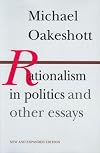
Oakeshott is an honest writer and presents his ideas in direct if somewhat turgid prose. He advocates for tradition and experience in making political decisions rather than what he sees as dangerously proscriptive rationalism. It's an attractive position, but I think Oakeshott underestimates the duplicitousness of most politicians. They are nothing like a collection of disinterested Oxford dons! Even so, I think Oakeshott's ideas are important and these essays give a unique and appealing show more philosophy of political conservatism. show less
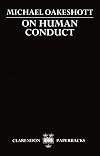
Philosophical reflections undertaken for enjoyment, in order to understand in other terms what is already, to some extent, already understood. Oakeshott prefaces this text by calling this a "well-considered intellectual adventure recollected in tranquility." In an age where so much philosophical talk, and intellectual writing, is mere activist dogma lined up for political advantage, and not real thinking at all, this is refreshing. Oakeshoot considers questions of human practice, civil show more association, and the modern state. Enlightening indeed. show less
The meandering prose makes the book longer than it needs to be and sacrifices some clarity. Rationalism in Politics is the best essay, presenting a solid conservative case against the rationalist turn in modern politics that oddly coincides with similar critiques on the far left. The Voice of Poetry in the Conversation of Mankind, a tedious meditation on art in which Oakeshott's prose is at its most florid and overwrought, is the worst of the collection.
Awards


You May Also Like


Associated Authors
Statistics
- Works
- 28
- Also by
- 5
- Members
- 1,122
- Popularity
- #22,905
- Rating
- 3.6
- Reviews
- 15
- ISBNs
- 77
- Languages
- 5
- Favorited
- 3