
Thomas Pynchon
Author of The Crying of Lot 49
About the Author
Thomas Pynchon was born in Glen Cove, New York on May 8, 1937. In 1959 he graduated with a B.A. in English from Cornell, where he had taken Vladimir Nabokov's famous course in modern literature after studying engineering physics and serving in the U.S. Navy for two years. He worked as a technical show more writer at Boeing for two and a half years. Pynchon won the Faulkner First Novel Award for V. in 1963, and in The Crying of Lot 49 (1966), again his symbolism and commentary on the United States and human isolation have been praised as intricate and masterly, though some reviewers found it to be maddeningly dense. With this book Pynchon won the Rosenthal Foundation Award. Gravity's Rainbow, winner of the National Book Award for Fiction in 1974, is in part a fictional elegy and meditation on death and an encyclopedic work that jumps through time. Pynchon has also written numerous essays, reviews, and introductions, plus the fictional works Slow Learner, Vineland, Mason & Dixon, Against the Day, and Inherent Vice. His title Bleeding Edge made The New York Times Best Seller List for 2013. He is famous for his reclusive nature, although he has made several animated appearances on The Simpsons television series. (Bowker Author Biography) show less
Image credit: Pynchon, age 16, in his 1953 high-school yearbook, one of the few known photos of the author
Works by Thomas Pynchon
Associated Works
Been Down So Long It Looks Like Up to Me (1966) — Introduction, some editions — 1,099 copies, 17 reviews
Storming the Reality Studio: A Casebook of Cyberpunk and Postmodern Science Fiction (1991) — Contributor — 263 copies
The Teachings of Don B.: Satires, Parodies, Fables, Illustrated Stories, and Plays of Donald Barthelme (1992) — Introduction — 230 copies, 2 reviews
The Graphic Canon, Vol. 3: From Heart of Darkness to Hemingway to Infinite Jest (2013) — Contributor — 162 copies, 1 review
Fifty Years of the American Short Story from the O. Henry Awards 1919-1970 (1970) — Contributor — 17 copies, 1 review
Fifty Years of the American Short Story from the O. Henry Awards 1919-1970, Volume 2 (1970) — Contributor — 5 copies
Mondaugen — Contributor — 1 copy
Aerospace Safety (1960-12 - Vol 16 No 12) — Contributor — 1 copy
Tagged
Common Knowledge
- Legal name
- Pynchon, Thomas Ruggles, Jr.
- Other names
- Pynchon, Thomas
- Birthdate
- 1937-05-08
- Gender
- male
- Education
- Cornell University (A.B. ∙ 1959)
- Occupations
- technical writer
novelist
short story writer - Organizations
- United States Navy
- Awards and honors
- MacArthur Fellowship (1988)
U.S. National Book Award for Fiction (1973)
Faulkner First Novel Award (1963)
Christopher Lightfoot Walker Award (2018) - Agent
- Melanie Jackson (current)
Candida Donadio (former) - Relationships
- Jackson, Melanie (wife)
Taormino, Tristan (niece) - Nationality
- USA
- Birthplace
- Glen Cove, New York, USA
- Places of residence
- Glen Cove, New York, USA
Seattle, Washington, USA
Manhattan Beach, California, USA
New York, New York, USA
Ithaca, New York, USA
Aptos, California, USA - Associated Place (for map)
- USA
Members
Discussions
Thomas Pynchon's most American novel? in Book talk (Thursday 2:18pm)
Inherent Vice in Pynchon Pandæmonium (August 2022)
Group Read, April 2019: Vineland in 1001 Books to read before you die (May 2019)
The Crying of Lot 49 in Someone explain it to me... (March 2017)
Club Read 2013 : Kesbooks reading plan in Club Read 2013 (June 2013)
Reviews
Warning: core dump of brain in progress.
"Now single up all lines!"
That first line sounds like a call to battle, or like the last instruction of a band leader before he kicks into the intro of his newest composition. What it actually is is the command to launch the dirigible airship Inconvenience, manned by the boys' adventure book heroes The Chums Of Chance, forever young and Biggles-ishly intent on making the late-19th century world a better place from their vantage point on high.
The show more problem for them is that the band leader in question is Thomas Pynchon, who is to literature what a free jazz player with ADD (Anarchist Deconstruction Disorder) is to music. Just as we've gotten to know the Chums and their playful, Star Trek-like view of the world, the plot moves to someone else, the lines fray and the music starts getting chaotic. The boys' adventure book turns into a Steinbeck-on-acid-like novel about poor miners. The Steinbeck turns into a Wild West revenge tale. The Wild West revenge tale veers briefly into Lovecraft before turning into an HG Wells-ian time travel story and then a European spy thriller. The spy thriller becomes a love story, the love story becomes bisexual porn, the porn becomes a code cracker mystery, the code cracker mystery becomes a math textbook, the math textbook turns into vicious satire on the current state of the world which at the same time is a story of the search for a shangri la... etc etc. And obviously, all of these stories aren't so much sequential as they are simultaneous; they all interweave.
Pynchon is the ultimate post-modern madman; more enamoured with chance than Auster, more encyclopedic than Eco, more absurd than Vonnegut and with more bizarre guest spots (from Bela Lugosi to Elmer Fudd) and song numbers than a whole season of The Simpsons. (Yes, of course he drops a Simpsons joke or two in there.) But where Auster uses chance as the exception to the rule, the thing that jolts his character out of their lives, in Pynchon chance and chaos IS the rule. Where Eco lectures, Pynchon often seems to take for granted that his readers know as much as he does about Balkan history, advanced maths, dimensional theory or famous anarchists; if we don't, hell, look it up; every single reference he drops seems to suggest a story that could take off in another direction - like Bob Dylan once said that every line in "Hard Rain" could be turned into a song unto itself.
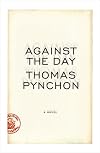
Which isn't necessarily in a direction we know. Against The Day is a tesseract; just like the pages of a novel are a two-dimensional representation of (hopefully) three-dimensional characters (note the overlaying fonts on the jacket of ATD), the characters of ATD are three-dimensional characters living in a four-dimensional world. Things happen which they cannot understand, just like a stick figure on a piece of paper cannot understand the three-dimensional pencil drawing him. As mankind learns to fly and conquers the third dimension and its possibilities for good and evil (Russian airships dropping bricks remarkably similar to Tetris blocks on their enemies - come to think of it, reading Pynchon is a lot like playing Tetris, you better keep up or the screen will fill up and you lose) people start to wonder what discoveries and weapons may lie in the next dimension.
And in a four-dimensional world, time is negotiable in the same sense that height is in a 3D world. When you come to a fork in the road, take it. Everything can exist at least twice; indeed, so much of the novel is about dualities, bilocations, doubles, mirror images that come to life, the way a good novel is a mirror of real life. Light refracts in a mirror, splits in two directions. Light as in progress. Light as in electricity. Light as in enlightenment. Light as in daylight. It can go either way. On the one side, we can build a better world. On the other, we're great at building machine guns, too. Prepare yourself against the day.
Five random thoughts:
1. Yes, of course Pynchon is still obsessed with secret societies, secret ways of communications, invisible train lines and stamps from post offices that never existed. You're telling me that's somehow not relevant in the Internet age? Why the hell is one of the main characters named Webb Traverse, d'ya think?
2. Ornette Coleman had a double quartet (!) when he recorded "Free Jazz".
3. There's something under Asia's deserts which is, apparently, worth going to war over. No one seems to know quite why we need it, but...
4. If everything exists in two versions, can there be a singularity? Can there be a third way?
5. "The sun would not have risen. A mere ball of flaming gas would have illuminated the world." (Terry Pratchett, Hogfather)
Reading ATD is hard work. It needs to be. Don't get me wrong, it's a lot of fun, it's exhilarating, and it don't mean a thing if it ain't got that swing, but it's so goddamn busy that it demands your undivided attention for 1085 pages straight. There were days when I was hard-pressed to manage five pages. I'm not sure if this is Pynchon's best novel. It's kinda hard to tell; it's frequently all over the place and while I'm pretty sure there's a point to all of it, I don't always see that point. Yet. If it's his last novel, it's a worthy farewell; there's enough reading here to rediscover and reinterpret more times than most readers are able to, and the logical conclusion to an authorship that has alwasy wanted to do MORE with fiction. It's chaotic, but there's method in it. Just like the difference between pure noise and really wild jazz; the swing, the humour, the flow, the way the theme suddenly pops up somewhere for a few seconds before leading into something new, the way you can almost dance to it without breaking a leg. The way one player will occasionally break away into something completely different and the others either follow him into this new and exciting tune or do everything in their power to stop him and force him back in line. And all the while, the balloon boys on board Inconvenience pop in and out of reality and the storyline like a naive jingle-jangle guitar pop song.
Mash it up, burn it down, start all over again.
And that's the only way I know how to explain it. Thus far. show less
"Now single up all lines!"
That first line sounds like a call to battle, or like the last instruction of a band leader before he kicks into the intro of his newest composition. What it actually is is the command to launch the dirigible airship Inconvenience, manned by the boys' adventure book heroes The Chums Of Chance, forever young and Biggles-ishly intent on making the late-19th century world a better place from their vantage point on high.
The show more problem for them is that the band leader in question is Thomas Pynchon, who is to literature what a free jazz player with ADD (Anarchist Deconstruction Disorder) is to music. Just as we've gotten to know the Chums and their playful, Star Trek-like view of the world, the plot moves to someone else, the lines fray and the music starts getting chaotic. The boys' adventure book turns into a Steinbeck-on-acid-like novel about poor miners. The Steinbeck turns into a Wild West revenge tale. The Wild West revenge tale veers briefly into Lovecraft before turning into an HG Wells-ian time travel story and then a European spy thriller. The spy thriller becomes a love story, the love story becomes bisexual porn, the porn becomes a code cracker mystery, the code cracker mystery becomes a math textbook, the math textbook turns into vicious satire on the current state of the world which at the same time is a story of the search for a shangri la... etc etc. And obviously, all of these stories aren't so much sequential as they are simultaneous; they all interweave.
Pynchon is the ultimate post-modern madman; more enamoured with chance than Auster, more encyclopedic than Eco, more absurd than Vonnegut and with more bizarre guest spots (from Bela Lugosi to Elmer Fudd) and song numbers than a whole season of The Simpsons. (Yes, of course he drops a Simpsons joke or two in there.) But where Auster uses chance as the exception to the rule, the thing that jolts his character out of their lives, in Pynchon chance and chaos IS the rule. Where Eco lectures, Pynchon often seems to take for granted that his readers know as much as he does about Balkan history, advanced maths, dimensional theory or famous anarchists; if we don't, hell, look it up; every single reference he drops seems to suggest a story that could take off in another direction - like Bob Dylan once said that every line in "Hard Rain" could be turned into a song unto itself.
Which isn't necessarily in a direction we know. Against The Day is a tesseract; just like the pages of a novel are a two-dimensional representation of (hopefully) three-dimensional characters (note the overlaying fonts on the jacket of ATD), the characters of ATD are three-dimensional characters living in a four-dimensional world. Things happen which they cannot understand, just like a stick figure on a piece of paper cannot understand the three-dimensional pencil drawing him. As mankind learns to fly and conquers the third dimension and its possibilities for good and evil (Russian airships dropping bricks remarkably similar to Tetris blocks on their enemies - come to think of it, reading Pynchon is a lot like playing Tetris, you better keep up or the screen will fill up and you lose) people start to wonder what discoveries and weapons may lie in the next dimension.
And in a four-dimensional world, time is negotiable in the same sense that height is in a 3D world. When you come to a fork in the road, take it. Everything can exist at least twice; indeed, so much of the novel is about dualities, bilocations, doubles, mirror images that come to life, the way a good novel is a mirror of real life. Light refracts in a mirror, splits in two directions. Light as in progress. Light as in electricity. Light as in enlightenment. Light as in daylight. It can go either way. On the one side, we can build a better world. On the other, we're great at building machine guns, too. Prepare yourself against the day.
Five random thoughts:
1. Yes, of course Pynchon is still obsessed with secret societies, secret ways of communications, invisible train lines and stamps from post offices that never existed. You're telling me that's somehow not relevant in the Internet age? Why the hell is one of the main characters named Webb Traverse, d'ya think?
2. Ornette Coleman had a double quartet (!) when he recorded "Free Jazz".
3. There's something under Asia's deserts which is, apparently, worth going to war over. No one seems to know quite why we need it, but...
4. If everything exists in two versions, can there be a singularity? Can there be a third way?
5. "The sun would not have risen. A mere ball of flaming gas would have illuminated the world." (Terry Pratchett, Hogfather)
Reading ATD is hard work. It needs to be. Don't get me wrong, it's a lot of fun, it's exhilarating, and it don't mean a thing if it ain't got that swing, but it's so goddamn busy that it demands your undivided attention for 1085 pages straight. There were days when I was hard-pressed to manage five pages. I'm not sure if this is Pynchon's best novel. It's kinda hard to tell; it's frequently all over the place and while I'm pretty sure there's a point to all of it, I don't always see that point. Yet. If it's his last novel, it's a worthy farewell; there's enough reading here to rediscover and reinterpret more times than most readers are able to, and the logical conclusion to an authorship that has alwasy wanted to do MORE with fiction. It's chaotic, but there's method in it. Just like the difference between pure noise and really wild jazz; the swing, the humour, the flow, the way the theme suddenly pops up somewhere for a few seconds before leading into something new, the way you can almost dance to it without breaking a leg. The way one player will occasionally break away into something completely different and the others either follow him into this new and exciting tune or do everything in their power to stop him and force him back in line. And all the while, the balloon boys on board Inconvenience pop in and out of reality and the storyline like a naive jingle-jangle guitar pop song.
Mash it up, burn it down, start all over again.
And that's the only way I know how to explain it. Thus far. show less
I first read this book in my 20's, and loved it for the sheer hilarity. How can you not love a stamp dealer named Genghis Cohen? An actor/lawyer named Manny DiPresso also worked for me. Pynchon's manic erudition and love of the absurd are unmatched in this book, and in pretty much every book he writes, even the lighter fare. It is a little much for some (most?) people, but if I am in the right frame of mind I am more than happy to turn myself over to Pynchon mind, body and soul for the show more length of a novel. And I think you have to do that to enjoy Pynchon's work, you have to cede control and go with it because Pynchon's world is endlessly complex and the author himself is the only GPS that is going to get you out of that maze sane, sated, and flushed with pleasure. When I cede control I need to know the recipient of my trust deserves it. Pynchon? Yeah. Totally.
Let's start with Pynchon's technical skills. This is Pynchon's second book after the brilliant V, both published when he was in his 20's. How he had already developed this level of brilliance so early I do not know. Obviously he has raw talent and an imagination unlike any other, and also obviously the man worked hard to develop a unique, precise, yet surprising style. His books are symphonic in a way I see in very few writers -- Murakami comes to mind as another who does this, creates sonatas, and cantatas and fugues in novel form (though Murakami and Pynchon are very differnt writers.) But also, Pynchon books are filled with brilliant and challenging allusions to other writers' works, and I find it baffling that this 20-something understood the form and content of the works of so many writers well enough to simultaneously honor and subvert their work. The structure of his characters' journeys whether our hero here, Oedipa Maas. or Mason & Dixon (in the novel of that name) or any of the others before and after those books will bring to mind the classics. This is very much an Odyssey, sans gods but with aspects of American life no less mercurial than any god that play fast and loose with our hero. (Our sirens are a group of moptop Beatles wannabes named Leonard, Serge, Miles and Dean - presumably honoring Cohen, Gainsourg, Davis and Martin, which totally cracked me up.) In this book I also saw clear allusions to Moby Dick, The Sound and the Fury, and many others that blur the real and fantastical. It is all just dazzling. But with all that dazzle it never stops being fun.
This is pretty brilliant and i went back and forth between a 4 and 5 star. In the end I went with GR 4 (LT 4.5) for two reasons. It is not as brilliant as some other Pynchon books, including V, which immediately preceded this. More importantly, in the end, I felt like some viewpoint other than Oedipa's would have been helpful here.
One last thing I want to mention related to the Oedipa-centric story: This came out in 1966, and trust me there is plenty of objectifying of women going on, but also the only person whose perspective really matters is Oedipa, a smart and adventurous hot housewife from central California. The men around her are toxic assholes mostly but also this is not really their story -- the men are the side characters. I found this pretty surprising for a book written by a straight man at that time. I also found interesting that the reader sees the men are assholes and often wants better from them. But Oedipa expects nothing from any of the men. They behave the way they do and while she wishes one would ride alongside her, she doesn't expect it. She expects that she will have to be the one to take care of things. There are no knights in shining armor here, just men with power and a woman who has to get things done despite being powerless. show less
Let's start with Pynchon's technical skills. This is Pynchon's second book after the brilliant V, both published when he was in his 20's. How he had already developed this level of brilliance so early I do not know. Obviously he has raw talent and an imagination unlike any other, and also obviously the man worked hard to develop a unique, precise, yet surprising style. His books are symphonic in a way I see in very few writers -- Murakami comes to mind as another who does this, creates sonatas, and cantatas and fugues in novel form (though Murakami and Pynchon are very differnt writers.) But also, Pynchon books are filled with brilliant and challenging allusions to other writers' works, and I find it baffling that this 20-something understood the form and content of the works of so many writers well enough to simultaneously honor and subvert their work. The structure of his characters' journeys whether our hero here, Oedipa Maas. or Mason & Dixon (in the novel of that name) or any of the others before and after those books will bring to mind the classics. This is very much an Odyssey, sans gods but with aspects of American life no less mercurial than any god that play fast and loose with our hero. (Our sirens are a group of moptop Beatles wannabes named Leonard, Serge, Miles and Dean - presumably honoring Cohen, Gainsourg, Davis and Martin, which totally cracked me up.) In this book I also saw clear allusions to Moby Dick, The Sound and the Fury, and many others that blur the real and fantastical. It is all just dazzling. But with all that dazzle it never stops being fun.
This is pretty brilliant and i went back and forth between a 4 and 5 star. In the end I went with GR 4 (LT 4.5) for two reasons. It is not as brilliant as some other Pynchon books, including V, which immediately preceded this. More importantly, in the end, I felt like some viewpoint other than Oedipa's would have been helpful here.
One last thing I want to mention related to the Oedipa-centric story: This came out in 1966, and trust me there is plenty of objectifying of women going on, but also the only person whose perspective really matters is Oedipa, a smart and adventurous hot housewife from central California. The men around her are toxic assholes mostly but also this is not really their story -- the men are the side characters. I found this pretty surprising for a book written by a straight man at that time. I also found interesting that the reader sees the men are assholes and often wants better from them. But Oedipa expects nothing from any of the men. They behave the way they do and while she wishes one would ride alongside her, she doesn't expect it. She expects that she will have to be the one to take care of things. There are no knights in shining armor here, just men with power and a woman who has to get things done despite being powerless. show less
How do you even-
How did he-do dat?
I wrote some notes/lessons i've learned from Gravity's Rainbow down when i was 500/600pg in. It starts like this: You Can Put Fucking Anything In A Book.
The rest is this:
This book motivates and inspires me to be more - to peruse intelligence to its unending end.
To learn numerous languages, read textbooks on science, psychology & philosophy.
An urge i've always had tickled at but feared for being an outcast or doing too much or having limits.
This book has show more humbled me into persuing the kind of intellectual diet of Pynchon.
It also inspires me to write and write well. It has reinforced my love & validated my appreciation of the bitter aftertaste i love from the bleakness of cold, grey Manchester winter sunrises, after night shifts or white hotels
This book makes me want to be my very best, sack off the non essential and pursue my loves in acquiring knowledge in excess from around the world and subject and discipline, then disseminate everything, if anything, i've learned into writing, in my own personal prose, no matter what the final product. show less
How did he-do dat?
I wrote some notes/lessons i've learned from Gravity's Rainbow down when i was 500/600pg in. It starts like this: You Can Put Fucking Anything In A Book.
The rest is this:
This book motivates and inspires me to be more - to peruse intelligence to its unending end.
To learn numerous languages, read textbooks on science, psychology & philosophy.
An urge i've always had tickled at but feared for being an outcast or doing too much or having limits.
This book has show more humbled me into persuing the kind of intellectual diet of Pynchon.
It also inspires me to write and write well. It has reinforced my love & validated my appreciation of the bitter aftertaste i love from the bleakness of cold, grey Manchester winter sunrises, after night shifts or white hotels
This book makes me want to be my very best, sack off the non essential and pursue my loves in acquiring knowledge in excess from around the world and subject and discipline, then disseminate everything, if anything, i've learned into writing, in my own personal prose, no matter what the final product. show less
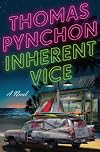
A smart and funny book that examines the cultural sea change transpiring in the early '70s through the lens of a hard-boiled detective story (albeit a Lebowski-esque pot-fueled PI). Probably worth a second read to better understand the way in which Pynchon is using motifs and themes of fog, drug trips, lost civilizations, and reincarnation/undeath among others to represent the waves and interplay of countercultural revolution and reactionary backlash. If you liked Vineland, this book mines show more similar territory but from the vantage point of LA and the year 1970.
Half the fun of the book is the vivid and oft-absurd way Pynchon portrays the strange and crazy world of surfers, potheads, musicians, LAPD, and ex-cons that populate his novel. show less
Half the fun of the book is the vivid and oft-absurd way Pynchon portrays the strange and crazy world of surfers, potheads, musicians, LAPD, and ex-cons that populate his novel. show less
Lists
Pynchon ranked (10)
. (1)
1980s (1)
. (1)
To read 2025 (1)
2022 (1)
Elegant Prose (1)
War Literature (1)
Books (1)
Read (1)
Greatest Books (1)
Cooper (1)
Best Audiobooks (1)
To read (1)
1960s (1)
Metafiction (1)
First Novels (1)
1970s (1)
E's Reader (1)
Thomas Pynchon books (10)
1990s (2)
A Novel Cure (2)
Magic Realism (2)
Best First Lines (2)
Unread books (6)
Franklit (1)
Yet another list (1)
Finished in 2024 (1)
Favourite Books (2)
Overdue Podcast (1)
Five star books (2)
Secret Histories (1)
Read This Next (1)
scav (1)
Awards


You May Also Like


Associated Authors
Statistics
- Works
- 31
- Also by
- 18
- Members
- 51,343
- Popularity
- #296
- Rating
- 4.1
- Reviews
- 770
- ISBNs
- 435
- Languages
- 28
- Favorited
- 365


