
David R. Loy
Author of Money, Sex, War, Karma: Notes for a Buddhist Revolution
About the Author
David R. Loy is the acclaimed author of The Great Awakening, The Dharma of Dragons and Daemons, and Money, Sex, War, Karma. He is qualified as a teacher in the Sanbo Kyodan tradition of Zen.
Works by David R. Loy
Lack and Transcendence: The Problem of Death and Life in Psychotherapy, Existentialism, and Buddhism (1996) 72 copies, 2 reviews
A New Buddhist Path: Enlightenment, Evolution, and Ethics in the Modern World (2015) 62 copies, 2 reviews
Healing Deconstruction: Postmodern Thought in Buddhism and Christianity (1996) — Editor; Introduction, some editions; Contributor, some editions — 9 copies
Associated Works
David Loy : Zen Philosopher and Social Critic [video recording, streaming] (1998) — Interviewee — 1 copy, 1 review
Tagged
Common Knowledge
- Birthdate
- 1947
- Gender
- male
- Education
- Carlton College (BA|Philosophy)
King's College, London (studied|Analytic Philosophy)
University of Hawaii (MA ∙ Asian Philosophy)
National University of Singapore (PhD ∙ Philosophy)
Carlton College (Honary PhD|for work in Engaged Buddhism) - Occupations
- professor
Zen teacher
writer - Organizations
- Rocky Mountain Echodarma Retreat Center
Sanbo Zen tradition of Japanese Zen Buddhism
Bunkyo University
Singapore University (later the National University of Singapore)
Xavier University
University of Cape Town - Relationships
- Aitken, Robert (Zen teacher)
Goodhew, Linda (wife)
Koun Yamada Roshi (Koan Study) - Nationality
- USA
- Birthplace
- Panama Canal Zone
- Places of residence
- Minnesota, USA
London, England, UK
San Francisco, California, USA
Hawaii, USA
Chigasaki, Kanagawa prefecture, Japan
near Boulder, Colorado, USA - Associated Place (for map)
- USA
Members
Reviews
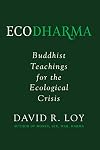
How might Buddhists respond to the ongoing ecological crisis? Loy builds some strong foundations here, on the way to an effective answer. I think his more concrete suggestions get weaker. This is a huge topic that is in the early stages of exploration, so it's really too much to expect a maturely ripe fruit at this point. A lot of what is here is just a restatement and summary of what one might find elsewhere, but there are some deep original ideas here too.
I've been involved in Buddhism for show more about forty years, and ecological at least aware and concerned for more like fifty. This book is really very close to the center of my core concerns. I found myself exclaiming "yes, but..." at quite a few points in my reading here. This would be an excellent book for readers both from the ecological and the Buddhist communities. I imagine everyone will nod in agreement at many points and be stopped at other points, but the particular reactions will vary a lot across that readership.
A key point that Loy makes here is that the climate crisis is just the tip of a vast iceberg, whose deeper layers are a much broader ecological crisis, social crises, and metaphysical outlooks that have spawned these problems. If we solve the climate crisis without addressing these deeper issues, we'll run into fresh symptoms quickly enough.
One beautiful thought I found here - surely I have heard this again and again, but somehow the way Loy put it hit me more deeply.... one main aspect of our problematic metaphysical outlook is how we treat the objects around us as tools we can use to fulfill our desires. We even treat time this way. The present moment is just a step on the path to the achievement of our goals.
Loy challenges Buddhism to change itself to become able to address these crises of our day. He repeats a slogan - Buddhism is not just what the Buddha said, it's also what the Buddha started. So Buddhism has evolved and can continue to evolve. Our problems now are systemic, structural. Loy brings up the idea of a collective self, to which Buddhist analysis and therapy might apply as they do to personal selves. These ideas will probably make tradition-bound Buddhists pause! Myself, I find them quite natural.
Loy puts a lot of hope in the notion of an eco-sattva, a sort of next step for a Bodhisattva. I agree that we do need such a new ideal. How such a new ideal might catalyze the kind of social transformation we need if we are to navigate any of the least miserable trajectories possible ahead of us... that's where I found the ideas in this book a bit weak. I can't really imagine very many people living up to any very high moral standard. Looking at the diversity of cultures around the world and through history, it's clear that profound change is possible, and that the ideals we hold are fundamental. Where I see a lot more exploration needed is in how our way of living and our ideals are related. One piece of that puzzle will be to look into the dynamics of societies, how they orbit in some stable basin for a few centuries, then somehow tumble into some different pattern. One way or another we are surely facing a period of tumbling. I am guessing that ideals and ways of living fit together differently in periods of tumbling versus periods of orbiting. show less
I've been involved in Buddhism for show more about forty years, and ecological at least aware and concerned for more like fifty. This book is really very close to the center of my core concerns. I found myself exclaiming "yes, but..." at quite a few points in my reading here. This would be an excellent book for readers both from the ecological and the Buddhist communities. I imagine everyone will nod in agreement at many points and be stopped at other points, but the particular reactions will vary a lot across that readership.
A key point that Loy makes here is that the climate crisis is just the tip of a vast iceberg, whose deeper layers are a much broader ecological crisis, social crises, and metaphysical outlooks that have spawned these problems. If we solve the climate crisis without addressing these deeper issues, we'll run into fresh symptoms quickly enough.
One beautiful thought I found here - surely I have heard this again and again, but somehow the way Loy put it hit me more deeply.... one main aspect of our problematic metaphysical outlook is how we treat the objects around us as tools we can use to fulfill our desires. We even treat time this way. The present moment is just a step on the path to the achievement of our goals.
Loy challenges Buddhism to change itself to become able to address these crises of our day. He repeats a slogan - Buddhism is not just what the Buddha said, it's also what the Buddha started. So Buddhism has evolved and can continue to evolve. Our problems now are systemic, structural. Loy brings up the idea of a collective self, to which Buddhist analysis and therapy might apply as they do to personal selves. These ideas will probably make tradition-bound Buddhists pause! Myself, I find them quite natural.
Loy puts a lot of hope in the notion of an eco-sattva, a sort of next step for a Bodhisattva. I agree that we do need such a new ideal. How such a new ideal might catalyze the kind of social transformation we need if we are to navigate any of the least miserable trajectories possible ahead of us... that's where I found the ideas in this book a bit weak. I can't really imagine very many people living up to any very high moral standard. Looking at the diversity of cultures around the world and through history, it's clear that profound change is possible, and that the ideals we hold are fundamental. Where I see a lot more exploration needed is in how our way of living and our ideals are related. One piece of that puzzle will be to look into the dynamics of societies, how they orbit in some stable basin for a few centuries, then somehow tumble into some different pattern. One way or another we are surely facing a period of tumbling. I am guessing that ideals and ways of living fit together differently in periods of tumbling versus periods of orbiting. show less
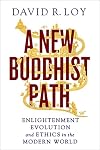
Loy addresses the challenges and opportunities that arise as Buddhism confronts the modern world. Of course this is a vast topic but Loy focuses on a few key points and brings a valuable perspective. Folks new to Buddhism and folks like myself who have been around for decades can both find a helpful orientation here.
Perhaps the nicest point here is the notion that social restructuring and personal restructuring are not merely both necessary but that each enables the other... actually, each show more consists of the other. The way to restructure oneself is to devote oneself to the restructuring of society. The way to restructure society is to devote society to the restructuring of individuals. There is no either/or to be found here. It is both/and or nothing.
In the conclusion Loy addresses karma and rebirth, which some modernizing Buddhists would like to jettison. Maybe I should say so-called Buddhists... can a person be a Buddhist without believing in karma, i.e. that good actions lead to good experiences, and bad actions lead to bad experiences? Loy addresses this puzzle in I think a perfect way. He sees it as a kind of reversal of Pascal's wager, which I think is a delightful insight. No need to worry about life after death. Good deeds are sufficient rewards unto themselves. If their good effects turn out to persist beyond death, no problem!
I am not too keen about hitching the Buddhism cart to the horse of science, either with quantum mechanical proofs of consciousness or with evolutionary creation stories. Schrodinger and Darwin are fine fellows but I think the way for Buddhism to address science is not to look for a way to fit in, but by addressing issues in philosophy of science, e.g. the idea that the real way to think about the question of the validity of some scientific hypothesis is not to puzzle over how many scientists it takes to form a consensus, but to see validity as an interdependent arising. A hypothesis has some fuzzily bounded sphere or domain of validity or utility.
Anyway Loy doesn't seem to be trying to carve out some solid position here but to be shining light on some interesting territory. Really almost all of what he is saying here is very traditional... if you are lucky enough to be tapped into the right traditions! Buddhism is quite vast and there is a lot of stuck thinking throughout - it's a bunch of ordinary humans, for the most part, after all! But there are these shining edges, little glittering sparkles, tucked here and there throughout. And these insights really do seem to have miraculous transformative potential applicable to many of the key issues of today. Loy does a great job of sketching out this potential. There is enormous work to do, but this book is a great starting point. show less
Perhaps the nicest point here is the notion that social restructuring and personal restructuring are not merely both necessary but that each enables the other... actually, each show more consists of the other. The way to restructure oneself is to devote oneself to the restructuring of society. The way to restructure society is to devote society to the restructuring of individuals. There is no either/or to be found here. It is both/and or nothing.
In the conclusion Loy addresses karma and rebirth, which some modernizing Buddhists would like to jettison. Maybe I should say so-called Buddhists... can a person be a Buddhist without believing in karma, i.e. that good actions lead to good experiences, and bad actions lead to bad experiences? Loy addresses this puzzle in I think a perfect way. He sees it as a kind of reversal of Pascal's wager, which I think is a delightful insight. No need to worry about life after death. Good deeds are sufficient rewards unto themselves. If their good effects turn out to persist beyond death, no problem!
I am not too keen about hitching the Buddhism cart to the horse of science, either with quantum mechanical proofs of consciousness or with evolutionary creation stories. Schrodinger and Darwin are fine fellows but I think the way for Buddhism to address science is not to look for a way to fit in, but by addressing issues in philosophy of science, e.g. the idea that the real way to think about the question of the validity of some scientific hypothesis is not to puzzle over how many scientists it takes to form a consensus, but to see validity as an interdependent arising. A hypothesis has some fuzzily bounded sphere or domain of validity or utility.
Anyway Loy doesn't seem to be trying to carve out some solid position here but to be shining light on some interesting territory. Really almost all of what he is saying here is very traditional... if you are lucky enough to be tapped into the right traditions! Buddhism is quite vast and there is a lot of stuck thinking throughout - it's a bunch of ordinary humans, for the most part, after all! But there are these shining edges, little glittering sparkles, tucked here and there throughout. And these insights really do seem to have miraculous transformative potential applicable to many of the key issues of today. Loy does a great job of sketching out this potential. There is enormous work to do, but this book is a great starting point. show less
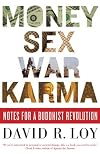
I was more impressed by the early chapters of this book than its conclusion. I had a couple of moments of clarity brought about by Loy's description of some of the more difficult concepts/non-concepts in Buddhism, particularly regarding non-self, arising, and emptiness. I think that Loy points to a number of essential pieces in our understanding of the ways in which people interact around issues of power and control. But like many cases with a primarily structural analysis of the show more institutions of power, he deftly highlights the flaws, and calls our attention to the need to create new structures, but in the end provides us with few tools to bring about change outside of ourselves and our fellow meditators.
I also found his treatment of sex to be superficial, although this reflects a still troubled relationship with body that is not new to me in Buddhist teachings. I will suggest to the author that West-meets-East really needs to take a better look at feminism-meets-patriarchy to better address our ambivalence at the fact of being consciousness embodied.
I would recommend this book regardless as a component of cultural awakening and an exceptional example of both structural analysis of power and Buddhism-meets-western philosophy. show less
I also found his treatment of sex to be superficial, although this reflects a still troubled relationship with body that is not new to me in Buddhist teachings. I will suggest to the author that West-meets-East really needs to take a better look at feminism-meets-patriarchy to better address our ambivalence at the fact of being consciousness embodied.
I would recommend this book regardless as a component of cultural awakening and an exceptional example of both structural analysis of power and Buddhism-meets-western philosophy. show less
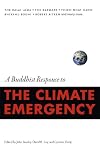
This is a collection of writings by a wide variety of esteemed Buddhist teachers, addressing the problem of climate change. Some of the contributions are very short aspiration prayers, while others are more analytical essays. At the front and back of the book, editor Stanley contributes sketches of the problem and of a variety of solutions.
I have been thinking for many years about the somewhat broader topic of Buddhism and modern science and technology. For me this book was somewhat show more disappointing. Mostly the discussion remained rather superficial. Actually the late Chatral Rinpoche contributed an aspirational prayer that was almost shocking in its brevity. I suspect the shock was intentional. We like to think of the problem in front of us as somehow very special, but really samsara has a pretty uniform taste and character! It's not like we really need some special medicine to cure this particular ill. If we just practice Dharma, the nature of reality and the nature of mind are as close as they ever have been!
It's a tricky situation, really. It's not like Buddhist cultures have really been the leaders in the industrialization that has brought us climate change. Japan is probably the most interesting case. Books like Rude Awakenings, edited by Heisig and Maraldo, address some deep issues, ways that Buddhism has really failed to address effectively the problematic aspects of modern technology.
A key issue that I struggle with is nuclear power. I don't recall seeing this discussed in any of the essays in this book. Nuclear power looks like a splendid way to have our planet and eat it too. I can't see how it won't turn out to be a much more hideous bargain with the devil than we have already seen with Chernobyl, Fukushima, Three Mile Island, Hiroshima and Nagasaki, etc.
Maybe the problem is really simple and all we need to do is build a bunch of windmills. I rather doubt it! That's why I think we need some deeper analysis.
I think the best audience for this book is folks who are quite familiar with Buddhism but not so familiar with climate change. It's a perfectly reasonable starting point to learn about the relevance of Buddhism to the problem. show less
I have been thinking for many years about the somewhat broader topic of Buddhism and modern science and technology. For me this book was somewhat show more disappointing. Mostly the discussion remained rather superficial. Actually the late Chatral Rinpoche contributed an aspirational prayer that was almost shocking in its brevity. I suspect the shock was intentional. We like to think of the problem in front of us as somehow very special, but really samsara has a pretty uniform taste and character! It's not like we really need some special medicine to cure this particular ill. If we just practice Dharma, the nature of reality and the nature of mind are as close as they ever have been!
It's a tricky situation, really. It's not like Buddhist cultures have really been the leaders in the industrialization that has brought us climate change. Japan is probably the most interesting case. Books like Rude Awakenings, edited by Heisig and Maraldo, address some deep issues, ways that Buddhism has really failed to address effectively the problematic aspects of modern technology.
A key issue that I struggle with is nuclear power. I don't recall seeing this discussed in any of the essays in this book. Nuclear power looks like a splendid way to have our planet and eat it too. I can't see how it won't turn out to be a much more hideous bargain with the devil than we have already seen with Chernobyl, Fukushima, Three Mile Island, Hiroshima and Nagasaki, etc.
Maybe the problem is really simple and all we need to do is build a bunch of windmills. I rather doubt it! That's why I think we need some deeper analysis.
I think the best audience for this book is folks who are quite familiar with Buddhism but not so familiar with climate change. It's a perfectly reasonable starting point to learn about the relevance of Buddhism to the problem. show less
Awards


You May Also Like


Associated Authors
Statistics
- Works
- 18
- Also by
- 1
- Members
- 842
- Popularity
- #30,363
- Rating
- 4.0
- Reviews
- 21
- ISBNs
- 45
- Languages
- 6
- Favorited
- 1