
Lars Iyer
Author of Spurious
About the Author
Lars Iyer is Lecturer in Philosophy at the University of Newcastle-upon-Tyne, UK.
Series
Works by Lars Iyer
Tagged
Common Knowledge
- Birthdate
- 1970-05-02
- Gender
- male
- Occupations
- Reader in Creative Writing and Subject Head of Creative Writing, Newcastle University
philosophy professor, the European Graduate School - Nationality
- UK
- Birthplace
- London, England, UK
- Map Location
- UK
Members
Reviews

To paraphrase Seinfeld, "It's a book about Nothing!" Okay, not exactly, it's a book about two academics, philosophers, who want to have Thoughts, and live in the world of Ideas, only they're too stupid, they realize, they know this, they can't accomplish anything, so the one verbally abuses the other to delightful effect, and they seek a Leader who can provide them Thoughts, only whenever they find one they scare him away by telling him they're his followers, so mostly they try to read books show more which they don't understand, and discuss the apocalypse and the Messiah, and try to look religious since they unfortunately lack all religious belief ("Nothing is more boring than an atheist", laments W.), and drink a lot of gin.
It's the sort of book that I'd say could be 30 pages or 300 pages, no matter. The full idea can be got across in 30, but equally it could go on much longer. Indefinitely really. Such is the liberation of plotlessness, as long as it is amusing. And this is fairly amusing, though I admit, I like Story. I like Plot. So I'm giving it 3 stars, though I'm also going to start the second book in this trilogy without hesitation.
And that's not exactly true either, there is a nod to Plot, in that Lars's apartment is being taken over by Damp. A mysterious damp that he muses may be a living entity, expressing itself through his dripping walls and ceilings. None of the experts he calls in can find the cause of this damp, and it has a Kafkaesque ring to it, who, naturally, is one of our heroes' heroes. show less
It's the sort of book that I'd say could be 30 pages or 300 pages, no matter. The full idea can be got across in 30, but equally it could go on much longer. Indefinitely really. Such is the liberation of plotlessness, as long as it is amusing. And this is fairly amusing, though I admit, I like Story. I like Plot. So I'm giving it 3 stars, though I'm also going to start the second book in this trilogy without hesitation.
And that's not exactly true either, there is a nod to Plot, in that Lars's apartment is being taken over by Damp. A mysterious damp that he muses may be a living entity, expressing itself through his dripping walls and ceilings. None of the experts he calls in can find the cause of this damp, and it has a Kafkaesque ring to it, who, naturally, is one of our heroes' heroes. show less
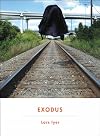
I read 'Exodus' on a series of Sunday trains that took me home by a circuitous and extended route, as a result of Engineering Works. This seemed like the ideal milieu for a rambling and circuitous commentary on academia, philosophy, armageddon, capitalism, and ineptitude. Much of the novel takes place on trains, in any case. As previously noted, I've enjoyed each installment of this trilogy more than the previous one ([b:Spurious|9578031|Spurious|Lars show more Iyer|https://images.gr-assets.com/books/1320541417s/9578031.jpg|14464916] then [b:Dogma|12577226|Dogma|Lars Iyer|https://images.gr-assets.com/books/1333580978s/12577226.jpg|17587970]) as the passage of time has made me more bitter, cynical, and resentful, about academia in general and being a postgraduate student in particular. There is much more talk of postgraduates in this installment, which I appreciated. I cannot resist quoting this commentary at length, because it is magnificent:
‘Exodus’ fitted my current state of mind perfectly, so I cannot help but give it five stars. It is a wonderful satire. I particularly liked the mockery of Oxford, the Slavoj Žižek cameo, and the typology of stupidity. show less
Postgraduates are the angels of the academic world, we agree. They’re between worlds - mediators between the heaven of full-time lecturers and the netherworld of the undergraduate. They teach - they often take seminars - but they are not a real part of the teaching staff. They study, it is true, but they’re not entirely students either.
They have a sense of what they want to achieve: an academic job, an academic career, but they know that there are very few such jobs, and very little chance of a career. They’ve fled from the world into academia, but they know they will most likely find themselves back where they came from, as though they’d dreamt up the entirety of their postgraduate lives…
There is no laughter like postgraduate laughter, W. says. There’s nothing as dark. Nothing as knowing. It’s death-row laughter, we agree. It’s the laughter of those condemned to death.
Because they are condemned to death, the postgraduates around us. Shown the greatest of vistas, the whole landscape of Old Europe at their feet, and then thrown out into the world, they’re condemned to a life without meaning, a life without succour, a life of shit in a world of shit…
They’re martyrs, the British postgraduates, we agree. They’re anchorites, like St Anthony in the desert. They’re exiles from the world. They’re proletariats, as Marx would say. They’re individuals, Kierkegaard would say. They’re waiting for the revolution, Marx would say. They’re waiting for grace, Kierkegaard would say.
‘Exodus’ fitted my current state of mind perfectly, so I cannot help but give it five stars. It is a wonderful satire. I particularly liked the mockery of Oxford, the Slavoj Žižek cameo, and the typology of stupidity. show less
'Spurious' has two characters named Lars and W, both apparently working in mid-level academia. They are close friends, despite W's constant browbeating of the apparently placid Lars. Both are obsessed with the apocalypse and messianism, which they discuss endlessly, alternating between delight and despair. Their relationship reminded me more than a little of 'Withnail and I', as did the descriptions of Lars' flat. Actually, the terrible damp and mould in Lars' flat was my favourite part of show more the book. It reminded me strongly of the last house I lived in, which likewise appeared to be in a constant state of decay. Our houseplants died and mushrooms grew in their plots; my bedroom curtains developed a paisley-esque mould pattern. It was terrible. Thus, this passage in which W visits Lars made me laugh with a certain bitterness:
The constant carping and obsessiveness, as well as the quasi-mystical mould takeover, made me wonder if this is what my future would be like if I stay in academia. Well, I do already have a fixation with the apocalypse. 'Spurious' is very amusing. Although it doesn't really go anywhere, I think that is the point. show less
'"What did you do to those plants? Desecrate them?" and then, "What's hung over your washing line? What was it, before it started rotting?", and then, "Were those bin bags? My God, what have they become?"'
The constant carping and obsessiveness, as well as the quasi-mystical mould takeover, made me wonder if this is what my future would be like if I stay in academia. Well, I do already have a fixation with the apocalypse. 'Spurious' is very amusing. Although it doesn't really go anywhere, I think that is the point. show less
If you:
...read too much Heidegger, Spinoza, and Kierkegaard in your formative years which then caused all experiences from puberty onward to become internal debates, crises of consciousness, self-reflexive moments that forced you to pull a Hamlet and dwell in your head rather than enjoy life without over-thinking it like those who read, say, Judy Blume in lieu of Kafka.show more
...have ever gotten drunk and thought that you were the Messiah.
...have ever gotten drunk and thought that your interlocutor
was the Messiah.... well, then, you must hastily get your hands on a copy of this and begun reading your way through Iyer's trilogy tout de suite. show less
...think that B��la Tarr is the Messiah.
...prefer your action rendered as "action" and thereafter rendered in Socratic dialogue, punctuated by ejaculations of "moor!" and "river!"
...think that we are in the end of days.
...are a fan of Derrida & co. and need a laughingly perverse bout of crying or a cryingly perverse bout of laughing.
...have a problem with damp in your flat and make not mountains out of molehills but allegories out of mold spores.
...admire your best friend more than yourself (as does he).
Lists
Awards


You May Also Like


Statistics
- Works
- 9
- Members
- 585
- Popularity
- #42,855
- Rating
- 3.2
- Reviews
- 35
- ISBNs
- 24
- Languages
- 2
- Favorited
- 2