
Robert K. Greenleaf (1904–1990)
Author of Servant Leadership: A Journey into the Nature of Legitimate Power and Greatness 25th Anniversary Edition
About the Author
Robert K. Greenleaf was the creator of the modern trend to empower employees; he also coined the term servant-leadership. He was a top executive in management research, development, and education and AT&T, as well as a visiting lecturer at MIT's Sloan School of Management and Harvard Business show more School. He also taught at Dartmouth College and the University of Virginia. Upon his retirement from AT&T, he founded the Center for Applied Ethics, which eventually became the Robert K. Greenleaf Center for Servant-Leadership, located in Indianapolis. Greenleaf died in 1990 at the age of 86. show less
Works by Robert K. Greenleaf
Servant Leadership: A Journey into the Nature of Legitimate Power and Greatness 25th Anniversary Edition (1977) 859 copies, 4 reviews
The Greenleaf Center's reading & dialogue study guide: For The servant as leader, The institution as servant, Truste (1998) 2 copies
Tagged
Common Knowledge
- Other names
- 羅伯.格林里夫
- Birthdate
- 1904
- Date of death
- 1990-09-29
- Gender
- male
- Occupations
- management consultant
- Place of death
- Kennett Square, Pennsylvania, USA
- Associated Place (for map)
- Pennsylvania, USA
Members
Reviews
Servant Leadership: A Journey into the Nature of Legitimate Power and Greatness 25th Anniversary Edition by Robert K. Greenleaf
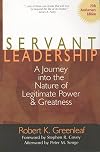
When observing the world, many see that true leadership does not reflect positions of power; rather, it reflects a quality of personal character. Robert Greenleaf looked at 1970s America and the 1970s world and observed a lack of leadership. We had educated talent out the wazoo, but lacked people able to usher in lasting, good change. He wrote this book to cultivate such leadership qualities in its readers. Leadership, to him, was of a servant's quality; it was not driven by acquiring power show more but instead by being a true "trustee."
Some of the material is not relevant today because it was so rooted in history. Particularly, his assessment of the universities reflected the historical student uprisings of the 1960s. Thankfully, many of the problems have been addressed. Likewise, churches now face a new cadre of problems, not moored to the problems of the 1970s. I suspect the same is true for foundations, another topic of his interest.
However, there is a lasting quality to his philosophy. We are in need of people to serve lasting organizations instead of just hopping on the next new thing. Those people do not necessarily need fancy titles to enact "legitimate power and greatness." The names writing the forward and afterward agree: famous business authors Stephen Covey and Peter Senge. Society needs to continue to read this book because we need better servant leaders.
This book is well-suited for undergraduate and graduate school students seeking to make more of an impact on their world. Young professionals might also give it a good read. Even older people involved in mentoring young adults can benefit from the words in its philosophy. This book is one of those lasting works that deserves to be read for a long time. To be effective, we all need to learn to be better servant leaders. show less
Some of the material is not relevant today because it was so rooted in history. Particularly, his assessment of the universities reflected the historical student uprisings of the 1960s. Thankfully, many of the problems have been addressed. Likewise, churches now face a new cadre of problems, not moored to the problems of the 1970s. I suspect the same is true for foundations, another topic of his interest.
However, there is a lasting quality to his philosophy. We are in need of people to serve lasting organizations instead of just hopping on the next new thing. Those people do not necessarily need fancy titles to enact "legitimate power and greatness." The names writing the forward and afterward agree: famous business authors Stephen Covey and Peter Senge. Society needs to continue to read this book because we need better servant leaders.
This book is well-suited for undergraduate and graduate school students seeking to make more of an impact on their world. Young professionals might also give it a good read. Even older people involved in mentoring young adults can benefit from the words in its philosophy. This book is one of those lasting works that deserves to be read for a long time. To be effective, we all need to learn to be better servant leaders. show less
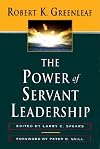
This book challenged my thinking in regard to the role of the seminary and theological education within the church world. I appreciate much of what it says.
I have been exposed to the idea of servant leadership in the past. However, I was rather surprised to understand the implicit connection that the author appears to make between servant leadership and his own pacifistic views. What struck me is that only a pacifist can hold to the theory of servant leadership.
I have been exposed to the idea of servant leadership in the past. However, I was rather surprised to understand the implicit connection that the author appears to make between servant leadership and his own pacifistic views. What struck me is that only a pacifist can hold to the theory of servant leadership.

Par for the course of self-improvement books. The principles are good, but the style of this genre does not appeal to me.
Servant Leadership: A Journey into the Nature of Legitimate Power and Greatness 25th Anniversary Edition by Robert K. Greenleaf
This is a very good book on leaders as servants; doing an excellent job of delineating what that idea truly means. The terminology can be a bit challenging as he writes across institutional lines applying his concepts to business & industry, as well as educational and religious institutions. Greenleaf suggests that foundational to a successful institution is the requirement that it must be more than simply the chief administrator who has a deep commitment. He calls for the show more board/trustees/synod/executive committee to be comprised of highly committed individuals who are very supportive of the missional goal of the organization. He insists that the chief administrator (CEO/president/minister) should be a first among equals. But he also insists that the equals must be equally committed to make the institution successful. The book expands and offers thoughts about the ways to accomplish this. It is not an easy read – much more like a textbook than anything else, but for those who are administrator’s there are tools here that can be utilized to build the organization. show less
You May Also Like


Associated Authors
Statistics
- Works
- 29
- Members
- 1,308
- Popularity
- #19,626
- Rating
- 4.0
- Reviews
- 8
- ISBNs
- 19
- Languages
- 2
- Favorited
- 2