
Todd S. Purdum
Author of Something Wonderful: Rodgers and Hammerstein's Broadway Revolution
Works by Todd S. Purdum
Something Wonderful: Rodgers and Hammerstein's Broadway Revolution (2018) — Author — 260 copies, 6 reviews
An Idea Whose Time Has Come: Two Presidents, Two Parties, and the Battle for the Civil Rights Act of 1964 (2014) 135 copies, 16 reviews
Associated Works
Tagged
Common Knowledge
- Legal name
- Purdum, Todd Stanley
- Birthdate
- 1959-12-13
- Gender
- male
- Education
- Princeton University (1982)
- Relationships
- Myers, Dee Dee (wife)
- Nationality
- USA
- Associated Place (for map)
- USA
Members
Reviews
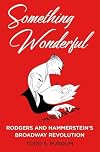
Todd Purdum's Something Wonderful: Rodgers and Hammerstein's Broadway Revolution, though ultimately an affectionate portrait (indeed the title gives it away) of the legendary songwriting team, does not ignore their theatrical missteps and failures, their personal fears and foibles, or their professional shortcomings, making this a very enjoyable read and surely the definitive biography of this unparalleled duo.
After the obligatory opening chapters on Richard Rodgers's and Oscar Hammerstein show more III's lives prior to their collaboration, the book hits its stride, exploring of the creative process that produced their songs, as well as the behind-the-scenes machinations required to bring the shows to opening night. It's fascinating to see how the well known smash hits like "Oklahoma!" and "South Pacific" came to be, but it's especially revealing to see what caused efforts such as the more obscure "Allegro" and "Juliet and Me" to be critical and financial disappointments. Threads of the personal lives of Rodgers and Hammerstein are woven in smoothly, providing insight into how their personal and professional lives intertwined. And the sprinkling of backstage lowdown on casting decisions, tempermental divas, dangerous liaisons, and festering feuds and grudges along the way adds some welcomed spice to the narrative. show less
After the obligatory opening chapters on Richard Rodgers's and Oscar Hammerstein show more III's lives prior to their collaboration, the book hits its stride, exploring of the creative process that produced their songs, as well as the behind-the-scenes machinations required to bring the shows to opening night. It's fascinating to see how the well known smash hits like "Oklahoma!" and "South Pacific" came to be, but it's especially revealing to see what caused efforts such as the more obscure "Allegro" and "Juliet and Me" to be critical and financial disappointments. Threads of the personal lives of Rodgers and Hammerstein are woven in smoothly, providing insight into how their personal and professional lives intertwined. And the sprinkling of backstage lowdown on casting decisions, tempermental divas, dangerous liaisons, and festering feuds and grudges along the way adds some welcomed spice to the narrative. show less
 This review was written for LibraryThing Early Reviewers.
An Idea Whose Time Has Come: Two Presidents, Two Parties, and the Battle for the Civil Rights Act of 1964 by Todd S. Purdum
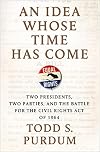
Todd Purdum's _An Idea Whose Time Has Come_ is a thorough, thoughtful, perceptive, and clear account of the political maneuvering surrounding the passage of the 1964 Civil Rights Act. It begins in February, 1963, when President Kennedy began his efforts to complete the work begun by Lincoln's Emancipation Proclamation, and continues through Kennedy's assassination to July, 1964, when the law was passed. Purdum is clearly sympathetic the goals of civil rights activists and to the liberal show more goals of the (mostly) Democratic politicians pressing to pass the law. But he is also clear about the mixed motives of all the politicians and activists. Lyndon Johnson is particularly well-presented as he fought to complete what Kennedy had begun, even as he worried that he might alienate the south and his own chances to be elected president on his own. Everett Dirkson gets similarly complete coverage, along with Robert Kennedy, Martin Luther King, Jr. and numerous others. I did not find the details and cast of characters confusing--in fact I read the book pretty much without stopping (except for prayer and sleep) and found engaging information and interpretations on virtually every page. The review copy I received is a pre-publication copy, with the occasional typo (which I hope will be fixed in the final copy) and incomplete reference notes (no page numbers yet). And I hope the final edition has a thorough index, because that would make it easier to revisit and assess the actions of this or that participant. Altogether a fine piece of work. show less
This review was written for LibraryThing Early Reviewers.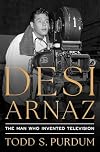
A good story well told. The author makes a decent case for Arnaz being "The Man Who Invented Television" or at least one among the top few. He had ideas and insights that looked beyond the immediate, and the personality to pull the disparate elements together, creating something completely new. He recognized and seized a crucial moment in time. Highly recommended, especially if you were there in the 1950's and 1960's.
I loved this book. I was already predisposed to like the story, because I am a great fan of musicals and in particular, those of Rodgers and Hammerstein. This is the incredibly talented team that came up with Oklahoma!, Carousel, South Pacific, The King and I, and The Sound of Music, inter alia.
But biographies and histories can be dry no matter how appealing the subject might be. This book, however, written in a spritely manner, is consistently entertaining. It took me a while to read it show more only because I kept having to break off for trips to YouTube to listen to the music. The whole neighborhood must have heard me sobbing while I watched videos of “You’ll Never Walk Alone,” “If I Loved You,” and “Something Wonderful.” Richard Rodgers once said art could be defined “as the expression of an emotion by means of a technique.” This description encapsulates for me exactly why their songs are so appealing.
The book is full of background on where the duo got their ideas, how they came up with the music and the lyrics, their working relationship, how they staged the productions and found the stars for their shows, and the ways in which the other collaborators - from arrangers, conductors, choreographers, and scenic designers - contributed so much to the productions - often without appropriate or adequate credit.
The author also explains the basic format of the American popular song, and how Rodgers and Hammerstein altered it depending on the culture or period they were depicting. For example, for “The King and I,” Rodgers needed to change the notes and the tempos to create a more exotic sounds. Even the instruments used to play the music needed to change. The author also adds earlier versions of lyrics when they are available, to show how they evolved and improved with each rewrite.
Most of the story takes off when Larry Hart, Rodgers long-time lyricist, was hardly functioning anymore because of an advanced state of alcoholism. Rodgers was asked to develop “Green Grow the Lilacs” into a musical, and he needed a partner. Hammerstein had previously worked on the masterpiece Show Boat with Jerome Kern, which opened in 1927 to rave reviews, but then Hammerstein hit a long dry patch and even Hammerstein thought his career in musical theater was over.
It was 1942. Rodgers and Hammerstein met over lunch; agreed to become partners; “Green Grow the Lilacs” became “Oklahoma!”; and Broadway theater would never be the same. “Oklahoma!” won a special honorary Pulitzer Prize and would run for over five years, breaking all previous records. The author observes that the show was more than a Broadway hit - it was “a cultural phenomenon, and much of that had to do with World War II.” As a member of the New York State Federation of Women’s Clubs told one of the stars, it carried a necessary message, “when people are going out to fight for this country, and may die for it, to be reminded of the kind of courage, the unselfconscious courage, that settled this country.” Indeed, Purdum records, men in uniform flocked to the show.
The team went on to win a total of 34 Tony Awards, 15 Academy Awards, two Pulitzer Prizes, two Grammys, and two Emmys, a record unmatched by any other writing team. Stephen Sondheim, who was Oscar’s surrogate son and later protégé, thought Hammerstein’s lyrics were simplistic. But there is no doubt about their staying power, or that of Rodgers’ music. Purdum notes:
“On a single spring evening in 2014, in the United States alone, there were 11 productions of Carousel, 17 of The King and I, 26 of South Pacific, 64 of Oklahoma!, and 106 of The Sound of Music."
Oscar Hammerstein died in 1960 and while Rodgers kept busy, he never again experienced the degree of success he had with Hammerstein. In addition, the nature of what the public wanted had changed. Rodgers died in 1979.
A critic in 1993 wrote deprecatingly that the world of Rodgers and Hammerstein was too much of a wholesome and saccharine place in which good triumphed over evil. Parodying their music he explained:
“If you kept on whistling a happy tune, you would never walk alone. And on some enchanted evening, you might even find your true love. Those who climbed every mountain, beginning with foothills that were alive with the sound of music, would surely find their dreams.”
He concluded that in the light of today’s sexual and racial politics, this perspective seemed no longer relevant. And yet. There is a reason the plays and the music endure. As Julie Andrews said in an interview:
“Rodger’s music was always melodically glorious, simple yet soaring. . . . Hammerstein’s lyrics were equally rich [and] brilliantly constructed…. Their shows managed to be both timely and timeless - the epitome of classic.”
The book includes photos.
Evaluation: You may ask, how can I objectively evaluate this book when clearly I loved it even before I cracked open the cover? Yes, true indeed. But I would also observe that I have a number of other books on musical theater, Broadway, Tin Pan Alley, and Hollywood musicals, and none of them are as well-written as this one. This one does what Rodgers and Hammerstein did at their best: it comes up with a unified story and peppers it with details that are interesting, inspiring, instructive, sentimental, gossipy, and even salacious. It throws in unforgettable lyrics, and thanks to the internet, stirring background music is only as far away as your computer or smart phone. show less
But biographies and histories can be dry no matter how appealing the subject might be. This book, however, written in a spritely manner, is consistently entertaining. It took me a while to read it show more only because I kept having to break off for trips to YouTube to listen to the music. The whole neighborhood must have heard me sobbing while I watched videos of “You’ll Never Walk Alone,” “If I Loved You,” and “Something Wonderful.” Richard Rodgers once said art could be defined “as the expression of an emotion by means of a technique.” This description encapsulates for me exactly why their songs are so appealing.
The book is full of background on where the duo got their ideas, how they came up with the music and the lyrics, their working relationship, how they staged the productions and found the stars for their shows, and the ways in which the other collaborators - from arrangers, conductors, choreographers, and scenic designers - contributed so much to the productions - often without appropriate or adequate credit.
The author also explains the basic format of the American popular song, and how Rodgers and Hammerstein altered it depending on the culture or period they were depicting. For example, for “The King and I,” Rodgers needed to change the notes and the tempos to create a more exotic sounds. Even the instruments used to play the music needed to change. The author also adds earlier versions of lyrics when they are available, to show how they evolved and improved with each rewrite.
Most of the story takes off when Larry Hart, Rodgers long-time lyricist, was hardly functioning anymore because of an advanced state of alcoholism. Rodgers was asked to develop “Green Grow the Lilacs” into a musical, and he needed a partner. Hammerstein had previously worked on the masterpiece Show Boat with Jerome Kern, which opened in 1927 to rave reviews, but then Hammerstein hit a long dry patch and even Hammerstein thought his career in musical theater was over.
It was 1942. Rodgers and Hammerstein met over lunch; agreed to become partners; “Green Grow the Lilacs” became “Oklahoma!”; and Broadway theater would never be the same. “Oklahoma!” won a special honorary Pulitzer Prize and would run for over five years, breaking all previous records. The author observes that the show was more than a Broadway hit - it was “a cultural phenomenon, and much of that had to do with World War II.” As a member of the New York State Federation of Women’s Clubs told one of the stars, it carried a necessary message, “when people are going out to fight for this country, and may die for it, to be reminded of the kind of courage, the unselfconscious courage, that settled this country.” Indeed, Purdum records, men in uniform flocked to the show.
The team went on to win a total of 34 Tony Awards, 15 Academy Awards, two Pulitzer Prizes, two Grammys, and two Emmys, a record unmatched by any other writing team. Stephen Sondheim, who was Oscar’s surrogate son and later protégé, thought Hammerstein’s lyrics were simplistic. But there is no doubt about their staying power, or that of Rodgers’ music. Purdum notes:
“On a single spring evening in 2014, in the United States alone, there were 11 productions of Carousel, 17 of The King and I, 26 of South Pacific, 64 of Oklahoma!, and 106 of The Sound of Music."
Oscar Hammerstein died in 1960 and while Rodgers kept busy, he never again experienced the degree of success he had with Hammerstein. In addition, the nature of what the public wanted had changed. Rodgers died in 1979.
A critic in 1993 wrote deprecatingly that the world of Rodgers and Hammerstein was too much of a wholesome and saccharine place in which good triumphed over evil. Parodying their music he explained:
“If you kept on whistling a happy tune, you would never walk alone. And on some enchanted evening, you might even find your true love. Those who climbed every mountain, beginning with foothills that were alive with the sound of music, would surely find their dreams.”
He concluded that in the light of today’s sexual and racial politics, this perspective seemed no longer relevant. And yet. There is a reason the plays and the music endure. As Julie Andrews said in an interview:
“Rodger’s music was always melodically glorious, simple yet soaring. . . . Hammerstein’s lyrics were equally rich [and] brilliantly constructed…. Their shows managed to be both timely and timeless - the epitome of classic.”
The book includes photos.
Evaluation: You may ask, how can I objectively evaluate this book when clearly I loved it even before I cracked open the cover? Yes, true indeed. But I would also observe that I have a number of other books on musical theater, Broadway, Tin Pan Alley, and Hollywood musicals, and none of them are as well-written as this one. This one does what Rodgers and Hammerstein did at their best: it comes up with a unified story and peppers it with details that are interesting, inspiring, instructive, sentimental, gossipy, and even salacious. It throws in unforgettable lyrics, and thanks to the internet, stirring background music is only as far away as your computer or smart phone. show less
Lists
Awards


You May Also Like


Associated Authors
Statistics
- Works
- 4
- Also by
- 2
- Members
- 495
- Popularity
- #49,935
- Rating
- 4.2
- Reviews
- 27
- ISBNs
- 20
