
Andy Beckett
Author of When the Lights Went Out: Britain in the Seventies
About the Author
Works by Andy Beckett
Tagged
Common Knowledge
- Birthdate
- 1969-12-22
- Gender
- male
- Education
- University of Oxford
University of California, Berkeley - Occupations
- journalist
historian - Nationality
- UK
- Places of residence
- London, England, UK
- Associated Place (for map)
- England, UK
Members
Reviews
The Searchers: Five Rebels, Their Dream of a Different Britain, and Their Many Enemies by Andy Beckett
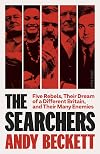
This is, among other things, a group biography of five leftwing Labour Party politicians: Tony Benn, Ken Livingstone, Diane Abbott, Jeremy Corbyn and John McDonnell. There were differences between these politicians but also sufficient common ground to view them as a group. Their politics combined the traditional socialist concern with class inequality with identity politics and social liberalism. They championed multiculturalism, feminism, gay rights, environmentalism and community action. show more This grassroots, slightly anarchic and coalition building form of politics was in stark contrast to the centralised, top-down and often socially conservative and paternalistic approach of traditional Labourism. All five were routinely vilified by the media but also, and more revealingly, their own party hierarchy. (Despite my use of the past tense I’m happy to report that four of these politicians are alive and three of them still in Parliament. Tony Benn passed away in 2014 at the age of 88).
Through the prism of his chosen quintet Andy Beckett provides a vivid and compelling history of the British Labour left from Benn’s radicalisation in the late 1960s, through Livingstone’s pioneering Greater London Council (GLC) in the ‘80s, onto Corbyn’s tenure as Labour leader, and beyond. It’s a story which raises fascinating questions about the true nature of political defeat and victory. All of these politicians took the long view, seeing politics as an incremental process of changing attitudes rather than just amassing votes for the installation of a new management team (‘meet the new boss, same as the old boss’. Thank you, Mr Townshend). Tony Benn once remarked, famously or infamously depending on your viewpoint, that far too much attention is paid to the outcomes of general elections. Their real importance, he thought, was as a platform on which to raise alternative ideas about society. Beckett argues that, despite the apparent electoral failure of the left, modern Britain has been shaped just as much by ideas espoused by the politicians in this book - particularly in regard to attitudes towards race, sexuality, and diversity in general - as by Thatcherism and its successors. Although even more economically unequal than it was in the 1960s contemporary Britain is undeniably - ongoing culture wars notwithstanding - much more socially liberal. It might be argued that Beckett overstates the role played by the Labour left in bringing about these social and cultural changes but he has a point nonetheless. As he says, pamphlets on the need for diversity in recruitment issued by Livingstone’s allegedly ‘loony’ GLC in the 1980s now ‘read like standard memos from Human Resources’.
The Searchers is highly readable, sympathetic but not uncritical, informative and thoughtful. Beckett’s nuanced approach is a welcome change to the customary bland talk about ‘the death of the left’ and provides fresh perspective on both the past and the present. This is a valuable and timely book which achieves Beckett’s aim of being as much about future possibilities as historic struggles. show less
Through the prism of his chosen quintet Andy Beckett provides a vivid and compelling history of the British Labour left from Benn’s radicalisation in the late 1960s, through Livingstone’s pioneering Greater London Council (GLC) in the ‘80s, onto Corbyn’s tenure as Labour leader, and beyond. It’s a story which raises fascinating questions about the true nature of political defeat and victory. All of these politicians took the long view, seeing politics as an incremental process of changing attitudes rather than just amassing votes for the installation of a new management team (‘meet the new boss, same as the old boss’. Thank you, Mr Townshend). Tony Benn once remarked, famously or infamously depending on your viewpoint, that far too much attention is paid to the outcomes of general elections. Their real importance, he thought, was as a platform on which to raise alternative ideas about society. Beckett argues that, despite the apparent electoral failure of the left, modern Britain has been shaped just as much by ideas espoused by the politicians in this book - particularly in regard to attitudes towards race, sexuality, and diversity in general - as by Thatcherism and its successors. Although even more economically unequal than it was in the 1960s contemporary Britain is undeniably - ongoing culture wars notwithstanding - much more socially liberal. It might be argued that Beckett overstates the role played by the Labour left in bringing about these social and cultural changes but he has a point nonetheless. As he says, pamphlets on the need for diversity in recruitment issued by Livingstone’s allegedly ‘loony’ GLC in the 1980s now ‘read like standard memos from Human Resources’.
The Searchers is highly readable, sympathetic but not uncritical, informative and thoughtful. Beckett’s nuanced approach is a welcome change to the customary bland talk about ‘the death of the left’ and provides fresh perspective on both the past and the present. This is a valuable and timely book which achieves Beckett’s aim of being as much about future possibilities as historic struggles. show less

By the end of the 1970s there was a widespread perception that the British post-war consensus of full employment, a mixed economy and the Welfare State had reached a point of terminal crisis. Following the election of Margaret Thatcher as Prime Minister in May 1979 Britain was about to undergo a radical and lasting transformation. One of the many virtues of Andy Beckett’s book is that it provides a nuanced account of a polarised and polarising period in British history. Historical memory show more has a tendency to simplify but this survey of the early 1980s complicates received wisdom in surprising and illuminating ways.
Given the eventual triumph of Thatcherism it came as something of a shock to be reminded that, by the end of 1980, the Conservative government was deeply divided and the most unpopular since polling began. Against a backdrop of the highest levels of unemployment since the 1930s, inner city riots and - perhaps most embarrassing for an avowedly monetarist administration - spiralling inflation, even traditionally conservative newspapers were writing the political obituary of Thatcher as Prime Minister and Thatcherism as an ideology.
Beckett correctly identifies the Falklands War as the turning point in her political fortunes. The Argentinian invasion was widely anticipated and largely the result of incompetence by the Thatcher government (‘one of the least surprising surprise attacks in modern military history’, as Beckett dryly puts it) but Britain’s eventual victory in the conflict unleashed a jingoistic wave of national pride which ensured Thatcher’s victory at the 1983 election.
He has an admirably unorthodox way of blurring the boundaries between Left and Right and dredging up often neglected and revealing facts. The 1980s regeneration of London Docklands, for example, was trumpeted as the triumph of free enterprise over the state, but Beckett points out that it was financed by Whitehall to the tune of £443 million, a figure far in excess of what had been spent on the area by previous governments.
The left-wing Greater London Council (GLC) was so detested by Margaret Thatcher that she eventually abolished the entire council (in the interests of preserving democracy against the threat of democratically elected politicians, presumably) but, with its emphasis on decentralisation and empowering people to change their own lives through voluntary associations, ‘red’ Ken Livingstone’s GLC carried a curious echo of Thatcherite rhetoric. In his own way Livingstone, the son of working class Tory voters, disliked the paternalism of the traditional British Labour movement as much as Margaret Thatcher did. The GLC was derided as the ‘loony left’ by the press, and not just the right wing press as Beckett points out, but its championing of gender equality, multiculturalism and LGBT rights was to have as enduring an influence on Britain as Thatcher’s espousal of market capitalism.
As Beckett shows the Thatcherite ideology of the untrammelled free market economy with its holy grail of commercial success began to spread almost by osmosis influencing even those who did not regard themselves as right-wing. In pop music, at that time still a strong indicator of wider societal trends, the insurrectionary anarchy of punk gave way to a shiny and tuneful new form of pop with previously left field musicians proudly declaring their desire to be rich and famous. Groups comprised of working class boys from the recession hit North of England made videos in which they sang and danced their way around country houses dressed up like characters from Brideshead Revisited or Restoration fops.
A chapter on Channel 4 television, launched in 1982, brings into focus the complex and often contradictory nature of the cultural changes taking place. Proposals for a fourth television channel in Britain went back into the mists of time (well, the 1960s) but Channel 4 was finally established by the Conservatives in November 1980. It’s perceived left-liberal programming agenda turned out to be not to Mrs Thatcher’s taste at all but the station gradually began to change the structure of British broadcasting in distinctly Thatcherite ways. It drew heavily on small independent production companies, previously largely unknown in British television, and displaced the duopoly of BBC and ITV in a way that Thatcher would have approved of (in 2023 independent production companies are key players in British TV with even the BBC now functioning as a publisher of programmes made by independents almost as much as an originator of them).
The independent production companies also began to erode traditional trade union practices and staffing levels. This was mainly for economic reasons rather than ideological ones but they were facilitated in this by the highly ideological trade union ‘reforms’ passed by the government. The story of Diverse Productions seems emblematic of the era: beginning as a subversively lefty sort of operation by the mid-eighties it was busy making a series in praise the free marketers called The New Enlightenment (predictably, this was the only programme shown on Channel 4 that Margaret Thatcher is known to have enjoyed). The independents might have started off as pioneering buccaneers but the successful ones gradually transmuted into fully-fledged capitalist businesses.
This is a wide-ranging and highly readable book which combines a journalistic narrative drive with subtle historical analysis. Beckett captures the mood of change, as both Left and Right sought to escape the stasis of the post-war consensus, and provides a fresh perspective on events too readily reduced to cliche. show less
Given the eventual triumph of Thatcherism it came as something of a shock to be reminded that, by the end of 1980, the Conservative government was deeply divided and the most unpopular since polling began. Against a backdrop of the highest levels of unemployment since the 1930s, inner city riots and - perhaps most embarrassing for an avowedly monetarist administration - spiralling inflation, even traditionally conservative newspapers were writing the political obituary of Thatcher as Prime Minister and Thatcherism as an ideology.
Beckett correctly identifies the Falklands War as the turning point in her political fortunes. The Argentinian invasion was widely anticipated and largely the result of incompetence by the Thatcher government (‘one of the least surprising surprise attacks in modern military history’, as Beckett dryly puts it) but Britain’s eventual victory in the conflict unleashed a jingoistic wave of national pride which ensured Thatcher’s victory at the 1983 election.
He has an admirably unorthodox way of blurring the boundaries between Left and Right and dredging up often neglected and revealing facts. The 1980s regeneration of London Docklands, for example, was trumpeted as the triumph of free enterprise over the state, but Beckett points out that it was financed by Whitehall to the tune of £443 million, a figure far in excess of what had been spent on the area by previous governments.
The left-wing Greater London Council (GLC) was so detested by Margaret Thatcher that she eventually abolished the entire council (in the interests of preserving democracy against the threat of democratically elected politicians, presumably) but, with its emphasis on decentralisation and empowering people to change their own lives through voluntary associations, ‘red’ Ken Livingstone’s GLC carried a curious echo of Thatcherite rhetoric. In his own way Livingstone, the son of working class Tory voters, disliked the paternalism of the traditional British Labour movement as much as Margaret Thatcher did. The GLC was derided as the ‘loony left’ by the press, and not just the right wing press as Beckett points out, but its championing of gender equality, multiculturalism and LGBT rights was to have as enduring an influence on Britain as Thatcher’s espousal of market capitalism.
As Beckett shows the Thatcherite ideology of the untrammelled free market economy with its holy grail of commercial success began to spread almost by osmosis influencing even those who did not regard themselves as right-wing. In pop music, at that time still a strong indicator of wider societal trends, the insurrectionary anarchy of punk gave way to a shiny and tuneful new form of pop with previously left field musicians proudly declaring their desire to be rich and famous. Groups comprised of working class boys from the recession hit North of England made videos in which they sang and danced their way around country houses dressed up like characters from Brideshead Revisited or Restoration fops.
A chapter on Channel 4 television, launched in 1982, brings into focus the complex and often contradictory nature of the cultural changes taking place. Proposals for a fourth television channel in Britain went back into the mists of time (well, the 1960s) but Channel 4 was finally established by the Conservatives in November 1980. It’s perceived left-liberal programming agenda turned out to be not to Mrs Thatcher’s taste at all but the station gradually began to change the structure of British broadcasting in distinctly Thatcherite ways. It drew heavily on small independent production companies, previously largely unknown in British television, and displaced the duopoly of BBC and ITV in a way that Thatcher would have approved of (in 2023 independent production companies are key players in British TV with even the BBC now functioning as a publisher of programmes made by independents almost as much as an originator of them).
The independent production companies also began to erode traditional trade union practices and staffing levels. This was mainly for economic reasons rather than ideological ones but they were facilitated in this by the highly ideological trade union ‘reforms’ passed by the government. The story of Diverse Productions seems emblematic of the era: beginning as a subversively lefty sort of operation by the mid-eighties it was busy making a series in praise the free marketers called The New Enlightenment (predictably, this was the only programme shown on Channel 4 that Margaret Thatcher is known to have enjoyed). The independents might have started off as pioneering buccaneers but the successful ones gradually transmuted into fully-fledged capitalist businesses.
This is a wide-ranging and highly readable book which combines a journalistic narrative drive with subtle historical analysis. Beckett captures the mood of change, as both Left and Right sought to escape the stasis of the post-war consensus, and provides a fresh perspective on events too readily reduced to cliche. show less
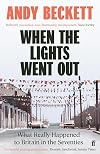
We all know the story of Britain in the 1970s. A decade of unrelenting doom and gloom, mindless strikes and economic disaster with Mrs Thatcher riding to the rescue in 1979. It’s a caricature of history but one that has been reiterated so many times that many accept it as fact. Andy Beckett’s political history challenges the myths and offers a more nuanced and complex account. Beckett interviewed most of the major political figures of the era who were still alive and travelled the show more country visiting many of the places where the battles of the seventies took place.
Beckett studied Modern History at Oxford University and Journalism at the University of California in Berkeley and his book is a skilful blend of history and journalism. He records his meetings with the politicos of the period and also the places he visits as he makes his pilgrimage around the Britain of the noughties in search of the foreign country that is the past.
When the Lights Went Out covers the main political events from the election of Edward Heath in 1970 to Margaret Thatcher’s victory in May 1979: the miners strikes, the Three-Day Week, Northern Ireland, Britain’s entry into the EEC, the IMF crisis, the Winter of Discontent. Having read a number of books on the subject, I thought I knew quite a lot about it, but Beckett’s book frequently took me by surprise.
The seventies was a time of conflict in Britain but also one of widespread consensus. Early in his premiership Heath made right wing noises but they were out of character and unconvincing. Both his party and Labour remained supporters of the post-war consensus of a mixed economy and extensive Welfare State. This began to change after Thatcher became leader of the opposition in 1975, but as Beckett’s account makes clear, the process of transforming the Conservatives into the party of the aggressive free market society and moral authoritarianism was a slow and uncertain one.
The chapters dealing with the events leading up to the downfall of the Callaghan Labour government are particularly fascinating and gripping. Beckett points out that monetarism began not with Thatcher but with the Labour Government in 1976 and by the late seventies the economic position of the country was steadily improving. The Conservative Party victory in 1979 was not inevitable but the result of a number of unpredictable factors, chief among them Callaghan’s decision not to call an election in October 1978 as had been widely anticipated and the subsequent and, in hindsight, spectacular own goal by the Trades Unions of The Winter of Discontent.
The Conservative Party manifesto at the 1979 election was untitled, short and vague, by no means a blueprint for the right wing transformation of society that eventually took place, and their victory itself less than overwhelming - the Conservatives won only 43.9 per cent of the vote and the Labour vote actually increased.
The reader is left with the strong impression that when Thatcher came to power she had a very clear idea of the economic and social changes she wanted to make but was not certain that she had sufficient electoral support to do so. Or, indeed, sufficient support within her own party - by the start of the eighties members of her own government were calling for a policy U-turn. Thatcherism as an ideology, and Margaret Thatcher’s longevity as Prime Minister, was only secured following Britain’s victory in the Falklands War in 1982, but this takes us beyond the timeframe set by Beckett’s book.
Beckett also demonstrates that the idealism of the sixties had not completely disappeared by the start of the seventies. In fact, a number of radical and progressive movements such as gay liberation, feminism and environmentalism, first entered mainstream consciousness in the 1970s.
Compulsively readable, When The Lights Went Out provides fresh insight into a period of British history we too readily assume we understand. show less
Beckett studied Modern History at Oxford University and Journalism at the University of California in Berkeley and his book is a skilful blend of history and journalism. He records his meetings with the politicos of the period and also the places he visits as he makes his pilgrimage around the Britain of the noughties in search of the foreign country that is the past.
When the Lights Went Out covers the main political events from the election of Edward Heath in 1970 to Margaret Thatcher’s victory in May 1979: the miners strikes, the Three-Day Week, Northern Ireland, Britain’s entry into the EEC, the IMF crisis, the Winter of Discontent. Having read a number of books on the subject, I thought I knew quite a lot about it, but Beckett’s book frequently took me by surprise.
The seventies was a time of conflict in Britain but also one of widespread consensus. Early in his premiership Heath made right wing noises but they were out of character and unconvincing. Both his party and Labour remained supporters of the post-war consensus of a mixed economy and extensive Welfare State. This began to change after Thatcher became leader of the opposition in 1975, but as Beckett’s account makes clear, the process of transforming the Conservatives into the party of the aggressive free market society and moral authoritarianism was a slow and uncertain one.
The chapters dealing with the events leading up to the downfall of the Callaghan Labour government are particularly fascinating and gripping. Beckett points out that monetarism began not with Thatcher but with the Labour Government in 1976 and by the late seventies the economic position of the country was steadily improving. The Conservative Party victory in 1979 was not inevitable but the result of a number of unpredictable factors, chief among them Callaghan’s decision not to call an election in October 1978 as had been widely anticipated and the subsequent and, in hindsight, spectacular own goal by the Trades Unions of The Winter of Discontent.
The Conservative Party manifesto at the 1979 election was untitled, short and vague, by no means a blueprint for the right wing transformation of society that eventually took place, and their victory itself less than overwhelming - the Conservatives won only 43.9 per cent of the vote and the Labour vote actually increased.
The reader is left with the strong impression that when Thatcher came to power she had a very clear idea of the economic and social changes she wanted to make but was not certain that she had sufficient electoral support to do so. Or, indeed, sufficient support within her own party - by the start of the eighties members of her own government were calling for a policy U-turn. Thatcherism as an ideology, and Margaret Thatcher’s longevity as Prime Minister, was only secured following Britain’s victory in the Falklands War in 1982, but this takes us beyond the timeframe set by Beckett’s book.
Beckett also demonstrates that the idealism of the sixties had not completely disappeared by the start of the seventies. In fact, a number of radical and progressive movements such as gay liberation, feminism and environmentalism, first entered mainstream consciousness in the 1970s.
Compulsively readable, When The Lights Went Out provides fresh insight into a period of British history we too readily assume we understand. show less

If journalism is the first draft of history, then Andy Beckett's description of Britain in the early 1980s is history version 1.5. Using a range of memoirs, contemporary accounts and personal interviews with man of the key individuals from the era, he offers a idiosyncratic description of the period that is leavened with his own memories of his life in Britain during that time. HIs argument is a somewhat contrarian one: that these years were not just the beginnings of a lurch rightward as show more has often been relieved, but a time of dynamic change in many other respects. In Beckett's view people like "Red Ken" Livingston and the Greenham Common protestors were in every respect as much an embodiment of the transformation taking place as was Margaret Thatcher, and with a legacy nearly as important to making Britain the country it is today. His analysis is provocative, as is his highlighting of how much of this change was built upon the achievements of the previous decades rather than reflecting a rejection of them. For anyone interested in learning ore about the history of Britain during this era this is an excellent book to read, one that hopefully Beckett will build upon with a successor volume that describes further how the decade unfolded from this provocative start. show less
Awards


You May Also Like


Associated Authors
Statistics
- Works
- 6
- Members
- 352
- Popularity
- #67,993
- Rating
- 4.0
- Reviews
- 18
- ISBNs
- 12
- Languages
- 1
