
About the Author
Lindsay C. Gibson, PsyD, is a clinical psychologist and author of Who You Were Meant to Be. She writes a monthly column on well-being for Tidewater Women magazine.
Image credit: Amazon
Works by Lindsay C. Gibson
Adult Children of Emotionally Immature Parents: How to Heal from Distant, Rejecting, or Self-Involved Parents (2015) 1,888 copies, 29 reviews
Recovering from Emotionally Immature Parents: Practical Tools to Establish Boundaries and Reclaim Your Emotional Autonomy (2019) 207 copies
Self-Care for Adult Children of Emotionally Immature Parents: Honor Your Emotions, Nurture Your Self, and Live with Confidence (2021) 113 copies, 2 reviews
How to Raise an Emotionally Mature Child: Your Blueprint to a Lifetime of Happiness and Success for Your Child (2026) 2 copies
Emotioneel onafhankelijk een praktische gids voor mensen die ongezien zijn opgegroeid (2022) 2 copies
Vuxna barn till känslomässigt omogna föräldrar : så läker du efter en uppväxt med avvisande eller självupptagna föräldrar (2023) 2 copies
Tagged
Common Knowledge
Members
Reviews
Adult Children of Emotionally Immature Parents: How to Heal from Distant, Rejecting, or Self-Involved Parents by Lindsay C. Gibson
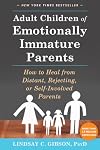
Whether you consider yourself a well-adjusted adult or not, this book helps give insights into how the maturity level of our parents when raising us has affected our behavior and relationships as adults. It’s a truly eye-opening book that can even help identify your own emotional immaturity so you can change your behavior and improve upon yourself.
Of particular importance is the ability to emotionally detach ourselves from our emotionally immature parents if we seek to have any kind of show more relationship with them. The realization that they cannot give you what they don't have is a key point in this book and drills home the fact that we are wasting precious emotional energy, and then some, trying to build something that cannot exist. Rather, we should work to maintain our own emotional well-being, and if they want to engage in a healthy manner, then that is the best we can hope for. However, there may be instances where a relationship cannot exist at all, and the best thing to maintain our mental and emotional health is to detach entirely.
Useful checklists throughout the book help to identify levels of emotional maturity, attachment style, and how to identify healthy relationships. More helpful are the plethora of patient stories used as examples. These anecdotes do an excellent job of grounding the concepts so the reader can see how they apply to their own situations.
What surprised me the most was how behaviors of emotionally immature parents can directly cause adult children to unconsciously also engage in emotionally immature behavior. Sometimes the adult children engage in the same or similar behavior. Other times, like a pendulum swing, the adult children engage in the opposite, almost compensatory, behavior.
Although brief, this is a very useful book that warrants having a sit and think with each chapter. It's full of insight and actionable recommendations. Highly recommended. show less
Of particular importance is the ability to emotionally detach ourselves from our emotionally immature parents if we seek to have any kind of show more relationship with them. The realization that they cannot give you what they don't have is a key point in this book and drills home the fact that we are wasting precious emotional energy, and then some, trying to build something that cannot exist. Rather, we should work to maintain our own emotional well-being, and if they want to engage in a healthy manner, then that is the best we can hope for. However, there may be instances where a relationship cannot exist at all, and the best thing to maintain our mental and emotional health is to detach entirely.
Useful checklists throughout the book help to identify levels of emotional maturity, attachment style, and how to identify healthy relationships. More helpful are the plethora of patient stories used as examples. These anecdotes do an excellent job of grounding the concepts so the reader can see how they apply to their own situations.
What surprised me the most was how behaviors of emotionally immature parents can directly cause adult children to unconsciously also engage in emotionally immature behavior. Sometimes the adult children engage in the same or similar behavior. Other times, like a pendulum swing, the adult children engage in the opposite, almost compensatory, behavior.
Although brief, this is a very useful book that warrants having a sit and think with each chapter. It's full of insight and actionable recommendations. Highly recommended. show less
Adult Children of Emotionally Immature Parents: How to Heal from Distant, Rejecting, or Self-Involved Parents by Lindsay C. Gibson
Adult Children of Emotionally Immature Parents: How to Heal from Distant, Rejecting, or Self-Involved Parents by Lindsay C. Gibson
My rating: 1 of 5 stars
The more I think about this book, the lower my rating gets.
This book taught me two valuable lessons:
1. Don’t buy any “non-fiction” books on a whim when I am premenstrual, sleep-deprived and feeling vulnerable, and the recommendation comes from the /emotionalneglict subreddit, which I ended up on through attempting to Google definitions show more of emotional neglect.
2. Audible returns do not cover books you buy for cash, not Audible credits. So even if the cash value is less than the 7.99 credit value… don’t do it unless I’m positive I’ll love the book.
And a third, and fourth, which I knew but forgot in my weakened state…
3. Research the author before buying the book.
4. Check the publisher.
So why did I buy this book? It’s not like me to read this kind of thing.
Poor sleep, pre-menstrual hormones and that mood of end-of-year reflection, plus the thought of Christmas looming with all the family time and inevitably stress of hosting this year, and considering what level of effort I want to go to, because often in the past it’s not felt appreciated. Who doesn’t, from time to time, consider whether they actually enjoy spending time with their family as people (and if they like spending time with you) or is it all just habit and obligation?
Basically, it was 1 pm, and I was having a “what is wrong with me?” moment. Obviously, the reason I am riddled with anxiety and low self-confidence is because of how I was raised – I am sure my parents were well-intentioned, but they definitely fucked up my development (as a shy and sensitive child) somewhere along the line. I’m sure it is too easily done; I’m always hearing about how parenting is hard.
I got the audiobook and listened to it mostly while I wasn’t able to sleep this week. I did not like the narrator. Her voice is a little bit unsettling… might be the American accent, the mature female voice and the “gentle” tone, but it was unnerving and felt manipulative (and this is a manipulative book!), like she was trying to hypnotise me or something. I probably should have immediately realised something was going to be off!
The book started well, and I was initially excited about it. It was validating to hear that there is a reason for the void of loneliness I’ve felt my entire life, especially when I was a child. I have always felt like an outsider in my family, and I still do. I am different to the others, and I don’t think anyone in my family understands me.
The full title is Adult Children of Emotionally Immature Parents: How to Heal from Distant, Rejecting, or Self-Involved Parents. I thought this book was going to give me some recommendations on how I can move forward, now I recognise the root cause of my issues. How might I be able to build better relationships and true emotional connections with the people in my life?
It doesn’t do that. The further I got into this book, the more uncomfortable it started to make me feel, and I started to reflect back on the earlier parts of the book, until I got to the point where I wanted a refund and felt ashamed of myself for ever spending money on it!
What is an emotionally immature parent? What does emotionally immature actually mean? Lindsay C. Gibson does not clearly define it. In fact, it isn’t actually a clinical term but pure pop psychology, and it just boils down to vibes. This whole book is just vibes.
She claims there are 4 types of emotionally immature parents, but each one is extremely vague and generalised, and she will give the most extreme example of it based on stereotypes. Then she uses the get out of ‘it’s a spectrum” and that your parents could be any combination of things… so you can easily read whatever you want to apply to whatever grievance you might have with your parents.
The so-called emotionally immature parents are also definitely painted as villains. The parents are at fault here, and there is something of a fuck them attitude and poor you, they ruined your life by being selfish and only ever thinking about their own needs.
She does not address why your parents might have emotional immaturity issues, and how they’ve very likely passed it on to you. I could definitely read myself as emotionally immature!
My entire family is unable to discuss emotions. We only talk about practical things; we never talk about feelings or anything serious. I’ve never gone to my parents for emotional support, and I’ve never felt like they offered it. It is only since I’ve been an adult that I started to say “love you” to my Mum on the phone, and she says it to me, but it’s always awkward. There has also never been physical affection – we don’t hug in my family unless it’s a special occasion. The close family relationships I see on TV or read in books are totally alien to me (as is the idea of a best friend). I can’t imagine having parents like that!
This book wants me to think of myself as a victim and blame my parents for this, as if it’s a conscious choice they made to neglect my emotional needs. I don’t think they did it intentionally; I think they did what they knew. My Dad is a farmer, so basically worked 24/7, and he’d only really be around before 7pm on Sundays, and so my Mum had me and my 2 years younger brother to look after by herself most of the time (I think I spent a lot of time with my grandparents because she found it hard).
The language used is highly emotive and manipulative. It really encourages a woe-is-me attitude and is clearly aimed at vulnerable and lonely people who are looking for a place to lay their troubles and would be happy to slap on a Victim badge. The author openly states that she expects her audience to be the type of people who come to her therapy office, and her theories here are based on nothing but her experiences with her patients.
There are exercises, but they’re asinine low effort shit, it boils down to writing lists. The one that was the final straw for me was the instruction to magically transport yourself back to being 10 years old (I think that’s 4th grade for Americans) and remember who you were then, what you liked to do andthe role you played in your family. This was ridiculous to me! I can’t remember being 10 years old. I guess I liked reading, and Sylvanian Families, and I was the cripplingly shy kid who was scared of everything (still am), but I don’t have clear, reliable memories.
I felt like I was being led to invent some memories that fit the narrative this book (or the type of victim I’d like ot cast myself as) was building for me on how evil and neglectful my parents were. This kind of thing seems unhealthy and detrimental.
The final chapter pretends to advise on how to deal with your emotionally immature parents moving forward. The advice is basically fuck ’em. Stop talking to them. They won’t change, don’t bother. If you have to keep talking to them, just emotionally detach.
If you have extremely toxic parental relationships, if your Mother is insulting you in public in front of your colleagues at an awards event (as one made-up sounding patient anecdotes tells), then sure. But if your parents are just the children of British baby boomers who met all your material needs but just were emotionally distant, didn’t know how to deal with an introverted and anxious child (and on some level probably feel guilty about that), then this attitude seems extreme, and like it’ll make everything worse.
In the end, this book pissed me off! It’s not based on any research, and I don’t think it’s actually trying to help anyone either. It’s just a grift, made to appeal to the type of people who are seeking out her therapy services, and you won’t get answers because you need to buy her next book.
What I wanted was to learn some ways I could work on building closer, more meaningful relationships with my family (and friends). It might be 30 years too late, it might lead to more feelings of rejection, but I don’t think not trying to bridge the gap is necessarily the answer!
Originally, I rated this 2 stars, but the more I’ve thought about it, the more bothered by it I get, so 1 star!
This book is going to get filed away as a mistake, and stop thinking about that £4.99.
REVIEW SUMMARY
I LIKED
- The author is telling me my problems aren’t my fault, and also I’m a special snowflake Internaliser (not a dickhead Externaliser, she hates those).
I DIDN’T LIKE
- Just vibes. Nothing is based on research.
- Completely generalised theories and examples, sounds like she’s pulled it all out of her arse.
- Low effort “exercises”
- Manipulative, emotive language with a weirdly hostile attitude towards parents.
- Does not acknowledge these behaviours are inherited, or what might cause them.
- Encourages breaking lines of communication with no attempt to heal them.
View all my reviews show less
My rating: 1 of 5 stars
The more I think about this book, the lower my rating gets.
This book taught me two valuable lessons:
1. Don’t buy any “non-fiction” books on a whim when I am premenstrual, sleep-deprived and feeling vulnerable, and the recommendation comes from the /emotionalneglict subreddit, which I ended up on through attempting to Google definitions show more of emotional neglect.
2. Audible returns do not cover books you buy for cash, not Audible credits. So even if the cash value is less than the 7.99 credit value… don’t do it unless I’m positive I’ll love the book.
And a third, and fourth, which I knew but forgot in my weakened state…
3. Research the author before buying the book.
4. Check the publisher.
So why did I buy this book? It’s not like me to read this kind of thing.
Poor sleep, pre-menstrual hormones and that mood of end-of-year reflection, plus the thought of Christmas looming with all the family time and inevitably stress of hosting this year, and considering what level of effort I want to go to, because often in the past it’s not felt appreciated. Who doesn’t, from time to time, consider whether they actually enjoy spending time with their family as people (and if they like spending time with you) or is it all just habit and obligation?
Basically, it was 1 pm, and I was having a “what is wrong with me?” moment. Obviously, the reason I am riddled with anxiety and low self-confidence is because of how I was raised – I am sure my parents were well-intentioned, but they definitely fucked up my development (as a shy and sensitive child) somewhere along the line. I’m sure it is too easily done; I’m always hearing about how parenting is hard.
I got the audiobook and listened to it mostly while I wasn’t able to sleep this week. I did not like the narrator. Her voice is a little bit unsettling… might be the American accent, the mature female voice and the “gentle” tone, but it was unnerving and felt manipulative (and this is a manipulative book!), like she was trying to hypnotise me or something. I probably should have immediately realised something was going to be off!
The book started well, and I was initially excited about it. It was validating to hear that there is a reason for the void of loneliness I’ve felt my entire life, especially when I was a child. I have always felt like an outsider in my family, and I still do. I am different to the others, and I don’t think anyone in my family understands me.
The full title is Adult Children of Emotionally Immature Parents: How to Heal from Distant, Rejecting, or Self-Involved Parents. I thought this book was going to give me some recommendations on how I can move forward, now I recognise the root cause of my issues. How might I be able to build better relationships and true emotional connections with the people in my life?
It doesn’t do that. The further I got into this book, the more uncomfortable it started to make me feel, and I started to reflect back on the earlier parts of the book, until I got to the point where I wanted a refund and felt ashamed of myself for ever spending money on it!
What is an emotionally immature parent? What does emotionally immature actually mean? Lindsay C. Gibson does not clearly define it. In fact, it isn’t actually a clinical term but pure pop psychology, and it just boils down to vibes. This whole book is just vibes.
She claims there are 4 types of emotionally immature parents, but each one is extremely vague and generalised, and she will give the most extreme example of it based on stereotypes. Then she uses the get out of ‘it’s a spectrum” and that your parents could be any combination of things… so you can easily read whatever you want to apply to whatever grievance you might have with your parents.
The so-called emotionally immature parents are also definitely painted as villains. The parents are at fault here, and there is something of a fuck them attitude and poor you, they ruined your life by being selfish and only ever thinking about their own needs.
She does not address why your parents might have emotional immaturity issues, and how they’ve very likely passed it on to you. I could definitely read myself as emotionally immature!
My entire family is unable to discuss emotions. We only talk about practical things; we never talk about feelings or anything serious. I’ve never gone to my parents for emotional support, and I’ve never felt like they offered it. It is only since I’ve been an adult that I started to say “love you” to my Mum on the phone, and she says it to me, but it’s always awkward. There has also never been physical affection – we don’t hug in my family unless it’s a special occasion. The close family relationships I see on TV or read in books are totally alien to me (as is the idea of a best friend). I can’t imagine having parents like that!
This book wants me to think of myself as a victim and blame my parents for this, as if it’s a conscious choice they made to neglect my emotional needs. I don’t think they did it intentionally; I think they did what they knew. My Dad is a farmer, so basically worked 24/7, and he’d only really be around before 7pm on Sundays, and so my Mum had me and my 2 years younger brother to look after by herself most of the time (I think I spent a lot of time with my grandparents because she found it hard).
The language used is highly emotive and manipulative. It really encourages a woe-is-me attitude and is clearly aimed at vulnerable and lonely people who are looking for a place to lay their troubles and would be happy to slap on a Victim badge. The author openly states that she expects her audience to be the type of people who come to her therapy office, and her theories here are based on nothing but her experiences with her patients.
There are exercises, but they’re asinine low effort shit, it boils down to writing lists. The one that was the final straw for me was the instruction to magically transport yourself back to being 10 years old (I think that’s 4th grade for Americans) and remember who you were then, what you liked to do andthe role you played in your family. This was ridiculous to me! I can’t remember being 10 years old. I guess I liked reading, and Sylvanian Families, and I was the cripplingly shy kid who was scared of everything (still am), but I don’t have clear, reliable memories.
I felt like I was being led to invent some memories that fit the narrative this book (or the type of victim I’d like ot cast myself as) was building for me on how evil and neglectful my parents were. This kind of thing seems unhealthy and detrimental.
The final chapter pretends to advise on how to deal with your emotionally immature parents moving forward. The advice is basically fuck ’em. Stop talking to them. They won’t change, don’t bother. If you have to keep talking to them, just emotionally detach.
If you have extremely toxic parental relationships, if your Mother is insulting you in public in front of your colleagues at an awards event (as one made-up sounding patient anecdotes tells), then sure. But if your parents are just the children of British baby boomers who met all your material needs but just were emotionally distant, didn’t know how to deal with an introverted and anxious child (and on some level probably feel guilty about that), then this attitude seems extreme, and like it’ll make everything worse.
In the end, this book pissed me off! It’s not based on any research, and I don’t think it’s actually trying to help anyone either. It’s just a grift, made to appeal to the type of people who are seeking out her therapy services, and you won’t get answers because you need to buy her next book.
What I wanted was to learn some ways I could work on building closer, more meaningful relationships with my family (and friends). It might be 30 years too late, it might lead to more feelings of rejection, but I don’t think not trying to bridge the gap is necessarily the answer!
Originally, I rated this 2 stars, but the more I’ve thought about it, the more bothered by it I get, so 1 star!
This book is going to get filed away as a mistake, and stop thinking about that £4.99.
REVIEW SUMMARY
I LIKED
- The author is telling me my problems aren’t my fault, and also I’m a special snowflake Internaliser (not a dickhead Externaliser, she hates those).
I DIDN’T LIKE
- Just vibes. Nothing is based on research.
- Completely generalised theories and examples, sounds like she’s pulled it all out of her arse.
- Low effort “exercises”
- Manipulative, emotive language with a weirdly hostile attitude towards parents.
- Does not acknowledge these behaviours are inherited, or what might cause them.
- Encourages breaking lines of communication with no attempt to heal them.
View all my reviews show less
The subject here: this book is about emotional deprivation, a form of child neglect every bit as damaging as the physical ones. It is about emotionally-phobic parents who feed you, clothe you and send you to school, but never once talk to you about anything important, teach you or take you anywhere, or hug you, or show they care about you; it is about the many different kinds of parent who never engage with a child properly, if at all, and about the consequences of that for the child in show more later life, from the mildly problematic to the catastrophic. It is about a real-life tragedy totally off most people’s radar.
What I suspect many of its readers will find here: first, some genuine insights, at last, into what happened to them, and why it happened, and the wretched lives which resulted; some understanding too, finally, of the most baffling thing of all—their own parents. Second, one common feature of this is the feeling that you alone in the whole wide world were treated this way; and this book may well help with that too. And third, even if it’s decades too late and you’ll never get a second shot at living your life, just maybe this understanding will bring some sort of peace.
Not all of Gibson’s book was relevant to me—about half of it was and half of it wasn’t—but to my surprise it not only helped, a number of times it left me sitting here quite overwhelmed. If any of the above sounds even remotely like you, I recommend this. show less
What I suspect many of its readers will find here: first, some genuine insights, at last, into what happened to them, and why it happened, and the wretched lives which resulted; some understanding too, finally, of the most baffling thing of all—their own parents. Second, one common feature of this is the feeling that you alone in the whole wide world were treated this way; and this book may well help with that too. And third, even if it’s decades too late and you’ll never get a second shot at living your life, just maybe this understanding will bring some sort of peace.
Not all of Gibson’s book was relevant to me—about half of it was and half of it wasn’t—but to my surprise it not only helped, a number of times it left me sitting here quite overwhelmed. If any of the above sounds even remotely like you, I recommend this. show less
Adult Children of Emotionally Immature Parents: How to Heal from Distant, Rejecting, or Self-Involved Parents by Lindsay C. Gibson
My brother read this book and recommended it. I figured it would be something of a waste of time; my childhood was fraught with turbulence, and my brother recommending this book only confirmed that, so what need did I have of verifying it for myself?
As I read (listened, since it was on Audible for free at the time), I rarely thought of my own parents. Instead, every time the author mentioned some way in which people act emotionally immature, I thought of myself and how I identified with each show more behavior. What an eye-opener. It's only been a week or two since reading, and I've already changed how I treat my daughters. And that's not because the book offered a bunch of ways to become less emotionally immature. Rather, just being aware takes you so far.
Great read, if you are the emotionally immature type. Since that can be hard to identify without knowing the behaviors, I recommend this book to everyone so you can find out for yourself. Hopefully it will be a waste of time for you, but if not, then you'll be happy to at least be aware. show less
As I read (listened, since it was on Audible for free at the time), I rarely thought of my own parents. Instead, every time the author mentioned some way in which people act emotionally immature, I thought of myself and how I identified with each show more behavior. What an eye-opener. It's only been a week or two since reading, and I've already changed how I treat my daughters. And that's not because the book offered a bunch of ways to become less emotionally immature. Rather, just being aware takes you so far.
Great read, if you are the emotionally immature type. Since that can be hard to identify without knowing the behaviors, I recommend this book to everyone so you can find out for yourself. Hopefully it will be a waste of time for you, but if not, then you'll be happy to at least be aware. show less
Lists
You May Also Like


Associated Authors
Statistics
- Works
- 22
- Members
- 2,349
- Popularity
- #10,919
- Rating
- 4.1
- Reviews
- 31
- ISBNs
- 65
- Languages
- 10
- Favorited
- 1