
Bessel A. van der Kolk
Author of The Body Keeps the Score: Brain, Mind, and Body in the Healing of Trauma
About the Author
Bessel van der Kolk M.D. has been active as a clinician, researcher and teacher in the area of posttraumatic stress and related phenomena since the 1970s. He was co-principal investigator of the DSM IV Field Trials for Post-Traumatic Stress Disorder. His current research is on how trauma affects show more memory processes and brain imaging studies of PTSD. He has written or co-written several books including Psychological Trauma, Traumatic Stress: The Effects of Overwhelming Experience on Mind, Body, and Society, and The Body Keeps the Score: Brain, Mind, and Body in the Healing of Trauma. (Bowker Author Biography) show less
Image credit: Bessel A. van der Kolk, M.D.
Works by Bessel A. van der Kolk
The Body Keeps the Score: Brain, Mind, and Body in the Healing of Trauma (2014) 8,235 copies, 105 reviews
Traumatic Stress: The Effects of Overwhelming Experience on Mind, Body, and Society (1996) — Editor — 173 copies, 1 review
The Body Keeps Score 9 copies
Post-Traumatic Stress Disorder: Psychological and Biological Sequelae (Clinical Insights) (1984) 4 copies
Das Trauma in dir wie der Körper den Schrecken festhält und wie wir heilen können 2 copies, 1 review
The Body Keeps the Score / Trauma and Recovery / Hidden Healing Powers of Super & Whole Foods (2018) — Contributor — 2 copies
Smart Trauma Interventions 1 copy
Associated Works
Overcoming Trauma through Yoga: Reclaiming Your Body (2011) — Introduction, some editions; Introduction, some editions — 148 copies
Trauma and the Body: A Sensorimotor Approach to Psychotherapy (Norton Series on Interpersonal Neurobiology) (2006) — Foreword, some editions — 136 copies
Widen the Window: Training Your Brain and Body to Thrive During Stress and Recover from Trauma (2019) — Foreword — 77 copies, 4 reviews
Treating Complex Traumatic Stress Disorders (Adults): An Evidence-Based Guide (2009) — Afterword — 55 copies
Treating Adult Survivors of Childhood Emotional Abuse and Neglect: Component-Based Psychotherapy (2019) — Foreword, some editions — 20 copies
Treating Complex Traumatic Stress Disorders in Children and Adolescents: Scientific Foundations and Therapeutic Models (2013) — Afterword, some editions — 19 copies
Let Your Light Shine: How Mindfulness Can Empower Children and Rebuild Communities (2022) — Foreword — 10 copies
Tagged
Common Knowledge
- Canonical name
- van der Kolk, Bessel A.
- Birthdate
- 1943
- Gender
- male
- Occupations
- psychiatrist
- Organizations
- Boston University School of Medicine
- Short biography
- Bessel van der Kolk (born 1943) is a Dutch psychiatrist, author, researcher and educator. Since the 1970s his research has been in the area of post-traumatic stress.
Van der Kolk formerly served as president of the International Society for Traumatic Stress Studies and is a former co-director of the National Child Traumatic Stress Network. He is a professor of psychiatry at Boston University School of Medicine and president of the Trauma Research Foundation in Brookline, Massachusetts.
Van der Kolk has published more than 150 peer-reviewed scientific articles and four books.
Wikipedia - Nationality
- Netherlands
- Birthplace
- The Hague, Netherlands
- Places of residence
- Boston, Massachusetts, USA
- Associated Place (for map)
- Netherlands
Members
Reviews
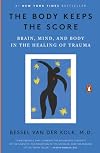
This book is now six years old (published 2014 for those reading this later than 2020), but it's going to remain relevant to basic trauma treatment as long as we remain human.
I've been making my way through it since early November (I always read nonfiction slowly), and can finally report that it is well worth your time. In fact, I'd go so far as to say everyone probably should read at least parts of it. We all have trauma or know & love people who carry trauma. For me, it's given me not show more only ways to understand behaviors in me and those around me, but also it's given me ways to be kinder. I'm grateful for that.
It's also left me hopeful. If we can fight down the asshats who've been put in charge to serve the rich greedy and power-hungry few, there is real progress to be made for each other, with each other.
I read this to familiarize myself with PTSD and trauma because one of my characters suffers. So, writers? Do your readers a favor and use this as research. You'll learn a LOT. show less
I've been making my way through it since early November (I always read nonfiction slowly), and can finally report that it is well worth your time. In fact, I'd go so far as to say everyone probably should read at least parts of it. We all have trauma or know & love people who carry trauma. For me, it's given me not show more only ways to understand behaviors in me and those around me, but also it's given me ways to be kinder. I'm grateful for that.
It's also left me hopeful. If we can fight down the asshats who've been put in charge to serve the rich greedy and power-hungry few, there is real progress to be made for each other, with each other.
I read this to familiarize myself with PTSD and trauma because one of my characters suffers. So, writers? Do your readers a favor and use this as research. You'll learn a LOT. show less
Fascinating and eyeopening book on the physiological/neurological effects of trauma, particularly childhood trauma. The book tracks how trauma affects the functioning of the brain in lasting ways, breaking down the normal coping and processing functions. The author is especially critical of current psychological diagnostic and treatment practice for those suffering in the wake of trauma, saving his most ardent criticism for pharmaceutical reliance which only mask symptoms. He spends the last show more few chapters on treatments more focused on addressing trauma in unique ways that allow the sufferer to slowly begin processing things normally again. While the book is incredibly detailed, the author never overplays the science - it's an incredibly readable book.
5 bones!!!!!
Highly recommended!!!!! show less
5 bones!!!!!
Highly recommended!!!!! show less
This is the Bible for medical gaslighters. Do not recommend. This needs to come out of curriculums as it contains dangerous concepts with little to no evidence-based research backing it up. It is regarded as scripture and should not be.
I keep thinking about this book and I read it 8 years ago. I continue seeing it in healthcare offices and it infuriates me. I read this book during a time I had chronic pain and other issues. I was diagnosed years later with a painful and pervasive condition show more that I had been living with my whole life. I let healthcare people tell me shit was in my head for a decade partly because of this book and its concepts. At one point, I even convinced myself it was in my head. Then, I got an accurate medical diagnosis explaining literally all of my medical problems. I subsequently developed cPTSD from people saying shits in my head my whole life. I continue to struggle with this mind fuckery because people would rather read and listen to books like this than learn about rare diseases. It’s much easier to diagnose someone with mental illness.
Until this happened, I thought the book was ok. Now I just hate it, but what I hate more is that people are educating to this book. Let’s teach people about rare diseases instead and leave this one on the shelf thank you show less
I keep thinking about this book and I read it 8 years ago. I continue seeing it in healthcare offices and it infuriates me. I read this book during a time I had chronic pain and other issues. I was diagnosed years later with a painful and pervasive condition show more that I had been living with my whole life. I let healthcare people tell me shit was in my head for a decade partly because of this book and its concepts. At one point, I even convinced myself it was in my head. Then, I got an accurate medical diagnosis explaining literally all of my medical problems. I subsequently developed cPTSD from people saying shits in my head my whole life. I continue to struggle with this mind fuckery because people would rather read and listen to books like this than learn about rare diseases. It’s much easier to diagnose someone with mental illness.
Until this happened, I thought the book was ok. Now I just hate it, but what I hate more is that people are educating to this book. Let’s teach people about rare diseases instead and leave this one on the shelf thank you show less
The Body Keeps the Score is an absolutely magisterial examination of the role of trauma in mental health, and the necessity of healing both body and mind. Van der Kolk has had a fascinating career, getting started in psychiatry treating Vietnam veterans with PTSD in the late 1970s, and then moving through the great pharmacological and neuro-imaging transformations of the following decades into advocacy of unconventional treatments for complex PTSD.
In van der Kolk's theory, being faced with show more annihilation creates longstanding neurological changes that trap a person in the moment of trauma, a permanently elevated stress response that has innumerable health and social consequences. The signs of trauma are many, and range from patterns of fMRI that indicate issues with speech and memory, to signature low levels of heart rate variability, to sunken body language.
There are many kinds of traumatic events: combat, violent accidents, but van der Kolk focuses mostly on domestic violence and sexual assault. Children are utterly dependent on their caregivers, and a shockingly high percentage, perhaps 10%-25%, are simply unfit for the role, disinterested to outright abusive. Without having a healthy relationship to pattern onto, childhood victims of trauma are set up for a life of bad consequences. Adverse childhood events are strongly associated with everything from addiction, to depression, to criminal activity as both victim and perpetrator.
There are ways through trauma. While van der Kolk does not discount traditional talk therapy, including its more stressful exposure therapy variations, or psychotropic medication, he argues that trauma is basically a pattern of activity encoded in the body, and that the somatic signs of trauma have to be met head on. Victims of trauma have to be taught to breath and feel their own bodies before they can face their memories and rebuild trust.
Reading some other reviews, I can see that van der Kolk has garnered a fair deal of criticism, especially for arguing in favor of repressed memories in court, and for pushing some treatments without a great deal of peer-reviewed evidence, including EMDR, emotional family systems, and theater-based therapies. Repressed memories are a complex subject. The converse, that victims of trauma accurately recall details of happened to them, is definitely not true. Emotional memories focus on some sensations, and leave context and sequence in disarray. Yet, how can we do justice when it is the word of a victim decades later against an alleged abuser? Even if van der Kolk has served as an expert witness, that judgement is outside of the scope of this book.
But I am firmly in agreement, as someone with a PhD in the social aspects of mental health, that psychopharmacology and the DSM are simply not living up to the requirement of reducing suffering. I'm not sure trauma is the be all, but there are a lot of damaged people walking around. And van der Kolk is persuasive in his argument, that historically from Freud forward, trauma-infused psychiatry was always slapped down when it asked the awkward question of "So who exactly is hurting these kids?" show less
In van der Kolk's theory, being faced with show more annihilation creates longstanding neurological changes that trap a person in the moment of trauma, a permanently elevated stress response that has innumerable health and social consequences. The signs of trauma are many, and range from patterns of fMRI that indicate issues with speech and memory, to signature low levels of heart rate variability, to sunken body language.
There are many kinds of traumatic events: combat, violent accidents, but van der Kolk focuses mostly on domestic violence and sexual assault. Children are utterly dependent on their caregivers, and a shockingly high percentage, perhaps 10%-25%, are simply unfit for the role, disinterested to outright abusive. Without having a healthy relationship to pattern onto, childhood victims of trauma are set up for a life of bad consequences. Adverse childhood events are strongly associated with everything from addiction, to depression, to criminal activity as both victim and perpetrator.
There are ways through trauma. While van der Kolk does not discount traditional talk therapy, including its more stressful exposure therapy variations, or psychotropic medication, he argues that trauma is basically a pattern of activity encoded in the body, and that the somatic signs of trauma have to be met head on. Victims of trauma have to be taught to breath and feel their own bodies before they can face their memories and rebuild trust.
Reading some other reviews, I can see that van der Kolk has garnered a fair deal of criticism, especially for arguing in favor of repressed memories in court, and for pushing some treatments without a great deal of peer-reviewed evidence, including EMDR, emotional family systems, and theater-based therapies. Repressed memories are a complex subject. The converse, that victims of trauma accurately recall details of happened to them, is definitely not true. Emotional memories focus on some sensations, and leave context and sequence in disarray. Yet, how can we do justice when it is the word of a victim decades later against an alleged abuser? Even if van der Kolk has served as an expert witness, that judgement is outside of the scope of this book.
But I am firmly in agreement, as someone with a PhD in the social aspects of mental health, that psychopharmacology and the DSM are simply not living up to the requirement of reducing suffering. I'm not sure trauma is the be all, but there are a lot of damaged people walking around. And van der Kolk is persuasive in his argument, that historically from Freud forward, trauma-infused psychiatry was always slapped down when it asked the awkward question of "So who exactly is hurting these kids?" show less
Lists
Awards


You May Also Like


Associated Authors
Statistics
- Works
- 20
- Also by
- 9
- Members
- 8,477
- Popularity
- #2,839
- Rating
- 4.2
- Reviews
- 108
- ISBNs
- 65
- Languages
- 20
- Favorited
- 1