
Timothy Miller (4)
Author of How to Want What You Have: Discovering the Magic and Grandeur of Ordinary Existence
For other authors named Timothy Miller, see the disambiguation page.
Works by Timothy Miller
How to Want What You Have: Discovering the Magic and Grandeur of Ordinary Existence (1995) 197 copies, 1 review
Tagged
Common Knowledge
There is no Common Knowledge data for this author yet. You can help.
Members
Reviews
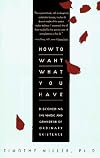
This is one of my all time favorite books. Every time I read it I come away feeling positive and uplifted. The author T. Miller helps his readers to get a clear understanding of what it takes to be content. According to Miller it's not our obsessive drive for more that will lead to happiness, instead he explains that a simple shift in our thoughts can bring us lasting peace of mind. Miller advocates Compassion, Attention and Gratitude as a means of achieving true happiness. As the saying show more goes "If you look at what you have you will always have enough. If you look at what you don't have you will never have enough." It's certainly not rocket science but it's a principle that is easily forgotten by most of us. The author provides plenty of thought provoking examples and helps the reader learn how to change his way of looking at life. I frequently reread this book and it always provides me with a new perspective. Definitely a must read! show less

A secular, cognitive-therapy approach to Buddhist philosophy - sensible, ethical balance between compassion and pragmatism. Miller does not write like a breathless New-Ager or a pop-psychology, self-help guru. His advice is excellent, however I much prefer his (out of print) first book, HOW TO WANT WHAT YOU HAVE: DISCOVERING THE MAGIC AND GRANDEUR OF ORDINARY EXISTENCE. The present workbook format is tiresome, and its text is written at a 6th grade level.
"Wanting what you have is a simple show more slogan that reflects a deep and challenging goal. The methods I suggest for wanting what you have revolve around three fundamental principles: Compassion, Attention, and Gratitude. I deliberately modeled the practice of Compassion, Attention, and Gratitude after modern methods of cognitive psychotherapy....
"... philosophers and religious teachers of old would have been more successful if they had known about modern cognitive methods for psychotherapy and self-help. Until recently, psychotherapeutic change was a murky and mysterious business, and so was spiritual growth. Self-help was often trendy, but its value was widely doubted....
"Twenty-five years of careful scientific research have shown that these nine statements are true for almost anyone:
"1. Many upsetting thoughts and beliefs are simply bad habits....
"2. Certain thoughts and beliefs can cause serious emotional problems such as depression and anxiety....
"3. Habits of thought can be critically examined....
"4. Habits of thought can be disputed....
"5. Old and harmful habits of thought can be replaced by new constructive ones....
"6. New habits of thought enable new habits of speech and behavior, and new choices....
"7. Once the desired new habits of thought are clear, changes in habitual speech and behavior can support the new habits of thought....
"8. Understanding the historical origins of a harmful belief can be worthwhile, but isn't absolutely necessary for success....
"9. The most reliable and effective way to relieve problems such as depression, anger, and anxiety is to alter harmful habits of thought...." [pp. 5-7]
"The goal of wanting what you have is much broader than the goal of psychotherapy, which is primarily to treat symptoms and relieve suffering. The goals of wanting what you have are: greater enjoyment of life and the people around us; greater serenity about disappointments, losses, and misfortunes; more kindness and empathy for the people around us, and less blame and judgement; a more ethical and environmentally responsible way of life; and greater appreciation for life's depth." [pg. 9] show less
"Wanting what you have is a simple show more slogan that reflects a deep and challenging goal. The methods I suggest for wanting what you have revolve around three fundamental principles: Compassion, Attention, and Gratitude. I deliberately modeled the practice of Compassion, Attention, and Gratitude after modern methods of cognitive psychotherapy....
"... philosophers and religious teachers of old would have been more successful if they had known about modern cognitive methods for psychotherapy and self-help. Until recently, psychotherapeutic change was a murky and mysterious business, and so was spiritual growth. Self-help was often trendy, but its value was widely doubted....
"Twenty-five years of careful scientific research have shown that these nine statements are true for almost anyone:
"1. Many upsetting thoughts and beliefs are simply bad habits....
"2. Certain thoughts and beliefs can cause serious emotional problems such as depression and anxiety....
"3. Habits of thought can be critically examined....
"4. Habits of thought can be disputed....
"5. Old and harmful habits of thought can be replaced by new constructive ones....
"6. New habits of thought enable new habits of speech and behavior, and new choices....
"7. Once the desired new habits of thought are clear, changes in habitual speech and behavior can support the new habits of thought....
"8. Understanding the historical origins of a harmful belief can be worthwhile, but isn't absolutely necessary for success....
"9. The most reliable and effective way to relieve problems such as depression, anger, and anxiety is to alter harmful habits of thought...." [pp. 5-7]
"The goal of wanting what you have is much broader than the goal of psychotherapy, which is primarily to treat symptoms and relieve suffering. The goals of wanting what you have are: greater enjoyment of life and the people around us; greater serenity about disappointments, losses, and misfortunes; more kindness and empathy for the people around us, and less blame and judgement; a more ethical and environmentally responsible way of life; and greater appreciation for life's depth." [pg. 9] show less
Lists
You May Also Like


Statistics
- Works
- 2
- Members
- 211
- Popularity
- #105,255
- Rating
- 4.2
- Reviews
- 2
- ISBNs
- 62
- Languages
- 3