
A. M. Homes
Author of This Book Will Save Your Life
About the Author
A. M. Homes is a contributing editor at Vanity Fair.
Image credit: Credit: David Shankbone, Sept. 2007
Works by A. M. Homes
Do Not Disturb [short story] 3 copies
Georgica [short story] 2 copies
A Real Doll [short story] 1 copy
[Title missing] 1 copy
Lost Weekend 1 copy
The Whiz Kids [short story] 1 copy
Slumber Party [short story] 1 copy
Jum Train [short story] 1 copy
The I of It [short story] 1 copy
Yours Truly [short story] 1 copy
Chunky in Heat [short story] 1 copy
Adults Alone [short story] 1 copy
Remedy [short story] 1 copy
Associated Works
Writers on Writing, 2: More Collected Essays from the New York Times (2003) — Contributor — 201 copies, 3 reviews
This Is My Best: Great Writers Share Their Favorite Work (2004) — Contributor — 175 copies, 3 reviews
Know the Past, Find the Future: The New York Public Library at 100 (2011) — Contributor — 133 copies, 4 reviews
The Worst Years of Your Life: Stories for the Geeked-Out, Angst-Ridden, Lust-Addled, and Deeply Misunderstood Adolescent in All of Us (2007) — Contributor — 94 copies, 1 review
Queer: A Collection of LGBTQ Writing from Ancient Times to Yesterday (2021) — Contributor, some editions — 66 copies
All the Ways Home: Parenting and Children in the Lesbian and Gay Communities - A Collection of Short Fiction (Lita) (1995) — Contributor — 55 copies, 1 review
Another Girl Another Planet: March 23 to April 17, 1999 — Contributor — 3 copies
Tagged
Common Knowledge
- Canonical name
- Homes, A. M.
- Legal name
- Homes, Amy Michael
- Other names
- Homes, Amy M.
- Birthdate
- 1961-12-18
- Gender
- female
- Education
- American University
Sarah Lawrence College (BA | 1985)
University of Iowa (MFA | 1988) - Occupations
- fiction writer
memoirist
screenwriter
teacher - Awards and honors
- Benjamin Franklin Award
National Endowment for the Arts fellowship
New York Foundation for the Arts Artists fellowship
New York Public Library. Cullman Center for Scholars and Writers fellowship
Guggenheim Foundation fellowship (1998) - Short biography
- A.M. Homes is a contributing editor at Vanity Fair and has published fiction and essays in The New Yorker, Harpers, McSweeny's and the New York Times. She lives in New York City. [from The Mistress's Daughter (2007)
- Nationality
- USA
- Birthplace
- Washington, D.C., USA
- Places of residence
- Washington, D.C., USA
New York, New York, USA - Associated Place (for map)
- USA
Members
Reviews
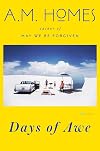
The twelve stories herein run the gamut from the peculiar to the extreme, but each shows the hand of a fine craftsperson at work and some exhibit moments of pure comic genius. Unsurprisingly for readers of Homes’ novels or previous short stories, the situations in which these stories take place border on the absurd. A good example is the lyrical but eerie, “Your Mother Was a Fish,” or the possibly apocalyptic, “Omega Point.” There are also recurring locales that Homes uses with show more skewering insight, such as the overly bright hills above Los Angeles. Equally Homesian is the story based around an experimental technique — such as the transcript of a chat room or when two characters role-play through the voices of other characters (real or imaginary).
Undoubtedly the best of these stories is the title story, “Days of Awe,” set at a conference on Genocide(S). All of Homes’ numerous strengths as a writer come to the fore there. And it’s also very funny! But I would be remiss if I didn’t also single out the two linked (though independent) stories that share a common set of characters, “Hello Everybody,” and, “She Got Away.” Priceless.
Recommended. show less
Undoubtedly the best of these stories is the title story, “Days of Awe,” set at a conference on Genocide(S). All of Homes’ numerous strengths as a writer come to the fore there. And it’s also very funny! But I would be remiss if I didn’t also single out the two linked (though independent) stories that share a common set of characters, “Hello Everybody,” and, “She Got Away.” Priceless.
Recommended. show less

Believe the hype: this is a deeply disturbing novel. And yet, Homes handles the subject matter (namely, pedophilia) with dexterity; she neither sensationalizes nor glosses over the gravity of the characters' past and present actions. Undoubtedly, The End of Alice is going to offend (or scandalize or rile) plenty of would-be readers, but I wouldn't toss it aside just because of its content. It's a highly uncomfortable yet strangely engrossing read.

A.M. Homes is a bastard. Literally, archaically speaking, she is. It's the kind of no-nonsense, bullshitless, provocative line A.M. Homes might have invoked about herself: "I am a bastard". I say it with the utmost homage and in admiration of Homes' raw transparency, so well chronicled in her memoir, The Mistress's Daughter. A.M. Homes' bio-mom got knocked-up at seventeen. Her bio-dad was a married man of then only meager entrepreneurial means (though by the time A.M. Homes finally met him show more thirty-three years after "fathering" her, he was quite well-to-do); a half-man/half-boy atrophied in his pathetic football adolescence, yet with a real doll of a society wife and four no doubt charming kids standing by his philandering side. Know that the bio-dad—in essence, little more than a spoonful of ejaculate—is the real fucking bastard of this sad, though adoption-affirming, inspiring as it is shocking, true tale.
Until reading A.M. Homes' (she's "Amy" here on out) magnificent memoir—a treatise of sorts on the trials of familial injustice—I viewed her wrongly as being like the preeminent shock-jock of contemporary U.S. literature. Like Howard Stern's highbrow sidekick, had such a sidekick existed. I viewed Amy that way because I had no idea where the grotesque satire of her short stories (which is all I'd ever read by her) was coming from. I knew she'd been adopted, but I had no real conception of how powerful were the psychic forces at work on her life and in her writing, first unleashed on Christmas Eve, 1992, when her adoptive mother, the only mother she'd ever known, informed her that their adoption attorney had called them out of the blue, having himself been contacted by Amy's biological mother, who requested that the adoption attorney have it communicated to Amy that, if Amy wanted to, it would be okay for Amy to contact her, the bio-mom. The adoption attorney complicated matters by contacting Amy's adoptive-mom with the news rather than Amy directly. WTF? was Amy's initial reaction to everything and everyone involved in this bombshell. Amy's life, as she'd known it up to then, was over. Not over for the worse entirely. But it would feel like the worse for her in a lot of fundamental ways for many years until she was able to see her bio-mom for the irreparably wounded woman she was; for the woman who never recovered from the exploitation and abandonment of her sickeningly narcissistic, summer-house-in-the-Hamptons, bio-dad, the coward who'd had her as that young piece of ass and then tossed her like so much used porn alongside the road. Amy Homes was thirty-one that Christmas Eve, on the cusp of discovering over the next fourteen years who she was, what she was made of, and perhaps more importantly, who she wasn't, what she wasn't made of.
"It's one of the pathological complications of adoption—adoptees don't really have rights, their lives are about supporting the secrets, the needs and desires of others."
As an adoptive parent myself, I am helped a lot in understanding many of the frustrations and fears potentially faced by my adopted kids, gleaned from reading so much practical wisdom (like what's quoted above—thank you, Amy!) even though none are yet adults, nor been sought after, so far, by persons of their biological beginnings.
What a phenomenal memoir, The Mistress's Daughter. It's as uncomfortably honest and unflinching as any I've ever read. Whatever fresh yet refined outrage emerges in Amy's telling, I know now—no matter what that crackpot critic with her Pulitzer Prize, Michiko Kakutani, ever spews in ignorance, misperception, personal bias or outright lies, about the artistic aspirations of A.M. Homes—is not driven by a desire to shock just for sensationalistic shocking's-sake (though shock you she will assuming you're human and not some vindictive robot writing book reviews for The New York Times—and that—no matter how desensitized you are to cruelty and hypocrisy), but to reveal the appalling truth and nothing but the appalling truth, Your Honor; the hardcore galling truth of her long-suffering journey to Identity; to some semblance of Acceptance after surviving the primal hells of the most heartless parental rejections; to a place of Peace after legal wrangling and threat of war, compelling her at all hours through a country of mothers, fathers, and other relative strangers on the internet, and landing her ultimately in an idyllic home with a garden on Long Island—near her adoptive roots and the nourishing memories of her "grandiloquent" adoptive grandmother—where A.M. Homes can breathe and just be again. show less
Until reading A.M. Homes' (she's "Amy" here on out) magnificent memoir—a treatise of sorts on the trials of familial injustice—I viewed her wrongly as being like the preeminent shock-jock of contemporary U.S. literature. Like Howard Stern's highbrow sidekick, had such a sidekick existed. I viewed Amy that way because I had no idea where the grotesque satire of her short stories (which is all I'd ever read by her) was coming from. I knew she'd been adopted, but I had no real conception of how powerful were the psychic forces at work on her life and in her writing, first unleashed on Christmas Eve, 1992, when her adoptive mother, the only mother she'd ever known, informed her that their adoption attorney had called them out of the blue, having himself been contacted by Amy's biological mother, who requested that the adoption attorney have it communicated to Amy that, if Amy wanted to, it would be okay for Amy to contact her, the bio-mom. The adoption attorney complicated matters by contacting Amy's adoptive-mom with the news rather than Amy directly. WTF? was Amy's initial reaction to everything and everyone involved in this bombshell. Amy's life, as she'd known it up to then, was over. Not over for the worse entirely. But it would feel like the worse for her in a lot of fundamental ways for many years until she was able to see her bio-mom for the irreparably wounded woman she was; for the woman who never recovered from the exploitation and abandonment of her sickeningly narcissistic, summer-house-in-the-Hamptons, bio-dad, the coward who'd had her as that young piece of ass and then tossed her like so much used porn alongside the road. Amy Homes was thirty-one that Christmas Eve, on the cusp of discovering over the next fourteen years who she was, what she was made of, and perhaps more importantly, who she wasn't, what she wasn't made of.
"It's one of the pathological complications of adoption—adoptees don't really have rights, their lives are about supporting the secrets, the needs and desires of others."
As an adoptive parent myself, I am helped a lot in understanding many of the frustrations and fears potentially faced by my adopted kids, gleaned from reading so much practical wisdom (like what's quoted above—thank you, Amy!) even though none are yet adults, nor been sought after, so far, by persons of their biological beginnings.
What a phenomenal memoir, The Mistress's Daughter. It's as uncomfortably honest and unflinching as any I've ever read. Whatever fresh yet refined outrage emerges in Amy's telling, I know now—no matter what that crackpot critic with her Pulitzer Prize, Michiko Kakutani, ever spews in ignorance, misperception, personal bias or outright lies, about the artistic aspirations of A.M. Homes—is not driven by a desire to shock just for sensationalistic shocking's-sake (though shock you she will assuming you're human and not some vindictive robot writing book reviews for The New York Times—and that—no matter how desensitized you are to cruelty and hypocrisy), but to reveal the appalling truth and nothing but the appalling truth, Your Honor; the hardcore galling truth of her long-suffering journey to Identity; to some semblance of Acceptance after surviving the primal hells of the most heartless parental rejections; to a place of Peace after legal wrangling and threat of war, compelling her at all hours through a country of mothers, fathers, and other relative strangers on the internet, and landing her ultimately in an idyllic home with a garden on Long Island—near her adoptive roots and the nourishing memories of her "grandiloquent" adoptive grandmother—where A.M. Homes can breathe and just be again. show less

Change comes in a variety of forms. The rarest, because it is usually virtuous and permanent, is the change a person chooses to make as a result of a realisation followed by a decision, for instance not to drink as much booze, or to eat many cup cakes, or to dedicate quite so much energy to levelling up and instead read a book occasionally. More usually, change arises as a result of a reaction to external events. Intervention change is very popular. Rule of thumb, if you get home and you are show more greeted by your dog wagging its tail with unconditional love, you can expect to go for a walk, have a beer, watch some telly and go to bed. If you get home and you are greeted with a room full of friends and family who begin the conversation with a declaration of their love for you (note not unconditional) then you had better develop a liking for orange juice, because chances are you are going to be drinking a shitload of it in future. Intervention change is so popular that it's become a television format, usually involving a host with a health related qualification from an educational establishment that only exists on the Internet confronting some poor sod with their weekly consumption of cheeseburgers, or porn (OK I made that last one up but that's the show I want to see, the amount of porn some poor pale bloke views on the web printed out in hard copy and used to stock a newsagent's shelves. Or a warehouse). And of course their is sudden change, either subtle or catastrophic, that is forced upon one and can be the result of years of smoking, a moment's inattention at your lathe, or an out-of-character unprovoked act of rage against some public art, or busker, as they are also known. How we deal with change is a mark of our character.
Change is in the wind for Harry, the protagonist in A. M. Homes's 'May we be forgiven'. Harry is not so much subject to the winds of change, but a full on blizzard of change, being a wind of change that snowballs.
Change is needed. Harry is unfulfilled and is just beginning to realise that his marriage is not successful and his job, if gauged by how interested his students are in his teaching, is frankly crap. Harry lacks the energy to do anything about this, but that's alright because his life is about to be dramatically changed for him. What begins with an apparent accident leads him to making some truly bad decisions and his life first falling apart and then arguably coming together in a wholly unexpected way that leaves him changed forever.
Family and relationships are at the centre of the novel. It's Harry's bullying younger brother whose car accident (or was it?) precipitates a tectonic shift in Harry's life and sees him go from married man to (in an unexpected but not wholly unbelievable twist) suburban sex-toy, from remote uncle to caring parent and from lacklustre teacher to scholar. All this and becoming a responsible pet-owner too.
It's a funny book, although at times the humour is found in some pretty dark places.
It's also surprisingly random and covers a lot of themes and issues. Although some ideas, like Harry's brother being released into the wild instead of banged up in prison, don't work so well, there's enough ideas and material in here for half a dozen novels, about middle aged people using the Internet to hook up for sex, and the consequences of this, about private education and its privileges and perils, about the relationship between monied America and poor America and between monied America and the developing world, about family and commitment and growing old.
The novel is, like Harry, deeply rooted in suburbia. It stresses the importance of home and family, is critical of boarding schools but chillingly acknowledges their occasional necessity, and is clear that the best place for children (of all ages) is in the home, not so that they can be watched over, but so that they can keep wayward adults on the straight and narrow. show less
Change is in the wind for Harry, the protagonist in A. M. Homes's 'May we be forgiven'. Harry is not so much subject to the winds of change, but a full on blizzard of change, being a wind of change that snowballs.
Change is needed. Harry is unfulfilled and is just beginning to realise that his marriage is not successful and his job, if gauged by how interested his students are in his teaching, is frankly crap. Harry lacks the energy to do anything about this, but that's alright because his life is about to be dramatically changed for him. What begins with an apparent accident leads him to making some truly bad decisions and his life first falling apart and then arguably coming together in a wholly unexpected way that leaves him changed forever.
Family and relationships are at the centre of the novel. It's Harry's bullying younger brother whose car accident (or was it?) precipitates a tectonic shift in Harry's life and sees him go from married man to (in an unexpected but not wholly unbelievable twist) suburban sex-toy, from remote uncle to caring parent and from lacklustre teacher to scholar. All this and becoming a responsible pet-owner too.
It's a funny book, although at times the humour is found in some pretty dark places.
It's also surprisingly random and covers a lot of themes and issues. Although some ideas, like Harry's brother being released into the wild instead of banged up in prison, don't work so well, there's enough ideas and material in here for half a dozen novels, about middle aged people using the Internet to hook up for sex, and the consequences of this, about private education and its privileges and perils, about the relationship between monied America and poor America and between monied America and the developing world, about family and commitment and growing old.
The novel is, like Harry, deeply rooted in suburbia. It stresses the importance of home and family, is critical of boarding schools but chillingly acknowledges their occasional necessity, and is clear that the best place for children (of all ages) is in the home, not so that they can be watched over, but so that they can keep wayward adults on the straight and narrow. show less
Lists
Awards


You May Also Like


Associated Authors
Statistics
- Works
- 43
- Also by
- 31
- Members
- 8,422
- Popularity
- #2,859
- Rating
- 3.7
- Reviews
- 265
- ISBNs
- 261
- Languages
- 12
- Favorited
- 37

