
Alec Ross (2) (1971–)
Author of The Industries of the Future
For other authors named Alec Ross, see the disambiguation page.
About the Author
Alec Ross is one of America's leadinq experts on innovation. He has been an entrepreneur, helped lead technology policy efforts for two presidential campaigns, and served for four years as Senior Advisor for Innovation to the Secretary of Stale. He is currently a Distinguished Visiting Fellow at show more Johns Hopkins University and serves as an advisor to CEOs and government leaders. JM Ross lives in Baltimore with his wife and their three children. show less
Image credit: from author's webpage
Works by Alec Ross
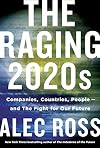
The Raging 2020s: Companies, Countries, People - and the Fight for Our Future (2021) 52 copies, 12 reviews
Tagged
Common Knowledge
- Canonical name
- Ross, Alec
- Legal name
- Ross, Alec
- Birthdate
- 1971-11-30
- Gender
- male
- Education
- Northwestern University (BA)
- Organizations
- Democratic Party
- Nationality
- USA
- Birthplace
- Charleston, West Virginia, USA
- Map Location
- USA
Members
Reviews
"I remember being at a party in Davos during the World Economic Forum, held in the chalet of a billionaire," says Alec Ross in The Raging 2020s (38), and it's from that point of view that he writes his book. As Ross exults, with the fall of the Soviet Union, "capitalism had won" (32), so while Ross wrings his hands over insulin costing hundreds of times more in the USA than it does elsewhere, he's generally pretty happy with the status quo; he just thinks things need to be re-regulated a show more bit. What we have now isn't capitalism, Ross laments, because capitalism benefits everyone (22). (I know, right?) Ross never uses the word "neoliberalism" to describe the concentration of wealth in the hands of an elite few because he's generally for it; he just wishes it didn't look so bad. So what you get here is a moderate Democrat's take (which elsewhere in the world would be a center-right take) on our economic-political situation in which "Walmart should serve as a model for the rest of the private sector" because they now carry concentrated detergents (51) and Amazon gladly sacrifices money in favor of bravely defending its employees' rights (38-9). If you're happy with Walmart, Amazon, and ameliorative reforms, then Ross, his ideas, & his book are for you. If not, check out the books at Versobooks.com. Verso is, as their website says, "the largest independent, radical publishing house in the English-speaking world" and you'll find lots of books that look at Chicago school economics and neoliberalism from a much more interesting, sophisticated, and activist standpoint. (I swear I'm not on staff.)
You might also want to look at Wendy Brown's "Undoing the Demos: Neoliberalism's Stealth Revolution" and/or Quinn Slobodian's "Globalists: The End of Empire and the Birth of Neoliberalism." For slightly less dense reading, check out Guy Standing's "The Precariat: The New Dangerous Class."
After thinking a bit, I can see how this would be a good book to hand to economic conservatives. It doesn't challenge their world-view overmuch but could educate them on the series of crises their policies have pushed us towards. There are lots of examples, clearly (if not completely) related in story-like form so it's easy for dissenting readers to take in & maybe have their minds changed. show less
You might also want to look at Wendy Brown's "Undoing the Demos: Neoliberalism's Stealth Revolution" and/or Quinn Slobodian's "Globalists: The End of Empire and the Birth of Neoliberalism." For slightly less dense reading, check out Guy Standing's "The Precariat: The New Dangerous Class."
After thinking a bit, I can see how this would be a good book to hand to economic conservatives. It doesn't challenge their world-view overmuch but could educate them on the series of crises their policies have pushed us towards. There are lots of examples, clearly (if not completely) related in story-like form so it's easy for dissenting readers to take in & maybe have their minds changed. show less
 This review was written for LibraryThing Early Reviewers.
Ross throws out a number of interesting ideas for a "reform" of American – and ultimately "world" capitalism – but it reached a point where I became a bit skeptical.
First, for the interesting ideas.
Sorry. Ross has a lot of interesting ideas, but somehow neolib (and neocon) ideas turn too often into blowing up other peoples' countries. Ross's attitude toward Assad is just one more example of why Americans should stop trying to be the "great white hope" of the world and start a bit more minding our own business.
That said, I'm rating this book 3½***, considerably higher than the majority of the other Early Reviewers who have already posted their reviews. Ross has some very good critiques of American capitalism and some very good suggestions for reform, and I suspect that this book is going to be quite popular for review and discussion in the mainstream media book-review sections once it's released in September. I'm just a bit skeptical that Ross's fellow neolib Clintonites can implement the ideas that Ross is suggesting, and I've got a concern that his plans for implementation could rely so much on a corporate "high tech" elite as to produce a serious populist backlash in the U.S., along with serious anti-trust violations. No, children, high-tech globalism is not a healthy environment for you and other sentient creatures!
As for myself, I consider myself a "left libertarian" – a staunch Tulsicrat (as in Tulsi Gabbard) who finds Bernie Sanders acceptable if not ideal and who's skeptical of neolib programmes. But do read Ross's book, because it's stimulating and deserves to be judged for itself, not for my own political views. show less
First, for the interesting ideas.
- "Shareholder" capitalism needs to be replaced with "stakeholder" capitalism. When the interests of the corporate shareholders reign supreme everything reduces itself to the least common denominator, no matter how well intentioned corporate management might be, because any threat to
- shareholder interests leads to stock-market losses which invite hostile takeovers. How to achieve a "stakeholder" capitalism? Ross suggests that ideologically advanced (my phrase, not his) corporate managers could work together but will need to enlist the support of elected politicians so that the same "stakeholder" rules will apply to at least the largest business entities.
- Eliminate stock buy-backs. They are wasteful of capital which could be better expended on R&D. (This seems to me to be the easiest to accomplish of Ross's goals, although its effects might be correspondingly more limited.)
- Change the system of corporate taxation. It's too easy for globalist corporations (especially tech and pharma, where intellectual property rights represent a large portion of assets) to create multiple affiliates (Google, for example, is actually "owned" by Alphabet Inc) whereby the locus of corporate profits can be "profit shifted" to low-tax jurisdictions, internationally and even from state to state within the U.S. Adopt a system of "unitary taxation" and "formulary apportionment" by which the super-globalist "holding company" (Alphabet Inc) will be taxed and some system of international agreements will provide just what portion of that company's profits will be taxed by each national entity. Good luck!
Sorry. Ross has a lot of interesting ideas, but somehow neolib (and neocon) ideas turn too often into blowing up other peoples' countries. Ross's attitude toward Assad is just one more example of why Americans should stop trying to be the "great white hope" of the world and start a bit more minding our own business.
That said, I'm rating this book 3½***, considerably higher than the majority of the other Early Reviewers who have already posted their reviews. Ross has some very good critiques of American capitalism and some very good suggestions for reform, and I suspect that this book is going to be quite popular for review and discussion in the mainstream media book-review sections once it's released in September. I'm just a bit skeptical that Ross's fellow neolib Clintonites can implement the ideas that Ross is suggesting, and I've got a concern that his plans for implementation could rely so much on a corporate "high tech" elite as to produce a serious populist backlash in the U.S., along with serious anti-trust violations. No, children, high-tech globalism is not a healthy environment for you and other sentient creatures!
As for myself, I consider myself a "left libertarian" – a staunch Tulsicrat (as in Tulsi Gabbard) who finds Bernie Sanders acceptable if not ideal and who's skeptical of neolib programmes. But do read Ross's book, because it's stimulating and deserves to be judged for itself, not for my own political views. show less
This review was written for LibraryThing Early Reviewers.Somewhere around three quarters through this book, it occurred to me that it was such a useful evaluation of prevalent politico-economic systems that it was a shame to anchor the title so distinctly to the 2020’s. Then I realized that its main point is that right now we’re at a critical point of choosing which inflection will determine our future. Capitalism and government are working differently, having moved on from the classic models conventional wisdom presumes. Combined with a tidal show more wave of ecological change and the acceleration of technology, we truly are at a collective decision point that could mean continued progression for all people or vast misery for all but the most fortunate. This book is worth reading right now, to inform the dialogue we all need to have. show less
This review was written for LibraryThing Early Reviewers.Start building the guillotines! In this books Mr. Ross describes in detail how most (if not all) international companies hide all their income and pay almost no taxes. Also, how governments, denied of this massive wealth, continue to lose power to the rich and how poorer countries are especially hurt by this.
He talks about how "stockholder primacy" has caused corporations to do whatever it takes to make sure their stockholders make the most amount of money, regardless of how that effect show more their workers and the communities those workers work in.
He talks about how authoritarian countries like China have an advantage over democracies because they can move quickly to change things, without having to worry about checks and balances.
He talks about northern European countries like Finland, Scandanavia and others having huge taxes but extremely happy people because they know they will be taken care of by the system if they "fall", but also says this is made easier by the homogeneity of their culture.
It's not all gloom and doom, but oh my god it is really depressing to see how money controls everything and the rich are just getting away with so much as the poor grind themselves down. He gives hope with solutions that are being worked on to prevent corporations from hiding all their profits and rich people hiding all their assets, but it will mean many countries working together and the big ones like the US and UK have much to lose. Basically, if we don't change the way things work, disaster is ahead. show less
He talks about how "stockholder primacy" has caused corporations to do whatever it takes to make sure their stockholders make the most amount of money, regardless of how that effect show more their workers and the communities those workers work in.
He talks about how authoritarian countries like China have an advantage over democracies because they can move quickly to change things, without having to worry about checks and balances.
He talks about northern European countries like Finland, Scandanavia and others having huge taxes but extremely happy people because they know they will be taken care of by the system if they "fall", but also says this is made easier by the homogeneity of their culture.
It's not all gloom and doom, but oh my god it is really depressing to see how money controls everything and the rich are just getting away with so much as the poor grind themselves down. He gives hope with solutions that are being worked on to prevent corporations from hiding all their profits and rich people hiding all their assets, but it will mean many countries working together and the big ones like the US and UK have much to lose. Basically, if we don't change the way things work, disaster is ahead. show less
Awards

You May Also Like


Statistics
- Works
- 2
- Members
- 478
- Popularity
- #51,586
- Rating
- 3.5
- Reviews
- 23
- ISBNs
- 33
- Languages
- 4
