
Merle Johnson (1874–1935)
Author of The Book of Pirates (Dover Children's Classics)
About the Author
Works by Merle Johnson
The Book of Pirates (Dover Children's Classics) (1921) — Compiler; Compiler, some editions — 422 copies, 8 reviews
Merle Johnson's American First Editions: Bibliographic Check Lists of the Works of 199 American Authors (1936) 15 copies, 1 review
A bibliographic check-list of the works of James Branch Cabell, 1904-1921 (1921) — Compiler — 8 copies
You Know These Lines! A Bibliography of the Most Quoted Verses in American Poetry (1935) 4 copies, 1 review
Associated Works
Tagged
Common Knowledge
- Legal name
- Johnson, Merle De Vore
- Birthdate
- 1874
- Date of death
- 1935
- Gender
- male
- Occupations
- bibliographer
book collector
illustrator
Members
Reviews
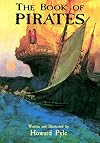
The Book of Pirates by Howard Pyle is a collection of illustrations and stories that were published separately in various magazines and books. These stories — sometimes recitations of historical facts and other times fanciful tales — are entertaining and beautifully illustrated. I can imagine little boys (and girls, for that matter) loving these tales and using them as jumping-off points for their own imaginations. Certainly there is something oddly appealing about pirates and their show more ill-gotten treasures.
Many of the stories have to do with ordinary people getting involved in pirates' affairs, like the young boy who (with the help of the local parson) discovers where Captain Kidd buried his treasure. I liked the one about the young Quaker, Jonathan Rugg, who accidentally kills three pirates while protecting the treasure of a pirate's daughter. When she offers Jonathan her father's treasure along with herself, he politely declines, saying that he is engaged and so is "not at all at liberty to consider my inclinations in any other direction." Such an understated sense of fun! But Quakers aren't always so virtuous. In "Captain Scarfield," Pyle tells about a one pirate's double life as both a strict Quaker leader and a feared buccaneer.
What struck me most about this collection is Pyle's justification for telling stories about pirates and their evil deeds. Pyle was a Quaker (like several of his characters) and it's interesting that he should be so fascinated with evil men. He writes:
Why is it that a little spice of deviltry lends not an unpleasantly titillating twang to the great mass of respectable flour that goes to make up the pudding of our modern civilization? And pertinent to this question another—Why is it that the pirate has, and always has had, a certain lurid glamour of the heroical enveloping him round about? Is there, deep under the accumulated debris of culture, a hidden groundwork of the old-time savage? Is there even in these well-regulated times an unsubdued nature in the respectable mental household of every one of us that still kicks against the pricks of law and order? ... Courage and daring, no matter how mad and ungodly, have always a redundancy of vim and life to recommend them to the nether man that lies within us, and no doubt his desperate courage, his battle against the tremendous odds of all the civilized world of law and order, have had much to do in making a popular hero of our friend of the black flag.
And later:
Such is a brief and bald account of the most famous of these pirates... And such is that black chapter of history of the past—an evil chapter, lurid with cruelty and suffering, stained with blood and smoke. Yet it is a written chapter, and it must be read. He who chooses may read betwixt the lines of history this great truth: Evil itself is an instrument toward the shaping of good. Therefore the history of evil as well as the history of good should be read, considered, and digested.
Convincing, isn't he? The foreword (by Merle Johnson) says that Pyle is not generally remembered for his writing — his illustrations had a far more profound effect on American art — but I think little gems like these are worthy of their settings in his illustrations.
These stories would probably have been more enjoyable if I read them piecemeal rather than in one afternoon. As it is, I wouldn't heartily recommend this collection unless someone was looking specifically for children's literature on pirates. show less
Many of the stories have to do with ordinary people getting involved in pirates' affairs, like the young boy who (with the help of the local parson) discovers where Captain Kidd buried his treasure. I liked the one about the young Quaker, Jonathan Rugg, who accidentally kills three pirates while protecting the treasure of a pirate's daughter. When she offers Jonathan her father's treasure along with herself, he politely declines, saying that he is engaged and so is "not at all at liberty to consider my inclinations in any other direction." Such an understated sense of fun! But Quakers aren't always so virtuous. In "Captain Scarfield," Pyle tells about a one pirate's double life as both a strict Quaker leader and a feared buccaneer.
What struck me most about this collection is Pyle's justification for telling stories about pirates and their evil deeds. Pyle was a Quaker (like several of his characters) and it's interesting that he should be so fascinated with evil men. He writes:
Why is it that a little spice of deviltry lends not an unpleasantly titillating twang to the great mass of respectable flour that goes to make up the pudding of our modern civilization? And pertinent to this question another—Why is it that the pirate has, and always has had, a certain lurid glamour of the heroical enveloping him round about? Is there, deep under the accumulated debris of culture, a hidden groundwork of the old-time savage? Is there even in these well-regulated times an unsubdued nature in the respectable mental household of every one of us that still kicks against the pricks of law and order? ... Courage and daring, no matter how mad and ungodly, have always a redundancy of vim and life to recommend them to the nether man that lies within us, and no doubt his desperate courage, his battle against the tremendous odds of all the civilized world of law and order, have had much to do in making a popular hero of our friend of the black flag.
And later:
Such is a brief and bald account of the most famous of these pirates... And such is that black chapter of history of the past—an evil chapter, lurid with cruelty and suffering, stained with blood and smoke. Yet it is a written chapter, and it must be read. He who chooses may read betwixt the lines of history this great truth: Evil itself is an instrument toward the shaping of good. Therefore the history of evil as well as the history of good should be read, considered, and digested.
Convincing, isn't he? The foreword (by Merle Johnson) says that Pyle is not generally remembered for his writing — his illustrations had a far more profound effect on American art — but I think little gems like these are worthy of their settings in his illustrations.
These stories would probably have been more enjoyable if I read them piecemeal rather than in one afternoon. As it is, I wouldn't heartily recommend this collection unless someone was looking specifically for children's literature on pirates. show less

4700. You Know These Lines! A Bibliography of the Most Quoted Verses in American Poetry, by Merle Johnson (read 24 Apr 2010) This 1935 book lists 100 poems and quotes famous parts from them. It also minutely describes the books in which these poems first appeared--valuable information for book collectors but of no interest to me. I don't know if in 1935 people would all know the verses he cites, but there were some I did not know. But there were many I did know, and quite a few were to poems show more I memorized, namely: Annabel Lee; Antony and Cleopatra; Ballad of the Tempest; Barbara Frietchie; The Chambered Nautilus; Concord Hymn; Curfew Must Not Ring Tonight; I Have a Rendezvous With Death. Little Boy Blue; O Captain! My Captain!; Old Ironsides; A Psalm of Life; The Raven; Rock Me to Sleep; Sheridan's Ride; Somebody's Mother; To a Waterfowl; Trees; and The Village Blacksmith;. The book does not have these poems in full--only famed lines therefrom. But I think the full poems can be found online. Some of the poems did not appeal to me at all, such as James Whitcomb Riley's dialect poems, which I think are best forgotten, as is also true of some of Lowell's poems. This is a great book for all interested in famed American poetry. show less
Collected stories of pirates. Personally, listening to the audiobook was hard - it just sort of rambled about various pirate stories, some being good and some just blah. I have heard that the written book, with illustrations, is much more enjoyable. Hence it's a little unfair for me to even try and review - just take this review as an "audiobook only" review. I suspect reading this book and looking at the illustrations would be much more fun.
So dry & uninteresting. Give me a protagonist & some storytelling, please!!!!!! Would never recommend to a child.
Lists
You May Also Like
Associated Authors
Statistics
- Works
- 14
- Also by
- 4
- Members
- 464
- Popularity
- #53,000
- Rating
- 3.2
- Reviews
- 10
- ISBNs
- 74
- Languages
- 1