

Jon Stone (1) (1931–1997)
Author of The Monster at the End of This Book
For other authors named Jon Stone, see the disambiguation page.
Series
Works by Jon Stone
Sesame Street: Would You Like to Play HIDE & SEEK in This Book with Lovable, Furry Old Grover? (1976) 357 copies, 1 review
The Songs of Sesame Street in poems and pictures: Featuring Jim Henson's Sesame Street Muppets (1983) — author — 14 copies
Don't Eat the Pictures: Sesame Street at the Metropolitan Museum of Art [1983 TV movie] (1987) — Director — 5 copies
Sesame Street Double Feature: Elmo's Musical Adventure/Sing Yourself Silly! [DVD] (2012) — Director — 1 copy
Associated Works
Rocky Mountain Holiday with John Denver and The Muppets [1983 TV special] (1983) — Writer — 15 copies
Tagged
Common Knowledge
- Canonical name
- Stone, Jon
- Legal name
- Stone, Jon Arthur
- Birthdate
- 1931-04-13
- Date of death
- 1997-03-30
- Gender
- male
- Education
- Williams College (Music)
Yale University School of Drama (MA)
Pomfret School, Pomfret, Connecticut - Occupations
- writer
producer
director - Organizations
- Sesame Street
CBS
Captain Kangaroo
PBS - Relationships
- Owen, Beverley (ex-wife)
- Nationality
- USA
- Birthplace
- New Haven, Connecticut, USA
- Places of residence
- New York, New York, USA
- Place of death
- New York, New York, USA
- Burial location
- Cremated, ashes given to family or friend
- Associated Place (for map)
- USA
Members
Reviews
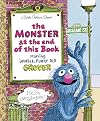
This book was hilarious. The entire time, the reader is warned not to turn the page, because there is a monster at the end. Each spread has a more elaborate scheme to prevent the reader from tuning the page. I can only imagine reading this to a child, and seeing the anticipation on their faces as to what the monster might be. Right at the end, the reader is warned that the monster is on the next page! Once the monster is discovered, I could not stop giggling. A very stress free book, that show more shows that sometime, the worst thing is in our imagination. show less
First sentence: What did that say? On the first page, what did that say? Did that say there will be a Monster at the end of this book? It did? Oh, I am so scared of Monsters!!!
Premise/plot: Grover does NOT, I repeat does NOT, want you to keep reading this book. Grover tries--but will he fail?!--to keep readers from turning pages. Is there really a monster at the end of the book?
My thoughts: This one is a classic for a reason. It is a FUN, DELIGHTFUL, SILLY read for parents to share with show more little ones. It is a great example of an again-again book--a book that almost begs you to read it again and again and again and again. Does one ever tire of Grover?
Text: 5 out of 5
Illustrations: 4 out of 5
Total: 9 out of 10 show less
Premise/plot: Grover does NOT, I repeat does NOT, want you to keep reading this book. Grover tries--but will he fail?!--to keep readers from turning pages. Is there really a monster at the end of the book?
My thoughts: This one is a classic for a reason. It is a FUN, DELIGHTFUL, SILLY read for parents to share with show more little ones. It is a great example of an again-again book--a book that almost begs you to read it again and again and again and again. Does one ever tire of Grover?
Text: 5 out of 5
Illustrations: 4 out of 5
Total: 9 out of 10 show less
In the first chapter (Or so we say – 21 propositions) of Simon Critchley’ s Things Merely Are, Proposition four states:
*“What then are poets for? In a time of dearth, they resist the pressure of reality, they press back against this oppressiveness with the power of imagination, producing felt variations in the appearance of things. Poetry enables us to feel differently, to see differently. It leavens a leaden time. This is poetry’s nobility, which is also a violence, an imaginative show more violence from within that protects us from the violence from without – violence against violence, then.”
I was having trouble trying to find the key to writing about this collection of poetry until reading the quote above, in the same book Critchley writes that “poetry reorders the order we find in things. It gives us things as they are, but beyond us”. He goes on to state that poetry give us an idea of order.
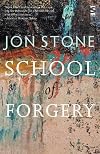
This makes sense as Stone creates his verse from the flotsam and jetsam of culture, from scraps of film and other poetics, crafting his language into works that, at the surface, shine like some glitter ball. It states on the inside cover that the School of Forgery, postulates the poem “as knock-off, as reclaimed scrap, and most of all as through-and-through fabrication” . This chimes with the idea of poet as artificer, of the world using their imagination to contrive a reality, to reorder the order found in things. The poet finds the words that allow us to see life as it is, anew & transfigured. It also states in the introduction that the School of Forgery principal teachings concern the volatile relationship between fakery and invention of which we all are alumni as is…
“the bandit boiled alive in a cauldron of oil. So are the perpetrators of hoaxes, the writers of pornographic Dōjinshi*, counterfeiters in love with their teachers and teens who dress up as birds to fight tyranny. Its professors proliferate. Its graduates excel in every field. Its campus is the world.”
This is Jon Stone’s first full-length collection and you get the impression of someone with a great knowledge of both pop culture and the arts, an individual who is as equally inspired by the works of Kenji Miyazawa as he is Arthur Rimbaud & can cherry- pick from either. Yet beneath all that artifice, beneath the games there is a candour that resonates, a passion that hooks you in past the word-bothering puzzles and clever facade, past the glitter-ball and the wizard of Oz contrivances, you find the poet, obsessed with language, and who has the ability to use it, not just as poetic gesture but with a depth, a strangeness and a beauty that beguiles.
The School of Forgery.
We’re doing Ernst this term – corkboard,
collage, gouache on card, “beyond painting”.
But all I want from Mrs W is Mrs W.
I’ve practised for months her husband’s hand,
almost finished the letter he was too wooden
with shame to write himself when he was twenty.
I’ll slip the envelope’s blanched almond tongue
into the just-open mouth of her marking drawer,
listen for her slight cry when she comes to it,
sweet as juice-pearl unwinding from a glass’s rim,
huge, to me, as the eye of The Fugitive
or one of those petrified cities under moonlight.
Then to perfect his body, its itch and scrawl.
His lurch for the knur-and-spell of her knees.
His leer for her waist’s gay lavolt.
Poetry Book Society Recommendation
School of Forgery saunters into the treasure-filled territories between original and derivative, fabricated and found, real and imagined. Here, through the medium of translations, travesties, knock-offs, collages and impersonations, through wrong-footing, fluid forms and wild tales, the slipperiness of language and identity is revealed for what it is.
http://parrishlantern.blogspot.co.uk/2012/09/school-of-forgeryjon-stone.html show less
*“What then are poets for? In a time of dearth, they resist the pressure of reality, they press back against this oppressiveness with the power of imagination, producing felt variations in the appearance of things. Poetry enables us to feel differently, to see differently. It leavens a leaden time. This is poetry’s nobility, which is also a violence, an imaginative show more violence from within that protects us from the violence from without – violence against violence, then.”
I was having trouble trying to find the key to writing about this collection of poetry until reading the quote above, in the same book Critchley writes that “poetry reorders the order we find in things. It gives us things as they are, but beyond us”. He goes on to state that poetry give us an idea of order.
This makes sense as Stone creates his verse from the flotsam and jetsam of culture, from scraps of film and other poetics, crafting his language into works that, at the surface, shine like some glitter ball. It states on the inside cover that the School of Forgery, postulates the poem “as knock-off, as reclaimed scrap, and most of all as through-and-through fabrication” . This chimes with the idea of poet as artificer, of the world using their imagination to contrive a reality, to reorder the order found in things. The poet finds the words that allow us to see life as it is, anew & transfigured. It also states in the introduction that the School of Forgery principal teachings concern the volatile relationship between fakery and invention of which we all are alumni as is…
“the bandit boiled alive in a cauldron of oil. So are the perpetrators of hoaxes, the writers of pornographic Dōjinshi*, counterfeiters in love with their teachers and teens who dress up as birds to fight tyranny. Its professors proliferate. Its graduates excel in every field. Its campus is the world.”
This is Jon Stone’s first full-length collection and you get the impression of someone with a great knowledge of both pop culture and the arts, an individual who is as equally inspired by the works of Kenji Miyazawa as he is Arthur Rimbaud & can cherry- pick from either. Yet beneath all that artifice, beneath the games there is a candour that resonates, a passion that hooks you in past the word-bothering puzzles and clever facade, past the glitter-ball and the wizard of Oz contrivances, you find the poet, obsessed with language, and who has the ability to use it, not just as poetic gesture but with a depth, a strangeness and a beauty that beguiles.
The School of Forgery.
We’re doing Ernst this term – corkboard,
collage, gouache on card, “beyond painting”.
But all I want from Mrs W is Mrs W.
I’ve practised for months her husband’s hand,
almost finished the letter he was too wooden
with shame to write himself when he was twenty.
I’ll slip the envelope’s blanched almond tongue
into the just-open mouth of her marking drawer,
listen for her slight cry when she comes to it,
sweet as juice-pearl unwinding from a glass’s rim,
huge, to me, as the eye of The Fugitive
or one of those petrified cities under moonlight.
Then to perfect his body, its itch and scrawl.
His lurch for the knur-and-spell of her knees.
His leer for her waist’s gay lavolt.
Poetry Book Society Recommendation
School of Forgery saunters into the treasure-filled territories between original and derivative, fabricated and found, real and imagined. Here, through the medium of translations, travesties, knock-offs, collages and impersonations, through wrong-footing, fluid forms and wild tales, the slipperiness of language and identity is revealed for what it is.
http://parrishlantern.blogspot.co.uk/2012/09/school-of-forgeryjon-stone.html show less
I read a lot. A. Lot.
This book is why. I, along with at least half of my senior class, have fond memories of going to our local library story time to hear the librarian (who I am lucky enough to also be able to claim as my Aunt) read this story book to us.
If you have not heard her read it, I'm sorry. You are missing out on something spectacular. The story is silly, of course. Grover freaks out about the monster at the end of the book and attempts to stop you from turning the page by trying show more to seal the pages shut. Even if you read this book with no infliction, it is amusing. If you really do it right though, read it with spirit and gusto, you will probably send your listener off on an adventure through the pages of numerous books and stories. It will give them a lifetime to explore the world in print.
This book made me love reading. This book literally changed my life. And while it sounds ridiculous to say that about a Sesame Street book when there are so many epic, great works of art out there, it is absolutely true for not only myself but many others from our small town. We, the class of 95, would talk about going to hear Kitty Wood read this book when we were kids. We would talk about how awesome the story was and how epic Kitty's version of it was. I would get jealous looks because they knew she was my aunt and they knew good and well I got extra readings of the story we all loved so much at home.
And I'm happy to say I did. ;) show less
This book is why. I, along with at least half of my senior class, have fond memories of going to our local library story time to hear the librarian (who I am lucky enough to also be able to claim as my Aunt) read this story book to us.
If you have not heard her read it, I'm sorry. You are missing out on something spectacular. The story is silly, of course. Grover freaks out about the monster at the end of the book and attempts to stop you from turning the page by trying show more to seal the pages shut. Even if you read this book with no infliction, it is amusing. If you really do it right though, read it with spirit and gusto, you will probably send your listener off on an adventure through the pages of numerous books and stories. It will give them a lifetime to explore the world in print.
This book made me love reading. This book literally changed my life. And while it sounds ridiculous to say that about a Sesame Street book when there are so many epic, great works of art out there, it is absolutely true for not only myself but many others from our small town. We, the class of 95, would talk about going to hear Kitty Wood read this book when we were kids. We would talk about how awesome the story was and how epic Kitty's version of it was. I would get jealous looks because they knew she was my aunt and they knew good and well I got extra readings of the story we all loved so much at home.
And I'm happy to say I did. ;) show less
Lists
Awards


You May Also Like


Associated Authors
Statistics
- Works
- 36
- Also by
- 4
- Members
- 8,585
- Popularity
- #2,803
- Rating
- 4.4
- Reviews
- 125
- ISBNs
- 120
- Languages
- 3
- Favorited
- 1