
Jeffrey M. Schwartz
Author of The Mind and the Brain: Neuroplasticity and the Power of Mental Force
About the Author
Jeffrey M. Schwartz M. D. is a psychiatrist and researcher in neuroplasticity and its connection to obeseeive-compulsive disorder. He is a believer in mind/body dualism and feels that science and religion should not be separated. Dr. Schwartz coined the term Brain Lock to describe show more obsessive-compulsive behavior and the treatment plan he formulated and wrote about in his book Brain Lock: Free Yourself from Obsessive-Compulsive Behavior. In his book Schwartz claims that obsessive-compulsive disorders (OCD) are a result of a bio-chemical imbalance where brain functions will get "locked" in an obsessive-compulsive pattern and that OCD can be self-treated by following four steps. His book outlines these steps as Relabel, Reattribute, Refocus and Revalue. His other books include The mind and the brain: Neuroplasticity and the power of mental force and You Are Not Your Brain: The 4-Step Solution for Changing Bad Habits, Ending Unhealthy Thinking, and Taking Control of Your Life. (Bowker Author Biography) show less
Works by Jeffrey M. Schwartz
Associated Works
The View from Within: First-Person Approaches to the Study of Consciousness (1999) — Contributor, some editions — 60 copies
Tagged
Common Knowledge
- Gender
- male
Members
Reviews
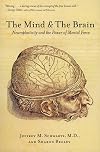
Jeffrey Schwartz, M.D., with help from the talented Sharon Begley, has written a sort of masterpiece exploring the mind's effect on the brain. He restores volition as agent in what has been predominantly a materialistic reduction in the explanation of the mind.
In this terrific book, he explores how history has reduced the view to mainly one that states that the mind arises solely and deterministically from the biological functioning of the brain.
What is particularly fascinating is his show more assertion that this view is wrong - that the mind, to a great exent, actually "creates the brain" - which he supports by his own well-known work with helping (and studying) patients with Obsessive Compulsive Disorder (OCD), as well as related work by other imminent researchers, such as Michael Merzenich, Edward Taub, and many others. He indicates that OCD is particularly valuable to studying the mind and brain, because OCD sufferers are cognizant of the faulty nature of their obsessions and compulsions, even if unable to control them.
Hence, there is an opportunity to study what appears, at first, as a mind/brain dichotomy in OCD sufferers, and Schwartz has helped patients use their "independent observer" (mindfulness) ability to build mindful awareness and attention in a four step program to re-label, re-attribute, re-focus, and revalue to overcome their disorder and actually physically change their brains. Volition in choosing what what pays attention to is what effects the change, and is, according to the great American psychologist William James, an essentially moral act. The mind and brain appear to be both separate and united at once.
There is brief periodic mention of Buddhist prescient observations about much of what neuroscience is now discovering - many parallels can be noted.
Schwartz explains how he and physicist Henry Stapp have collaborated to theorize how quantum physics explains the probabilistic window of opportunity in which volition and attention can act to change the brain.
It is somewhat difficult to do justice to, and accurately explain, the concepts in this book in a short review, because the book itself carefully builds in a way that I cannot do in a few sentences. I therefore recommend that one read this very interesting book! show less
In this terrific book, he explores how history has reduced the view to mainly one that states that the mind arises solely and deterministically from the biological functioning of the brain.
What is particularly fascinating is his show more assertion that this view is wrong - that the mind, to a great exent, actually "creates the brain" - which he supports by his own well-known work with helping (and studying) patients with Obsessive Compulsive Disorder (OCD), as well as related work by other imminent researchers, such as Michael Merzenich, Edward Taub, and many others. He indicates that OCD is particularly valuable to studying the mind and brain, because OCD sufferers are cognizant of the faulty nature of their obsessions and compulsions, even if unable to control them.
Hence, there is an opportunity to study what appears, at first, as a mind/brain dichotomy in OCD sufferers, and Schwartz has helped patients use their "independent observer" (mindfulness) ability to build mindful awareness and attention in a four step program to re-label, re-attribute, re-focus, and revalue to overcome their disorder and actually physically change their brains. Volition in choosing what what pays attention to is what effects the change, and is, according to the great American psychologist William James, an essentially moral act. The mind and brain appear to be both separate and united at once.
There is brief periodic mention of Buddhist prescient observations about much of what neuroscience is now discovering - many parallels can be noted.
Schwartz explains how he and physicist Henry Stapp have collaborated to theorize how quantum physics explains the probabilistic window of opportunity in which volition and attention can act to change the brain.
It is somewhat difficult to do justice to, and accurately explain, the concepts in this book in a short review, because the book itself carefully builds in a way that I cannot do in a few sentences. I therefore recommend that one read this very interesting book! show less
You Are Not Your Brain: The 4-Step Solution for Changing Bad Habits, Ending Unhealthy Thinking, and Taking Control of Your Life by Jeffrey M. Schwartz
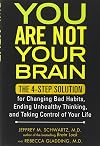
I've been on a neurology kick, and picked this up at the library based on the credentials of the author. I thought it would not be a typical self-help book, even though the cover sure looked like one. I should have turned it over and noticed that one of the blurbs on the back was from Leonardo DiCaprio, noted neurology researcher, I mean movie actor.
I guess that was a good example of a deceptive brain message, because this is a self-help manual with all the smarmy examples one might imagine. show more Abby thinks too much! Sarah is depressed! Let's examine their behaviour at length.
The death knell, for me, was the part where the authors explain, briefly, the neurology behind a certain response, then in essence dismissively say that you needn't bother your pretty little head- here's a perfect example:
"Collectively, you can think of the amygdala, insula, and anterior cingulate as the warning center of the brain, or what we like to call the Uh-Oh Center." Uh-oh, indeed.
This book didn't work for me (not that I applied it to any of my bad habits, I mean I didn't like it) and I can't recommend it unless you like dumbed-down science wrapped up in magazine-article style examples of people just like you only with no bad habits!!!!1! show less
I guess that was a good example of a deceptive brain message, because this is a self-help manual with all the smarmy examples one might imagine. show more Abby thinks too much! Sarah is depressed! Let's examine their behaviour at length.
The death knell, for me, was the part where the authors explain, briefly, the neurology behind a certain response, then in essence dismissively say that you needn't bother your pretty little head- here's a perfect example:
"Collectively, you can think of the amygdala, insula, and anterior cingulate as the warning center of the brain, or what we like to call the Uh-Oh Center." Uh-oh, indeed.
This book didn't work for me (not that I applied it to any of my bad habits, I mean I didn't like it) and I can't recommend it unless you like dumbed-down science wrapped up in magazine-article style examples of people just like you only with no bad habits!!!!1! show less
You Are Not Your Brain: The 4-Step Solution for Changing Bad Habits, Ending Unhealthy Thinking, and Taking Control of Your Life by Jeffrey M. Schwartz
Mindfulness For Dummies!
A very helpful book that illustrates exactly how to get rid of bad habits through mindfulness-based cognitive behavioral therapy. The accessibility of the writing is both the strength and weakness of the book as it makes it easy for anyone (especially the distressed demographic the book is aimed at) to get comprehend and begin applying the '4 steps' to their lives immediately, but will also inevitably leave some people feeling patronized as a result of seeing brain show more parts such as the hypothalamus and hippocampus be renamed as the 'Uh Oh Center' and 'habit center' respectively. That's not to say the science isn't there, as the author(s) made sure to give a fairly concise explanation on how neuroplasticity works, from the initial stimulus to the quantum zeno effect, to form habits. It's just represented in a very layman, self-help way (which, again, is probably for the best considering the book's audience).
Another thing I liked about the book is that it sort of serves as an all-in-one self-help book by taking relevant excerpts and lessons from other self-help books and presenting them in a summarized fashion, such as the importance of having meaning in life in Frankl's best selling book: Man's Search for Meaning, or the 5 A's from Feeling Good. I'd like to end by saying that I'm obviously a little biased here, since I'm kind of feeling fantastic after having applied the knowledge presented in this book to my life. I'd recommend this to anyone looking to make use of mindfulness to get rid of and incorporate certain habits. For those looking for a more in depth approach to neuroplasticity however, I'd look more towards The Brain That Changes Itself, or perhaps Shwartz's other book on the mind and the brain. show less
A very helpful book that illustrates exactly how to get rid of bad habits through mindfulness-based cognitive behavioral therapy. The accessibility of the writing is both the strength and weakness of the book as it makes it easy for anyone (especially the distressed demographic the book is aimed at) to get comprehend and begin applying the '4 steps' to their lives immediately, but will also inevitably leave some people feeling patronized as a result of seeing brain show more parts such as the hypothalamus and hippocampus be renamed as the 'Uh Oh Center' and 'habit center' respectively. That's not to say the science isn't there, as the author(s) made sure to give a fairly concise explanation on how neuroplasticity works, from the initial stimulus to the quantum zeno effect, to form habits. It's just represented in a very layman, self-help way (which, again, is probably for the best considering the book's audience).
Another thing I liked about the book is that it sort of serves as an all-in-one self-help book by taking relevant excerpts and lessons from other self-help books and presenting them in a summarized fashion, such as the importance of having meaning in life in Frankl's best selling book: Man's Search for Meaning, or the 5 A's from Feeling Good. I'd like to end by saying that I'm obviously a little biased here, since I'm kind of feeling fantastic after having applied the knowledge presented in this book to my life. I'd recommend this to anyone looking to make use of mindfulness to get rid of and incorporate certain habits. For those looking for a more in depth approach to neuroplasticity however, I'd look more towards The Brain That Changes Itself, or perhaps Shwartz's other book on the mind and the brain. show less
You are not your brain : the 4-step solution for ending destructive behavior, changing bad habits, and taking control of your life by Jeffrey M. Schwartz
This book was a real disappointment. There's nothing new here, just the same old advice wrapped in the flag of neuroscience. The neuroplasticity information is accurate, but has little to do with the advice and procedures contained in the book. This is very reminiscent of faith-based advice books, substituting a pseudo-scientific "wise advocate" for the god of your choice.
Not really worth the time spent reading it.
Not really worth the time spent reading it.
Lists
You May Also Like


Associated Authors
Statistics
- Works
- 6
- Also by
- 1
- Members
- 1,448
- Popularity
- #17,748
- Rating
- 3.8
- Reviews
- 21
- ISBNs
- 30
- Languages
- 2