
Maria Campbell (1) (1940–)
Author of Halfbreed
For other authors named Maria Campbell, see the disambiguation page.
Works by Maria Campbell
Associated Works
Tagged
Common Knowledge
- Birthdate
- 1940
- Gender
- female
- Occupations
- activist (Aboriginal rights and the rights of women)
filmmaker
broadcaster
writer-in-residence
academic
elder - Organizations
- Women’s Halfway House (founder)
Women and Children’s Emergency Crisis Centre (founder) - Awards and honors
- Order of Canada (2008)
Distinguished Canadian Award (2006)
Saskatchewan Order of Merit (2006)
National Aboriginal Achievement Award (1995)
Honorary Doctorate, Athabasca University (2000)
Honorary Doctorate, York University (1992) (show all 8)
Honorary Doctorate, University of Regina (1985)
Molson Prize (2004) - Short biography
- Maria Campbell, OC is a Métis author, playwright, broadcaster, filmmaker, and Elder. Born in northern Saskatchewan in 1940, Campbell is a fluent speaker of four languages: Cree, Michif, Saulteaux, and English. Her first book was the memoir Halfbreed (1973), which continues to be taught in schools across Canada, and which continues to inspire generations of indigenous women and men. Four of her published works have been published in eight countries and translated into four other languages (German, Chinese, French, Italian). She has written and/or directed films by the National Film Board of Canada (NFB) and Canadian Broadcasting Corporation (CBC), including My Partners My People, which aired on CTV for 3 years. She is coordinator and member of Sage Ensemble, a community theatre group for Aboriginal elders, and is actively associated with the Saskatchewan Native Theatre Company in Saskatoon. In addition to her work in the arts, Maria is a volunteer, activist and advocate for Aboriginal rights and the rights of women. She was a founder of the first Women’s Halfway House and the first Women and Children’s Emergency Crisis Centre in Edmonton. She has worked with Aboriginal youths in community theatre; set up food and housing co-ops; facilitated women’s circles; advocated for the hiring and recognition of Native people in the arts, and mentored many indigenous artists working in all forms of the arts. Maria sits as an Elder on the Saskatchewan Aboriginal Justice Commission, and is a member of the Grandmothers for Justice Society. Academically, she has focussed on teaching Metis history and Methods in Oral Tradition Research. She has worked as a researcher, meeting with elders to gather and record oral historical evidence of many aspects of aboriginal traditional knowledge, including medical and dietary as well as spiritual, social, and general cultural practises.
- Nationality
- Canada
- Associated Place (for map)
- Canada
Members
Reviews

Maria Campbell's "Halfbreed" tells her life story growing up as a Métis woman in northern Saskatchewan and the legacy of colonialism on her own psyche, that of her family and her community at large. The narrative starts with her childhood and goes up to 1966, as Native organizations work to address the legacy of colonialism in Canada. This work provides a fascinating memoir of Campbell's life and family, and how a Métis woman percieved events around her in the 40s-60s. This 1973 work is a show more fantastic foundational piece of Indigenous - and specifically, Métis - literature. I highly recommend it to anyone interested in Métis social history and life. show less
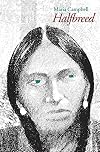
Maria Campbell is a Métis activist, author, playwright, and more. You can read about many of her accomplishments and important works on her Goodreads page.
Knowing about her accomplishments makes this memoir an interesting read--today's reader knows what the author herself did not yet know when this was first published in 1973. In this book she describes her childhood as the oldest child in her family. Poor but happy, their lives went downhill when her father lost his job and then her mother show more passed away. She tried to keep the family together as her dad worked, or drank, and she tried to attend school while doing the cooking and cleaning and childminding It didn't work. Marrying young as another way to keep them together, it also doesn't work. She has several children, moves around, is abandoned by her husband, discovers alcohol and drugs, holds various illegal jobs, and finally makes it back to see her grandmother and father and most of her siblings. She can't believe her people's situation seems even worse.
Campbell illustrates her struggles and readily admits to her failures, and you can see what she has learned, and how she matures. He frustration, shame, fear, and anger are palpable.
She also begins work that will lead to her later successes. She describes the supports for Native women that she thinks should exist. She herself later succeeded in establishing such supports.
I found the writing a little awkward, but this book is not about the writing. It's about a community that was (and still is) poorly treated and struggling, and about how one woman fought her way out of her early struggles to begin the career she had dreamed of. Though she mentions possibly writing another volume, I am not sure she has (yet?). Because it is time! show less
Knowing about her accomplishments makes this memoir an interesting read--today's reader knows what the author herself did not yet know when this was first published in 1973. In this book she describes her childhood as the oldest child in her family. Poor but happy, their lives went downhill when her father lost his job and then her mother show more passed away. She tried to keep the family together as her dad worked, or drank, and she tried to attend school while doing the cooking and cleaning and childminding It didn't work. Marrying young as another way to keep them together, it also doesn't work. She has several children, moves around, is abandoned by her husband, discovers alcohol and drugs, holds various illegal jobs, and finally makes it back to see her grandmother and father and most of her siblings. She can't believe her people's situation seems even worse.
Campbell illustrates her struggles and readily admits to her failures, and you can see what she has learned, and how she matures. He frustration, shame, fear, and anger are palpable.
She also begins work that will lead to her later successes. She describes the supports for Native women that she thinks should exist. She herself later succeeded in establishing such supports.
I found the writing a little awkward, but this book is not about the writing. It's about a community that was (and still is) poorly treated and struggling, and about how one woman fought her way out of her early struggles to begin the career she had dreamed of. Though she mentions possibly writing another volume, I am not sure she has (yet?). Because it is time! show less
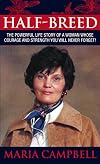
Very insightful on the psychological effects of being considered second class people. A very different legacy came down in part of my Missouri family. From the 1850s, leaving her culture behind, the sliver of Native DNA that came down was seen as pride. Little left by the time it reached me, only got 3% DNA according to National Geographic’s Genographic Project.
So the bigotry Ms Campbell describes is distressing. We must stand tall and shake off all preconceptions.
So the bigotry Ms Campbell describes is distressing. We must stand tall and shake off all preconceptions.
A deeply harrowing book. Campbell's direct, simple style conveys the intensity of her experiences without self-pity or drama.
I found this terribly difficult to read. I suspect it has permanently changed my understanding of native and Métis issues. I wouldn't say I was surprised by the life she relates, though I did learn many new things about our government's treatment of the first nations community, but everything was brought home to me viscerally, with a new intensity.
I found this terribly difficult to read. I suspect it has permanently changed my understanding of native and Métis issues. I wouldn't say I was surprised by the life she relates, though I did learn many new things about our government's treatment of the first nations community, but everything was brought home to me viscerally, with a new intensity.
Lists
Awards

You May Also Like


Associated Authors
Statistics
- Works
- 8
- Also by
- 7
- Members
- 482
- Popularity
- #51,207
- Rating
- 4.0
- Reviews
- 8
- ISBNs
- 33
- Languages
- 3
