
Joseph Boyden
Author of Three Day Road
About the Author
Joseph Boyden is a novelist and short story writer. His first novel, Three Day Road won the Amazon/Books in Canada First Novel Award and the Rogers Writers' Trust Fiction Prize. His second novel, Through Black Spruce, won the 2008 Scotiabank Giller Prize. Of Irish, Scottish and Anishinaabe show more heritage, Boyden writes about First Nations heritage and culture. He studied creative writing at York University and the University of New Orleans, and taught in the Aboriginal Student Program at Northern College. He is currently a Lecturer with the UBC Creative Writing Program. (Bowker Author Biography) show less
Image credit: Photo by Nigel Beale / Flickr
Series
Works by Joseph Boyden
Associated Works
Dreaming in Indian: Contemporary Native American Voices (2016) — Contributor — 217 copies, 15 reviews
Tagged
Common Knowledge
- Birthdate
- 1966-10-31
- Gender
- male
- Education
- York University (Creative Writing)
Unviersity of New Orleans - Occupations
- novelist
lecturer (Creative Writing)
short story writer - Organizations
- University of British Columbia
- Awards and honors
- Doctor of Letters, Honoris Causa, from Nipissing University (2009)
Honorary Degree from Algoma University (2013) - Agent
- Simonoff, Eric
- Relationships
- Boyden, Amanda (wife)
- Nationality
- Canada
- Birthplace
- Willowdale, Ontario, Canada
- Places of residence
- Toronto, Ontario, Canada
New Orleans, Louisiana, USA
Northern Ontario, Canada - Map Location
- Canada
Members
Reviews
The more I read and see about World War I the more I wonder how those men managed to survive the conditions they faced. I get miserable if my feet get wet on the way home from work and I have to squelch in my shoes for a few blocks. They lived in cold water for weeks on end and then were expected to make their way through mud and decaying bodies to face almost certain annihilation.
This story of two Ojibwe men from northern Ontario who join up to fight in the war is not an easy read. I had show more to read it in small bites but in a few hours I couldn't resist picking it up again to read just a bit more. Xavier Bird and Elijah Whiskeyjack are unforgettable characters but Xavier's aunt, Niska, is the true star of the book I think. It is she that rescued both of them from the residential school. She taught them how to hunt and survive which made them "successful" in the war. And her spirit guides Xavier when he faces dilemmas overseas and when he comes back home missing a leg and addicted to morphine. show less
This story of two Ojibwe men from northern Ontario who join up to fight in the war is not an easy read. I had show more to read it in small bites but in a few hours I couldn't resist picking it up again to read just a bit more. Xavier Bird and Elijah Whiskeyjack are unforgettable characters but Xavier's aunt, Niska, is the true star of the book I think. It is she that rescued both of them from the residential school. She taught them how to hunt and survive which made them "successful" in the war. And her spirit guides Xavier when he faces dilemmas overseas and when he comes back home missing a leg and addicted to morphine. show less

"The world must change, though. This is no secret. Things cannot stay the same for long. With each baby girl born into her longhouse and her clan, with each old man's death feast and burial in the ossuary, new worlds are build as old ones fall apart. And sometimes, this change we speak of happens right under our noses, in tiny increments, without our noticing. By then, though, oh, by then it's simply too late" (153).
The Orenda is a novel about the change that occurs when worlds collide.
The show more initial collision is between the Huron and the Iroquois people. At war for years, the latest child-kidnapping has sparked a conflict that threatens to destroy one of them. The second and more subtle collision is between the Jesuit missionaries and the First Nations people. The diseases they bring to the new world along with their determined proselytizing change life forever.
I was grateful for the honestly with which Boyden portrayed the players in his drama. I half expected a story about how the "noble savage" fell to the corrupting influences of Imperialist forces in the form of greedy missionaries. No such simplistic tropes exist here. Boyden's researched portrayal of Huron-Iroquois warfare is stomach-curdling in its violence. The Jesuits, while certainly confused by the culture, are portrayed with a steadfast (if misguided) devotion.
This clash of cultures is best explained by one of my favourite scenes in the book. Crow (the Huron name for a Jesuit missionary) has decided that if he can only bring his prospective convert to kiss the crucifix he will make major strides towards the conversion of the village. Snow Falls (the potential convert) awakens to see in Crow's crucifix the fallen body of her murdered father. She assumes that Crow is trying to steal her soul next.
This story is what happens when worldviews crash. It's honest, violent, and heroic. show less
The Orenda is a novel about the change that occurs when worlds collide.
The show more initial collision is between the Huron and the Iroquois people. At war for years, the latest child-kidnapping has sparked a conflict that threatens to destroy one of them. The second and more subtle collision is between the Jesuit missionaries and the First Nations people. The diseases they bring to the new world along with their determined proselytizing change life forever.
I was grateful for the honestly with which Boyden portrayed the players in his drama. I half expected a story about how the "noble savage" fell to the corrupting influences of Imperialist forces in the form of greedy missionaries. No such simplistic tropes exist here. Boyden's researched portrayal of Huron-Iroquois warfare is stomach-curdling in its violence. The Jesuits, while certainly confused by the culture, are portrayed with a steadfast (if misguided) devotion.
This clash of cultures is best explained by one of my favourite scenes in the book. Crow (the Huron name for a Jesuit missionary) has decided that if he can only bring his prospective convert to kiss the crucifix he will make major strides towards the conversion of the village. Snow Falls (the potential convert) awakens to see in Crow's crucifix the fallen body of her murdered father. She assumes that Crow is trying to steal her soul next.
This story is what happens when worldviews crash. It's honest, violent, and heroic. show less

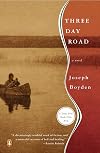
Xavier Bird and Elijah Weeageechak were two young Cree boys, removed from a residential school to live with Xavier's aunt, Niska, a medicine woman who lived in the bush following the old traditions. Boyden's story was inspired in part by real-life aboriginal WWI heroes Francis Pegahmagabow and John Shiwak. The title refers to those about to die having to walk the Three Day Road. Xavier is travelling his Three Day Road back to his home in Northern Ontario while Niska tells stories to heal him show more as she paddles the canoe. Xavier's memories of the war are interwoven with Niska's stories. In this way the reader gets to know their history, the Cree lifestyle, and the horrors Xavier and Elijah experienced at Ypres, the Somme, and Passchendaele. Boyden has given this book a depth and passion not often seen in fiction as the reader becomes deeply immersed with the characters, their lives and the cultural differences. This is a powerful story that is worthy of the accolades it garnered. Its breathtaking prose is all the more impressive for a debut novel. show less
As WWI ends, a mystic/healer of the First Nations Cree canoes three days to the town where her nephew, whom she raised, is returning after years as a sniper for the Canadian Army fighting in Europe. He is badly injured: one leg missing, addicted to morphine with his supply running out, and almost dead of starvation. Her hope is to get him home to "the bush" and to heal him. During their trip the nephew hallucinates the story of his years at war, while his aunt tells him stories of their show more tribe and of their individual upbringings, hoping to ground him in this life before he slips over to the next. These two voices alternate, and the tales they tell are a rich look at life at war, the Canadian Indian experience, and the love between close family members. I was blown away at the depth of this book. It's not a quick read because it's almost all description, but it's well worth the time. The title refers to the time it takes the soul of a dead person to reach its destination. Very highly recommended! show less
Lists
Awards


You May Also Like


Associated Authors
Statistics
- Works
- 10
- Also by
- 5
- Members
- 4,914
- Popularity
- #5,110
- Rating
- 4.1
- Reviews
- 215
- ISBNs
- 99
- Languages
- 7
- Favorited
- 21
