
Gene Brucker (1924–2017)
Author of Renaissance Florence
About the Author
Works by Gene Brucker
Associated Works
Tagged
Common Knowledge
- Legal name
- Brucker, Gene Adam
- Birthdate
- 1924-10-15
- Date of death
- 2017-07-09
- Gender
- male
- Education
- University of Illinois (B.A. ∙ 1946 ∙ M.A. ∙ 1948)
Wadham College, Oxford (B.Litt. ∙ 1950)
Princeton University (Ph.D|1954) - Occupations
- art historian
university professor - Organizations
- University of California, Berkeley
Renaissance Society of America - Awards and honors
- Fellow of the Medieval Academy of America (1978)
Rhodes Scholarship (1948-1950)
Fullbright Scholarship (1952-54)
Guggenheim Fellowship (1960-61)
Visiting Fellow, Institute for Advanced Study at Princeton (1968-69)
Fellow, American Academy of Arts and Sciences (1980) (show all 8)
Phi Beta Kappa
Paul Oskar Kristeller Lifetime Achievement Award (2000) - Nationality
- USA (birth)
- Birthplace
- Cropsey, Illinois, USA
- Places of residence
- Illinois, USA
Florence, Italy
Berkeley, California, USA - Place of death
- Emeryville, California, USA
- Associated Place (for map)
- USA
Members
Reviews

In 1455, in Florence, Lusanna di Benedetto, a widow of the artisanal class, brought suit against the noble, Giovanni della Casa, attempting to prove that he had secretly married her, and that, therefore, his publicly celebrated marriage to another was bigamous.
Professor Brucker has taken the simple records of this lawsuit and has used them as the framework for a short, but information-packed, account of Florentine society in the 14th-century. This story of a woman who challenged class and show more hierarchy in order to protect her reputation and prove the legitimacy of her marriage has a great deal to teach us about the legal process of the time, the interplay and tension between civil and church authority, the relationship between social classes, gender norms, and, of course, marriage laws and customs. This book shows Brucker as not only a scholar, but a story-teller, one who can turn the dry papers of the law courts into a fascinating human narrative. In particular, he brings Lusanna and Giovanni to life. We can almost feel what they felt, and understand how their upbringing, social positions and expectations brought them, first, together, and then into conflict. I was, frankly, surprised to find how much I had learned from a book of slightly over 100 pages!
As one who believes that one of the great disadvantages of closed stacks and internet search engines is the minimized opportunity for digression and serendipitous finds, I was delighted to read that this book was the result of Professor Brucker's fascination with a story that he came across while doing research into another matter at the Florentine State Archives. Indeed, he temporarily abandoned that research to concentrate on this story. A man after my own heart! show less
Professor Brucker has taken the simple records of this lawsuit and has used them as the framework for a short, but information-packed, account of Florentine society in the 14th-century. This story of a woman who challenged class and show more hierarchy in order to protect her reputation and prove the legitimacy of her marriage has a great deal to teach us about the legal process of the time, the interplay and tension between civil and church authority, the relationship between social classes, gender norms, and, of course, marriage laws and customs. This book shows Brucker as not only a scholar, but a story-teller, one who can turn the dry papers of the law courts into a fascinating human narrative. In particular, he brings Lusanna and Giovanni to life. We can almost feel what they felt, and understand how their upbringing, social positions and expectations brought them, first, together, and then into conflict. I was, frankly, surprised to find how much I had learned from a book of slightly over 100 pages!
As one who believes that one of the great disadvantages of closed stacks and internet search engines is the minimized opportunity for digression and serendipitous finds, I was delighted to read that this book was the result of Professor Brucker's fascination with a story that he came across while doing research into another matter at the Florentine State Archives. Indeed, he temporarily abandoned that research to concentrate on this story. A man after my own heart! show less
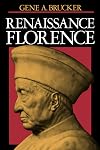
Renaissance Florence is a solid and very readable synthesis of one of the great cities. Drawing on post-war scholarship, and his own PhD work in the archivio de stato, Brucker describes the city in terms of its daily life, dipping through personal letters, business ledgers, and official pronouncements to render the proud and industrious people of Florence at a time when they were the leading city in Europe.
Renaissance Florence was a densely packed urban warren. The city's wealth came from show more mastery of cloth manufacture, which became the foundation of a European mercantile and banking network. Social life was defined by dense ties between classes, ranging from living on the same street, to rents and patronage, to the complexities of the largely unincorporated laborers and farmers, to the twenty one official guilds and their control of public offices, to the wealthy magnate families who dominated the apex of power but were officially banned from office. It's a complex web who's form shifted a lot over the nearly 200 years covered by the book, but out of this arose the scholarship and artistic creativity that birthed the renaissance. Conversely, the 14th century was also a dark time for the city, marked by the Black Death, recurrent war, and economic stagnation. It's odd that this period, in many ways objectively less prosperous than the ones that preceded and followed it, came to be the Renaissance.
Brucker has a keen awareness for social history, and for the ways in which his sources are representative or unrepresentative of their larger community. He gently chides Marxists for trying to fit the Florentines into a strictly orthodox structure of revolutionary classes, while maintaining an awareness of how birth defined the largely conservative order of his subjects world. This book would make a great major text for a undergraduate class focused on Renaissance Florence, supported by some context for the world and a few chosen primary sources. The biggest strike against it is that published in 1969, it's old, and I'm not sure what new scholarship has revealed. show less
Renaissance Florence was a densely packed urban warren. The city's wealth came from show more mastery of cloth manufacture, which became the foundation of a European mercantile and banking network. Social life was defined by dense ties between classes, ranging from living on the same street, to rents and patronage, to the complexities of the largely unincorporated laborers and farmers, to the twenty one official guilds and their control of public offices, to the wealthy magnate families who dominated the apex of power but were officially banned from office. It's a complex web who's form shifted a lot over the nearly 200 years covered by the book, but out of this arose the scholarship and artistic creativity that birthed the renaissance. Conversely, the 14th century was also a dark time for the city, marked by the Black Death, recurrent war, and economic stagnation. It's odd that this period, in many ways objectively less prosperous than the ones that preceded and followed it, came to be the Renaissance.
Brucker has a keen awareness for social history, and for the ways in which his sources are representative or unrepresentative of their larger community. He gently chides Marxists for trying to fit the Florentines into a strictly orthodox structure of revolutionary classes, while maintaining an awareness of how birth defined the largely conservative order of his subjects world. This book would make a great major text for a undergraduate class focused on Renaissance Florence, supported by some context for the world and a few chosen primary sources. The biggest strike against it is that published in 1969, it's old, and I'm not sure what new scholarship has revealed. show less
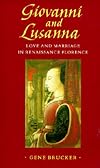
A serendipitous find in the Florentine archives offers us a glimpse of a tumultuous relationship between an upper class banker and a middle class widow of the 15th century, micro history at its best. While the barren (and at first married) Lusanna was an attractive lover for Giovanni Della Casa, the equation changed when it turned to perpetuating a dynasty. The fallout of this change and the resulting canonical lawsuit highlights both gender and social relations in Renaissance show more Florence.
Overall, a great case and a lucky find that ultimately does not attain the gold standard set by Natalie Zemon Davis in The Return of Martin Guerre. Having told his story, Brucker does not dig deep enough in his analysis of the different power relations, leaving much of the interpretation to the reader. show less
Overall, a great case and a lucky find that ultimately does not attain the gold standard set by Natalie Zemon Davis in The Return of Martin Guerre. Having told his story, Brucker does not dig deep enough in his analysis of the different power relations, leaving much of the interpretation to the reader. show less
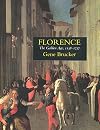
After reading Mary McCarthy’s The Stones of Florence, I decided that I wanted to read a more straightforward history of the city. I picked this book based on the Amazon reviews, but never expected a coffee table-type book, albeit with a paper cover. Lavishly illustrated, The Golden Age of Florence covers the city from the initial stages of the Renaissance to its end. Florence was a turbulent city, sometimes ruled by a group of nobility, sometimes by its guilds, and eventually by the show more Medici. The city faced as much danger from its own internal squabbles as it did from its external enemies. Yet, despite this, the city experience unprecedented economic , industrial, and artistic development , producing some of the finest wool in Europe along with Dante, Machiavelli, Michelangelo, Botticelli, among so many.
This book does a fine job of telling this story, not just the politics, but the economics and the various arts. It is a general overview, not meant to be a scholarly work. The writing is designed to bring the reader to the Florence during its Golden Age, drawing interesting portraits of all the relevant characters. I grew somewhat frustrated with the lack of connection between one event to another. Savonarola somehow sneaked up, took over the city, and died as a heretic, with no real explanation of who he was and how he came to take on such a role. Although the book itself only covers a 600 year period of time, an appendix in the back does have a brief synopsis of historical events starting from its founding and ending with the rule by the Austrians. The illustrations in the book are arranged in categories, so each page centers not on the text itself, though it may be related, but on the general theme. The author has selected drawings from manuscripts, photographs of sculptures and buildings, and representations of paintings.
Despite any quibbles mentioned, I highly recommend the book for anyone who wants to learn a general overview of the history of Florence illustrated with some of the finest works of art that man has ever produced. show less
This book does a fine job of telling this story, not just the politics, but the economics and the various arts. It is a general overview, not meant to be a scholarly work. The writing is designed to bring the reader to the Florence during its Golden Age, drawing interesting portraits of all the relevant characters. I grew somewhat frustrated with the lack of connection between one event to another. Savonarola somehow sneaked up, took over the city, and died as a heretic, with no real explanation of who he was and how he came to take on such a role. Although the book itself only covers a 600 year period of time, an appendix in the back does have a brief synopsis of historical events starting from its founding and ending with the rule by the Austrians. The illustrations in the book are arranged in categories, so each page centers not on the text itself, though it may be related, but on the general theme. The author has selected drawings from manuscripts, photographs of sculptures and buildings, and representations of paintings.
Despite any quibbles mentioned, I highly recommend the book for anyone who wants to learn a general overview of the history of Florence illustrated with some of the finest works of art that man has ever produced. show less
Awards


You May Also Like


Associated Authors
Statistics
- Works
- 19
- Also by
- 2
- Members
- 1,058
- Popularity
- #24,345
- Rating
- 3.7
- Reviews
- 6
- ISBNs
- 49
- Languages
- 5
- Favorited
- 1

