
Works by Jonathan W. Jordan
Brothers, Rivals, Victors: Eisenhower, Patton, Bradley and the Partnership that Drove the Allied Conquest in Europe (2011) 180 copies, 6 reviews
American Warlords: How Roosevelt's High Command Led America to Victory in World War II (2015) 116 copies, 2 reviews
Armchair Reader: The Amazing Book of History: Extraordinary Facts and Stories (2008) 69 copies, 1 review
Associated Works
MHQ: The Quarterly Journal of Military History — Spring 1999 (1999) — Co-Author "Triumph of the Trireme" — 16 copies
MHQ: The Quarterly Journal of Military History — Autumn 1999 (1999) — Author "Lone Star Republic's Navy" — 13 copies
MHQ: The Quarterly Journal of Military History — Summer 2006 (2006) — Author "Arms and Men: Master of the Long Rifle" — 11 copies, 1 review
MHQ: The Quarterly Journal of Military History — Spring 2003 (2003) — Author "Arms and Men: Hitler's Flying Artillery" — 9 copies
MHQ: The Quarterly Journal of Military History — Autumn 2004 (2004) — Author "Arms and Men: From 'Belgian Rattlesnakes' to BARs" — 9 copies
MHQ: The Quarterly Journal of Military History — Summer 2000 (2000) — Author "Thunder at the Gates of Moscow" — 7 copies
MHQ: The Quarterly Journal of Military History — Summer 2005 (2005) — Author "Reign of the Railroads" — 7 copies
Tagged
Common Knowledge
Members
Reviews
Brothers, Rivals, Victors: Eisenhower, Patton, Bradley and the Partnership that Drove the Allied Conquest i n Europe by Jonathan W. Jordan
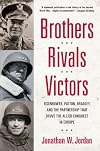
Brothers, Rivals, Victors is a well-crafted if conventional account of the relationship between the three top American soldiers in the European theater. Working from diaries and letters, Jordan reconstructs the emotional state of these three men as they liberated occupied Europe. The tone of the book is perhaps best brought out by the names used to address the generals, Ike, Brad, and George. This book is familiar and gossipy, Mean Girls in HQ instead of high school.
Mean Girls "On D-Day we show more wear khaki"
Patton is the protagonist of the book. Charismatic, immensely self-assured, vain, and a warrior to the bone, Patton saw his destiny to be one of the Great Captains of history. His military skills were rivaled by a lack of restraint and a mouth that got him in trouble repeatedly, most notoriously in the Sicily slapping incidents, where he struck two soldiers in the hospital for 'combat fatigue' and berated them as cowards. But again and again, the basic plot of this book is Patton saying something stupid, and Eisenhower saving the old warrior's career.
Jordan is aware of Patton's self-mythologizing and mastery of the press, but not aware enough to avoid participating. It's hard to blame him. Among other traits, Patton was an inveterate diarist and letter writer, and his "private" remarks have an acid candor about the personalities of the other commanders. I use private in quotes because Patton absolutely planned his memoirs. If he had not died in a car crash in 1945, they might have been more edited and considered, but I believe his remarks on Eisenhower's pro-British leanings and Bradley's caution were meant for history, not just venting spleen.
Eisenhower is the second great personality of the book. Ike and George were genuine friends, dating back to joint service in the nascent tank corps immediately after WW1. But where Patton was a showboat who saw the tank as a means to an industrial version of the classic cavalry pursuit, Ike became a well-rounded, strategic commander. Picked by Chief of Staff Marshall for the key job of overseeing the American contribution to North Africa, Ike's steady leadership and ability to balance the competing military and political priorities across the services and allies made his the central figure of the war. Despite the lofty title of 'Supreme Commander', Eisenhower had less direct power than it seemed. His orders always had to be filtered through subordinates, not all of whom were willing to listen, and political considerations complicated direct military strategy. One thing that comes through is the stress Eisenhower was under as the face of the Allied effort. He smoked up to four packs of cigarettes a day and basically imploded his health trying to keep the war together.
Bradley is the forgotten member of the trio, lacking Eisenhower's presidential legacy and Patton's gift of showmanship. It's an unfortunate oversight, as Bradley was Eisenhower's trusted right hand, and in the first ranks of American combat commanders along with General Grant and General Sherman. Bradley's steadiness in combat and reputation as the 'GI's general' was balanced by an explosive temper and a merciless attitude towards subordinates who he deemed incompetent. Patton was a sentimentalist, and Ike was willing to bestow second chances. Bradley would cashier an officer who made a single mistake.
If there's an antagonist to this book, it's British general Bernard Montgomery. Monty used his reputation as the hero of El Alamein and his position as the senior British ground commander to demand the lion's share of supplies and key terrain features, claiming priority for his immaculately planned set-piece attacks which often came to naught (Market Garden), or were superseded by events.
Overall, I'd describe this book as 'Dadly'. It's not that far from the movie version of Patton with extra footnotes. As a conventional Greatest Generation hagiography, it's not particularly challenging, but it's well done. show less
Mean Girls "On D-Day we show more wear khaki"
Patton is the protagonist of the book. Charismatic, immensely self-assured, vain, and a warrior to the bone, Patton saw his destiny to be one of the Great Captains of history. His military skills were rivaled by a lack of restraint and a mouth that got him in trouble repeatedly, most notoriously in the Sicily slapping incidents, where he struck two soldiers in the hospital for 'combat fatigue' and berated them as cowards. But again and again, the basic plot of this book is Patton saying something stupid, and Eisenhower saving the old warrior's career.
Jordan is aware of Patton's self-mythologizing and mastery of the press, but not aware enough to avoid participating. It's hard to blame him. Among other traits, Patton was an inveterate diarist and letter writer, and his "private" remarks have an acid candor about the personalities of the other commanders. I use private in quotes because Patton absolutely planned his memoirs. If he had not died in a car crash in 1945, they might have been more edited and considered, but I believe his remarks on Eisenhower's pro-British leanings and Bradley's caution were meant for history, not just venting spleen.
Eisenhower is the second great personality of the book. Ike and George were genuine friends, dating back to joint service in the nascent tank corps immediately after WW1. But where Patton was a showboat who saw the tank as a means to an industrial version of the classic cavalry pursuit, Ike became a well-rounded, strategic commander. Picked by Chief of Staff Marshall for the key job of overseeing the American contribution to North Africa, Ike's steady leadership and ability to balance the competing military and political priorities across the services and allies made his the central figure of the war. Despite the lofty title of 'Supreme Commander', Eisenhower had less direct power than it seemed. His orders always had to be filtered through subordinates, not all of whom were willing to listen, and political considerations complicated direct military strategy. One thing that comes through is the stress Eisenhower was under as the face of the Allied effort. He smoked up to four packs of cigarettes a day and basically imploded his health trying to keep the war together.
Bradley is the forgotten member of the trio, lacking Eisenhower's presidential legacy and Patton's gift of showmanship. It's an unfortunate oversight, as Bradley was Eisenhower's trusted right hand, and in the first ranks of American combat commanders along with General Grant and General Sherman. Bradley's steadiness in combat and reputation as the 'GI's general' was balanced by an explosive temper and a merciless attitude towards subordinates who he deemed incompetent. Patton was a sentimentalist, and Ike was willing to bestow second chances. Bradley would cashier an officer who made a single mistake.
If there's an antagonist to this book, it's British general Bernard Montgomery. Monty used his reputation as the hero of El Alamein and his position as the senior British ground commander to demand the lion's share of supplies and key terrain features, claiming priority for his immaculately planned set-piece attacks which often came to naught (Market Garden), or were superseded by events.
Overall, I'd describe this book as 'Dadly'. It's not that far from the movie version of Patton with extra footnotes. As a conventional Greatest Generation hagiography, it's not particularly challenging, but it's well done. show less
Brothers, Rivals, Victors: Eisenhower, Patton, Bradley and the Partnership that Drove the Allied Conquest in Europe by Jonathan W. Jordan
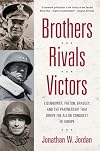
Brothers – Rivals – Victors is an interesting read. Jonathan W. Jordan has managed to intertwine the stories of three American generals who arguably brought about eventual victory in Europe during World War II. He pulls no punches. Those who have watched the overly positive biographies on Generals Patton, Bradley and Eisenhower will want to prepare themselves before diving into the six hundred and thirty-five pages of this book.
Jordan is fair however and even though my favourite general show more takes a beating throughout the pages of his book, I forgive him because he is one of the first to be brutally honest about good ol’ Field Marshal Bernard Law Montgomery. If the swagger stick wielding egomaniac is your favourite, it’s best that you pass this book up. The bitter truths within will hurt.
However, if you can get past the bitter truth, this book gives a no holds barred history of the three generals and their battles amongst themselves and the battles that liberated Europe.
I gave it four stars. I would have given it four and a half, but ^&$%, I do have to take offence to what is said about my *$&(#@!&^ favourite general. Oh just go and buy the *%@^ book! You won't regret it! :)
www.daniellittle.com show less
Jordan is fair however and even though my favourite general show more takes a beating throughout the pages of his book, I forgive him because he is one of the first to be brutally honest about good ol’ Field Marshal Bernard Law Montgomery. If the swagger stick wielding egomaniac is your favourite, it’s best that you pass this book up. The bitter truths within will hurt.
However, if you can get past the bitter truth, this book gives a no holds barred history of the three generals and their battles amongst themselves and the battles that liberated Europe.
I gave it four stars. I would have given it four and a half, but ^&$%, I do have to take offence to what is said about my *$&(#@!&^ favourite general. Oh just go and buy the *%@^ book! You won't regret it! :)
www.daniellittle.com show less
American Warlords: How Roosevelt's High Command Led America to Victory in World War II by Jonathan W. Jordan
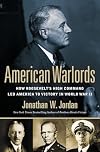
American Warlords is an attempt at a World War II version of the classic Team of Rivals, focusing on the work of FDR, Secretary of War Stimson, Army Chief of Staff Marshall, and Chief of Naval Operations King. It's an engaging enough story, but Jordan gets caught in the details and fails to come to a truly important understanding of American strategy.
B-24's under construction at Willow Run
By far the most important person was President Roosevelt. Roosevelt was the consummate politician, a man show more adept at finding consensus among the most ardent foes. This skill would be sorely tested, balancing the interests of Churchill and Stalin, the American homefront, and his senior commanders. Roosevelt gets a lot of pages, but we don't much insight into his thinking. It's somewhat counter-intuitive that a man allergic to clear lines of command and Clausewitzian concentration would preside over the greatest American victory.
Of the other three men, King is drawn the most clearly. A staunch naval chauvinist, and advocate of offensives against Japan when the stated policy was 'Germany first', he fought for his vision of the war. Some wag (elsewhere, not in this book), said that "Admiral King was the most even-tempered man in high command. He was always furious." Marshall is a self-effacing, trying to reign in Churchillian sideshows, while letting Eisenhower serve as the liberator of Europe. Stimson disappears almost entirely.
The focus on strategy and personalities is reasonable enough, but what I find most interesting about America in World War II was that it fought a New Deal War. America in 1940, as the clouds of war loomed, was at best a second rate power. Even before Pearl Harbor, Roosevelt and Marshall turned millions of civilians into soldiers, sailors, and airmen. They set factories churning out weapons, a tide of material warfare that buried the Axis power under tens of thousands of warplanes per year, M1 rifles, carbines, and tanks, dozens of aircraft carriers, and 2710 Liberty ships to bring the war to Europe and Japan. They harnessed science and technology to create advanced wonder weapons, including the B-29, the proximity fuse, the ULTRA codebreaking program, and above all else, the atomic bomb. This transformation of America into the arsenal of democracy was the real battle of the war, and Jordan only discusses it in passing. show less
B-24's under construction at Willow Run
By far the most important person was President Roosevelt. Roosevelt was the consummate politician, a man show more adept at finding consensus among the most ardent foes. This skill would be sorely tested, balancing the interests of Churchill and Stalin, the American homefront, and his senior commanders. Roosevelt gets a lot of pages, but we don't much insight into his thinking. It's somewhat counter-intuitive that a man allergic to clear lines of command and Clausewitzian concentration would preside over the greatest American victory.
Of the other three men, King is drawn the most clearly. A staunch naval chauvinist, and advocate of offensives against Japan when the stated policy was 'Germany first', he fought for his vision of the war. Some wag (elsewhere, not in this book), said that "Admiral King was the most even-tempered man in high command. He was always furious." Marshall is a self-effacing, trying to reign in Churchillian sideshows, while letting Eisenhower serve as the liberator of Europe. Stimson disappears almost entirely.
The focus on strategy and personalities is reasonable enough, but what I find most interesting about America in World War II was that it fought a New Deal War. America in 1940, as the clouds of war loomed, was at best a second rate power. Even before Pearl Harbor, Roosevelt and Marshall turned millions of civilians into soldiers, sailors, and airmen. They set factories churning out weapons, a tide of material warfare that buried the Axis power under tens of thousands of warplanes per year, M1 rifles, carbines, and tanks, dozens of aircraft carriers, and 2710 Liberty ships to bring the war to Europe and Japan. They harnessed science and technology to create advanced wonder weapons, including the B-29, the proximity fuse, the ULTRA codebreaking program, and above all else, the atomic bomb. This transformation of America into the arsenal of democracy was the real battle of the war, and Jordan only discusses it in passing. show less
American Warlords: How Roosevelt's High Command Led America to Victory in World War II by Jonathan W. Jordan
A very good and very readable run-through of the interactions between the key men that led the US in WW2 They were from diverse backgrounds and experiences. There were frequent, even combative discussions but few true arguments. The whirlwind of global combat drew politics, leadership issues, economic stress, and many other forces into its vortex. The trigger words were: conscription, an integrated military, women in the workforce, restructuring industries, using nuclear weapons and many show more more; but the harmony behind this theme was always; who will die next and where. show less
Lists
Awards
You May Also Like


Associated Authors
Statistics
- Works
- 6
- Also by
- 7
- Members
- 449
- Popularity
- #54,621
- Rating
- 3.9
- Reviews
- 11
- ISBNs
- 36