
About the Author
Michael F. Bird is academic dean and lecturer in theology at Ridley College in Melbourne, Australia. He's is the author of more than a dozen books including What Christians Ought to Believe and Evangelical Theology. He also runs a popular theological studies blog called "Euangelion" and can be show more followed on twitter @mbird12. show less
Image credit: Faculty profile picture (Ridley College)
Series
Works by Michael F. Bird
The New Testament in Its World: An Introduction to the History, Literature, and Theology of the First Christians (2019) — Author — 597 copies, 2 reviews
How God Became Jesus: The Real Origins of Belief in Jesus' Divine Nature---A Response to Bart D. Ehrman (2014) 244 copies
What Christians Ought to Believe: An Introduction to Christian Doctrine Through the Apostles’ Creed (2016) 215 copies
Jesus and the Powers: Christian Political Witness in an Age of Totalitarian Terror and Dysfunctional Democracies (2024) — Author — 188 copies, 2 reviews
The Faith of Jesus Christ: Exegetical, Biblical, and Theological Studies (2009) — Editor; Introduction — 124 copies, 2 reviews
The Saving Righteousness of God: Studies on Paul, Justification and the New Perspective (2007) 101 copies
Religious Freedom in a Secular Age: A Christian Case for Liberty, Equality, and Secular Government (2022) 99 copies, 1 review
Trinity Without Hierarchy: Reclaiming Nicene Orthodoxy in Evangelical Theology (2019) — Editor — 90 copies, 3 reviews
The New Testament in Its World Workbook: An Introduction to the History, Literature, and Theology of the First Christians (2019) — Author — 84 copies, 1 review
Bourgeois Babes, Bossy Wives, and Bobby Haircuts: A Case for Gender Equality in Ministry (Fresh Perspectives on Women in Ministry) (2012) 79 copies, 2 reviews
The New Testament You Never Knew Study Guide: Exploring the Context, Purpose, and Meaning of the Story of God (2019) — Author — 55 copies
Jesus and the Origins of the Gentile Mission (The Library of New Testament Studies) (2006) 28 copies
Romans: Greek-English Interlinear | Paraphrase | Study Notes (Lexham Interpreter's Translation) (2025) 25 copies
The Cambridge Companion to the Apostolic Fathers (Cambridge Companions to Religion) (2021) 24 copies
Paul and the Gospels: Christologies, Conflicts and Convergences (Library of New Testament Studies) (2011) 14 copies
The New Testament You Never Knew Video Study: Exploring the Context, Purpose, and Meaning of the Story of God (2019) — Author — 13 copies
The New Testament You Never Knew Study Guide with DVD: Exploring the Context, Purpose, and Meaning of the Story of God (2019) — Author — 10 copies
1 Esdras: Introduction and Commentary on the Greek Text in Codex Vaticanus (Septuagint Commentary) (2012) 6 copies
The Sacred Text: Excavating the Texts, Exploring the Interpretations, and Engaging the Theologies of the Christian Scriptures (2010) — Editor — 2 copies
Unlimited Atonement 1 copy
Associated Works
The World of the New Testament: Cultural, Social, and Historical Contexts (2013) — Contributor — 193 copies
Jesus Is Lord, Caesar Is Not: Evaluating Empire in New Testament Studies (2012) — Contributor — 85 copies, 1 review
This World and the World to Come: Soteriology in Early Judaism (The Library of Second Temple Studies) (2011) — Contributor — 13 copies
Tagged
Common Knowledge
- Birthdate
- 1974
- Gender
- male
- Occupations
- theologian
Anglican priest - Organizations
- Studiorum Novi Testamenti Societas
- Nationality
- Australia
- Associated Place (for map)
- Australia
Members
Reviews
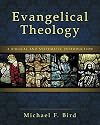
Evangelical Theology by Michael Bird is a book that will grab readers early on and will not let them go for 800 , rich pages of theology, humor and worship. Bird hooked me early. From the outset, he cannot help but show his love for the church catholic and historic, freely citing authors from all walks of the Christian faith, from throughout two millennia of Christian history. His implicit focus on the fellowship of the saints in studying theology made it feel like, and really become, a show more worshipful and communal event.
Hearing a bit of who Michael Bird is encouraged me even more to dive into this text. He lays his “ecclesial and theological cards on the table” and shares a bit about himself early on.
"On the church side of things, I did not grow up in a Christian home, but I came to Christ through a Baptist church in Sydney, Australia. I also attended a Baptist seminary (Malyon College) and have been a pastoral intern and itinerant preacher in Baptist churches. I taught for five years in an interdenominational theological college committed to the Reformed tradition in Scotland (Highland Theological College); more recently I spent three years teaching at an interdenominational college in Brisbane while being on the preaching team of a Presbyterian church (Crossway College). I am now a lecturer in theology at an Anglican College (Ridley Melbourne). Strange as it sounds, I would describe myself as an ex-Baptist postPresbyterian Anglican."
Bird considers himself a “mere evangelical” and attempts to write his systematic from that perspective.
One of the things you will note in Evangelical Theology is the tone. Bird writes deeply and lightly, using humor freely to make points and disarm the reader. Is his use of humor good or bad? It is hard for me to say, but I am sure that some readers will be put off by it and some readers will benefit from it and enjoy it greatly. His tone makes this immense volume immensely readable but may leave it with a short shelf life due to pop culture references and whatnot. Will it stand the test of time? Who knows. But, it does allow a broader range of believers to access his work and be ministered to by it here and now, so for that reason I tend to view his tone and humor as a benefit of the book.
Bird starts his text off, after a proper prolegomena, with the Trinity. He makes some valid points as to why the Trinity should be the launching point for theological study rather than Scripture.
"Whereas the medieval theological tradition began with the Triune God as the starting point for theology, it was the Second Helvetic Confession (followed by the Irish Articles and Westminster Confession) that broke the mold by putting the doctrine of Scripture first in the order of topics covered in theology. This Protestant move is understandable, opposing as it does the medieval Roman Catholic view of authority; yet it was a misstep that ultimately led to a shift from theology beginning with God-in-himself to theology beginning with human reception/perception of revelation. It was inevitably that Protestant theology, in some quarters, would move from theology to anthropology as the measure of religious truth."
Bird rejects the Bibliolatry that many Evangelicals can, and do, slip into and labors the supremacy of the incarnation as God’s ultimate revelation. In his section on revelation as Bird argues for the “extra extra special revelation” of the incarnation, he writes:
"I am not denying the supremacy of Scripture as our witness to Jesus. Jesus himself said that the Scriptures testify to him (e.g., John 5:36 – 39; 7:38). Nor do I want to minimize the necessity of Scripture for knowing Jesus. Yet the Bible does not have a monopoly for giving us access to knowledge about the incarnation and the salvation that it brings. You can apprehend knowledge of Jesus Christ through the proclamation of the gospel, by the experience of him in baptism and Eucharist, and through catechisms and creeds that summarize the teaching of Scripture."
Bird writes to his current audience. He knows the culture and mindset that we, as Evangelicals, live in and writes a systematic theology to address our current age. Bird addresses possible positions fairly and fully and then expounds on the position he holds to be true. He does not come to the task with a back full of straw and mean names, ready to engage in a battle of fallacies in hopes of being shown to be smarter, righter, holier, or better than those who would propose a different position than he. Rather, he engages arguments at their strongest point and even allows room for his own error or possibility of differing, yet correct, interpretations and positions.
Bird spends time looking especially at doctrines that are being shaped and debated currently in our Evangelical world, and does so with his typical humor and relevance.
As he discusses the differing views on the atonement he summarizes the Christus Victor position with a line from Getty and Townend. “Perhaps the best way to summarize the Christus Victor view is with a line from the wonderful modern hymn “In Christ Alone” by Stuart Townshend and Keith Getty: 'And as he stands in victory, Sin’s curse has lost its grip on me.'” That is simple enough, even for me!
When speaking of penal substitutionary atonement and our quickness to bypass the Gospels for Paul’s writings, he says:
“Routinely students run to Paul’s letters or to Hebrews in search of proof texts for penal substitution. They completely bypass the Gospels like tourists from Florida detouring around Philadelphia on their way to New York. How much I enjoy the surprise when students learn that the gospel of the cross actually begins with the gospel according to the Evangelists. Even more gobsmacking is when they learn that you actually can preach the gospel from the Gospels! Who would have imagined!”
When speaking about the atonement being about both penal substitution and Christus Victor Bird writes,
"I do not wish to disparage Jesus’ death as an atoning, vicarious, substitutionary, and penal sacrifice for sin. May I be anathematized — or even worse, may I be tied to a chair, have my eyelids taped open, and be forced to watch Rob Bell Nooma clips — should I ever downplay the cruciality of Jesus’ sacrifice for sinners. However, I am convinced that Jesus’ death for sinners on the cross is part of a bigger picture that is laid out in redemptive history, visible in the very shape of our canon, apparent in biblical theology, ubiquitous in historical theology, and explicit in Pauline theology. The doctrines of penal substitution and Christus Victor do not compete against each other, for the former is clearly the grounds for the latter. What binds together new exodus, new creation, Jesus’ ministry, the cross, and the mission of God’s people in the world is the victory of God in the substitutionary death of Jesus."
I cannot express how many “aha” moments I enjoyed in this book. Bird allowed me to understand how a Lutheran could legitimately hold to consubstantiation in his discussion of the communication of divine attributes.(I still do not hold to the view, but it is real nice knowing that my Lutheran brothers and sisters did not just pull the idea out of nowhere!)
Bird also allowed me to gain some insight on Karl Barth. To this point I had not progressed much in my understanding of Barth other than “Barth=bad”. Bird spends some time addressing Barth; his theology, his legacy, his infamy, how to pronounce his name…and left me with a more sympathetic view of the man and a curiosity to learn more about his thought and life.
Bird’s leaning towards Biblical Theology shows up in section 5.2, Redemptive History: The Plan for the Gospel. If you want a beautiful text on the Gospel from cover to cover of Scripture, a section to study and enjoy, this is for you. I will personally be returning there over and over because to see the Gospel throughout all of Scripture is a wonderful thing.
His section on ecclesiology was especially interesting. Bird discusses the eclectic and often-anemic nature of Evangelical ecclesiology.
"Evangelical ecclesiology has always been a bit of a conundrum. That is because there is no standard 'evangelical ecclesiology,' nor can there be in the strict sense. You can have an Anglican, Catholic, Baptist, Lutheran, Methodist, or Presbyterian ecclesiology. Such ecclesiologies prescribe the confession, order, structure, discipline, governance, worship, sacraments, and ministries of these respective denominations. But there is no prescriptive evangelical equivalent because evangelicalism is a theological ethos, not a denominational entity. While evangelicals might agree on certain ecclesiological principles, like Jesus Christ is the head of the church and the church is the body of Christ, the general agreements largely break down when it comes to the specific ordering and structures of the church. Yet this has not always been a negative thing. Precisely because evangelicalism has no prescriptive ecclesiology, it can accommodate itself to virtually any form of church order. Evangelicals have implied an ecclesiology more than worked one out."
Bird maintains that Evangelicals have an ecclesiology, but the emphasis on it is well short of where it should be.
“(S)omething seems to be lacking in evangelical ecclesiology. I do not see anywhere near the same excitement, emotion, resolve, and passion for debates about ecclesiology as, for example, soteriology. I doubt that many American Presbyterians get riled over Tom Wright’s ecclesiology as they do over his soteriology. “
Bird sees a few culprits, all valid, but I intensely agree with him on the culpability of hyperindividualism as a reason for Evangelicals poor and self-centered ecclesiology.
"For some folks the gospel is an iGod app that enables a person to get a wifi connection with heaven (where the one mediator between God and Man is Apple Inc.). To use another metaphor, the church is reduced to the weekly meeting of Jesus’ Facebook friends. The locus of Christianity becomes God and me rather than God and us. One could contrast two slogans: 'I believe, therefore I am saved' with “We believe, therefore we are God’s people.” Evangelicals tend to prefer the former rather than the latter as the default setting for their ecclesiology."
Bird’s discussion on “The shape of the church” edifying and challenging. Bird shows the church to be a community that is eschatological, Trinitarian, diacanol, holistic, and fellowshipping. The importance of these truths is spelled out nicely by Bird and I echo his sentiments on their importance.
The “What to take home” sections are immensely helpful and flashcard worthy. Bird does well in summarizing large chunks of information and leaving the reader with a page to take away from each chapter.
Bird takes positions I am not comfortable with, he quotes people I am not comfortable with, he approaches things in a way that sometimes leave me scratching my head…and this is why I love this book. He challenges me. He attacks, like a surgeon attacking a tumor, my small-town, American, evangelical, YRR, Puritans Piper=perfect mentality on things. He does not do so maliciously or self-righteously. He does so in a manner that makes me want to grab hands with people I differ with on secondary issues and live out our common faith together, as brothers and sisters bonded together in Christ.
This book was challenging and encouraging and just a fun read. I recommend this to anyone with a love of the Gospel and an interest in Theology. I encourage you to read and re-read…as I will be doing.
I couldn’t figure out how to work this quote in to the review, but I loved it and just thought I would tag it on the end. Bird writes beautifully and God used him to lead me in worship throughout this book.
"The gospel declares the victory of the Lord Jesus over death by deposing death of its power (i.e., evil) through the cross and by robbing death of its prize (i.e., human lives) through the resurrection. As a famous Greek hymn says: “Christ has risen, trampling down death by death, and giving life to those in the grave.” Death, armed with evil and law, was no match for the Prince of Life. The gospel is not simply about how God deals with the individual’s personal sins, a transaction of sin and righteous ness to clean the slate; yes, that is true, but the gospel declares so much more, namely, God’s victory over the personal and impersonal forces of evil: the world, the flesh, and Satan. The gospel is an invitation to live in fellowship with Christ rather than to suffer under the tyranny of evil. The gospel means emancipation from the slavery of evil to the freedom of a new and authentic humanity. The gospel of Christ blesses us with the news that a world ravaged with evil is not how it ought to be, nor how it can be, nor how it will be. The gospel whispers to us that Jesus means freedom."
**I received a review copy of this book to provide an honest review. I purchased my own copy when it came out because I thoroughly enjoyed it. show less
Hearing a bit of who Michael Bird is encouraged me even more to dive into this text. He lays his “ecclesial and theological cards on the table” and shares a bit about himself early on.
"On the church side of things, I did not grow up in a Christian home, but I came to Christ through a Baptist church in Sydney, Australia. I also attended a Baptist seminary (Malyon College) and have been a pastoral intern and itinerant preacher in Baptist churches. I taught for five years in an interdenominational theological college committed to the Reformed tradition in Scotland (Highland Theological College); more recently I spent three years teaching at an interdenominational college in Brisbane while being on the preaching team of a Presbyterian church (Crossway College). I am now a lecturer in theology at an Anglican College (Ridley Melbourne). Strange as it sounds, I would describe myself as an ex-Baptist postPresbyterian Anglican."
Bird considers himself a “mere evangelical” and attempts to write his systematic from that perspective.
One of the things you will note in Evangelical Theology is the tone. Bird writes deeply and lightly, using humor freely to make points and disarm the reader. Is his use of humor good or bad? It is hard for me to say, but I am sure that some readers will be put off by it and some readers will benefit from it and enjoy it greatly. His tone makes this immense volume immensely readable but may leave it with a short shelf life due to pop culture references and whatnot. Will it stand the test of time? Who knows. But, it does allow a broader range of believers to access his work and be ministered to by it here and now, so for that reason I tend to view his tone and humor as a benefit of the book.
Bird starts his text off, after a proper prolegomena, with the Trinity. He makes some valid points as to why the Trinity should be the launching point for theological study rather than Scripture.
"Whereas the medieval theological tradition began with the Triune God as the starting point for theology, it was the Second Helvetic Confession (followed by the Irish Articles and Westminster Confession) that broke the mold by putting the doctrine of Scripture first in the order of topics covered in theology. This Protestant move is understandable, opposing as it does the medieval Roman Catholic view of authority; yet it was a misstep that ultimately led to a shift from theology beginning with God-in-himself to theology beginning with human reception/perception of revelation. It was inevitably that Protestant theology, in some quarters, would move from theology to anthropology as the measure of religious truth."
Bird rejects the Bibliolatry that many Evangelicals can, and do, slip into and labors the supremacy of the incarnation as God’s ultimate revelation. In his section on revelation as Bird argues for the “extra extra special revelation” of the incarnation, he writes:
"I am not denying the supremacy of Scripture as our witness to Jesus. Jesus himself said that the Scriptures testify to him (e.g., John 5:36 – 39; 7:38). Nor do I want to minimize the necessity of Scripture for knowing Jesus. Yet the Bible does not have a monopoly for giving us access to knowledge about the incarnation and the salvation that it brings. You can apprehend knowledge of Jesus Christ through the proclamation of the gospel, by the experience of him in baptism and Eucharist, and through catechisms and creeds that summarize the teaching of Scripture."
Bird writes to his current audience. He knows the culture and mindset that we, as Evangelicals, live in and writes a systematic theology to address our current age. Bird addresses possible positions fairly and fully and then expounds on the position he holds to be true. He does not come to the task with a back full of straw and mean names, ready to engage in a battle of fallacies in hopes of being shown to be smarter, righter, holier, or better than those who would propose a different position than he. Rather, he engages arguments at their strongest point and even allows room for his own error or possibility of differing, yet correct, interpretations and positions.
Bird spends time looking especially at doctrines that are being shaped and debated currently in our Evangelical world, and does so with his typical humor and relevance.
As he discusses the differing views on the atonement he summarizes the Christus Victor position with a line from Getty and Townend. “Perhaps the best way to summarize the Christus Victor view is with a line from the wonderful modern hymn “In Christ Alone” by Stuart Townshend and Keith Getty: 'And as he stands in victory, Sin’s curse has lost its grip on me.'” That is simple enough, even for me!
When speaking of penal substitutionary atonement and our quickness to bypass the Gospels for Paul’s writings, he says:
“Routinely students run to Paul’s letters or to Hebrews in search of proof texts for penal substitution. They completely bypass the Gospels like tourists from Florida detouring around Philadelphia on their way to New York. How much I enjoy the surprise when students learn that the gospel of the cross actually begins with the gospel according to the Evangelists. Even more gobsmacking is when they learn that you actually can preach the gospel from the Gospels! Who would have imagined!”
When speaking about the atonement being about both penal substitution and Christus Victor Bird writes,
"I do not wish to disparage Jesus’ death as an atoning, vicarious, substitutionary, and penal sacrifice for sin. May I be anathematized — or even worse, may I be tied to a chair, have my eyelids taped open, and be forced to watch Rob Bell Nooma clips — should I ever downplay the cruciality of Jesus’ sacrifice for sinners. However, I am convinced that Jesus’ death for sinners on the cross is part of a bigger picture that is laid out in redemptive history, visible in the very shape of our canon, apparent in biblical theology, ubiquitous in historical theology, and explicit in Pauline theology. The doctrines of penal substitution and Christus Victor do not compete against each other, for the former is clearly the grounds for the latter. What binds together new exodus, new creation, Jesus’ ministry, the cross, and the mission of God’s people in the world is the victory of God in the substitutionary death of Jesus."
I cannot express how many “aha” moments I enjoyed in this book. Bird allowed me to understand how a Lutheran could legitimately hold to consubstantiation in his discussion of the communication of divine attributes.(I still do not hold to the view, but it is real nice knowing that my Lutheran brothers and sisters did not just pull the idea out of nowhere!)
Bird also allowed me to gain some insight on Karl Barth. To this point I had not progressed much in my understanding of Barth other than “Barth=bad”. Bird spends some time addressing Barth; his theology, his legacy, his infamy, how to pronounce his name…and left me with a more sympathetic view of the man and a curiosity to learn more about his thought and life.
Bird’s leaning towards Biblical Theology shows up in section 5.2, Redemptive History: The Plan for the Gospel. If you want a beautiful text on the Gospel from cover to cover of Scripture, a section to study and enjoy, this is for you. I will personally be returning there over and over because to see the Gospel throughout all of Scripture is a wonderful thing.
His section on ecclesiology was especially interesting. Bird discusses the eclectic and often-anemic nature of Evangelical ecclesiology.
"Evangelical ecclesiology has always been a bit of a conundrum. That is because there is no standard 'evangelical ecclesiology,' nor can there be in the strict sense. You can have an Anglican, Catholic, Baptist, Lutheran, Methodist, or Presbyterian ecclesiology. Such ecclesiologies prescribe the confession, order, structure, discipline, governance, worship, sacraments, and ministries of these respective denominations. But there is no prescriptive evangelical equivalent because evangelicalism is a theological ethos, not a denominational entity. While evangelicals might agree on certain ecclesiological principles, like Jesus Christ is the head of the church and the church is the body of Christ, the general agreements largely break down when it comes to the specific ordering and structures of the church. Yet this has not always been a negative thing. Precisely because evangelicalism has no prescriptive ecclesiology, it can accommodate itself to virtually any form of church order. Evangelicals have implied an ecclesiology more than worked one out."
Bird maintains that Evangelicals have an ecclesiology, but the emphasis on it is well short of where it should be.
“(S)omething seems to be lacking in evangelical ecclesiology. I do not see anywhere near the same excitement, emotion, resolve, and passion for debates about ecclesiology as, for example, soteriology. I doubt that many American Presbyterians get riled over Tom Wright’s ecclesiology as they do over his soteriology. “
Bird sees a few culprits, all valid, but I intensely agree with him on the culpability of hyperindividualism as a reason for Evangelicals poor and self-centered ecclesiology.
"For some folks the gospel is an iGod app that enables a person to get a wifi connection with heaven (where the one mediator between God and Man is Apple Inc.). To use another metaphor, the church is reduced to the weekly meeting of Jesus’ Facebook friends. The locus of Christianity becomes God and me rather than God and us. One could contrast two slogans: 'I believe, therefore I am saved' with “We believe, therefore we are God’s people.” Evangelicals tend to prefer the former rather than the latter as the default setting for their ecclesiology."
Bird’s discussion on “The shape of the church” edifying and challenging. Bird shows the church to be a community that is eschatological, Trinitarian, diacanol, holistic, and fellowshipping. The importance of these truths is spelled out nicely by Bird and I echo his sentiments on their importance.
The “What to take home” sections are immensely helpful and flashcard worthy. Bird does well in summarizing large chunks of information and leaving the reader with a page to take away from each chapter.
Bird takes positions I am not comfortable with, he quotes people I am not comfortable with, he approaches things in a way that sometimes leave me scratching my head…and this is why I love this book. He challenges me. He attacks, like a surgeon attacking a tumor, my small-town, American, evangelical, YRR, Puritans Piper=perfect mentality on things. He does not do so maliciously or self-righteously. He does so in a manner that makes me want to grab hands with people I differ with on secondary issues and live out our common faith together, as brothers and sisters bonded together in Christ.
This book was challenging and encouraging and just a fun read. I recommend this to anyone with a love of the Gospel and an interest in Theology. I encourage you to read and re-read…as I will be doing.
I couldn’t figure out how to work this quote in to the review, but I loved it and just thought I would tag it on the end. Bird writes beautifully and God used him to lead me in worship throughout this book.
"The gospel declares the victory of the Lord Jesus over death by deposing death of its power (i.e., evil) through the cross and by robbing death of its prize (i.e., human lives) through the resurrection. As a famous Greek hymn says: “Christ has risen, trampling down death by death, and giving life to those in the grave.” Death, armed with evil and law, was no match for the Prince of Life. The gospel is not simply about how God deals with the individual’s personal sins, a transaction of sin and righteous ness to clean the slate; yes, that is true, but the gospel declares so much more, namely, God’s victory over the personal and impersonal forces of evil: the world, the flesh, and Satan. The gospel is an invitation to live in fellowship with Christ rather than to suffer under the tyranny of evil. The gospel means emancipation from the slavery of evil to the freedom of a new and authentic humanity. The gospel of Christ blesses us with the news that a world ravaged with evil is not how it ought to be, nor how it can be, nor how it will be. The gospel whispers to us that Jesus means freedom."
**I received a review copy of this book to provide an honest review. I purchased my own copy when it came out because I thoroughly enjoyed it. show less
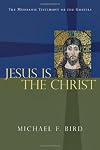
So when did Jesus’ followers begin to proclaim him the Messiah? Michael Bird argues that Jesus deliberately acted out a messianic role, and that his followers would hardly have proclaimed Jesus to be the Messiah against Jesus’ own self-understanding. I needed no convincing on this topic, but if I did, the introduction to Bird’s book alone provides evidence enough. Indeed, I found the long introduction to be the most thought-provoking part of the book!
After the introduction the book show more settles down to a methodical look at each of the four gospels and their unique contribution in portraying Jesus as the Judaic Messiah. I found Bird’s examination of the gospels less bold, but no less interesting and informative. The question to be answered seems to shift from When did Jesus become known as Messiah? to How clearly is Jesus portrayed as Messiah? Bird describes the gospels as “stained-glass windows offering different shapes and colors about a figure they all regard in their own unique way as the long-promised Messiah.” He reads them this way:
Mark: The Crucified Messiah
Matthew: The Davidic Messiah
Luke/Acts: The Prophetic Messiah
John: The Elusive Messiah
The three main titles that Bird examines are Son of Man, Son of God, and Son of David. Each, he argues, is a messianic expression. The Gospel Christology thus is a form of messianism and must be understood in that light.
Bird’s writing is scholarly, precise, and well-argued, with lots of references and endnotes. I’ll definitely be picking up more books from this author. show less
After the introduction the book show more settles down to a methodical look at each of the four gospels and their unique contribution in portraying Jesus as the Judaic Messiah. I found Bird’s examination of the gospels less bold, but no less interesting and informative. The question to be answered seems to shift from When did Jesus become known as Messiah? to How clearly is Jesus portrayed as Messiah? Bird describes the gospels as “stained-glass windows offering different shapes and colors about a figure they all regard in their own unique way as the long-promised Messiah.” He reads them this way:
Mark: The Crucified Messiah
Matthew: The Davidic Messiah
Luke/Acts: The Prophetic Messiah
John: The Elusive Messiah
The three main titles that Bird examines are Son of Man, Son of God, and Son of David. Each, he argues, is a messianic expression. The Gospel Christology thus is a form of messianism and must be understood in that light.
Bird’s writing is scholarly, precise, and well-argued, with lots of references and endnotes. I’ll definitely be picking up more books from this author. show less
Jesus and the Powers: Christian Political Witness in an Age of Totalitarian Terror and Dysfunctional Democracies by N. T. Wright
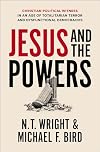
Many have advocated for religion to stay away from politics. As a result, far too many have allowed their political imagination and identity to be shaped by secular forces without much of a word regarding Jesus and the values of His Kingdom.
And then, of course, are those who think their political ideology is the way of Jesus and His Kingdom.
N.T. Wright and Michael Bird, noted theologians, have come together to speak a word in the midst of our political moment in Jesus and the Powers: show more Christian Political Witness in an Age of Totalitarian Terror and Dysfunctional Democracies.
Throughout the authors grapple with the often fraught relationship between Christianity and the affairs of this world. They start with Jesus and the establishment of the Kingdom in the days of the Roman Empire; they consider the rise of Christendom after Constantine. The closest we get to discussion of the “powers” centers on how those powers were understood and defined and how John, Paul, and the early Christians maintained primary loyalty to Jesus and sought to live justly in their societies.
They make much of how Christians should recognize how they are to bring the Kingdom of Jesus to bear in every aspect of their lives, including in how they approach matters of the city and state (politics). They sketch out a way between abject, fawning submission, and outright hostility and subversion. They attempt to uphold what good has come out of the shaping of a lot of Western values in a generally “Christian” direction while remaining sanguine about the cost of compromise between church and state. The authors are no fans of Christian nationalism or anything of that sort. In the end, they attempt to present a way forward in which (philosophical) liberal ideals are upheld in affirming the rights of all people and thus well loving your neighbor as yourself and an encouragement of tolerance to a significant degree.
It’s a generally good word which proves important for the moment. It is good to grapple with the complexity of the inheritance of Christendom, although I personally feel Wright and Bird are a bit too invested in it (for understandable reasons). The more global perspective is also helpful, since far too many Americans suffer from a failure of imagination regarding the way the faith is lived in other places. It’s a good work to consider. show less
And then, of course, are those who think their political ideology is the way of Jesus and His Kingdom.
N.T. Wright and Michael Bird, noted theologians, have come together to speak a word in the midst of our political moment in Jesus and the Powers: show more Christian Political Witness in an Age of Totalitarian Terror and Dysfunctional Democracies.
Throughout the authors grapple with the often fraught relationship between Christianity and the affairs of this world. They start with Jesus and the establishment of the Kingdom in the days of the Roman Empire; they consider the rise of Christendom after Constantine. The closest we get to discussion of the “powers” centers on how those powers were understood and defined and how John, Paul, and the early Christians maintained primary loyalty to Jesus and sought to live justly in their societies.
They make much of how Christians should recognize how they are to bring the Kingdom of Jesus to bear in every aspect of their lives, including in how they approach matters of the city and state (politics). They sketch out a way between abject, fawning submission, and outright hostility and subversion. They attempt to uphold what good has come out of the shaping of a lot of Western values in a generally “Christian” direction while remaining sanguine about the cost of compromise between church and state. The authors are no fans of Christian nationalism or anything of that sort. In the end, they attempt to present a way forward in which (philosophical) liberal ideals are upheld in affirming the rights of all people and thus well loving your neighbor as yourself and an encouragement of tolerance to a significant degree.
It’s a generally good word which proves important for the moment. It is good to grapple with the complexity of the inheritance of Christendom, although I personally feel Wright and Bird are a bit too invested in it (for understandable reasons). The more global perspective is also helpful, since far too many Americans suffer from a failure of imagination regarding the way the faith is lived in other places. It’s a good work to consider. show less
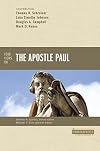
This is the first book of the recently popular "N Views on Topic X" form that I've read, and I think it's a great format. Each author writes a chapter from a particular perspective, then the other authors write short responses. It's about as close to attending a seminar as you can get in book form, and is especially well suited to encouraging students and other readers to form their own opinions based on what they've read.
Of course, the selection of the N views is key to the quality of the show more book, and here editor Michael F. Bird has done a fine job. Resisting the temptation to include a broad array of perspectives and thus produce either a shallow survey or an unmanageable tome, his choice of four views allowed a substantive presentation of each perspective, plus responses, in 300 pages. Thomas R. Schreiner and Luke Timothy Johnson represent the Reformed Protestant and Roman Catholic views that characterize the basic Reformation-shaped discussions of Paul in Western Christianity. Douglas Campbell presents a view that has been developed in light of the New Perspective on Paul, as well as other Protestant influences. The surprising inclusion of Mark D. Nanos for a Jewish perspective of the "apostle to the Gentiles" fruitfully deepens the discussion of the Jewishness of Paul that has been raised by the New Perspective.
This selection of views is excellent, and bringing a Jewish voice to the table is important from a diversity standpoint: honestly, it's embarrassing to hear only Christians talking about whether and how Paul was a Jew. It is only unfortunate that Bird did not identify a woman scholar to represent one or more of the views, so that we did not hear only men talking about Paul's views on women. Such a scholar would likely have critiqued Campbell's exclusive use of "brothers" as language that adequately depicts Christians.
Bird structures the conversation by asking the authors to identify the theological framework that should be used to understand Paul, and to describe Paul's view of salvation, of the significance of Christ, and his vision for the churches. As he states in his introduction, these questions were selected in order to focus the discussion on areas in which there is significant disgreement. He also introduces the background of each contributor; in the conclusion, he helpfully summarizes the points of agreement and disagreement.
Although Johnson begins his essay with demurrals about how specifically Roman Catholic his position may be, it is clear to me that he and I operate out of the same tradition. His methodology and premises were at once familiar and persuasive to me, especially in comparison to Schreiner. Johnson's basic approach of identifying a few themes or concepts with broad attestation across many letters strikes me as more reliable than Schreiner's approach of constructing a systematic narrative that cites a verse or two as support for each statement and relies heavily on Romans and Galatians. Campbell takes an even narrower approach, concentrating on Romans 5-8 in order to identify and develop a single coherent theme; however, his discussion of freedom in the context of the communal, networked, social anthropology he sees in Paul was helpful and persuasive.
I read Nanos' chapter together with a Jewish friend with whom I've studied informally for several years on topics of Judaism, Christianity, and Jewish-Christian dialogue. She was very pleased by Nanos' ability to articulate several attitudes and concepts that she has struggled to express in our studies, and I found it edifying to understand how Paul has traditionally been perceived by the Jewish community. We both appreciated the careful verbal distinctions in this chapter between Jesus-believing Jews, non-Jesus-believing Jews, and Jesus-believing Gentiles: the language is cumbersome, but helpful in avoiding the unconscious translation of 1st-century terms to 21st-century categories.
Overall, this is a very good book, particularly well suited to ecumenical study and to the preparation of those who will minister and preach against an ecumenical background. (That would include pretty much all ministers in the Western church today.) It does require some basic familiarity with theological terms and Paul's letters, but does not require previous expertise in Pauline studies.
Dr. Bird kindly arranged for me to receive an advance copy of this book for use in my independent study course on Catholic, Orthodox, and Protestant perspectives on Paul in the summer of 2012. It was extremely helpful for this work. show less
Of course, the selection of the N views is key to the quality of the show more book, and here editor Michael F. Bird has done a fine job. Resisting the temptation to include a broad array of perspectives and thus produce either a shallow survey or an unmanageable tome, his choice of four views allowed a substantive presentation of each perspective, plus responses, in 300 pages. Thomas R. Schreiner and Luke Timothy Johnson represent the Reformed Protestant and Roman Catholic views that characterize the basic Reformation-shaped discussions of Paul in Western Christianity. Douglas Campbell presents a view that has been developed in light of the New Perspective on Paul, as well as other Protestant influences. The surprising inclusion of Mark D. Nanos for a Jewish perspective of the "apostle to the Gentiles" fruitfully deepens the discussion of the Jewishness of Paul that has been raised by the New Perspective.
This selection of views is excellent, and bringing a Jewish voice to the table is important from a diversity standpoint: honestly, it's embarrassing to hear only Christians talking about whether and how Paul was a Jew. It is only unfortunate that Bird did not identify a woman scholar to represent one or more of the views, so that we did not hear only men talking about Paul's views on women. Such a scholar would likely have critiqued Campbell's exclusive use of "brothers" as language that adequately depicts Christians.
Bird structures the conversation by asking the authors to identify the theological framework that should be used to understand Paul, and to describe Paul's view of salvation, of the significance of Christ, and his vision for the churches. As he states in his introduction, these questions were selected in order to focus the discussion on areas in which there is significant disgreement. He also introduces the background of each contributor; in the conclusion, he helpfully summarizes the points of agreement and disagreement.
Although Johnson begins his essay with demurrals about how specifically Roman Catholic his position may be, it is clear to me that he and I operate out of the same tradition. His methodology and premises were at once familiar and persuasive to me, especially in comparison to Schreiner. Johnson's basic approach of identifying a few themes or concepts with broad attestation across many letters strikes me as more reliable than Schreiner's approach of constructing a systematic narrative that cites a verse or two as support for each statement and relies heavily on Romans and Galatians. Campbell takes an even narrower approach, concentrating on Romans 5-8 in order to identify and develop a single coherent theme; however, his discussion of freedom in the context of the communal, networked, social anthropology he sees in Paul was helpful and persuasive.
I read Nanos' chapter together with a Jewish friend with whom I've studied informally for several years on topics of Judaism, Christianity, and Jewish-Christian dialogue. She was very pleased by Nanos' ability to articulate several attitudes and concepts that she has struggled to express in our studies, and I found it edifying to understand how Paul has traditionally been perceived by the Jewish community. We both appreciated the careful verbal distinctions in this chapter between Jesus-believing Jews, non-Jesus-believing Jews, and Jesus-believing Gentiles: the language is cumbersome, but helpful in avoiding the unconscious translation of 1st-century terms to 21st-century categories.
Overall, this is a very good book, particularly well suited to ecumenical study and to the preparation of those who will minister and preach against an ecumenical background. (That would include pretty much all ministers in the Western church today.) It does require some basic familiarity with theological terms and Paul's letters, but does not require previous expertise in Pauline studies.
Dr. Bird kindly arranged for me to receive an advance copy of this book for use in my independent study course on Catholic, Orthodox, and Protestant perspectives on Paul in the summer of 2012. It was extremely helpful for this work. show less
Lists
Awards


You May Also Like


Associated Authors
Statistics
- Works
- 52
- Also by
- 7
- Members
- 3,966
- Popularity
- #6,367
- Rating
- 4.0
- Reviews
- 23
- ISBNs
- 123
- Languages
- 1
- Favorited
- 1