
Philip Thody (1928–1999)
Author of Introducing Sartre
About the Author
Works by Philip Thody
Le Franglais forbidden English, forbidden American : law, politics, and language in contemporary France : a study in loan words and national identity (1995) 11 copies
The Fifth French Republic: Presidents, Politics and Personalities: A Study of French Political Culture (1998) 6 copies
Associated Works
Tagged
Common Knowledge
- Canonical name
- Thody, Philip
- Legal name
- Thody, Philip Malcolm Waller
- Birthdate
- 1928-03-21
- Date of death
- 1999-06-15
- Gender
- male
- Education
- King's College, London
Sorbonne - Occupations
- Professor of French Literature
- Organizations
- Queen's University, Belfast
Leeds University - Relationships
- Joy Woodin (wife)
- Short biography
- French scholar: born Lincoln 21 March 1928; Temporary Assistant Lecturer in French, Birmingham University 1954-55; Assistant Lecturer, then Lecturer in French, Queen's University, Belfast 1956-65; Professor of French Literature, Leeds University 1965-93 (Emeritus), Chairman of the Department of French 1968-72, 1975-79, 1982-85, 1987-93; married 1954 Joy Woodin (two sons, two daughters). "He retired in 1993 to spend more time with his golf clubs and his word processor. Although he continued to teach, lecture and produce another half-dozen books... Civilised, tolerant, urbane and totally unmalicious, he was a marvellous conversationalist - funny, often at his own expense, and always aware that there is a life beyond academic wrangles."
- Nationality
- UK
- Associated Place (for map)
- UK
Members
Reviews
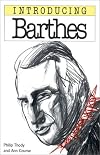
This should have got three stars as a bog standard basic introduction to the semiologist, Roland Barthes, but the graphics really do let it down and graphics are an essential element in this series which sells itself on using imagery to help get across complex ideas. The fact that Barthes was a sort of philosopher not only of language but of images makes this weakness doubly embarrassing.
And why is it so poor - other than looking as if it were little more than scribbles on a page? Because of show more a strange obsession with penises and sex that the artist, Ann Course, seems to have.
There is a natural point where sex comes into play but the interest here seems unnecessarily obsessive - not only in the insistence of five pages devoted to illustrating De Sade's range of perversity and the images of the homosexual Barthes buggering people but the repeated motif of willies on nearly every page in the first half, not a few of them clearly erect if clothed. Fine, nothing wrong with willies but the pictures and a strange leitmotif of a robot like creature with eyes on stalks add absolutely nothing to the argument.
The textual argument itself is fine as far as it goes (it is basically an hour's lecture) - though clearly Philip Thody isn't entirely convinced by his own subject, something which becomes fairly clear by the end. The truth is that Barthes is a bit of a one-trick pony, fashionable in his day, but a foot note in intellectual history. Perhaps he will always have to be read by anyone curious about the shenanigans of the post-war French Left Bank and, yes, he adds his bit to the general sense of cynical libertarianism that was part of the culture of the Generation of 68 but, no, he does not really say anything that others have not said better.
The flaw in post-structuralism is the obvious one - the great, 'so what?' that it inspires. We are living in a world of codes and significations - so what? Humans need narrative and codes and significations to create narrative - so what? Do the post-structuralists posit truth? or just expose lies?
And then it hits you - these people are just Gallic moralists with their visceral and unfair hatred of the 'bourgeois' and often silly (and soon dropped) adulation of the masses. There is no consideration of the human right to be self-deluded as a means of psychic survival in a dangerous world nor of the fact that the deluded and the aware are to be found in all walks of life regardless of their relationship to the means of production. Willing suspension of belief or, indeed, of disbelief is how we get along - observe the hysteria over Obama in recent weeks.
And as for Barthes' 'obsession' - that we can be artistically moved by the non-existent. Again, so what? Diana's funeral is a great 'movement' of this sort and some lost themselves in the nonsense (which is their right) while others saw through it and chose to stay silent so as not to hurt the feelings of the insanely sentimental. But we did not need post-structuralists to tell us what was going on? We knew it or we chose subconsciously not to know it - that is what being human is all about.
The knowers are not morally superior to the deluded - just different and with a rightful caution about what happens when the deluded capture the State and other forms of power over the undeluded. Fortunately one set of deluded usually dislikes the pretensions of the others enough to enable some degree of protection for those who can see the bones beneath the skin of society and culture.
In the end, we are left with another case of intellectuals discovering the bleeding obvious and then packaging it for a career. The squabbles between intellectuals in France in the 1970s about Racine seem to be mere repetitions in style (though not in content) of those between Catholics and Jansenists and not much better than that between the monks whose fisticuffs in Jerusalem are reported today (November 9th, 2008) - futile grandstanding between egos and tribes. So much intellectual effort to so little purpose ... show less
And why is it so poor - other than looking as if it were little more than scribbles on a page? Because of show more a strange obsession with penises and sex that the artist, Ann Course, seems to have.
There is a natural point where sex comes into play but the interest here seems unnecessarily obsessive - not only in the insistence of five pages devoted to illustrating De Sade's range of perversity and the images of the homosexual Barthes buggering people but the repeated motif of willies on nearly every page in the first half, not a few of them clearly erect if clothed. Fine, nothing wrong with willies but the pictures and a strange leitmotif of a robot like creature with eyes on stalks add absolutely nothing to the argument.
The textual argument itself is fine as far as it goes (it is basically an hour's lecture) - though clearly Philip Thody isn't entirely convinced by his own subject, something which becomes fairly clear by the end. The truth is that Barthes is a bit of a one-trick pony, fashionable in his day, but a foot note in intellectual history. Perhaps he will always have to be read by anyone curious about the shenanigans of the post-war French Left Bank and, yes, he adds his bit to the general sense of cynical libertarianism that was part of the culture of the Generation of 68 but, no, he does not really say anything that others have not said better.
The flaw in post-structuralism is the obvious one - the great, 'so what?' that it inspires. We are living in a world of codes and significations - so what? Humans need narrative and codes and significations to create narrative - so what? Do the post-structuralists posit truth? or just expose lies?
And then it hits you - these people are just Gallic moralists with their visceral and unfair hatred of the 'bourgeois' and often silly (and soon dropped) adulation of the masses. There is no consideration of the human right to be self-deluded as a means of psychic survival in a dangerous world nor of the fact that the deluded and the aware are to be found in all walks of life regardless of their relationship to the means of production. Willing suspension of belief or, indeed, of disbelief is how we get along - observe the hysteria over Obama in recent weeks.
And as for Barthes' 'obsession' - that we can be artistically moved by the non-existent. Again, so what? Diana's funeral is a great 'movement' of this sort and some lost themselves in the nonsense (which is their right) while others saw through it and chose to stay silent so as not to hurt the feelings of the insanely sentimental. But we did not need post-structuralists to tell us what was going on? We knew it or we chose subconsciously not to know it - that is what being human is all about.
The knowers are not morally superior to the deluded - just different and with a rightful caution about what happens when the deluded capture the State and other forms of power over the undeluded. Fortunately one set of deluded usually dislikes the pretensions of the others enough to enable some degree of protection for those who can see the bones beneath the skin of society and culture.
In the end, we are left with another case of intellectuals discovering the bleeding obvious and then packaging it for a career. The squabbles between intellectuals in France in the 1970s about Racine seem to be mere repetitions in style (though not in content) of those between Catholics and Jansenists and not much better than that between the monks whose fisticuffs in Jerusalem are reported today (November 9th, 2008) - futile grandstanding between egos and tribes. So much intellectual effort to so little purpose ... show less

"He wanted, as he said in 1949, to be able to write as Mozart composed music. This is an ambition which he still has, but one which he knows cannot be realized by turning his back upon the human tragedy. It is from Camus's awareness of this tragedy, coupled with his integrity both as a thinker and as an artist, that we can confidently expect many more admirable works of art from one of the greatest humanists of our day"
Philip Thody wrote this in 1957 as the conclusion to his review of show more Albert Camus published works. He did not of course realize that Camus would die in an automobile accident in 1960 without publishing anything else of significance. In effect Thody's [A Study of his Work] is a complete critical biography and one that has been written while Camus was still alive. Therefore this is a contemporaneous text written with a feel for the times in which Camus lived and which I think adds much to our understanding of Camus thoughts and reflections of that world and milieu.
Thody emphasises that the ideas and themes behind Camus works are as important as his artistry and literary techniques and therefore to really appreciate this writer the reader needs to understand both these aspects. Thody leads us through the works chronologically demonstrating how Camus thoughts/philosophy develops as his writing matured. Camus as we know was off to a great start with his first novel [The Stranger] and Thody explains just what Camus was getting at with his ideas on the "absurd world" in which he believe we all lived, pointing out the effects of the Second World War on the intellectual climate and on Camus writing his book in 1940-42. Thody also explains how important this novel was to intellectual thought in France at the time. He also discusses the plays and the essays in [The Myth of Sisyphus] pointing out how Camus ideas of "revolte" would lead to a difference of opinion with the leading existentialists. Thody's chapter on [The Plague] is excellent as he develops further his ideas on Camus answers to the absurd world and how humans can resist that plague. He also brings out themes of exile and separation and how people at the time of the novel's publication believed the plague was a metaphor for the Nazi's invasion of Paris. Thody continues to lead the reader by the hand as he attempts to come to terms with the ideas held in Camus difficult third novel: [L'homme revolte] (the Rebel). There are again excellent chapters on the short stories, essays and Camus final masterpiece [The Fall]
Throughout this book of literary criticism Thody takes a fair minded view of Camus achievements and his final chapter entitled "achievements and limitations" is a fine piece of writing summing up just how much Camus had accomplished. For me Thody pitches his analysis perfectly, his explanations are clear and fairly concise and he lets Camus speak for himself whenever it is appropriate, using passages form his books as examples. I gained much from this relatively short book of 120 odd pages which in addition has a postscript and plenty of notes which include passages from the works of Camus in their original language. It serves as a very good guide for the general reader and I would rate it at 4.5 stars show less
Philip Thody wrote this in 1957 as the conclusion to his review of show more Albert Camus published works. He did not of course realize that Camus would die in an automobile accident in 1960 without publishing anything else of significance. In effect Thody's [A Study of his Work] is a complete critical biography and one that has been written while Camus was still alive. Therefore this is a contemporaneous text written with a feel for the times in which Camus lived and which I think adds much to our understanding of Camus thoughts and reflections of that world and milieu.
Thody emphasises that the ideas and themes behind Camus works are as important as his artistry and literary techniques and therefore to really appreciate this writer the reader needs to understand both these aspects. Thody leads us through the works chronologically demonstrating how Camus thoughts/philosophy develops as his writing matured. Camus as we know was off to a great start with his first novel [The Stranger] and Thody explains just what Camus was getting at with his ideas on the "absurd world" in which he believe we all lived, pointing out the effects of the Second World War on the intellectual climate and on Camus writing his book in 1940-42. Thody also explains how important this novel was to intellectual thought in France at the time. He also discusses the plays and the essays in [The Myth of Sisyphus] pointing out how Camus ideas of "revolte" would lead to a difference of opinion with the leading existentialists. Thody's chapter on [The Plague] is excellent as he develops further his ideas on Camus answers to the absurd world and how humans can resist that plague. He also brings out themes of exile and separation and how people at the time of the novel's publication believed the plague was a metaphor for the Nazi's invasion of Paris. Thody continues to lead the reader by the hand as he attempts to come to terms with the ideas held in Camus difficult third novel: [L'homme revolte] (the Rebel). There are again excellent chapters on the short stories, essays and Camus final masterpiece [The Fall]
Throughout this book of literary criticism Thody takes a fair minded view of Camus achievements and his final chapter entitled "achievements and limitations" is a fine piece of writing summing up just how much Camus had accomplished. For me Thody pitches his analysis perfectly, his explanations are clear and fairly concise and he lets Camus speak for himself whenever it is appropriate, using passages form his books as examples. I gained much from this relatively short book of 120 odd pages which in addition has a postscript and plenty of notes which include passages from the works of Camus in their original language. It serves as a very good guide for the general reader and I would rate it at 4.5 stars show less

This book is a good mix of biography and literary criticism. In a mere 142 pages, one gets to understand the influences on Sartre and the significance of each of his works.
The only problem that I have is that the biographical details are perhaps given too much of the centre stage. Much is made of his early life and the relationship between his parents and grandparents. Whilst these are, of course, important to Sartre, as they are to everyone else, the implication that he became an author show more because of these relationships, is a little too glib.
Worth a read and I know much more about Sartre the man than before. show less
The only problem that I have is that the biographical details are perhaps given too much of the centre stage. Much is made of his early life and the relationship between his parents and grandparents. Whilst these are, of course, important to Sartre, as they are to everyone else, the implication that he became an author show more because of these relationships, is a little too glib.
Worth a read and I know much more about Sartre the man than before. show less
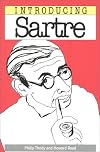
I’m no philosopher, but I love these “Introducing . . .” or “. . . for Beginners” books. They’re full of drawings that help you remember the key points of a person’s philosophy without needing a degree to get started.
Sarte, as most of you already know if you’re looking this up, was a French existentialist who protested the French occupation of Algeria and believed socialism was the answer to the oppression of the working class. He believed strongly in human freedom, but not show more in a positive way. Humans are free because they are always one step removed from experiences—they always have a choice in their response to circumstance. Sarte believed that humans always wish they could live the experiences directly, without being one step removed.
If there are any philosophers out there reading this, feel free to correct me. The preceding paragraph is merely my summary of a beginner’s book on a brilliant thinker. For those looking for an introduction to his life and works, this book will get you thinking. show less
Sarte, as most of you already know if you’re looking this up, was a French existentialist who protested the French occupation of Algeria and believed socialism was the answer to the oppression of the working class. He believed strongly in human freedom, but not show more in a positive way. Humans are free because they are always one step removed from experiences—they always have a choice in their response to circumstance. Sarte believed that humans always wish they could live the experiences directly, without being one step removed.
If there are any philosophers out there reading this, feel free to correct me. The preceding paragraph is merely my summary of a beginner’s book on a brilliant thinker. For those looking for an introduction to his life and works, this book will get you thinking. show less
You May Also Like


Associated Authors
Statistics
- Works
- 25
- Also by
- 1
- Members
- 795
- Popularity
- #32,057
- Rating
- 3.7
- Reviews
- 8
- ISBNs
- 85
- Languages
- 5