
Yevgeny Yevtushenko (1933–2017)
Author of Penguin Modern European Poets : Yevtushenko : selected poems
About the Author
Yevgeny Yevtushenko was born Yevgeny Aleksandrovich Gangnus on July 18, 1933, in Zima Junction, a remote lumber station on the trans-Siberian Railway in the Irkutsk region of Siberia. He became a poet whose work inspired a generation of young Russians in their fight against Stalinism during the show more Cold War. His poems included Zima Junction, My Beloved Will Come, Stalin's Heirs, Babi Yar, and Russian Tanks in Prague. He also wrote two novels including Don't Die Before You're Dead. He died on April 1, 2017 at the age of 83. (Bowker Author Biography) show less
Image credit: Photo by Ellen Wright, 2006
Works by Yevgeny Yevtushenko
Bratsk Station,: The city of yes & the city of no and other new poems (The Sun poetry series) (1970) 13 copies
Poesie 7 copies
Mellem byen ja og byen nej 6 copies
La stazione di Zimà 5 copies
Poesie d'amore 5 copies
Olen vaiti ja huudan 5 copies
Autobiografía precoz 3 copies
Poesie 1952-1973 2 copies
Reden über Deutschland . die Reden wurden gehalten auf dem "Münchner Podium in den Kammerspielen '90" (1990) 2 copies
La stazione di Zima e altri versi 2 copies
Poesie 2 copies
I Came To You, Babi Yar... 2 copies
Идут белые снеги... 2 copies
Евг. Евтушенко 1 copy
Rassegna Sovietica 1 copy
In beginning was word 10 centuries Russian poezii t1 anthology V nachale bylo slovo 10 vekov russkoy poezii T1 antologiya (2008) 1 copy
"Non sono nato tardi" 1 copy
Māte un neitronbumba : poēma 1 copy
Катер связи [Стихи] 1 copy
Condannato all'immortalità 1 copy
Half-Way to the Moon 1 copy
Invisible threads / 1 copy
PRECOCIOUS AUTOBIOGRAPHY 1 copy
Selected Poems. Translated with an Introduction by Robin Milner-Gulland and Peter Levi, S.J. (1962) 1 copy
Le betulle nane 1 copy
Não Morra Antes De Morrer 1 copy
Poetry 1 copy
BAHAR DAR OUKRAEIN 1 copy
Tyazhelee Zemli 1 copy
Il vento del domani 1 copy
Ébredő város [versek] 1 copy
Babij Jar och andra dikter 1 copy
כביש הנלהבים : שירים 1 copy
Vzmakh ruki: stikhi 1 copy
Poesie d’amore 1 copy
Ébredő város 1 copy
Zima Kavşağı 1 copy
Associated Works
Democracy in Print: The best of the Progressive Magazine, 1909-2009 (2009) — Contributor — 14 copies
Moderne russische Erzähler — Author — 1 copy
Tagged
Common Knowledge
- Canonical name
- Jevtoesjenko, Jevgeni
- Legal name
- Evtushenko, Evgeny Aleksandrovich
- Other names
- Gangnus, Yevgeny Aleksandrovich (birth name)
- Birthdate
- 1933-07-18
- Date of death
- 2017-04-01
- Gender
- male
- Education
- Gorky Institute of Literature
- Occupations
- poet
film director
teacher
novelist
essayist
dramatist (show all 10)
screenwriter
publisher
actor
editor - Organizations
- USSR Writer's Union
- Awards and honors
- Ovid Prize (2007)
Royal Spanish Academy of Fine Arts
American Academy of Arts and Letters (1987) - Relationships
- Akhmadulina, Bella (1st wife)
Yevtushenko, Sasha (son) - Cause of death
- heart failure
- Nationality
- USSR
Russia - Birthplace
- Zima Junction, USSR
- Places of residence
- Zima, Siberia, USSR
Moscow, Russia, USSR
Tulsa, Oklahoma, USA
Manhattan, New York, New York, USA - Place of death
- Tulsa, Oklahoma, USA
- Burial location
- Peredelkino cemetery, Moscow, Russia
Members
Reviews
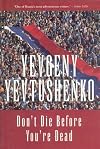
While sublime on its own accord, it should be perhaps pursued in tandem w/ Remnick's Lenin's Tomb for purposes of context. One couldn't imagine a better example of poet's journalism. This shouldn't be confused with poetic journalism, of which Robert Musil was a licensed practitioner. No this a poet parsing reality as history hemorrhages. The eloquence of the event becomes an image: Rostapovich with a Kalashnikov and a girl named Boat lost to the whimsy of Time.

From my guts I learned the hunger of war
My ribs taught me the geography of Russia
Yevtushenko has always impressed me as a novelist and essayist. This first venture into his verse did not reflect those earlier joyful successes. The opening poem I Would Like is a cry for a nuanced appreciation of everything, a plea that all should have the experiences of those separated by land, class or tongue. The next poem is Fuku, a 70 page exploration of the legacy of hatred and destruction. Fuku itself show more is an African word meaning agent of misfortune and through the poem we touch base with the Gulag, Harlem, Paula Hitler and a depressing host of road-side attractions of atrocity: name dropping napalm and Pinochet all along its merry way. From there matters just appeared to unravel, singing the praises of the hungry children and Louis Armstrong's sweat. It was appropriate that while reading this volume I listened to the Dylan Bootleg series Volumes 1-3. Despite so much beauty, so many things have not aged well. show less
My ribs taught me the geography of Russia
Yevtushenko has always impressed me as a novelist and essayist. This first venture into his verse did not reflect those earlier joyful successes. The opening poem I Would Like is a cry for a nuanced appreciation of everything, a plea that all should have the experiences of those separated by land, class or tongue. The next poem is Fuku, a 70 page exploration of the legacy of hatred and destruction. Fuku itself show more is an African word meaning agent of misfortune and through the poem we touch base with the Gulag, Harlem, Paula Hitler and a depressing host of road-side attractions of atrocity: name dropping napalm and Pinochet all along its merry way. From there matters just appeared to unravel, singing the praises of the hungry children and Louis Armstrong's sweat. It was appropriate that while reading this volume I listened to the Dylan Bootleg series Volumes 1-3. Despite so much beauty, so many things have not aged well. show less
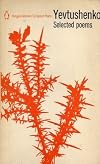
Yevgeny Yevtushenko is the fearless spokesman of his generation in Russia. In verse that is young, fresh and outspoken he frets at restraint and injustice, as in his now famous protest over the Jewish pogrom at Kiev.

Page 200 of Yevtushenko's Wild Berries was reached last night before the soft tumble into dreamseas. The novel has been quite vivid both to location and to character. as to the latter, it reminds me of Turgenev's Sketches, tiny knots of human sensibility brushing one another in fornt of the hearth. The scenery of the tiaga must be amazing, breeding a not-necessarly nietzchean sense of the eternal return. It becmae quite clear that my travels northwward in upper Michigan and southern Sweden show more were not of this stripe.
The book reminded me initially of Bitov, especially given his tendency to lyricize the habit of fauna in place of recognizing the human government around him. This changes around p. 70 with a series of characters reminiscing on the Civil War and the famines which stripped the Ukraine in the 30s. Stalin himself is not named, at least so far in the novel but the entire spectrum of human endeavor is displayed, most notably amongst the geologists sent to the tiagra to locate a strata of mineral (a subtle contrast, perhaps, between urban/intellectual and rural). show less
The book reminded me initially of Bitov, especially given his tendency to lyricize the habit of fauna in place of recognizing the human government around him. This changes around p. 70 with a series of characters reminiscing on the Civil War and the famines which stripped the Ukraine in the 30s. Stalin himself is not named, at least so far in the novel but the entire spectrum of human endeavor is displayed, most notably amongst the geologists sent to the tiagra to locate a strata of mineral (a subtle contrast, perhaps, between urban/intellectual and rural). show less
Lists
You May Also Like


Associated Authors
Statistics
- Works
- 123
- Also by
- 8
- Members
- 1,947
- Popularity
- #13,217
- Rating
- 3.8
- Reviews
- 20
- ISBNs
- 135
- Languages
- 13
- Favorited
- 7