

Eugen Weber (1925–2007)
Author of Peasants into Frenchmen: The Modernization of Rural France, 1870-1914
About the Author
Eugen Weber is Joan Palevsky Professor of Modern European History, Emeritus, at the University of California, Los Angeles. Among his many publications is France, Fin de Siecle (Harvard).
Works by Eugen Weber
Peasants into Frenchmen: The Modernization of Rural France, 1870-1914 (1976) — Author — 263 copies, 3 reviews
Apocalypses: Prophecies, Cults, and Millennial Beliefs through the Ages (1999) 175 copies, 4 reviews
A Modern History of Europe: Men Cultures and Societies from the Renaissance to the Present (1971) 47 copies
Paths to the Present: Aspects of European Thought from Romanticism to Existentialism. (1960) 23 copies
Movements, Currents, Trends: Aspects of European Thought in the Nineteenth and Twentieth Centuries (Sources in Modern History Series) (1992) 10 copies
Une histoire de l'Europe. 2 Des Lumières à nos jours -: hommes, cultures et sociétés de la Renaissance à nos jours (1987) 5 copies
Une Histoire de l'Europe, hommes, cultures et sociétés de la Renaissance à nos jours, tome 1 : De la Renaissance au XVIIIe siècle (1986) 3 copies
La France de nos aïeux : La fin des terroirs, Les imaginaires et la politique au XXe siècle (2005) 2 copies
Paris: La Belle Époch 1 copy
WESTERN TRADITION 1 copy
Associated Works
Tagged
Common Knowledge
- Canonical name
- Weber, Eugen
- Legal name
- Weber, Eugen Joseph
- Birthdate
- 1925-04-24
- Date of death
- 2007-05-17
- Gender
- male
- Education
- Ashville College, Harrogate, England, UK
Sorbonne University
University of Cambridge
Institut d'Etudes Politiques de Paris - Occupations
- professor (History)
lecturer
author - Organizations
- University of California, Los Angeles
- Awards and honors
- Ordre National des Palmes Académiques
American Academy of Arts and Sciences - Short biography
- Romanian-born, English-educated American historian who was one of the world’s foremost interpreters of modern France and an authority on modern Europe. In addition to writing books, Weber was a popular lecturer, most famous for his public television series on the Western tradition.
- Nationality
- USA
- Birthplace
- Bucharest, Romania
- Places of residence
- California, USA
England, UK
Paris, France - Place of death
- Brentwood, California, USA
Members
Reviews

The closing of a century is a time of change in history and culture. This was never more true than at the end of the nineteenth century; the era now known as the "fin de siecle". Eugen Weber focuses on France in this fine history of that era. It is a history organized topically rather than chronologically. Thus Weber offers discussion of the lives of people, their way of living and the impact of technological changes. The change in political and educational patterns highlight how the old show more morphs into the new even in this area. Anyone interested in the arts is treated to a discussion of decadence which opens the book. There is the naturalism of writers like Zola, but also the neurosis of the age with hints of Freud and Nietzsche. Even sports is not neglected in this eclectic and always fascinating picture of the end of a century. show less

The behavior of France in World War II always perplexed me. It appeared the French simply said, "C'est la vie", and all but invited the Germans to walk right on in without much of a fight. It has forever tainted France, to the point where I have travelled worldwide and have heard jokes about the lack of resolve for Frenchmen.
Yet, for almost 120 years, France was a mighty war power. Napoleon set in bootprints the path his countrymen would take, and it carried into the mid-nineteenth century show more where France was considered the greatest military power on the continent (not the Brits, who focused on industry and empire consolidation). Mon dieu, what happened?
The Crimean War happened. The Franco-Prussian War happened. World War I happened. By the time the 1930s came around, France had enough of war and the senseless slaughter of seemingly every other generation of young men. While this doesn't excuse their limp response to Hitler, it does explain the background leading to the beginning of WWII.
Eugen Weber does a good job of understanding that the basic reader will be opening the book with the same question I had, and he takes the reader briskly through history and the results. Still, the results leave one saddened...Great Britain also had the disastrous Crimean War and the Boer War, plus the generation lost in the Great War. Yet, the Brits never gave up, even with the bombing that cost them more civilian lives than the French endured from the Nazis.
So, perhaps, in the end, one thinks that maybe the backbone of a nation is its leaders...England had Churchill and the good fortune to have a King whose brother might have brought the nation to surrender. France had destroyed its monarchy long ago and seemingly any sense of leadership. Maybe it's easy for me to sit back and decide what history should have been without having experienced the trauma preceding the fact. Still, it doesn't excuse the Vichy Regime and the handing over of France's Jewish population.
For shame, my father's people, for shame.
Book Season = Spring (April in Paris might help) show less
Yet, for almost 120 years, France was a mighty war power. Napoleon set in bootprints the path his countrymen would take, and it carried into the mid-nineteenth century show more where France was considered the greatest military power on the continent (not the Brits, who focused on industry and empire consolidation). Mon dieu, what happened?
The Crimean War happened. The Franco-Prussian War happened. World War I happened. By the time the 1930s came around, France had enough of war and the senseless slaughter of seemingly every other generation of young men. While this doesn't excuse their limp response to Hitler, it does explain the background leading to the beginning of WWII.
Eugen Weber does a good job of understanding that the basic reader will be opening the book with the same question I had, and he takes the reader briskly through history and the results. Still, the results leave one saddened...Great Britain also had the disastrous Crimean War and the Boer War, plus the generation lost in the Great War. Yet, the Brits never gave up, even with the bombing that cost them more civilian lives than the French endured from the Nazis.
So, perhaps, in the end, one thinks that maybe the backbone of a nation is its leaders...England had Churchill and the good fortune to have a King whose brother might have brought the nation to surrender. France had destroyed its monarchy long ago and seemingly any sense of leadership. Maybe it's easy for me to sit back and decide what history should have been without having experienced the trauma preceding the fact. Still, it doesn't excuse the Vichy Regime and the handing over of France's Jewish population.
For shame, my father's people, for shame.
Book Season = Spring (April in Paris might help) show less
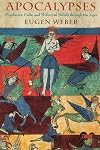
I tried to read this a couple of times but just couldn't get past the first third. There's simply much too much information crammed into such a short book that it leaves no room for interpretation or for a coherent narrative to emerge. It might serve scholars as a timeline of apocalyptic-inspired events, but it's just a trudge to a lay reader like me.

Eugen Weber appropriately begins his book on apocalypses with a discussion of chronologies and the fin de siecle for, as he discusses, time is a social construct and the nature of fin de siecles is dependent upon this. The differing perspectives of time and the way we view historical events is the jumping off point for his discussion of the views and beliefs of people over the years regarding the end times. It is the book of Revelation and the "dark and bloody" apocaplypse that is described show more there that captured my imagination and was a starting point for a tour through history of the varying adpatations and expectations of humans regarding Apocalypses over the centuries. These views continue into our own violent and bloody century (both current and immediately preceding) where there are groups like the "Millenium Watch Institute" that keeps "an eye out for signs of the Coming" (p 209). Whether considered as "a growth industry" or a phenomenon of one of many belief systems, Armageddon has been a concept that has captured the imagination of humans for ages. Eugen Weber shares some insights on the history of this and other apocalyptic ideas in this fascinating and informative book. show less
Lists
Awards


You May Also Like


Associated Authors
Statistics
- Works
- 44
- Also by
- 1
- Members
- 1,340
- Popularity
- #19,206
- Rating
- 3.6
- Reviews
- 14
- ISBNs
- 85
- Languages
- 7
- Favorited
- 3


