
Alistair Horne (1925–2017)
Author of A Savage War of Peace: Algeria 1954-1962
About the Author
Alistair Allan Horne was born in London, England on November 9, 1925. He enlisted in the Royal Air Force, but failed to qualify for pilot training because of poor eyesight. He later joined the Coldstream Guards, attaining the rank of captain. When the war ended, he was transferred to the show more Intelligence Corps and stationed in Cairo where he monitored Soviet activity in the Balkans. He received a master's degree in English in 1949 from Jesus College, Cambridge. Before becoming an author, he was a foreign correspondent for The Daily Telegraph and a spy for MI6, Britain's foreign intelligence service. His books included The Fall of Paris: The Siege and the Commune, 1870-71; To Lose a Battle: France 1940; Small Earthquake in Chile: A Visit to Allende's South America; The French Army and Politics, 1870-1970; Seven Ages of Paris; The Age of Napoleon; La Belle France: A Short History; and Kissinger: 1973, The Crucial Year. The Price of Glory: Verdun 1916 won the Hawthornden Prize and A Savage War of Peace: Algeria 1954-1962 won the Wolfson Prize. He wrote several memoirs including A Bundle from Britain and But What Do You Actually Do?: A Literary Vagabondage. He was knighted in 2003. He died on May 25, 2017 at the age of 91. (Bowker Author Biography) show less
Series
Works by Alistair Horne
Death of a Generation: Neuve Chapelle to Verdun and the Somme (Library of 20th Century) (1970) 29 copies, 1 review
Small earthquake in Chile: New, revised and expanded edition of the classic account of Allende's Chile (1972) 21 copies
Epoka Napoleonit 1 copy
Slag zonder einde 1 copy
Associated Works
What If? The World's Foremost Military Historians Imagine What Might Have Been (1999) — Contributor; Contributor — 1,940 copies, 27 reviews
What If? 2: Eminent Historians Imagine What Might Have Been (2001) — Contributor — 1,088 copies, 11 reviews
MHQ: The Quarterly Journal of Military History — Autumn 1995 (1995) — Author "In Defense of Montgomery" — 21 copies
MHQ: The Quarterly Journal of Military History — Summer 1992 (1992) — Author "How The Other Side Lived" — 20 copies
MHQ: The Quarterly Journal of Military History — Spring 1998 (1998) — Author "The Overreachers" — 17 copies
MHQ: The Quarterly Journal of Military History — Summer 1998 (1998) — Author "The Bloody Week" — 16 copies
MHQ: The Quarterly Journal of Military History — Summer 1999 (1999) — Author "Paris for the Price of a Mass" — 12 copies
MHQ: The Quarterly Journal of Military History — Winter 2000 (1999) — Author "Greatest Leader: Winston S. Churchill" and "The Battle That Made France" — 10 copies
MHQ: The Quarterly Journal of Military History — Summer 2001 (2001) — Author "The Balloons of Paris" — 10 copies
MHQ: The Quarterly Journal of Military History — Spring 2005 (2005) — Author "In Review: The Franco-Prussian War: The German Conquest of France in 1870-1871" — 9 copies
MHQ: The Quarterly Journal of Military History — Summer 2007 (2007) — Author "In Review: Time at War" — 9 copies
MHQ: The Quarterly Journal of Military History — Summer 2004 (2004) — Author "Antwerp: Allies' Missed Opportunity" — 7 copies
Tagged
Common Knowledge
- Legal name
- Horne, Sir Alistair Allan
- Birthdate
- 1925-11-09
- Date of death
- 2017-05-25
- Gender
- male
- Education
- Millbrook School
Jesus College, University of Cambridge (MA|1949 - English) - Occupations
- foreign correspondent
historian - Organizations
- Royal Air Force, 1943-1944
Coldstream Guards, 1944-1947
The Daily Telegraph - Awards and honors
- Order of the British Empire (Commander, 1992)
Royal Society of Literature (Fellow, 1968)
Légion d'Honneur (Chevalier, 1993)
Knight Bachelor (2002)
Fellow, St Antony's College, Oxford University
Wolfson Prize (1978) - Relationships
- Buckley, William F., Jr. (friend)
- Short biography
- Sir Alistair Horne was born in London in 1925, and has spent much of his life abroad, including periods at schools in the United States and Switzerland. He served with the R.C.A.F. in Canada in 1943 and ended his war service with the rank of Captain in the Coldstream Guards attached to MI5 in the Middle East. He then went up to Jesus College, Cambridge, where he read English Literature and played international ice-hockey. After leaving Cambridge, Alistair Horne concentrated on writing: he spent three years in Germany as correspondent for the Daily Telegraph and speaks fluent French and German. His books include Back into Power; Small Earthquake in Chile; The Price of Glory: Verdun 1916 ; and The Seven Ages of Paris. A Savage War of Peace: Algeria 1954–62 won both the Yorkshire Post Book of the Year Prize and the Wolfson History Award in 1978, and he is the official biographer of Harold Macmillan. In 1970, he founded a research Fellowship for young historians at St Antony’s College, Oxford. In 1992 he was awarded the CBE; in 1993 he received the French Légion d’Honneur for his work on French history and a Litt.D. from Cambridge University.
http://www.panmacmillan.com/author/al... - Nationality
- UK
- Birthplace
- London, Middlesex, England, UK
- Places of residence
- England, UK
USA - Place of death
- Turville, Buckinghamshire, England, UK
- Map Location
- England, UK
Members
Reviews
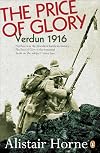
I have a Sick Child right now, which means I'm currently running on less than three hours' sleep. This feels to me like total exhaustion. Still, things could be a lot worse. It's been instructive to remind myself that French soldiers in the line at Verdun not uncommonly went eleven days without any rest at all. Although when I cheerfully reminded my wife of this fact at 4 a.m. she didn't seem to find it very reassuring.
Eleven days though! Imagine trying to confront an armed Brandenburger show more with that level of sleep-deprivation. Luckily, such an eventuality rarely came up: one of the most striking things about Verdun was the fact that you were unlikely ever to face up to the enemy, or even see him. All you had to do was wait until your turn in the front-line trenches, and then endure as much shelling as you could before you were eviscerated.
This perhaps sounds like some grimly comic exaggeration, but in fact the French commanders were quite explicit about the pointless deaths they expected from their men. General Nivelle's orders were to ‘Ne pas se rendre, ne pas reculer d'un pouce, se faire tuer sur place’, while one colonel told his troops: ‘On the day they want to, they will massacre you to the last man, and it is your duty to fall.’
As pep-talks go, that's not exactly the St. Crispin's Day speech from Henry V. In fact it's only a couple of rungs up from ‘Men, why don't all of you fuck off and die.’
What was it all about? Well, the Germans guessed rightly that France would never surrender Verdun, which was a key fortress-town near the front lines. They therefore reckoned that by attacking it continually, they would force the French to sacrifice themselves in order to prevent its loss: ‘the forces of France will bleed to death,’ in the words of the famous German memo, ‘whether we reach our goal or not.’
This subtle plan had, as Captain E. Blackadder would later put it, just one tiny flaw: it was bollocks. The problem was that the Germans attacking Verdun were compelled to haemorrhage troops almost as fast as the French. So you had both armies hurling great bodies of men at each other, both sides constantly decimated by extremely heavy artillery fire, all over an objective that the Germans never even seriously expected to win.
It was very quickly obvious that the whole affair was pointless; but, because of astonishingly limp leadership on both sides, it went on for fully ten months. At the end of which, the front line was in roughly the same place it had been at the beginning and three hundred thousand boys were dead.
As Paul Fussell has pointed out elsewhere, to call Verdun a ‘battle’ – as though this relentless endurance of shelling were remotely similar to Blenheim or Waterloo – is to give entirely the wrong impression. Men did not fight men at Verdun, or very rarely; instead, men were pitted against heavy artillery. They heard little but screaming shells and lived – if they were lucky – half-underground in trenches where the water was often waist-high. The ground had been churned up so many times that corpses were (to borrow a cooking term) folded in throughout, and body-parts protruded from the trench walls or confounded your spade when you tried to dig in.
The psychological effect of this on the soldiers is…well, it can hardly be imagined. One priest, Sergeant Dubrelle, wrote home with some decidedly un-Catholic feelings:
Having despaired of living amid such horror, we begged God not to have us killed – the transition is too atrocious – but just to let us be dead. We had but one desire; the end!
Alistair Horne – rising to the peaks of desperate irony that Verdun demands – comments: ‘At least this part of Dubrelle's prayers was answered the following year.’ Horne's tone and command of his material really is excellent throughout; he is very good on the political side, he offers outstanding character sketches of the major players, but he is also determined to make clear the experience of the regular soldiers who, amidst the horror, enacted ‘countless, unrecorded Thermopylaes’.
Many of the peripheral details here are fascinating. I knew of course that cavalry was still considered a strong tactic at the start of the war, but I had not previously appreciated how proportionally undeveloped was the use of motor-cars. In 1914, there were only 170 vehicles in the entire French army, and the Senegalese troops brought in to the service depots at first ate the grease.
One of the most riveting aspects of learning about the First World War, for me, has been the extent to which it is inseparable from the Second, so that whole period of 1914-1945 can be understood (as one historian said) almost as another Thirty Years War. This element comes across strongly in Horne as well, in unexpectedly tragic ways. It was Verdun that convinced French commanders of the vital necessity of strong forts, leading to their later over-dependence on the Maginot Line; indeed, ‘more than any isolated event of the First War, Verdun led to France's defeat in 1940’. While on the other side of the lines, it created ‘a vacuum of leadership in Germany into which rushed the riff-raff of the Himmlers and Goebbels’.
The most prominent symbol of this trajectory is poor Pétain, who emerges here as one of the great tragic figures of the century. Deeply protective of his troops, by far the most humanitarian French general, he would almost certainly have evacuated the whole Verdun salient if he'd been allowed; instead, he was forced to preside over a protracted slaughter. His resulting defeatism and pessimism were the first steps on the road that led inexorably to Vichy France.
In terms of raw numbers, there were probably more outrageous encounters; 20,000 British alone were killed on just the first day of the Somme, for instance. But what made Verdun uniquely horrific was how long it went on for. Even academic, judicious Horne finds himself concluding that ‘It is probably no exaggeration to call Verdun the “worst” battle in history’, and a microcosm of the wider conflagration:
It was the indecisive battle in an indecisive war; the unnecessary battle in an unnecessary war; the battle that had no victors in a war that had no victors.
One feels deeply that what happened from February to December 1916 was a ghastly mistake for the species as a whole. Then again, perhaps the most appalling thing is the possibility that this is not so. ‘War is less costly than servitude,’ writes the French novelist Jean Dutourd, in a comment that Horne quotes twice and that I found utterly chilling: ‘the choice is always between Verdun and Dachau.’ Now there's a choice to keep you up at night. show less
Eleven days though! Imagine trying to confront an armed Brandenburger show more with that level of sleep-deprivation. Luckily, such an eventuality rarely came up: one of the most striking things about Verdun was the fact that you were unlikely ever to face up to the enemy, or even see him. All you had to do was wait until your turn in the front-line trenches, and then endure as much shelling as you could before you were eviscerated.
This perhaps sounds like some grimly comic exaggeration, but in fact the French commanders were quite explicit about the pointless deaths they expected from their men. General Nivelle's orders were to ‘Ne pas se rendre, ne pas reculer d'un pouce, se faire tuer sur place’, while one colonel told his troops: ‘On the day they want to, they will massacre you to the last man, and it is your duty to fall.’
As pep-talks go, that's not exactly the St. Crispin's Day speech from Henry V. In fact it's only a couple of rungs up from ‘Men, why don't all of you fuck off and die.’
What was it all about? Well, the Germans guessed rightly that France would never surrender Verdun, which was a key fortress-town near the front lines. They therefore reckoned that by attacking it continually, they would force the French to sacrifice themselves in order to prevent its loss: ‘the forces of France will bleed to death,’ in the words of the famous German memo, ‘whether we reach our goal or not.’
This subtle plan had, as Captain E. Blackadder would later put it, just one tiny flaw: it was bollocks. The problem was that the Germans attacking Verdun were compelled to haemorrhage troops almost as fast as the French. So you had both armies hurling great bodies of men at each other, both sides constantly decimated by extremely heavy artillery fire, all over an objective that the Germans never even seriously expected to win.
It was very quickly obvious that the whole affair was pointless; but, because of astonishingly limp leadership on both sides, it went on for fully ten months. At the end of which, the front line was in roughly the same place it had been at the beginning and three hundred thousand boys were dead.
As Paul Fussell has pointed out elsewhere, to call Verdun a ‘battle’ – as though this relentless endurance of shelling were remotely similar to Blenheim or Waterloo – is to give entirely the wrong impression. Men did not fight men at Verdun, or very rarely; instead, men were pitted against heavy artillery. They heard little but screaming shells and lived – if they were lucky – half-underground in trenches where the water was often waist-high. The ground had been churned up so many times that corpses were (to borrow a cooking term) folded in throughout, and body-parts protruded from the trench walls or confounded your spade when you tried to dig in.
The psychological effect of this on the soldiers is…well, it can hardly be imagined. One priest, Sergeant Dubrelle, wrote home with some decidedly un-Catholic feelings:
Having despaired of living amid such horror, we begged God not to have us killed – the transition is too atrocious – but just to let us be dead. We had but one desire; the end!
Alistair Horne – rising to the peaks of desperate irony that Verdun demands – comments: ‘At least this part of Dubrelle's prayers was answered the following year.’ Horne's tone and command of his material really is excellent throughout; he is very good on the political side, he offers outstanding character sketches of the major players, but he is also determined to make clear the experience of the regular soldiers who, amidst the horror, enacted ‘countless, unrecorded Thermopylaes’.
Many of the peripheral details here are fascinating. I knew of course that cavalry was still considered a strong tactic at the start of the war, but I had not previously appreciated how proportionally undeveloped was the use of motor-cars. In 1914, there were only 170 vehicles in the entire French army, and the Senegalese troops brought in to the service depots at first ate the grease.
One of the most riveting aspects of learning about the First World War, for me, has been the extent to which it is inseparable from the Second, so that whole period of 1914-1945 can be understood (as one historian said) almost as another Thirty Years War. This element comes across strongly in Horne as well, in unexpectedly tragic ways. It was Verdun that convinced French commanders of the vital necessity of strong forts, leading to their later over-dependence on the Maginot Line; indeed, ‘more than any isolated event of the First War, Verdun led to France's defeat in 1940’. While on the other side of the lines, it created ‘a vacuum of leadership in Germany into which rushed the riff-raff of the Himmlers and Goebbels’.
The most prominent symbol of this trajectory is poor Pétain, who emerges here as one of the great tragic figures of the century. Deeply protective of his troops, by far the most humanitarian French general, he would almost certainly have evacuated the whole Verdun salient if he'd been allowed; instead, he was forced to preside over a protracted slaughter. His resulting defeatism and pessimism were the first steps on the road that led inexorably to Vichy France.
In terms of raw numbers, there were probably more outrageous encounters; 20,000 British alone were killed on just the first day of the Somme, for instance. But what made Verdun uniquely horrific was how long it went on for. Even academic, judicious Horne finds himself concluding that ‘It is probably no exaggeration to call Verdun the “worst” battle in history’, and a microcosm of the wider conflagration:
It was the indecisive battle in an indecisive war; the unnecessary battle in an unnecessary war; the battle that had no victors in a war that had no victors.
One feels deeply that what happened from February to December 1916 was a ghastly mistake for the species as a whole. Then again, perhaps the most appalling thing is the possibility that this is not so. ‘War is less costly than servitude,’ writes the French novelist Jean Dutourd, in a comment that Horne quotes twice and that I found utterly chilling: ‘the choice is always between Verdun and Dachau.’ Now there's a choice to keep you up at night. show less

A book that sat of my shelf far too long! This was absolutely outstanding. The subject matter is as grim as anything you've ever read, but Horne's telling of the story is superb. I've been reading military history all my life, and to have never known the story of Fort Vaux is a scandal. I myself am guilty of telling the "France can't fight" jokes, but I know better now.
Read this book. It will teach you more about what the human spirit can survive. It will also remind you that man's greatest show more enemy is, and will always be, himself. show less
Read this book. It will teach you more about what the human spirit can survive. It will also remind you that man's greatest show more enemy is, and will always be, himself. show less

Yowza. It is a doozy. Reading this book takes a lot of courage? insight? foolhardiness? and it's best to read it in a few weeks rather than pick up and put down. But gosh how rewarding it is to read it again.
It was originally assigned in my freshman year of college and I only made it through the seizure of Fort Douaumont before I stopped. Could not handle the deaths and the description of the devastated landscapes, and those only got worse as the war progressed.
Re-read it in 1990-91 and just show more mourned the horrendous loss of life that happened day after day during this longest battle of World War I. I had also visited one of the smaller soldiers' graveyards in Verdun as a result of this book and that certainly changed me.
This book was written with great insight into the thinking on both sides, German and French, and how the generals' flawed way of viewing warfare as a way to settle scores or to reclaim their nation's past glory was what led to a this ten-month long battle.
For the Germans, General Falkenhayn's indecisiveness lost several chances for successful German victory during key advances. The idea of l'Attaque à l'outrance of Colonel de Grandmaison was the drumbeat the French side: to attack without a care for the munitions on the other side, let alone one's own life, as a way to purge the shame the French retreat in 1870 during the Franco-Prussian War.
Alistair Horne wrote this detailed book in 1962 and added to it in the early 1990's after the fall of the Berlin Wall. The details he brings to his research span from the French HQ at Chantilly and the disconnect of the generals from the trenches, to the letters home from soldiers detailing the harsh conditions under which they lived during the 10 months of fighting.
There were times I would take a moment from reading and think about 40 shells falling in that minute or two of respite, such as happened on 21st February on the first day of fighting. Then there were the runners who could maybe advance 300 yards before enemy shells killed them or they found shelter in a shell hole full of water and corpses. Descriptions of the aftermath included finding remains of 3 people in the undergrowth, even as late as the 50's and 60's: a wounded soldier and his two stretcher bearers killed by a shell. Horne does not hold back from describing the realities of war, nor should he.
The maps were key to understanding what and where, and I can only wish there were more authors and publishers who would add them to their works.
What we can learn from The Great War is vast. This book is one of the pillars of that study. show less
It was originally assigned in my freshman year of college and I only made it through the seizure of Fort Douaumont before I stopped. Could not handle the deaths and the description of the devastated landscapes, and those only got worse as the war progressed.
Re-read it in 1990-91 and just show more mourned the horrendous loss of life that happened day after day during this longest battle of World War I. I had also visited one of the smaller soldiers' graveyards in Verdun as a result of this book and that certainly changed me.
This book was written with great insight into the thinking on both sides, German and French, and how the generals' flawed way of viewing warfare as a way to settle scores or to reclaim their nation's past glory was what led to a this ten-month long battle.
For the Germans, General Falkenhayn's indecisiveness lost several chances for successful German victory during key advances. The idea of l'Attaque à l'outrance of Colonel de Grandmaison was the drumbeat the French side: to attack without a care for the munitions on the other side, let alone one's own life, as a way to purge the shame the French retreat in 1870 during the Franco-Prussian War.
Alistair Horne wrote this detailed book in 1962 and added to it in the early 1990's after the fall of the Berlin Wall. The details he brings to his research span from the French HQ at Chantilly and the disconnect of the generals from the trenches, to the letters home from soldiers detailing the harsh conditions under which they lived during the 10 months of fighting.
There were times I would take a moment from reading and think about 40 shells falling in that minute or two of respite, such as happened on 21st February on the first day of fighting. Then there were the runners who could maybe advance 300 yards before enemy shells killed them or they found shelter in a shell hole full of water and corpses. Descriptions of the aftermath included finding remains of 3 people in the undergrowth, even as late as the 50's and 60's: a wounded soldier and his two stretcher bearers killed by a shell. Horne does not hold back from describing the realities of war, nor should he.
The maps were key to understanding what and where, and I can only wish there were more authors and publishers who would add them to their works.
What we can learn from The Great War is vast. This book is one of the pillars of that study. show less

Macmillan may be all too easily forgotten today. His tenure as Prime Minister was well over half a century ago and lasted under seven years, during peacetime with little fundamental difference in the economy between when he started and when he finished.
This neglect would be a mistake amidst the turmoil of Brexit because it was Macmillan who laid down the pattern for modern centrist conservatism in three important respects even if a fourth (economic) was thoroughly flattened by Margaret show more Thatcher's hand bag.
These policy imperatives all arose out of the brutal reality of the 1956 Suez Crisis which showed that the British Empire no longer existed as a viable global entity and that the UK had to steer its way through a Cold War world where its rivals were France and a recovering Germany.
It is hard to appeciate the shock of this today. Ten years earlier the British Empire was carving up the world with the United States and the Soviet Union. After Suez, it was not insignificant but it was ailing and a rescued nation and a defeated nation had to be accommodated.
His first policy imperative was to hang on to the coat tails of the United States and re-build the relationship that had almost foundered on Suez. Although Churchill was the founder of modern Atlanticism, Macmillan consolidated it. British centrists are almost defined by this policy.
The second policy imperative was a relationship with Europe that offered the UK as first among equals in partnership with the US. The French and Germans saw through this then as they do today but it set the tone for subsequent Tory commitment to the European Union.
The fact that Macmillan failed to get into the Common Market is not the point. What is the point is that the manipulative political leadership loyal to his world view - notably Ted Heath - hung on in there and made it happen, whittling away sovereignty decade on decade.
The third policy imperative was the dumping of expensive and futile imperial entanglements in Africa in order to try and keep what could be kept of British global influence through the promotion of a sort of soft empire in the Commonwealth.
This was not an unravelling of global influence but an attempt to act quickly to shore it up and it led directly to the Crown's absurd game of 'punching above our weight' and getting hauled into futile wars that defined the great centrist successor to the Tory mantle, Tony Blair.
Atlanticism, Europeanism and 'punching above our weight' were all consolidated by Macmillan into a pattern of statecraft that wobbled under Old Labour but reached its apotheosis under New Labour and then under New Labour's elite version, the Tory Party of David Cameron.
Until 2016 and the Brexit vote, British politics was so defined by this Centrist consensus that the current state of affairs would be totally inconceivable to any serious politician before then. Even now, the bulk of the Labour Party and a rump of Tories have simply 'not got it'.
These three imperatives guided the Tory elite even under Thatcher (despite her Bruges Speech) right up until the fall of Cameron. Even now, the rising populism of the Tory Right is reversing only the European commitment - if anything, Atlanticism and soft trade imperialism are strengthening.
The only significant break was monetarism. Macmillan, a one nation Tory, was prepared to entertain corporatism under conditions where social cohesion was preferable to growth but it was soft monetarism that was effectively adopted by new centrists like Blair.
Macmillan's position, on the other hand, was honed in by a decent horror at the misery caused by economic depression in his own Northern constituency between the wars. He was the epitome of 'one nation' Toryism.
Austerity, yes, if 'necessary' but without Thatcher's petit-bourgeois class war on the working classes. Public school boys do not need to do such things. And presumably moderating Thatcherism was to be comfortable for the Old Etonians in the next century.
In 2015 the Centrist world view was absolute, unchallenged, the basis of political careers and the assumed world view of the administrative classes, the media, managers and the universities. Excepting the incursion of Thatcher's economics, Macmillan's world view had reigned sixty years!
This 1989 Official Biography (the second of two volumes) may not be anything other than a kindly and non-analytical account of a tough but basically decent man yet it is also a reminder of what the Conservative Party is for good or ill - not its members but its elite!
The shock of 2016 is precisely the shock of seeing 'noblesse oblige' pushed aside by democracy and a cardinal plank of the Macmillan Tory Party (and its New Labour successor) being reversed literally over night by a bunch of 'spivs'.
The revolutionary impact of 2016 is very precisely confirmed by the Government's intensification of the other two 'old order' policy imperatives and the appropriation of Thatcher to their cause. To understand the Macmillan years is to understand why Brexit is so traumatic for the Party.
Soft corporatism has gone (a long time ago), the European Union has been rejected - how much longer before questions are raised about Atlanticism as the US flails around in the wake of Trump and 'global influence' is reduced to export trading.
Already many on the Tory Right question the old guard's obsessive, almost demented, Russophobia and prepare to trade on equal terms with the world in preference to FCO posturing and military dabbling. And if they do not go down that route, Corbyn certainly will.
Macmillan, of course, faced a very different Labour Party, which was neither Marxist in the Corbyn sense nor "New Labour" (basically a Tory adaptation) but corporatist and redistributionist within a moderate Atlanticist and post-imperialist model suspicious of Europe.
Labour under Blair and the rebels against Corbyn would probably be unrecognisable to Gaitskell, Wilson, Brown and Callaghan and very likely to have puzzled but possible pleased the wily old fox who then led their rival Conservative Party,
As to the book itself, I am afraid it serves as a record of the times but Horne likes the old man too much as he visits him in his old age. We get very little analysis that is not more than analysis of incident. It really is one of those 'events, dear boy, events' sorts of political biography.
This volume takes up the story in 1956 but Macmillan did have a life after 1963 as a publisher and as Chancellor of Oxford yet these years are dealt with in a desultory manner, based largely on gossip and impressions, so that we do not get a fully rounded view of the older man.
It is thus not so much a biography of the man (though it is to a degree) but a political history from Macmillan's perspective of a premiership. This is probably what most people in 1989 bought the book for - Tories perhaps out of affection - but a better book is needed.
As to the subject, my own politics might suggest that he was flawed in his excessive conservative pessimism about the ability of the UK to stand on its own two feet, over-sentimental about global influence (Blair's abiding fault) and unimaginative in dealing with national economic weakness.
He comes across as a gentleman-politician as one might refer to a gentleman-farmer - good at farming (in his case politics and publishing) and able to turn a profit but really interested in other things. His vision of the nation reflected his own personality and limitations.
But just because one disagrees with a man's politics does not mean you have to dislike him as a person (and vice versa). Macmillan comes across as someone I would have personally liked very much and respected as man, a politician and even as Prime Minister at the time.
It is no surprise to see the loyalty he inspired but also to see him make mistakes. This is a very human Prime Minister with that hinterland which Denis Healey always considered so vital in a politician. In a crisis, he reads Trollope and other masters of English fiction.
The account of the last days is sensitive and feels true. All politicians should read it as a 'memento mori', that having achieved the top of the greasy pole, their end shall be that of all men - declining powers, frustration and eventually death. Macmillan's dignity should be a model for such men.
He was a good sort was Macmillan in many ways ... he got the country out of the Suez pickle and maintained the ship of state on an even keel but his gentlemanly conservatism set us down the route which required the shock of 2016 to get us back on track (if indeed this is allowed to us).
Coasting gently towards the future is not a strategy any more than weakening sovereignty with an excess of alliances and entanglements. Thatcher saw this in class war context sixteen years later but the drift continued to reach its darkest moment in Blair and its final stage in Cameron.
As we write, the Tory Party is in virtual civil war (no less than Labour). That civil war is made up of the pull of those who still accept Macmillan's coasting one nation vision and the push of those who want to restore national sovereignty.
No one knows what will happen next but a restoration of Macmillanism looks very unlikely except as some duff coasting centre party. Macmillan in the midst of the economic crises triggered by monetarism would mutter about national government. Either would be a tragedy.
Centrist have ruled the roost until now because their petty elites controlled undemocratic parties made up of political serfs. Both political parties now have memberships in revolt against such presumption. This is a good thing - it means an end to the politics of coasting.
If the centre cannot hold I shall not be sorry but the man who created it should still be respected as a decent man. This biography at least gives us the data to uncover the roots of today's ineffectual elite centrism yet appreciate the man who created it. show less
This neglect would be a mistake amidst the turmoil of Brexit because it was Macmillan who laid down the pattern for modern centrist conservatism in three important respects even if a fourth (economic) was thoroughly flattened by Margaret show more Thatcher's hand bag.
These policy imperatives all arose out of the brutal reality of the 1956 Suez Crisis which showed that the British Empire no longer existed as a viable global entity and that the UK had to steer its way through a Cold War world where its rivals were France and a recovering Germany.
It is hard to appeciate the shock of this today. Ten years earlier the British Empire was carving up the world with the United States and the Soviet Union. After Suez, it was not insignificant but it was ailing and a rescued nation and a defeated nation had to be accommodated.
His first policy imperative was to hang on to the coat tails of the United States and re-build the relationship that had almost foundered on Suez. Although Churchill was the founder of modern Atlanticism, Macmillan consolidated it. British centrists are almost defined by this policy.
The second policy imperative was a relationship with Europe that offered the UK as first among equals in partnership with the US. The French and Germans saw through this then as they do today but it set the tone for subsequent Tory commitment to the European Union.
The fact that Macmillan failed to get into the Common Market is not the point. What is the point is that the manipulative political leadership loyal to his world view - notably Ted Heath - hung on in there and made it happen, whittling away sovereignty decade on decade.
The third policy imperative was the dumping of expensive and futile imperial entanglements in Africa in order to try and keep what could be kept of British global influence through the promotion of a sort of soft empire in the Commonwealth.
This was not an unravelling of global influence but an attempt to act quickly to shore it up and it led directly to the Crown's absurd game of 'punching above our weight' and getting hauled into futile wars that defined the great centrist successor to the Tory mantle, Tony Blair.
Atlanticism, Europeanism and 'punching above our weight' were all consolidated by Macmillan into a pattern of statecraft that wobbled under Old Labour but reached its apotheosis under New Labour and then under New Labour's elite version, the Tory Party of David Cameron.
Until 2016 and the Brexit vote, British politics was so defined by this Centrist consensus that the current state of affairs would be totally inconceivable to any serious politician before then. Even now, the bulk of the Labour Party and a rump of Tories have simply 'not got it'.
These three imperatives guided the Tory elite even under Thatcher (despite her Bruges Speech) right up until the fall of Cameron. Even now, the rising populism of the Tory Right is reversing only the European commitment - if anything, Atlanticism and soft trade imperialism are strengthening.
The only significant break was monetarism. Macmillan, a one nation Tory, was prepared to entertain corporatism under conditions where social cohesion was preferable to growth but it was soft monetarism that was effectively adopted by new centrists like Blair.
Macmillan's position, on the other hand, was honed in by a decent horror at the misery caused by economic depression in his own Northern constituency between the wars. He was the epitome of 'one nation' Toryism.
Austerity, yes, if 'necessary' but without Thatcher's petit-bourgeois class war on the working classes. Public school boys do not need to do such things. And presumably moderating Thatcherism was to be comfortable for the Old Etonians in the next century.
In 2015 the Centrist world view was absolute, unchallenged, the basis of political careers and the assumed world view of the administrative classes, the media, managers and the universities. Excepting the incursion of Thatcher's economics, Macmillan's world view had reigned sixty years!
This 1989 Official Biography (the second of two volumes) may not be anything other than a kindly and non-analytical account of a tough but basically decent man yet it is also a reminder of what the Conservative Party is for good or ill - not its members but its elite!
The shock of 2016 is precisely the shock of seeing 'noblesse oblige' pushed aside by democracy and a cardinal plank of the Macmillan Tory Party (and its New Labour successor) being reversed literally over night by a bunch of 'spivs'.
The revolutionary impact of 2016 is very precisely confirmed by the Government's intensification of the other two 'old order' policy imperatives and the appropriation of Thatcher to their cause. To understand the Macmillan years is to understand why Brexit is so traumatic for the Party.
Soft corporatism has gone (a long time ago), the European Union has been rejected - how much longer before questions are raised about Atlanticism as the US flails around in the wake of Trump and 'global influence' is reduced to export trading.
Already many on the Tory Right question the old guard's obsessive, almost demented, Russophobia and prepare to trade on equal terms with the world in preference to FCO posturing and military dabbling. And if they do not go down that route, Corbyn certainly will.
Macmillan, of course, faced a very different Labour Party, which was neither Marxist in the Corbyn sense nor "New Labour" (basically a Tory adaptation) but corporatist and redistributionist within a moderate Atlanticist and post-imperialist model suspicious of Europe.
Labour under Blair and the rebels against Corbyn would probably be unrecognisable to Gaitskell, Wilson, Brown and Callaghan and very likely to have puzzled but possible pleased the wily old fox who then led their rival Conservative Party,
As to the book itself, I am afraid it serves as a record of the times but Horne likes the old man too much as he visits him in his old age. We get very little analysis that is not more than analysis of incident. It really is one of those 'events, dear boy, events' sorts of political biography.
This volume takes up the story in 1956 but Macmillan did have a life after 1963 as a publisher and as Chancellor of Oxford yet these years are dealt with in a desultory manner, based largely on gossip and impressions, so that we do not get a fully rounded view of the older man.
It is thus not so much a biography of the man (though it is to a degree) but a political history from Macmillan's perspective of a premiership. This is probably what most people in 1989 bought the book for - Tories perhaps out of affection - but a better book is needed.
As to the subject, my own politics might suggest that he was flawed in his excessive conservative pessimism about the ability of the UK to stand on its own two feet, over-sentimental about global influence (Blair's abiding fault) and unimaginative in dealing with national economic weakness.
He comes across as a gentleman-politician as one might refer to a gentleman-farmer - good at farming (in his case politics and publishing) and able to turn a profit but really interested in other things. His vision of the nation reflected his own personality and limitations.
But just because one disagrees with a man's politics does not mean you have to dislike him as a person (and vice versa). Macmillan comes across as someone I would have personally liked very much and respected as man, a politician and even as Prime Minister at the time.
It is no surprise to see the loyalty he inspired but also to see him make mistakes. This is a very human Prime Minister with that hinterland which Denis Healey always considered so vital in a politician. In a crisis, he reads Trollope and other masters of English fiction.
The account of the last days is sensitive and feels true. All politicians should read it as a 'memento mori', that having achieved the top of the greasy pole, their end shall be that of all men - declining powers, frustration and eventually death. Macmillan's dignity should be a model for such men.
He was a good sort was Macmillan in many ways ... he got the country out of the Suez pickle and maintained the ship of state on an even keel but his gentlemanly conservatism set us down the route which required the shock of 2016 to get us back on track (if indeed this is allowed to us).
Coasting gently towards the future is not a strategy any more than weakening sovereignty with an excess of alliances and entanglements. Thatcher saw this in class war context sixteen years later but the drift continued to reach its darkest moment in Blair and its final stage in Cameron.
As we write, the Tory Party is in virtual civil war (no less than Labour). That civil war is made up of the pull of those who still accept Macmillan's coasting one nation vision and the push of those who want to restore national sovereignty.
No one knows what will happen next but a restoration of Macmillanism looks very unlikely except as some duff coasting centre party. Macmillan in the midst of the economic crises triggered by monetarism would mutter about national government. Either would be a tragedy.
Centrist have ruled the roost until now because their petty elites controlled undemocratic parties made up of political serfs. Both political parties now have memberships in revolt against such presumption. This is a good thing - it means an end to the politics of coasting.
If the centre cannot hold I shall not be sorry but the man who created it should still be respected as a decent man. This biography at least gives us the data to uncover the roots of today's ineffectual elite centrism yet appreciate the man who created it. show less
Lists
Awards


You May Also Like


Associated Authors
Statistics
- Works
- 31
- Also by
- 16
- Members
- 5,891
- Popularity
- #4,189
- Rating
- 3.8
- Reviews
- 87
- ISBNs
- 169
- Languages
- 8
- Favorited
- 11


