
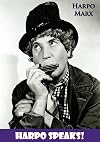
Harpo Marx (1888–1964)
Author of Harpo Speaks!
About the Author
Image credit: Credit: Vandamm Studio
Courtesy of the NYPL Digital Gallery
(image use requires permission from the New York Public Library)
Courtesy of the NYPL Digital Gallery
(image use requires permission from the New York Public Library)
Works by Harpo Marx
The Marx Brothers Silver Screen Collection: The Cocoanuts / Animal Crackers / Monkey Business / Horse Feathers / Duck Soup (1929) — Actor — 127 copies
The Marx Brothers Collection (A Night at the Opera / A Day at the Races/ A Night In Casablanca / Room Service / At the Circus / Go West / The Big Store) (2004) — Actor — 59 copies
Harpo in Hi-Fi 1 copy
Associated Works
Marx Brothers Box Set: Love Happy, A Girl in Every Port, The Cocoanuts, Room Service, Animal Crackers, Monkey Business, Horse Feathers, Duck Soup — Actor — 7 copies
The 4 Marx Brothers at Paramount 1929-1933 (Animal Crackers / The Cocoanuts / Duck Soup / Horse Feathers / Monkey Business) 5 copies, 1 review
The Marx Brothers Collection (A Night at the Opera / A Day at the Races / At the Circus / Go West / The Big Store / A Night in Casablanca) (2004) 4 copies
The Marx Brothers Collection: Animal Crackers / Horse Feathers / Duck Soup — Actor — 2 copies
Die Marx Brothers Radio Show: Im Theater; Im Kaufhaus; Der indische Guru, 1 Audio-CD (2001) — Author — 1 copy
Tagged
Common Knowledge
- Canonical name
- Marx, Harpo
- Legal name
- Marx, Adolph (birth)
Marx, Arthur (changed, 1911) - Birthdate
- 1888-11-23
- Date of death
- 1964-09-28
- Gender
- male
- Occupations
- comedian
actor - Organizations
- Algonquin Round Table
- Relationships
- Marx, Groucho (brother)
Marx, Maxine (niece)
Marx, Bill (son) - Nationality
- USA
- Birthplace
- New York, New York, USA
- Place of death
- Los Angeles, California, USA
- Associated Place (for map)
- USA
Members
Reviews
My third attempt at a Marx Brothers text (a selection of their film bits transcribed by Penguin Modern Classics, and the Groucho letters) and this one is the clear winner. Harpo chronicles their slow rise to comedy history and unravels a lot of the myths and vagaries of the brothers, his own most of all.
Given the subject is a man most well-known for not speaking, the book succeeded in capturing and translating the classic Marx physical slapstick to text (much kudos to the ghostwriter). We show more are given a glimpse of the extraordinarily hard graft that the brothers did prior to their successes, the evolution of some of their best-loved routines, as well Minnie Marx's brilliant foresight and managering.
About two-thirds of the book is when the brothers have made it big, and so is more focused on Harpo's relationship with Alexander Woollcott and the Algonquin Round Table and the lives of the well-off snobs. With the distance of time and text (and probably again kudos to the ghostwriter's digestible style), a lot of their pranks and lifestyles are much more palatable. But otherwise what a tiresome group of moneyed-up toddlers!
It was very sweet to read about Harpo and his wife Susan - an arrested development man and a very persistent starlet! And their four kids through adoption and their wholesome lives on a ranch where Harpo is the silly yet sensible dad who they want to get out of the house sometimes! A classic rags-to-riches autobiography of a very full and contented life. show less
Given the subject is a man most well-known for not speaking, the book succeeded in capturing and translating the classic Marx physical slapstick to text (much kudos to the ghostwriter). We show more are given a glimpse of the extraordinarily hard graft that the brothers did prior to their successes, the evolution of some of their best-loved routines, as well Minnie Marx's brilliant foresight and managering.
About two-thirds of the book is when the brothers have made it big, and so is more focused on Harpo's relationship with Alexander Woollcott and the Algonquin Round Table and the lives of the well-off snobs. With the distance of time and text (and probably again kudos to the ghostwriter's digestible style), a lot of their pranks and lifestyles are much more palatable. But otherwise what a tiresome group of moneyed-up toddlers!
It was very sweet to read about Harpo and his wife Susan - an arrested development man and a very persistent starlet! And their four kids through adoption and their wholesome lives on a ranch where Harpo is the silly yet sensible dad who they want to get out of the house sometimes! A classic rags-to-riches autobiography of a very full and contented life. show less
I became interested in Harpo Marx when I ran across this quote (attributed to him by George Burns): "I’d like to adopt as many children as I have windows in my house. So when I leave for work, I want a kid in every window, waving goodbye."
Someone like that, I told myself, would be worth knowing. So I picked up the autobiography.
It offers a wealth of information on:
- average life in NYC in the 1900s (unsurprisingly not that great. And those ELECTIONS! talk about an experience)
- the glitzy, show more glamorous, carefree 1920s (Incredibly tiring to read about)
- The USSR in the 1940's (Wilder must have heard from him before he filmed "One, Two, Three." *)
- the way we've changed our approach to normal (I'm pretty sure today he would have been diagnosed with multiple disorders which, in turn, could have squashed something touchingly genuine and beautiful)
-Hollywood and its hodgepodge of celebrities (and NYC and its celebrities. No name-dropping here. Marx is genuinely interested in the person or the interaction's potential for humor).
- show business in general (I wouldn't have made it in Vaudeville. And I can just see him now turning up his nose at Garland and Rooney's put-on-a-show films).
- And all the fun you can have if you just stop taking yourself (and life and the culture) too seriously. **
Despite all this (0r perhaps because of all this), Harpo seems like a wonderful human being who probably really said something similar to the quote that started this all. He's naive, caring, accepting, genuine, happy, positive, giving, grateful, and practically every other positive characteristic you could want.... besides the expletives that pop out fairly consistently(NYC-style, I guess), and a couple of off-color stories. But, strangely, I didn't find most of those stories to be offensive-- largely because the facts of life were hardly as taboo in 1900 NYC tenements as they became in 1940-50s suburbia, and because he didn't tell the stories with the intent to tantalize. He told them with the intent to paint an accurate picture of himself and the world around him, to draw attention to a caste/culture that wasn't kind to many involved, and, at the end of the novel and my least favorite of the reasons, to get a couple laughs. I'd rate it PG-13.
* Parental preview suggested
** as much as I feel like people should be accepted, I think Harpo presents a lovely picture about how it doesn't matter what you do or how you behave. The people worth knowing and caring about will naturally flock to you so long as you're a decent human being. Why not just be you and forget about forcing people to accept you? He did. And had a blast it seems like. show less
Someone like that, I told myself, would be worth knowing. So I picked up the autobiography.
It offers a wealth of information on:
- average life in NYC in the 1900s (unsurprisingly not that great. And those ELECTIONS! talk about an experience)
- the glitzy, show more glamorous, carefree 1920s (Incredibly tiring to read about)
- The USSR in the 1940's (Wilder must have heard from him before he filmed "One, Two, Three." *)
- the way we've changed our approach to normal (I'm pretty sure today he would have been diagnosed with multiple disorders which, in turn, could have squashed something touchingly genuine and beautiful)
-Hollywood and its hodgepodge of celebrities (and NYC and its celebrities. No name-dropping here. Marx is genuinely interested in the person or the interaction's potential for humor).
- show business in general (I wouldn't have made it in Vaudeville. And I can just see him now turning up his nose at Garland and Rooney's put-on-a-show films).
- And all the fun you can have if you just stop taking yourself (and life and the culture) too seriously. **
Despite all this (0r perhaps because of all this), Harpo seems like a wonderful human being who probably really said something similar to the quote that started this all. He's naive, caring, accepting, genuine, happy, positive, giving, grateful, and practically every other positive characteristic you could want.... besides the expletives that pop out fairly consistently(NYC-style, I guess), and a couple of off-color stories. But, strangely, I didn't find most of those stories to be offensive-- largely because the facts of life were hardly as taboo in 1900 NYC tenements as they became in 1940-50s suburbia, and because he didn't tell the stories with the intent to tantalize. He told them with the intent to paint an accurate picture of himself and the world around him, to draw attention to a caste/culture that wasn't kind to many involved, and, at the end of the novel and my least favorite of the reasons, to get a couple laughs. I'd rate it PG-13.
* Parental preview suggested
** as much as I feel like people should be accepted, I think Harpo presents a lovely picture about how it doesn't matter what you do or how you behave. The people worth knowing and caring about will naturally flock to you so long as you're a decent human being. Why not just be you and forget about forcing people to accept you? He did. And had a blast it seems like. show less

The silent Marx Brother is surprisingly wordy in this entertaining memoir. Harpo's early days are full of stories of hustling and mischief in a Jewish enclave of Manhattan. Then his mother Minnie shaped the Marx Brothers into a performing troupe with years and years of grueling tours across the country. They become famous on Broadway and then in Hollywood, although Harpo spends surprisingly little time talking about their films.
The book sags a bit when Harpo talks about how his friendship show more with theater critic Alexander Woollcott earned him a spot on the Algonquin Roundtable. There are pages and pages of stories about playing croquet and traveling the world with the literati. Things pick up again in 1933 when Harpo became the first American performer to tour the Soviet Union and how he became a courier for the State Department on the way home. Later parts in the book are charmingly wholesome as he gives up his longtime bachelor status to marry Susan Fleming and together they raise four children.
A great book for fans of the Marx Brothers and anyone with in interest in early 20th century show business. show less
The book sags a bit when Harpo talks about how his friendship show more with theater critic Alexander Woollcott earned him a spot on the Algonquin Roundtable. There are pages and pages of stories about playing croquet and traveling the world with the literati. Things pick up again in 1933 when Harpo became the first American performer to tour the Soviet Union and how he became a courier for the State Department on the way home. Later parts in the book are charmingly wholesome as he gives up his longtime bachelor status to marry Susan Fleming and together they raise four children.
A great book for fans of the Marx Brothers and anyone with in interest in early 20th century show business. show less
Absolutely delightful. Can't recommend enough; just a wonderful read if you're at all interested in unusual life stories. This would be an interesting pairing with Charlie Chaplin's autobiography; both men came from poverty, became expert physical comedians, and eventually wealthy mega-stars. Where Chaplin ends up slightly sour (understandably!), Harpo is warm throughout, even during some hair-raising adventures.
Recommendation: Toward the end of the book, look for his and his wife's show more philosophy on starting and running a family. Their approach to telling their four children, all adopted, their origin story is so special.
As a note, the Hoopla edition is full of typos, so just lower your expectations there and you'll be fine! show less
Recommendation: Toward the end of the book, look for his and his wife's show more philosophy on starting and running a family. Their approach to telling their four children, all adopted, their origin story is so special.
As a note, the Hoopla edition is full of typos, so just lower your expectations there and you'll be fine! show less
Lists
Backlisted (1)
Awards


You May Also Like


Associated Authors
Statistics
- Works
- 10
- Also by
- 29
- Members
- 909
- Popularity
- #28,218
- Rating
- 4.1
- Reviews
- 14
- ISBNs
- 29
- Languages
- 6
- Favorited
- 2

