
Marion Lena Starkey (1901–1991)
Author of The Devil in Massachusetts: A Modern Enquiry into the Salem Witch Trials
About the Author
Image credit: Peoplepill
Works by Marion Lena Starkey
The Devil in Massachusetts: A Modern Enquiry into the Salem Witch Trials (1949) 859 copies, 13 reviews
The Congregational way; the role of the Pilgrims and their heirs in shaping America (1966) 29 copies, 1 review
Lace Cuffs and Leather Aprons: Popular Struggles in the Federalist Era, 1783-1800 (1972) 12 copies, 2 reviews
Associated Works
The Education of Henry Adams: An Autobiography Volume 1 of 2 (1918) — Introduction, some editions — 50 copies
Tagged
Common Knowledge
- Birthdate
- 1901-04-13
- Date of death
- 1991-12-18
- Gender
- female
- Education
- Boston University
Harvard Graduate School of Education - Occupations
- historian
professor
newspaper editor
author - Awards and honors
- Guggenheim Fellowship
- Short biography
- Marion Lena Starkey was born in Worcester, Massachusetts, to an old New England family. One of her ancestors, Peregrine White, was born on the Pilgrim ship Mayflower. She began writing as a child. She earned her B.S. in 1922 and her M.A. in 1935 from Boston University, and attended the Harvard Graduate School of Education. She worked as an editor for the Saugus Herald from 1923 to 1927, and spent two years in the Women’s Army Corps (WACs) during World War II. While in the Army, she saw Morocco, Algeria, Italy, and France, having previously visited Russia, Czechoslovakia, and Mexico in peacetime. She was a professor of English at the Hampton Institute in Virginia and at the University of Connecticut in New London, before becoming a full-time writer. Her most famous book was The Devil in Massachusetts: A Modern Inquiry into the Salem Witch Trials (1949). Working from court records, Miss Starkey created a now-famous psychological portrait tracing the development of the event from child fantasies to societal hysteria. Arthur Miller is said to have used this work in his research for his 1953 play The Crucible. Miss Starkey received a Guggenheim Fellowship to do research in Massachusetts history for her book A Little Rebellion (1955), about the series of revolts that culminated in Shays’ Rebellion. Her other history books included Land Where Our Fathers Died: The Settling of the Eastern Shores, 1607-1735 (1962); Lace Cuffs and Leather Aprons: Popular Struggles in the Federalist Era, 1783-1800 (1972); and a children's book, The Tall Man from Boston (1975).
- Nationality
- USA
- Birthplace
- Worcester, Massachusetts, USA
- Places of residence
- Saugus, Massachusetts, USA
- Place of death
- Saugus, Massachusetts, USA
- Associated Place (for map)
- Massachusetts, USA
Members
Reviews

This is a riveting account of the Salem Witch Trials. Marion Starkey includes just the right amount of detail to portray all the elements of this horrifying story. From the hysteria spun out of fanaticism to the economic and social background that provided a fertile ground, the events unfold in a way that kept this reader spellbound. The author highlights the relationships of the people in the community and how their bonds were broken by the reactions of the accusations of the young girls. show more This was well before the era when hysteria was diagnosed as a psychiatric disorder, thus it seems that the townspeople had fewer coping mechanisms when the emotions went out of control. Neither Church nor Civil authorities were able to maintain control and their actions probably aggravated the crisis. There may be more recent accounts that cover more details, but this is the classic telling of this tale of witchcraft and evil. show less

Religion is dangerous. So are teenage girls. This seems to be the main theme of this book. Starkey has gathered myriad sources on the Salem Witch Trials and managed to put together a cohesive account which is neither dry nor dense. Though written in 1949, it is comprehensible to the modern reader and also fascinating. Starkey has taken great care not to fabricate action or dialogue in order to add drama to her tale; she hardly needs to. She has copied entire sections of dialogue from court show more reports and detailed diaries of eyewitnesses to the trials.
Starkey also claims in her introduction that she has tried to apply some 'modern psychology' to the major players in the conflict, but I saw little evidence of that. There was definitely some borderline personality disorder among the 'afflicted girls,' most notably Abigail Williams.
Overall, an engaging and informative non-fiction work. show less
Starkey also claims in her introduction that she has tried to apply some 'modern psychology' to the major players in the conflict, but I saw little evidence of that. There was definitely some borderline personality disorder among the 'afflicted girls,' most notably Abigail Williams.
Overall, an engaging and informative non-fiction work. show less
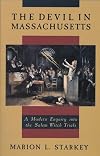
A modern look at the Salem witch trials. First written in 1949, there is nothing about this book that feels dated except the typeface. The author writes history that reads like a novel, and even though it is a history that many have written before and since, she still brings a new voice and some new information. The dry wit and frequent use of what can only be read as sarcasm actually enhances the book. She focuses a great deal more on the character of the 'witches' than on the accusers, but show more she does spend a little time building up the tale to its onset with the first calling out of a witch, perhaps with a bit more interpolation than is acceptable in a purely scientific or historical work, as she makes assumptions about what is going through the mind of young Abigail Williams. After the first chapter, though, she pieces together most of her information from the copious records kept of the hearings, the diaries of people in the town, and other contemporary sources, only occasionally straying inside the psyche of the long-dead, and then usually with a disclaimer about what they "might" be thinking or feeling. Overall, a decent way to spend a few days of my reading time. show less
The devil in Massachusetts: A modern inquiry into the Salem Witch trials (Time reading program special edition) by Marion L. Starkey

I’ve been working my way through a series of books on the Salem witchcraft outbreak of 1692; so far this includes Stacy Schiff’s The Witches, Paul Boyer and Stephen Nissenbaums’s Salem Possessed, and Cotton Mather’s The Wonders of the Invisible World.
Marion Starkey’s The Devil in Massachusetts is the most readable so far, although the almost novelistic treatment may disguise some historical inaccuracy (in her Preface, she notes she “…has taken slight liberties with the show more records”). Her narration is in chronological order and her characters all have real personalities – perhaps not their actual personalities, of course. In Starkey’s version, Reverend Samuel Parris, the slave Tituba, and the children Betty Parris and Abigail Williams are somewhat more culpable in the initial events here than they are in the other books, as is Cotton Mather in the later part of the story (particularly the trial and execution of George Burroughs). Starkey, like Schiff, buys into “hysteria” as the cause of the girls’ accusations – even putting Freud in her references section. Starkey also refers to a suggestion – not in the main text but in her endnotes – that some of the accusers’ “possession” may have been due to consuming or handling Jimson weed. She doesn’t go to far with that and none of the other books I’ve read have mentioned it.
Of the work’s I’ve read, Boyer and Nissenbaum’s is the only one that really goes into the sociological background of what went on – the political and social aspects of living in 17th century Massachusetts. Starkey mentions a little of this – how the inhabitants of Salem were historically contentious, ready to dispute with each other over details of land boundaries and minister’s salaries, and suggests that perhaps some of these disputes may have metamorphosed into accusations of witchcraft.
One of the things that’s missing is any reference to the McCarthy Hearings – because they hadn’t happened yet; this book was written in 1947. And of course the Satanic Panic of the 1970s was decades in the future; in Starkey’s final chapter Massachusetts has redeemed itself by the early 1700s, offering compensation to those accused of witchcraft; there’s not the slightest suggestion that anything like Salem could ever happen again. Optimism springs eternal.
No illustrations. Starkey doesn’t use numbered notes; instead a “Notes” section has a discussion of the sources used for each chapter. There is a good reference section. The index seems sparse; I had a hard time finding some things I wanted to look up. show less
Marion Starkey’s The Devil in Massachusetts is the most readable so far, although the almost novelistic treatment may disguise some historical inaccuracy (in her Preface, she notes she “…has taken slight liberties with the show more records”). Her narration is in chronological order and her characters all have real personalities – perhaps not their actual personalities, of course. In Starkey’s version, Reverend Samuel Parris, the slave Tituba, and the children Betty Parris and Abigail Williams are somewhat more culpable in the initial events here than they are in the other books, as is Cotton Mather in the later part of the story (particularly the trial and execution of George Burroughs). Starkey, like Schiff, buys into “hysteria” as the cause of the girls’ accusations – even putting Freud in her references section. Starkey also refers to a suggestion – not in the main text but in her endnotes – that some of the accusers’ “possession” may have been due to consuming or handling Jimson weed. She doesn’t go to far with that and none of the other books I’ve read have mentioned it.
Of the work’s I’ve read, Boyer and Nissenbaum’s is the only one that really goes into the sociological background of what went on – the political and social aspects of living in 17th century Massachusetts. Starkey mentions a little of this – how the inhabitants of Salem were historically contentious, ready to dispute with each other over details of land boundaries and minister’s salaries, and suggests that perhaps some of these disputes may have metamorphosed into accusations of witchcraft.
One of the things that’s missing is any reference to the McCarthy Hearings – because they hadn’t happened yet; this book was written in 1947. And of course the Satanic Panic of the 1970s was decades in the future; in Starkey’s final chapter Massachusetts has redeemed itself by the early 1700s, offering compensation to those accused of witchcraft; there’s not the slightest suggestion that anything like Salem could ever happen again. Optimism springs eternal.
No illustrations. Starkey doesn’t use numbered notes; instead a “Notes” section has a discussion of the sources used for each chapter. There is a good reference section. The index seems sparse; I had a hard time finding some things I wanted to look up. show less
Lists
Awards


You May Also Like


Associated Authors
Statistics
- Works
- 11
- Also by
- 2
- Members
- 1,031
- Popularity
- #24,977
- Rating
- 3.7
- Reviews
- 17
- ISBNs
- 16