
Mary Beth Norton
Author of In the Devil's Snare: The Salem Witchcraft Crisis of 1692
About the Author
Mary Beth Norton is Mary Donlon Alger Professor of History at Cornell University. She is the author of many books, including Liberty's Daughters: The Revolutionary Experience of American Women, 1750-1800, also from Cornell; In the Devil's Snare: The Salem Witchcraft Crisis of 1692; and Founding show more Mothers Fathers: Gendered Power and the Forming of American Society. show less
Series
Works by Mary Beth Norton
Liberty's Daughters: The Revolutionary Experience of American Women, 1750-1800 (1980) 343 copies, 1 review
Founding Mothers & Fathers: Gendered Power and the Forming of American Society (1996) 257 copies, 1 review
A People and a Nation: A History of the United States, Vol. B: Since 1865 [Brief Edition] (1991) 49 copies
A People and a Nation: A History of the United States, Vol. A: To 1877 [Brief Edition] (1991) 38 copies
Associated Works
I Wish I'd Been There: Twenty Historians Bring to Life Dramatic Events That Changed America (2006) — Contributor — 303 copies, 3 reviews
The Transformation of Early American History: Society, Authority, and Ideology: How the Writings and Influence of Bernard Bailyn Have Changed Our Understanding of the American… (1991) — Contributor — 39 copies, 2 reviews
Tagged
Common Knowledge
- Birthdate
- 1943-03-25
- Gender
- female
- Education
- Harvard University (Ph.D. | 1969)
Harvard University (M.A. | 1965)
University of Michigan (B.A. | 1964) - Occupations
- professor (American history)
historian - Organizations
- Cornell University
American Historical Association (vice-president, president)
National Council on the Humanities
Berkshire Conference of Women Historians
American Academy of Arts and Sciences
Organization of American Historians (show all 12)
Society of American Historians
American Antiquarian Society
Coordinating Council for Women in History
Phi Beta Kappa
Mortar Board
Phi Kappa Phi - Awards and honors
- Stephen H. Weiss Presidential Fellowship (2008)
- Nationality
- USA
- Birthplace
- Ann Arbor, Michigan, USA
- Associated Place (for map)
- Michigan, USA
Members
Reviews
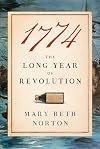
It is a fifteen-month period in the history of North American that changed it forever, during that time British colonists went from being dominated by moderates to dividing to the extremes with bloody consequences. 1774: The Long Year of Revolution by Mary Beth Norton covers the period from December 1773 to April 1775 in which colonists separated into Whigs and Tories, aka Loyalists.
Over the course of 344 of text, Norton shows the reactions to a tax on tea and Parliament giving the East show more India Company direct access to colonial market which led to the final crisis between the colonies and Britain as well a break amongst the patriot colonists themselves when congresses and committees begin to be formed. As a longtime researcher of American Loyalists and Women, respectfully, during the Revolutionary era, Norton brings those elements as well as those well known to general history readers to give great context to this time in Colonial American history that doesn’t get a real in-depth look in histories that cover the period between 1763-1789 given everything that happened. Norton not only deals with what is happening in America, but real times events in Britain—as well as Europe as the year progresses—to show how events happening simultaneously or in reaction to previous events come at the point when debate or discussions have moved on thus showing how this crisis spiraled until bloodshed was inevitable. Overall, this book shows how the events of April 1775 became inevitable when just a year before they were unimaginable.
1774 is an insightful, in-depth history for general history readers as well as those interested in specialized. Mary Beth Norton is an accomplished historian that is well-written and very thorough in her research giving the reader confidence in what they read. show less
Over the course of 344 of text, Norton shows the reactions to a tax on tea and Parliament giving the East show more India Company direct access to colonial market which led to the final crisis between the colonies and Britain as well a break amongst the patriot colonists themselves when congresses and committees begin to be formed. As a longtime researcher of American Loyalists and Women, respectfully, during the Revolutionary era, Norton brings those elements as well as those well known to general history readers to give great context to this time in Colonial American history that doesn’t get a real in-depth look in histories that cover the period between 1763-1789 given everything that happened. Norton not only deals with what is happening in America, but real times events in Britain—as well as Europe as the year progresses—to show how events happening simultaneously or in reaction to previous events come at the point when debate or discussions have moved on thus showing how this crisis spiraled until bloodshed was inevitable. Overall, this book shows how the events of April 1775 became inevitable when just a year before they were unimaginable.
1774 is an insightful, in-depth history for general history readers as well as those interested in specialized. Mary Beth Norton is an accomplished historian that is well-written and very thorough in her research giving the reader confidence in what they read. show less
A fascinating read that argues the big context in New England matters to understanding what has always seemed to be a hyper-localized and idiosyncratic event in the late 17th century. The book subsequently almost becomes as much about the Maine frontier as Salem Village, and as much about Indian wars against the local Wabanakis as about Satan's evil designs upon a town or a colony. It's a compelling argument and makes a lot of sense. What's missing is a convincing explanation for how a show more general context that applies to much of New England north of Boston manifested as a witchcraft crisis in a relatively discrete geographic location. That never really comes together here.
Overall, a good reinterpretation of a well-known (or supposedly so) episode of the pre-Enlightenment American experience. show less
Overall, a good reinterpretation of a well-known (or supposedly so) episode of the pre-Enlightenment American experience. show less
An interesting and fun read on this seminal event in American history. Norton does a phenomenal job challenging many of the popularized caricatures of the Salem Witch Trials including feminist and rationalist interpretations. Far form being a coordinated attack on powerless women by powerful men, Norton shows that the Salem Witch "crisis" was far more women-led than we've been told. Women and their testimonies were overwhelmingly believed in the courtroom, not dismissed. Even men were show more counted among the victims by controversy's end!
I think Norton presents sufficient evidence to categorize the crisis as a product of Indian Wars more than anything else. The vast amount of overlap between victims of the paranormal activity and Indian brutality is hard to ignore. That the colonists in Essex county saw them as one and the same is also evident. show less
I think Norton presents sufficient evidence to categorize the crisis as a product of Indian Wars more than anything else. The vast amount of overlap between victims of the paranormal activity and Indian brutality is hard to ignore. That the colonists in Essex county saw them as one and the same is also evident. show less
Margaret Atwood has noted that one of her inspirations for the "Handmaid’s Tale" was her study of 17th-century Puritan New England. That note in itself might be a reason to dip into this book, and a reader would find some satisfying parallels. But this was not why I read it. I’ve had a long-time interest in the lives and experiences of women (woman studies, as you will) ; I’ve read Mary Beth Norton’s work before (her book on the Salem Witch Trials is one of the best I’ve read, if show more not the best). and because my family roots almost entirely pass through this period in 17th century New England (literally many hundreds of them) so I read out of interest and curiosity, and because it provides context to my ancestry pursuits (oh, and yes, I live in New England). I felt compelled to take copious notes while reading this book, likely one of the reason it took me so long to get through it, and I find these notes of little use in my effort to write a review of this book, nor did notes really enhance my reading (note to self: skip the notes).
.
"Founding Mothers and Fathers" is a balanced study of gendered power in the early 17th century colonies of America (roughly 1620-1670), it notes English political and societal precedents (Filmer and Locke’s formulations of political power and the nature of government authority) and how the precedents were applied in the development of the early colonies of America. Because of the availability of records, Norton focuses mostly on two New England colonies (Massachusetts Bay and New Haven) and two in the Chesapeake (Maryland & Virginia). She discusses gendered power within the family, the community and in the state, and how similar these institutions were to each other. She also discusses how differently New England and the Chesapeake develop according to the differing makeup of their populations and their priorities.
One of the strengths of this book is Norton’s inclusion of the voices of real people presented as articulated through court documents or personal writings. And her illustrative examples are both very welcome and wonderfully effective elucidating the practical functioning of the societies. Much more could be included in this review, and if needed, one can search for the copiously more detailed and erudite reviews for this book online. Otherwise, here is a very modest, off-the-top-of-my-head list of some of the many fascinating and interesting bits of content:
*The importance of good relations with neighbors.
*The authority and investigative powers of the midwife.
*The complications or limitations of a widow becoming a head of household.
*How very little men of the time knew about pregnancy & childbirth and that women were known to be ‘especially knowledgable of sexual matters
*The importance of guarding one’s reputation.
*The power and societal functions of gossip.
*In 1648 the New England colony adopted a death penalty for rebellious children over 16 who cursed or struck either parent (very few were prosecuted).
*The most common insults between men (rogue, knave) and between women (whore, jade, thief, toad, slut).
*How in New England the family was the considered the lowest court in the court system.
*The existence of divorce as a legally voided civil contract.
*To sue a wife you had to sue the husband.
*The exceptions to many of the rules and norms.
*That men had many ways to express their anger and thus possibilities of a vengeful attack was endless.
*The standard punishment in Plymouth for adultery was for the woman to wear a badge on their sleeve with the letters “AD” on it for a period of time, and if found without it, she would be branded on her face.
*A misbehaving colonist was more likely to be tried & convicted in NE than in the Chesapeake and differences in law enforcement.
*Whipping was the 2nd most popular punishment in both regions.
*How in a very gendered world, a Chesapeake court handled the case of an ambiguously gendered person. show less
.
"Founding Mothers and Fathers" is a balanced study of gendered power in the early 17th century colonies of America (roughly 1620-1670), it notes English political and societal precedents (Filmer and Locke’s formulations of political power and the nature of government authority) and how the precedents were applied in the development of the early colonies of America. Because of the availability of records, Norton focuses mostly on two New England colonies (Massachusetts Bay and New Haven) and two in the Chesapeake (Maryland & Virginia). She discusses gendered power within the family, the community and in the state, and how similar these institutions were to each other. She also discusses how differently New England and the Chesapeake develop according to the differing makeup of their populations and their priorities.
One of the strengths of this book is Norton’s inclusion of the voices of real people presented as articulated through court documents or personal writings. And her illustrative examples are both very welcome and wonderfully effective elucidating the practical functioning of the societies. Much more could be included in this review, and if needed, one can search for the copiously more detailed and erudite reviews for this book online. Otherwise, here is a very modest, off-the-top-of-my-head list of some of the many fascinating and interesting bits of content:
*The importance of good relations with neighbors.
*The authority and investigative powers of the midwife.
*The complications or limitations of a widow becoming a head of household.
*How very little men of the time knew about pregnancy & childbirth and that women were known to be ‘especially knowledgable of sexual matters
*The importance of guarding one’s reputation.
*The power and societal functions of gossip.
*In 1648 the New England colony adopted a death penalty for rebellious children over 16 who cursed or struck either parent (very few were prosecuted).
*The most common insults between men (rogue, knave) and between women (whore, jade, thief, toad, slut).
*How in New England the family was the considered the lowest court in the court system.
*The existence of divorce as a legally voided civil contract.
*To sue a wife you had to sue the husband.
*The exceptions to many of the rules and norms.
*That men had many ways to express their anger and thus possibilities of a vengeful attack was endless.
*The standard punishment in Plymouth for adultery was for the woman to wear a badge on their sleeve with the letters “AD” on it for a period of time, and if found without it, she would be branded on her face.
*A misbehaving colonist was more likely to be tried & convicted in NE than in the Chesapeake and differences in law enforcement.
*Whipping was the 2nd most popular punishment in both regions.
*How in a very gendered world, a Chesapeake court handled the case of an ambiguously gendered person. show less
Lists
Awards


You May Also Like


Associated Authors
Statistics
- Works
- 27
- Also by
- 6
- Members
- 2,859
- Popularity
- #8,974
- Rating
- 3.8
- Reviews
- 25
- ISBNs
- 155
- Favorited
- 2