
Sarah Rainsford
Author of Goodbye to Russia: A Personal Reckoning from the Ruins of War
About the Author
Image credit: Author's photo shared publicly on Twitter
Works by Sarah Rainsford
Tagged
Common Knowledge
- Legal name
- Rainsford, Sarah Elizabeth
- Birthdate
- c.1974
- Gender
- female
- Education
- University of Cambridge (Fitzwilliam|degree|Languages)
- Occupations
- journalist
- Relationships
- Aspden, Kester (spouse)
- Birthplace
- Harrogate, North Yorkshire, England, UK
- Places of residence
- Knaresborough, North Yorkshire, England, UK
Worcester, Worcestershire, England, UK
Saint Petersburg, Russia
Moscow, Russia
Warsaw, Poland
Members
Reviews

British journalist, Sarah Rainsford, was stationed in Havana, Cuba as a member of the press corps for several years. After leaving for another assignment in Moscow, she returned periodically, summoned by the seductive appeal of the island, its people, and - more so - its history. Rainsford's book is entitled "Our Woman in Havana" because she uses Graham Greene's time in Cuba and his popular book from 1958 - "Our Man in Havana" as the inspiration for her own musings. Rainsford introduces her show more readers to the old Havana (pre-Revolution and the days of Batista); the early days of the Revolution; the mysterious, intriguing Fidel; the foreign press corps and the work they did in the country; the Russians coming, the Russians going; the successes and failures of the Revolution; the loosening up of certain restrictions after Raul Castro came to power, and a current-day look at tourism - what it has done for Cuba, pro and con.
The reader is eating well on one page and starving on the next. One despairs at the condition of old, historic buildings and yet is drawn to them on the next page (if they haven't yet collapsed). Listening to street vendors and local workers, one wonders how they have survived all these years of sacrifice, but turning the page tells of some of the successes of the Revolution, and the reader - not unlike the author -is once again torn between whether the Revolution was a good happening or a bad happening. Old Havana in the Batista days, although corrupt, is made to sound appealing, yet so is the Revolution and its results . . .in a way. There is a tremendous pull between the old and the new, the scorned and the accepted, the reality and the dreams.
Fidel Castro, as in many writers' books, is still both admired and loathed, missed, memorialized, and remembered. Charismatic, clever, and visionary, he was the architecture of the modern Cuba. One can say that he did not destroy the country or the spirit of its people. The question still lingers: what if the US had accepted Fidel's government? What if there hadn't been an embargo? What if free trade had continued between the two nations? What if tourism's dollars had remained a viable way for the new government to maintain its infrastructure? It is impossible now to say "What if?" yet any reader of Rainsford's book will say those two words often as they turn the pages of her most absorbing book.
Rainsford traces old landmarks from Graham Greene's novel as well as personal haunts of the man himself. She looks for famous buildings only to find them turned into parks or piles of rubble. Certain popular bars and nightclubs have reopened under the new, freer, more open Cuba, but since socialism doesn't do capitalism well, Rainsford finds most of these revived places to be lacking in history, memory, and feeling. Yes, one can still go to a bar that was popular with tourists in the 1950s, but all one will be getting is a trip to a location, not an experience back in time. Rainsford visits other parts of Cuba outside Havana, as well, and she speaks with just about anyone who will speak with her. Perhaps because she is British and not American, people seem to trust her. Informal conversations with folks indicate that many are still afraid to criticize the government, but the quiet, side comments indicate that no one is happy. Of course, if one were interviewing random Americans, the result might be similar. Americans are rarely afraid to criticize their government, but, like Cuban workers, most are not happy.
Music appears to be the savior of the people in Rainsford's book. Cubans seem to turn to music and dance for just about everything: happiness, solace, escape. Rainsford has done an admirable job conveying a sense of the importance of music in the culture. Although music has changed greatly over the decades, it is still music that gets Cubans through everything from hurricanes to rationing.
For anyone looking for a modern-day view of Cuba along with some historic background and a journalistic perspective, Rainsford's book is highly recommended. Although much has been written about Cuba through the years, Rainsford's work is the latest and perhaps the best compilation of Old Cuba/New Cuba. Her work leaves one wondering: what will happen next to this most interesting country? Will the US end its embargo? Will diplomatic relations improve? Will tourism strengthen?
If one can finish Rainsford's book without crying for the fate of all the historic old buildings or feeling anger at the poor infrastructure within the country, that would be one strong (or detached) reader. Rainsford shows that Cuba is more than just its politics, its people, and the way it is perceived internationally. It is a collection of memories, buildings holding stories, and a wild, tropical history crying out in some way for clarification. show less
The reader is eating well on one page and starving on the next. One despairs at the condition of old, historic buildings and yet is drawn to them on the next page (if they haven't yet collapsed). Listening to street vendors and local workers, one wonders how they have survived all these years of sacrifice, but turning the page tells of some of the successes of the Revolution, and the reader - not unlike the author -is once again torn between whether the Revolution was a good happening or a bad happening. Old Havana in the Batista days, although corrupt, is made to sound appealing, yet so is the Revolution and its results . . .in a way. There is a tremendous pull between the old and the new, the scorned and the accepted, the reality and the dreams.
Fidel Castro, as in many writers' books, is still both admired and loathed, missed, memorialized, and remembered. Charismatic, clever, and visionary, he was the architecture of the modern Cuba. One can say that he did not destroy the country or the spirit of its people. The question still lingers: what if the US had accepted Fidel's government? What if there hadn't been an embargo? What if free trade had continued between the two nations? What if tourism's dollars had remained a viable way for the new government to maintain its infrastructure? It is impossible now to say "What if?" yet any reader of Rainsford's book will say those two words often as they turn the pages of her most absorbing book.
Rainsford traces old landmarks from Graham Greene's novel as well as personal haunts of the man himself. She looks for famous buildings only to find them turned into parks or piles of rubble. Certain popular bars and nightclubs have reopened under the new, freer, more open Cuba, but since socialism doesn't do capitalism well, Rainsford finds most of these revived places to be lacking in history, memory, and feeling. Yes, one can still go to a bar that was popular with tourists in the 1950s, but all one will be getting is a trip to a location, not an experience back in time. Rainsford visits other parts of Cuba outside Havana, as well, and she speaks with just about anyone who will speak with her. Perhaps because she is British and not American, people seem to trust her. Informal conversations with folks indicate that many are still afraid to criticize the government, but the quiet, side comments indicate that no one is happy. Of course, if one were interviewing random Americans, the result might be similar. Americans are rarely afraid to criticize their government, but, like Cuban workers, most are not happy.
Music appears to be the savior of the people in Rainsford's book. Cubans seem to turn to music and dance for just about everything: happiness, solace, escape. Rainsford has done an admirable job conveying a sense of the importance of music in the culture. Although music has changed greatly over the decades, it is still music that gets Cubans through everything from hurricanes to rationing.
For anyone looking for a modern-day view of Cuba along with some historic background and a journalistic perspective, Rainsford's book is highly recommended. Although much has been written about Cuba through the years, Rainsford's work is the latest and perhaps the best compilation of Old Cuba/New Cuba. Her work leaves one wondering: what will happen next to this most interesting country? Will the US end its embargo? Will diplomatic relations improve? Will tourism strengthen?
If one can finish Rainsford's book without crying for the fate of all the historic old buildings or feeling anger at the poor infrastructure within the country, that would be one strong (or detached) reader. Rainsford shows that Cuba is more than just its politics, its people, and the way it is perceived internationally. It is a collection of memories, buildings holding stories, and a wild, tropical history crying out in some way for clarification. show less
 This review was written for LibraryThing Early Reviewers.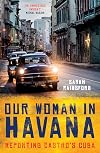
Britain's BBC television reporter Sarah Rainsford proves to be a journalist extraordinaire with this book. The work emerges almost six decades after Fidel Castro's overthrow of Fulgencio Batista's U.S. backed authoritarian Cuban regime. It's an excellent first non-fiction venture into print by an accomplished television reporter. The title is an intentionally reminiscent tribute to the late Graham Greene's memorable 1958 Our Man in Havana, the novel that was adapted the the next year into a show more motion picture staring Alec Guinness.
Rainsford shines light on the ugliness of communist Cuba. There's not very much that's positive to that can be said about a such a closed society. Even as the country was being propped up by an infusion of money from the Soviet Union, the place was pretty dark and dismal. Following the collapse of the Soviet regime, the author witnessed first-hand an accelerated deterioration of the island nation. Billions of dollars of capital was severed. Now the city of Havana is literally falling apart. The author reports that the one time mecca for tourists who frequented mobster-owned casinos has as many as three buildings collapsing daily.
You'll read of some things you may not have known. Close political ally of Fidel Castro Nicaraguan dictator Hugo Chavez spent his dying days in a Havana hospital. The fact that he was nearing the end of life in Cuba was hidden. Later as Fidel Castro himself was hospitalized during his final days, that fact likewise was concealed from the population. The British Broadcasting Corporation, sensing what was Fidel's health state, set Rainsford to work on the task of updating his obituary. When the end materialized it was brother Raul who delivered the shocking news to the Cuban citizenry via television.
The woman who gave much effort to the task of retracing places that had been visited by Graham Greene has produced this great read entitled Our Woman in Havana: Reporting Castro's Cuba. This will be a fascinating work to you if you have even a smidgen of curiosity about the little country which is just 90 miles away from the United States. It's so close; yet so far away. show less
Rainsford shines light on the ugliness of communist Cuba. There's not very much that's positive to that can be said about a such a closed society. Even as the country was being propped up by an infusion of money from the Soviet Union, the place was pretty dark and dismal. Following the collapse of the Soviet regime, the author witnessed first-hand an accelerated deterioration of the island nation. Billions of dollars of capital was severed. Now the city of Havana is literally falling apart. The author reports that the one time mecca for tourists who frequented mobster-owned casinos has as many as three buildings collapsing daily.
You'll read of some things you may not have known. Close political ally of Fidel Castro Nicaraguan dictator Hugo Chavez spent his dying days in a Havana hospital. The fact that he was nearing the end of life in Cuba was hidden. Later as Fidel Castro himself was hospitalized during his final days, that fact likewise was concealed from the population. The British Broadcasting Corporation, sensing what was Fidel's health state, set Rainsford to work on the task of updating his obituary. When the end materialized it was brother Raul who delivered the shocking news to the Cuban citizenry via television.
The woman who gave much effort to the task of retracing places that had been visited by Graham Greene has produced this great read entitled Our Woman in Havana: Reporting Castro's Cuba. This will be a fascinating work to you if you have even a smidgen of curiosity about the little country which is just 90 miles away from the United States. It's so close; yet so far away. show less
This review was written for LibraryThing Early Reviewers.This is a look at Cuban life from the mid-50's, prior to Castro, to now although the author only lived there for 3 years starting in 2011, visiting several times after 2014. Her descriptions of Cuba before her arrival are taken from Graham Greene and the reminisces of people she interviewed. The book gives a colorful picture of Cuba which even handedly presents both the good and the bad of country's history.
This review was written for LibraryThing Early Reviewers.I have to admit that I have not read Graham Greene's Our Man in Havana, but I enjoyed this riff on it anyway. Sarah Rainsford followed in his footsteps, sometimes relating his experiences through his writing and sometimes on her own.
My major complaint is that I was not always sure what year she was writing about, especially in the beginning of the book. She took multiple trips to Cuba, and they got muddles in my (puny little) mind. Nevertheless, she gave a good accounting of Cuba then and show more Cuba now, how the revolutionaries overtook a corrupt government in an idealistic enthusiasm, and how that so badly went astray. It also discussed how things changed under President Obama's terms and how conditions in Cuba are backsliding under Trump.
The writing was descriptive without meandering into flowery. I liked hearing about the people, their struggles, their love of music and dance, and the contrasts so common. Quite an interesting book. show less
My major complaint is that I was not always sure what year she was writing about, especially in the beginning of the book. She took multiple trips to Cuba, and they got muddles in my (puny little) mind. Nevertheless, she gave a good accounting of Cuba then and show more Cuba now, how the revolutionaries overtook a corrupt government in an idealistic enthusiasm, and how that so badly went astray. It also discussed how things changed under President Obama's terms and how conditions in Cuba are backsliding under Trump.
The writing was descriptive without meandering into flowery. I liked hearing about the people, their struggles, their love of music and dance, and the contrasts so common. Quite an interesting book. show less
This review was written for LibraryThing Early Reviewers.Lists
Awards


Statistics
- Works
- 2
- Members
- 62
- Popularity
- #271,093
- Rating
- 3.9
- Reviews
- 12
- ISBNs
- 8

