
Tony Vigorito
Author of Just a Couple of Days
Works by Tony Vigorito
Tagged
Common Knowledge
- Birthdate
- c. 1980
- Gender
- male
- Education
- Ohio State University (PhD)
- Nationality
- USA
- Associated Place (for map)
- USA
Members
Reviews

I liked this unusual entry in the end-of-the-world-as-we-know-it genre just about to the end, where it all really fell apart on me. Until then, I was enjoying the account of a manmade virus, engineered as a “humane” weapon, that renders human communication impossible and is unexpectedly let loose on the populace. The virus’s designers and the story’s narrator, a rather self-pitying, forlorn geneticist hired to find a cure, survive in an underground bunker. But the novel doesn’t show more fulfill its early promise. There are unexpected effects of the virus, to be sure, but they are not fully explored or explained. And the end peters out, as if the author had painted himself into a corner — which, considering that his first-person narrator had contracted the virus himself and was no longer able to write a coherent story that we could read, he had.
The title Just a Couple of Days comes from a piece of graffiti which appeared on both sides of an overpass just outside of Athens, Ohio on U.S. Route 33 and remained there for over two years. show less
The title Just a Couple of Days comes from a piece of graffiti which appeared on both sides of an overpass just outside of Athens, Ohio on U.S. Route 33 and remained there for over two years. show less
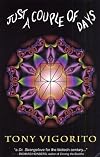
The first 21 pages of this book are available for download at justacoupleofdays.com.
From it's introductory question: "Why aren't apples called reds?" and the brief, meandering meditation upon the femininity of questions, the masculinity of answers and the essence of the question itself, I suspected I was going to like this book.
Immediately you notice that Vigorito's words flow with grace – "I hasten to add that he was not what you might term psychotic. Rather, he lost himself somewhere on show more the harmless side of lunacy, slightly south of innocuous but definitely north of demented." – calling to mind on reflection Hamlet being mad only when the wind is southerly.
When Dr. Blip Korterly paints out all of the graffiti in a busy underpass and replaces it with "UH-OH", the city becomes enamored, wondering what it means. This peaked someone's interest and they graffitied "WHEN?". In response, the Doctor jocularly responds with "JUST A COUPLE OF DAYS".
Dr, Flake Fountain, a molecular geneticist and friend to Blip, is narrating the story and is perhaps the only character in the book who is not an exaggerated stereotype. His cynicism is welcome to contradict Blip and his wife Sofia's hippie outlook.
An interesting situation that occurs early in the book sums up Blip and Sophia well. They make homemade bread, and Blip marvels at the way Sophia strategically cuts the bread so that it will fit in the toaster. Sophia tells Blip that she was copying what HE did that same morning, but then Blip responds that he actually cut the bread after it had been toasted and had used their historic method of flipping the bread halfway through the toaster's cycle to get the whole thing toasted. The upshot of which is that Sophia was copying something she thought Blip had done but that he hadn't. Sophia then shrewdly asks: "Where did that idea come from?"
This sort of intellectual curiosity abounds in the book and soon Vigorito begins to explore what the lack of a symbolic facility would engender for humanity. Unfortunately, he is not very successful at this because he changes the rules midstream and instead, inexplicably, explores a telepathic dystopian love and dance fest. I'm looking forward to reading a fiction exploring language and concepts (chess, or Cooknote Fiberglass) instead of language and objects (apples).
There were some other problems with the book. This is the author's first and I think it shows in the pacing of the story. It was printed by Bast Books out of Columbus, Ohio, so I assume that he did not have an especially talented editor to tighten this up. The Book o' Billets-doux chapters added nothing to the story, with the exception of the last, and were completely skimmable. There is a section at the end of the book that brought Ayn Rand vividly to mind, but only because Vigorito makes the grave stylistic error of writing an entire chapter that preaches a philosophy – the content itself is exactly opposite that of Rand. Finally, as I said earlier, many of the supporting characters were greatly exaggerated, stereotypical characters. I think this might have been on purpose, though I can't imagine why.
Of special interest to Discordians is Sofia and Blip's daughter, Dandelion, who acts like Eris incarnate. Her first word was "Gardyloo!", which is what people hollered out their windows before they threw out their chamber pots in medieval times. Until she was three, dandelion would come into the room when adults were talking, listen intently to what a person was saying and when they were finished reply with a grand "Gardyloo!"
Also, Sofia bends all of her knives to 23.5 degrees, claiming she heard someone in a coffee house say that they were more ergonomically correct that way – it was probably Omar and Mal-2 talking, after returning from the bowling alley, but Vigorito doesn't say.
Loki is also referred to as a trickster god of chaos: "He is a mockery of order, a braying heretic." And "At his discretion, Loki may tickle us tenderly or fling the wickedest of insults, but he promises to leave a greater approximation of truth in his wake." These sentences could just as easily apply to Our Lady.
I'm torn over this book. The author's voice and inherent intellectual curiosity will ensure that I'll pick up his next, but I think he still has lots to learn about his craft. A quick glance at the reviews on Amazon confirm what I suspected: most people who read this and bothered to post there really loved it, and can't understand how anyone could not.
I think it is so hard to find a story that steps outside the normal boundaries of commercial fiction, but is still accessible, that when something like this comes along it is embraced aggressively by many people despite any flaws it may have. show less
From it's introductory question: "Why aren't apples called reds?" and the brief, meandering meditation upon the femininity of questions, the masculinity of answers and the essence of the question itself, I suspected I was going to like this book.
Immediately you notice that Vigorito's words flow with grace – "I hasten to add that he was not what you might term psychotic. Rather, he lost himself somewhere on show more the harmless side of lunacy, slightly south of innocuous but definitely north of demented." – calling to mind on reflection Hamlet being mad only when the wind is southerly.
When Dr. Blip Korterly paints out all of the graffiti in a busy underpass and replaces it with "UH-OH", the city becomes enamored, wondering what it means. This peaked someone's interest and they graffitied "WHEN?". In response, the Doctor jocularly responds with "JUST A COUPLE OF DAYS".
Dr, Flake Fountain, a molecular geneticist and friend to Blip, is narrating the story and is perhaps the only character in the book who is not an exaggerated stereotype. His cynicism is welcome to contradict Blip and his wife Sofia's hippie outlook.
An interesting situation that occurs early in the book sums up Blip and Sophia well. They make homemade bread, and Blip marvels at the way Sophia strategically cuts the bread so that it will fit in the toaster. Sophia tells Blip that she was copying what HE did that same morning, but then Blip responds that he actually cut the bread after it had been toasted and had used their historic method of flipping the bread halfway through the toaster's cycle to get the whole thing toasted. The upshot of which is that Sophia was copying something she thought Blip had done but that he hadn't. Sophia then shrewdly asks: "Where did that idea come from?"
This sort of intellectual curiosity abounds in the book and soon Vigorito begins to explore what the lack of a symbolic facility would engender for humanity. Unfortunately, he is not very successful at this because he changes the rules midstream and instead, inexplicably, explores a telepathic dystopian love and dance fest. I'm looking forward to reading a fiction exploring language and concepts (chess, or Cooknote Fiberglass) instead of language and objects (apples).
There were some other problems with the book. This is the author's first and I think it shows in the pacing of the story. It was printed by Bast Books out of Columbus, Ohio, so I assume that he did not have an especially talented editor to tighten this up. The Book o' Billets-doux chapters added nothing to the story, with the exception of the last, and were completely skimmable. There is a section at the end of the book that brought Ayn Rand vividly to mind, but only because Vigorito makes the grave stylistic error of writing an entire chapter that preaches a philosophy – the content itself is exactly opposite that of Rand. Finally, as I said earlier, many of the supporting characters were greatly exaggerated, stereotypical characters. I think this might have been on purpose, though I can't imagine why.
Of special interest to Discordians is Sofia and Blip's daughter, Dandelion, who acts like Eris incarnate. Her first word was "Gardyloo!", which is what people hollered out their windows before they threw out their chamber pots in medieval times. Until she was three, dandelion would come into the room when adults were talking, listen intently to what a person was saying and when they were finished reply with a grand "Gardyloo!"
Also, Sofia bends all of her knives to 23.5 degrees, claiming she heard someone in a coffee house say that they were more ergonomically correct that way – it was probably Omar and Mal-2 talking, after returning from the bowling alley, but Vigorito doesn't say.
Loki is also referred to as a trickster god of chaos: "He is a mockery of order, a braying heretic." And "At his discretion, Loki may tickle us tenderly or fling the wickedest of insults, but he promises to leave a greater approximation of truth in his wake." These sentences could just as easily apply to Our Lady.
I'm torn over this book. The author's voice and inherent intellectual curiosity will ensure that I'll pick up his next, but I think he still has lots to learn about his craft. A quick glance at the reviews on Amazon confirm what I suspected: most people who read this and bothered to post there really loved it, and can't understand how anyone could not.
I think it is so hard to find a story that steps outside the normal boundaries of commercial fiction, but is still accessible, that when something like this comes along it is embraced aggressively by many people despite any flaws it may have. show less
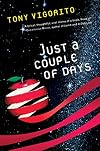
I had the pleasure to take several classes from Tony for my undergrad minor in sociology. I didn't know he was a novelist when I signed up for the first one, and never got around to reading my copy of Just a Couple of Days until after I was done with college altogether... but I had such strong flashbacks to sitting in a UTC classroom listening to many of the same ideas.
This is a book with a pretty transparent agenda, and it comes across so strongly that I would hesitate to recommend it to show more anyone who is not already dabbling in anti-consumerism and the nature of perception by others, self-perception, and self-construction. If the whole Burning Man ethos frightens and concerns you, Tony Vigorito does not write books you will enjoy.
This is a novel to read for the ideas it contains, not the quality of the fiction. show less
This is a book with a pretty transparent agenda, and it comes across so strongly that I would hesitate to recommend it to show more anyone who is not already dabbling in anti-consumerism and the nature of perception by others, self-perception, and self-construction. If the whole Burning Man ethos frightens and concerns you, Tony Vigorito does not write books you will enjoy.
This is a novel to read for the ideas it contains, not the quality of the fiction. show less
It is a wonderful, life-affirming treatise on what makes us happy, what is communication, what is society, and where does it really end. I deducted a star because the story is kind of silly and unneccessary.... yet it is just a fun romp - a huge and thought provoking stream-of-conciousness about life and everything.
Lists
Awards

You May Also Like


Statistics
- Works
- 3
- Members
- 571
- Popularity
- #43,840
- Rating
- 3.6
- Reviews
- 10
- ISBNs
- 12
- Languages
- 2
- Favorited
- 4