
Julia Armfield
Author of Our Wives Under the Sea
About the Author
Image credit: Avery Curran
Works by Julia Armfield
Holds 1 copy
Associated Works
Tagged
Common Knowledge
- Canonical name
- Armfield, Julia
- Birthdate
- 1990
- Gender
- female
- Education
- Royal Holloway, University of London
- Occupations
- writer
- Short biography
- Julia Armfield is a fiction writer, living in London with her girlfriend who is fine and their cat who is garbage.
Her work has been published in Granta, The White Review and Best British Short Stories 2019 and 2021. In 2019, she was shortlisted for the Sunday Times Young Writer of the Year award. She was longlisted for the Deborah Rogers Award 2018, and won the White Review Short Story Prize 2018 and a Pushcart Prize in 2020. She is the author of salt slow, a collection of short stories, which was longlisted for the Polari Prize 2020 and the Edge Hill Prize 2020. Her debut novel, Our Wives Under The Sea, was shortlisted for the Foyles Fiction Book of the Year Award 2022 and won the Polari Prize 2023. - Nationality
- UK
- Places of residence
- Cobham, Surrey, England, UK
London, England, UK - Associated Place (for map)
- England, UK
Members
Reviews

4.75 stars. the writing in this book is absolutely stunning. i really loved this, right from the start, and it only continued to awe me as it went.
i think a lot of people will read this as a book of horror or science fiction and maybe that's what it is. but to me it's one giant metaphor for how we live when someone we love changes. whether that's just people who change separately so the relationship doesn't fit anymore, or something happens to change someone like a trauma or accident, or if show more someone transitions maybe. there are so many ways this can be true, and that's why i love reading it this way. we change in all sorts of ways, so many of which could be antithetical to the relationship that worked so well before. maybe it can still work, but maybe it can't. and what does it look like as you figure that out? i think it looks kind of like this. for most of the book i thought that miri was unrealistically passive. i wanted to yell at her to just do something, anything, but really, i don't know what's more realistic than being frozen with uncertainty, want, and sadness, as you see the world you had made crumbling. as someone who freezes under pressure myself, i should have given her more leeway throughout the book. i can see just moving forward while trying to hold on to whatever you can of the past and the person you love, not knowing what to do, until you do.
"I see my mother in myself, though less in the sense of inherited features and more in the sense of an intruder poor hidden behind a curtain."
"My heart is a thing thing, these days -- shred of paper blown between the spaces in my ribs."
the only line i didn't like and that really rubbed me the wrong way: "The problem with relationships between women is that neither one of you is automatically the wronged party, which frankly takes a lot of the fun out of an argument." this felt way too pat and frankly not worthy of the rest of the book this is in. show less
i think a lot of people will read this as a book of horror or science fiction and maybe that's what it is. but to me it's one giant metaphor for how we live when someone we love changes. whether that's just people who change separately so the relationship doesn't fit anymore, or something happens to change someone like a trauma or accident, or if show more someone transitions maybe. there are so many ways this can be true, and that's why i love reading it this way. we change in all sorts of ways, so many of which could be antithetical to the relationship that worked so well before. maybe it can still work, but maybe it can't. and what does it look like as you figure that out? i think it looks kind of like this. for most of the book i thought that miri was unrealistically passive. i wanted to yell at her to just do something, anything, but really, i don't know what's more realistic than being frozen with uncertainty, want, and sadness, as you see the world you had made crumbling. as someone who freezes under pressure myself, i should have given her more leeway throughout the book. i can see just moving forward while trying to hold on to whatever you can of the past and the person you love, not knowing what to do, until you do.
"I see my mother in myself, though less in the sense of inherited features and more in the sense of an intruder poor hidden behind a curtain."
"My heart is a thing thing, these days -- shred of paper blown between the spaces in my ribs."
the only line i didn't like and that really rubbed me the wrong way: "The problem with relationships between women is that neither one of you is automatically the wronged party, which frankly takes a lot of the fun out of an argument." this felt way too pat and frankly not worthy of the rest of the book this is in. show less
I loved this book, and it was interesting to read it not very long after having read Jeff VanderMeer's Annihilation. Though comparisons are inevitable, these are very different works, and while I enjoyed VanderMeer's novel, Armfield's strikes at the heart in a very different way. Whereas Annihilation undoubtedly leans into gothic horror, marketing Armfield's book as a horror novel is a mistake, though certainly what happens in it is nothing short of horrific. On the surface Annihilation is show more about what makes us human and about human tendencies. It's more nuanced than that, but I'm talking about at the most superficial level. Our Wives Under the Sea is about grief. Again, that's superficial but also potent, real, and personal.
When in the throes of grief, people often do things that seem strange or "wrong" to those who aren't living under the same influence of shock, dismay, and denial. Miri makes many choices that come off as illogical because they are, but she's as deeply under the ocean of grief and confusion as Leah is deep down in the unknown sea. We will learn that Leah goes through her own process of grieving and missing Miri, both while she is trapped in the submersible and when she is trapped in whatever metamorphosis is overtaking and erasing her.
We don't get any real answers. Who is behind the Centre, what was the real nature of their mission, what is really down there? These things don't matter. What happened and what's happening is what matters. Who or what Miri becomes is as mysterious to Leah as it is to the reader, but the fact of the matter is the whole of this metamorphosis also changes the couple's relationship, and it changes Leah. These things are inevitable; when the onslaught of grief comes there's no stopping it, and it is a solitary, re-defining experience that cuts the griever off from the rest of the world. Whether you lose someone to an accident, an illness, age, or unforgivable behavior, the effect is the same. You can lose someone all at once or over long periods of time. Either way, the very moment in which that loss is finalized always comes a surprise. You find you have lost but also that you have become lost. Left behind isn't a place that feels orienting. You get taken under, left with selected memories of what was and what will no longer ever be.
Armfield's writing is elegant, lyrical, and to me, deeply satisfying even if I keep asking myself why 4 stars and not 5. I don't know, and that is likely appropriate since that's also an element of this work: accepting the not knowing. show less
When in the throes of grief, people often do things that seem strange or "wrong" to those who aren't living under the same influence of shock, dismay, and denial. Miri makes many choices that come off as illogical because they are, but she's as deeply under the ocean of grief and confusion as Leah is deep down in the unknown sea. We will learn that Leah goes through her own process of grieving and missing Miri, both while she is trapped in the submersible and when she is trapped in whatever metamorphosis is overtaking and erasing her.
We don't get any real answers. Who is behind the Centre, what was the real nature of their mission, what is really down there? These things don't matter. What happened and what's happening is what matters. Who or what Miri becomes is as mysterious to Leah as it is to the reader, but the fact of the matter is the whole of this metamorphosis also changes the couple's relationship, and it changes Leah. These things are inevitable; when the onslaught of grief comes there's no stopping it, and it is a solitary, re-defining experience that cuts the griever off from the rest of the world. Whether you lose someone to an accident, an illness, age, or unforgivable behavior, the effect is the same. You can lose someone all at once or over long periods of time. Either way, the very moment in which that loss is finalized always comes a surprise. You find you have lost but also that you have become lost. Left behind isn't a place that feels orienting. You get taken under, left with selected memories of what was and what will no longer ever be.
Armfield's writing is elegant, lyrical, and to me, deeply satisfying even if I keep asking myself why 4 stars and not 5. I don't know, and that is likely appropriate since that's also an element of this work: accepting the not knowing. show less
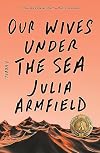
The biggest question is what happens to a marriage when the person you married is no longer the person you married? Leah and Miri find themselves having to come to terms with that question. The two women had always had a conventional marriage of mostly comfortable routine. They shared a love of movies, and genuine happiness at having actually found each other. Then Leah, who is a marine scientist, goes on a three-week submarine expedition on which things go disastrously wrong. She and her show more shipmates disappear for six months to the bottom of the ocean. Most of the story from here is in Miri’s narrative which is composed mostly from excerpts from Leah’s diary of the mission. We learn of their growing awareness and grudging management of the changes and relationship losses they both endured as a result of their prolonged separation. Although Leah returns home, things do not go as Miri had envisioned. From the time of her return there has been an unanticipated transformation, a terrifying dissolution of her human form into something unfamiliar and strange which heavily challenges Miri’s assumptions about the course of what their life was to be for them together. Life for them grows deeper and darker as the novel slowly reveals that the horrific situation Leah tolerated may not have been as accidental as it first was revealed to be. The unearthly circumstances of Leah’s underwater captivity and mutation are horrible enough, but take on new meaning in relation to other, more understandable situations Miri has faced in her life...the metamorphosis her mother underwent during a fatal illness and the sometimes-irritating voices she hears constantly emanating from an unseen neighbor’s television. Is Leah's current circumstance just further along the lines associated with human understanding of loss and endurance...or is it something much less understood or expected? The author does a great job of guiding the reader through the unsure and unexpected parts of the couple’s lives and even sometimes approaching them with ironic humor. We see that the bleakest horror story can often also be a love story. show less

A strange, unsettling, weird, sad love story about the things we’ll do and the things we’ll sacrifice for the one we love. The fantastical/science fictional elements are surreal, dreamlike. I was reminded of those nightmares where something awful is happening and there’s nothing you can do about it—you can’t find your house, you can’t remember something essential, your teeth are falling out—when in real life you’d just ask for directions or see a dentist. So the actual plot show more is nightmarishly nonsensical. The real strength of this book is the myriad tiny everyday details that make up a loving relationship, that make up our concept of the one we love: the small gestures cherished, fragments of conversations remembered, even the fights and annoyances. It’s a love story, above all. show less
Lists
Female Author (1)
2025 (1)
Awards


You May Also Like


Associated Authors
Statistics
- Works
- 6
- Also by
- 3
- Members
- 2,570
- Popularity
- #9,995
- Rating
- 3.8
- Reviews
- 103
- ISBNs
- 46
- Languages
- 5
- Favorited
- 2