
Christian Boltanski (1944–2021)
Author of Christian Boltanski (Contemporary Artists)
About the Author
Works by Christian Boltanski
Hans Ulrich Obrist & Christian Boltanski: The Conversation Series: Vol. 19 (Conversation (Verlag Der Buchhandlung)) (2009) 6 copies
Les habitants de Malmö : [Malmödelen av telefonkatalogen med erratablad över avlidna i området 1993] : [utställning (1993) 3 copies
Christian Boltanski 2 copies
Ost/West 2 copies
Parcours d’ombres 1 copy
Saynetes comiques 1 copy
Boltanski: Revenir 1 copy
Les Suisses morts 1 copy
Associated Works
Theories and Documents of Contemporary Art: A Sourcebook of Artists' Writings (1995) — Contributor — 419 copies, 1 review
Tagged
Common Knowledge
- Canonical name
- Boltanski, Christian
- Legal name
- Boltanski, Christian Liberté
- Birthdate
- 1944-09-06
- Date of death
- 2021-07-14
- Gender
- male
- Occupations
- artist
- Nationality
- France
- Birthplace
- Paris, France
- Place of death
- Paris, France
- Associated Place (for map)
- Paris, France
Members
Reviews
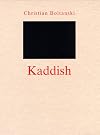
Published alongside the 1998 exhibition at the Musée d’Art Moderne de la Ville de Paris, ‘Kaddish’ by Christian Boltanski is a haunting visual requiem. Conceived as a ‘catalogue of humanity’, the book gathers nearly 1,200 anonymous photographs—family portraits, yearbook snapshots, images of soldiers, victims and everyday people—into a staggering meditation on memory, identity and loss.
With each image, Boltanski blurs the line between personal and collective remembrance, show more transforming found imagery into an elegy for the unknown. A powerful exploration of absence and the fragile imprint of human existence.
Kaddish accompanies Christian Boltanski's largest exhibition in Paris to date, which is being held at the Musee d'Art Moderne from May to October 1998. But Kaddish is no catalogue in the conventional sense. It is better described as the high point in a long series of art books which are of outstanding importance to Boltanski's oeuvre. In contrast with the ephemeral presence of exhibitions, the book form offers a unique opportunity to bring images together in a lasting cumulation. Availability created in this way sets the stage for individual analysis. Interpretation occurs solely within the spectator, even when the content is inherent. "Each object conceals a story", according to the artist, "and each object has its own face". show less
With each image, Boltanski blurs the line between personal and collective remembrance, show more transforming found imagery into an elegy for the unknown. A powerful exploration of absence and the fragile imprint of human existence.
Kaddish accompanies Christian Boltanski's largest exhibition in Paris to date, which is being held at the Musee d'Art Moderne from May to October 1998. But Kaddish is no catalogue in the conventional sense. It is better described as the high point in a long series of art books which are of outstanding importance to Boltanski's oeuvre. In contrast with the ephemeral presence of exhibitions, the book form offers a unique opportunity to bring images together in a lasting cumulation. Availability created in this way sets the stage for individual analysis. Interpretation occurs solely within the spectator, even when the content is inherent. "Each object conceals a story", according to the artist, "and each object has its own face". show less
This book is a mystery of sorts. Boltanski states at the beginning of the book that many years ago he found in a cigar box some photographs of Géo Harly, who he believes was born over a hundred years ago, had a brother, and loved his mother dearly. The remainder of the book, presented in the form of a photo-album, focuses on the photographs that help shed light on this Harly character.
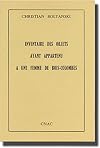
Photobook published by photographer and artist Boltanski, whose mission was to depict someone by photographing all of her worldly possessions. In Inventaire Des Objets Ayant Appartenu a Une Femme de Bois-Colombes, Boltanski photographs the belongings of a single woman living in a flat in Bois-Colombes, a suburb of Paris.

In the introduction Boltanski writes: 'Now fifty year have passed, and when I look at the faces of these lost children I find myself trying to imagine what has become of them. They have become part of the post-war history of Germany with all its changes. Has fate brought them happy or unhappy lives, made them rich or poor? I should like to find them again. They are about my own age, and their history is similar in some ways to mine, to ours. We too are in search of our parents.'
This show more publication accompanied an exhibition with the same title in the Museum Ludwig, Cologne, 28 November 1993 - 28 January 1994
Added one original photograph by Martien Coppens, showing a poster 'Diese Kinder suchen ihre Eltern' for the German Red Cross, district Hamburg. show less
This show more publication accompanied an exhibition with the same title in the Museum Ludwig, Cologne, 28 November 1993 - 28 January 1994
Added one original photograph by Martien Coppens, showing a poster 'Diese Kinder suchen ihre Eltern' for the German Red Cross, district Hamburg. show less
You May Also Like


Associated Authors
Statistics
- Works
- 55
- Also by
- 1
- Members
- 288
- Popularity
- #81,141
- Rating
- 3.9
- Reviews
- 14
- ISBNs
- 52
- Languages
- 7
- Favorited
- 1