
Thornton W. Burgess (1874–1965)
Author of The Burgess Bird Book for Children
About the Author
Thornton Waldo Burgess was born in Sandwich on January 14, 1874. Burgess graduated from Sandwich High School in 1891, and went on to attend a Business College in Boston from 1892-93. At the age of 17, Burgess briefly lived in Boston and then moved to Springfield, Massachusetts. He bought a place in show more Hampden, Massachusetts in 1925 and made it his permanent home in 1957. He published his first book, Old Mother West Wind, in 1910 Burgess was a naturalist and conservationist, and loved loved nature and its living creatures so much that he wrote about them for 50 years. By the time he retired, he had written more than 170 books and 15,000 stories for daily columns in newspapers. Burgess was also actively involved with conservation efforts. Some of his projects over his lifetime included: The Green Meadow Club for land conservation programs. The Bedtime Stories Club for wildlife protection programs, the Happy Jack Squirrel Saving Club for War Savings Stamps & Bonds, the Radio Nature League broadcast from WBZA Springfield, MA., as well as helping to pass laws protecting migrant wildlife. For his efforts, an Honorary Literary Degree was bestowed upon Burgess in 1938 from Northeastern University. The Boston Museum of Science awarded him a gold medal for "leading children down the path to the wide wonderful world of the outdoors." He was also awarded the distinguished Service Medal of the Permanent Wildlife Protection Fund. In 1960, Burgess published his last book, Now I Remember, an autobiography. That same year, Burgess at the age of 83, had published his 15,000th story. From 1912 to 1960, without interruption, Burgess wrote a syndicated daily newspaper column titled "Bedtime Stories". Thornton Burgess died June 5, 1965, at the age of 91. The Thornton W. Burgess Society was incorporated in 1976. (Bowker Author Biography) show less
Series
Works by Thornton W. Burgess
Thornton Burgess Five-Minute Bedtime Tales: From Old Mother West Wind's Library (Dover Children's Classics) (2011) 23 copies
Aunt Sally's friends in fur, or, The Woodhouse Night Club (Bedtime story book series) (1955) 9 copies
Mother West Wind's Neighbors #4 5 copies
Nature almanac 4 copies
Burgess' Bedtime Story-Books, Vol. 3: The Adventures of Chatterer the Red Squirrel, Sammy Jay, Buster Bear, and Old Mr. Toad (2011) 4 copies
Burgess' Bedtime Story-Books, Vol. 1: Reddy Fox, Johnny Chuck, Peter Cottontail, & Unc' Billy Possum (2011) 3 copies
Stories to Read Aloud 3 copies
Green Meadow Stories 2 copies
The Burgess Bird Book with Original Illustrations in B&W: Bird and Nature Education Storybook for Kids (2021) 2 copies
Aventurile lui Nelu Hârciog 2 copies
Aventurile lui Toni Bizam 2 copies
Tommy's Wishing-Stone Adventures--The Wishing Stone,Wishes Come True, Change of Heart (2010) 2 copies
Neighbors 1 copy
(1948) The Little Burgess Animal Book for Children ... With illustrations by Louis Agassiz Fuertes 1 copy
Buster Bear's Twins (Dover Children's Thrift Classics) by Thornton W. Burgess (1999) Paperback 1 copy
Aventurile Ursului Buf 1 copy
Happy Jacks 1 copy
The Adventures of Buster Bear, Old Mr. Toad, Prickly Porky, Old Man Coyote, and Paddy the Beaver 1 copy
The Adventures of Reddy Fox, Johnny Chuck, Peter Cottontail, Unc’ Billy Possum, and Mr. Mocker 1 copy
Mother West Wind's Neighbor 1 copy
The Burgess animal book for children,: By Thornton W. Burgess, with illustrations by Louis Agassiz Fuertes (1942) 1 copy
How To Draw Forest Animals 1 copy
The New Burgess Animal Book 1 copy
The New Burgess Bird Book 1 copy
The New Burgess Flower Book 1 copy
Various Animal Stories 1 copy
The New Burgess Bird Book 1 copy
The New Burgess Flower Book 1 copy
Old Mother West Wind #1 1 copy
The New Burgess Animal Book 1 copy
Wildflowers We Know 1 copy
Unc' Billy Possum 1 copy
The Dear Old Briar-patch 1 copy
Peter Rabbit is Lonesome 1 copy
Fun with Farmer Brown's Boy 1 copy
Jerry Muskrat is Laughed At 1 copy
The Digging Match 1 copy
reads to you LP 1 copy
A Glad Time Made a Sad Time 1 copy
Burgess' Bedtime Story-Books, Vol. 4: Adventures of Prickly Porky | Old Man Coyote | Paddy the Beaver | Poor Mrs. Quack (2010) 1 copy
Green Forest Series 4 volumes: Blacky the Crow, Buster Bear's Twins, Lightfoot the Deer, Whitefoot the Wood Mouse (1923) 1 copy
Robber the Rat Loses Out 1 copy
Burgess' Bedtime Story-Books, Vol. 5: The Adventures of Bobby Coon; Jimmy Skunk; Bob White; & Ol' Mistah Buzzard (2010) 1 copy
Friendly Animals 1 copy
Jimmy Skunk's Justice 1 copy
Robber The Rat, No. 3700 B 1 copy
Unc' Billy Gets Even 1 copy
Busy Folks and Sleepy Folks 1 copy
Peter Rabbit's Prank 1 copy
The Stolen Eggs 1 copy
Associated Works
The Illustrated Treasury of Children's Literature, Volumes 1-2 (1955) — Contributor — 523 copies, 4 reviews
Tagged
Common Knowledge
- Legal name
- Burgess, Thornton Waldo
- Birthdate
- 1874-01-14
- Date of death
- 1965-06-05
- Gender
- male
- Education
- Sandwich High School, Sandwich, Massachusetts, USA (1891)
- Occupations
- children's book author
conservationist - Nationality
- USA
- Birthplace
- Sandwich, Massachusetts, USA
- Places of residence
- Sandwich, Massachusetts, USA
Boston, Massachusetts, USA
Hampden, Massachusetts, USA
Springfield, Massachusetts, USA - Place of death
- Hampden, Massachusetts, USA
- Burial location
- Springfield Cemetery, Springfield, Massachusetts, USA
- Map Location
- Massachusetts, USA
Members
Reviews
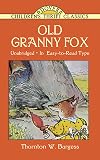
More than any other Burgess book I've read, this one is about relationships. Old Granny Fox and the young Reddy are having a tough time finding food in the winter. Reddy Fox is quite the know-it-all and even mocks the older fox when he doesn't understand what she's doing but Granny is remarkably patient and shows him that he still has a lot to learn. Reddy despairs that they can't find any food in the snow. Granny shows him how to perform for ducks and take the farm dog's dinner, but when show more they've exhausted every other means of getting food they resort to stealing hens. She makes quite a point out of the fact that the foxes only take the hens because they're starving so that's okay even though it's stealing; the humans have plenty of food so they can spare a few chickens. The raid on the chicken coop is a big event in the book; even here Reddy is overeager and Granny Fox must teach him to be patient, to wait until it's perfectly safe, to stay away afterwards so they have a chance to get hens again at a later date. However most of the story seemed to be about lessons on respecting your elders and having a willingness to learn. It even seems that things have finally sunk in for Reddy Fox; at one point he finds a fish to eat and even though he's starving he thinks of Granny Fox waiting at home, unable to hunt for herself and he takes the food back to her. It was a wonderful change of heart for him, this feisty little fox who usually only thinks of himself.
from the Dogear Diary show less
from the Dogear Diary show less
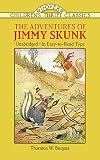
First sentence: The Imp of Mischief, woe is me, is always busy as a bee. That is why so many people are forever getting into trouble. He won't keep still. No, Sir, he won't keep still unless he is made to. Once let him get started there is no knowing where he will stop. Peter Rabbit had just seen Jimmy Skunk disappear inside an old barrel, lying on its side at the top of the hill, and at once the Imp of Mischief began2 to whisper to Peter. Of course Peter shouldn't have listened. Certainly show more not. But he did. You know Peter dearly loves a joke when it is on some one else. He sat right where he was and watched to see if Jimmy would come out of the barrel. Jimmy didn't come out, and after a little Peter stole over to the barrel and peeped inside. There was Jimmy Skunk curled up for a nap. Peter tiptoed away very softly. All the time the Imp of Mischief was whispering to him that this was a splendid chance to play a joke on Jimmy. You know it is very easy to play a joke on any one who is asleep. Peter doesn't often have a chance to play a joke on Jimmy Skunk. It isn't a very safe thing to do, not if Jimmy is awake. No one knows that better than Peter.
Premise/plot: Though Jimmy Skunk is perhaps the central character in this classic animal fantasy novel by Thornton Burgess, plenty of other characters get their moments to shine as well. (INCLUDING UNC' Billy Possum). Over half the novel features JIMMY SKUNK and UNC' BILLY POSSUM together getting into trouble--chiefly having to do with their love for EGGS. (The first half of the novel focuses on Peter Rabbit and Jimmy Skunk pranking each other.)
Burgess' animal world is DELIGHTFUL.
My thoughts: I LOVED, LOVED, LOVED this one. Did I love it more than The Adventures of Unc' Billy Possum???? Good question. Fair question. I think I loved them both equally. Because they share main characters--Jimmy Skunk and Unc' Billy Possum.
Quotes:
Jimmy Skunk ambled along down the Lone Little Path through the Green Forest. He didn't hurry. Jimmy never does hurry. Hurrying and worrying are two things he leaves for his neighbors. Now and then Jimmy stopped to turn over a bit of bark or a stick, hoping to find some fat beetles. But it was plain to see that he had something besides fat beetles on his mind.
Up the Lone Little Path through the Green Forest shuffled Unc' Billy Possum. He didn't hurry. It was too warm to hurry. Unlike Jimmy Skunk,62 he does hurry sometimes, does Unc' Billy, especially when he suspects that Bowser the Hound is about. And sometimes Unc' Billy does worry. You see, there are people who think that Unc' Billy would make a very good dinner. Unc' Billy doesn't think he would. Anyway, he has no desire to have the experiment tried. So occasionally, when he discovers one of these people who think he would make a good dinner, he worries a little.
But just now Unc' Billy was neither hurrying nor worrying. There was no need of doing either, and Unc' Billy never does anything that there is no need of doing. So Unc' Billy shuffled up the Lone Little Path, and Jimmy Skunk ambled down the Lone Little Path, and right at a bend in the Lone Little Path they met. show less
Premise/plot: Though Jimmy Skunk is perhaps the central character in this classic animal fantasy novel by Thornton Burgess, plenty of other characters get their moments to shine as well. (INCLUDING UNC' Billy Possum). Over half the novel features JIMMY SKUNK and UNC' BILLY POSSUM together getting into trouble--chiefly having to do with their love for EGGS. (The first half of the novel focuses on Peter Rabbit and Jimmy Skunk pranking each other.)
Burgess' animal world is DELIGHTFUL.
My thoughts: I LOVED, LOVED, LOVED this one. Did I love it more than The Adventures of Unc' Billy Possum???? Good question. Fair question. I think I loved them both equally. Because they share main characters--Jimmy Skunk and Unc' Billy Possum.
Quotes:
Jimmy Skunk ambled along down the Lone Little Path through the Green Forest. He didn't hurry. Jimmy never does hurry. Hurrying and worrying are two things he leaves for his neighbors. Now and then Jimmy stopped to turn over a bit of bark or a stick, hoping to find some fat beetles. But it was plain to see that he had something besides fat beetles on his mind.
Up the Lone Little Path through the Green Forest shuffled Unc' Billy Possum. He didn't hurry. It was too warm to hurry. Unlike Jimmy Skunk,62 he does hurry sometimes, does Unc' Billy, especially when he suspects that Bowser the Hound is about. And sometimes Unc' Billy does worry. You see, there are people who think that Unc' Billy would make a very good dinner. Unc' Billy doesn't think he would. Anyway, he has no desire to have the experiment tried. So occasionally, when he discovers one of these people who think he would make a good dinner, he worries a little.
But just now Unc' Billy was neither hurrying nor worrying. There was no need of doing either, and Unc' Billy never does anything that there is no need of doing. So Unc' Billy shuffled up the Lone Little Path, and Jimmy Skunk ambled down the Lone Little Path, and right at a bend in the Lone Little Path they met. show less

Bowser the Hound isn't very clever -- certainly not as clever as Old Man Coyote, who's full of tricks! There's one thing, though, that Bowser's really good at, and that's pursuing someone who'll give him a long, hard run. Actually, he'll go without eating just for the pleasure of chasing Reddy and Granny Fox or Old Man Coyote.
One day, Bowser gets more than he bargained for when Old Man Coyote decides to lead him on a long chase, just for fun, and make Bowser run and run. In fact, Bowser runs show more out of the forest and the old pasture until he's so far from home, he feels as if he is in another country. But with the help of Blacky the Crow and other friends, Bowser finally gets even with the old coyote. show less
One day, Bowser gets more than he bargained for when Old Man Coyote decides to lead him on a long chase, just for fun, and make Bowser run and run. In fact, Bowser runs show more out of the forest and the old pasture until he's so far from home, he feels as if he is in another country. But with the help of Blacky the Crow and other friends, Bowser finally gets even with the old coyote. show less

Mother West Wind 'Why' Stories is the fifth book in Thornton W. Burgess' series of Mother West Wind stories. The sixteen stories follow a formula: some character, usually Peter Rabbit (not Beatrix Potter's character), starts wondering about a characteristic of another character and asks wise old Grandfather Frog about it. Grandfather Frog tells the story, usually referring to the animal's ancestor as the 'grandfather a thousand times removed' or 'great-great-ever-so-great grandfather'. One show more story is told by Ol' [Old] Mistah [Mister] Buzzard.
The characteristics are either a reward or a punishment from Old Mother Nature. Grandfather Frog will give a moral about the story. The listener or listeners might also comment.
The stories are:
'Why Striped Chipmunk is Proud of His Stripes'
'Why Peter Rabbit Cannot Fold His Hands'
'Why Unc' Billy Possum Plays Dead'
'Why Reddy Fox Wears Red'
'Why Jimmy Skunk Never Hurries'
'Why Sammy Jay Has a Fine Coat'
'Why Jerry Muskrat Builds His House on Water'
'Why Old Man Coyote Has Many Voices'
'Why Miner the Mole Lives Under Ground'
'Why Mr. Snake Cannot Wink'
'Why Bobby Coon has rings on His Tail'
'Why There is a Black Head in the Buzzard Family'
'Why Buster Bear Appears to Have No Tail'
'Why Flitter the Bat Flies at Night'
'Why Spotty the Turtle Carries His House With Him'
'Why Paddy the Beaver Has a Broad Tail'
Almost all of the stories are charming and fun. I like it when Grandfather Frog invites his listener to use his head. Sadly, Ol' Mistah Buzzard's story is racist, but that can be avoided if the adult reading aloud ignores a couple of insulting adjectives. The copyright for these stories is 1915, but children today should enjoy them. show less
The characteristics are either a reward or a punishment from Old Mother Nature. Grandfather Frog will give a moral about the story. The listener or listeners might also comment.
The stories are:
'Why Striped Chipmunk is Proud of His Stripes'
'Why Peter Rabbit Cannot Fold His Hands'
'Why Unc' Billy Possum Plays Dead'
'Why Reddy Fox Wears Red'
'Why Jimmy Skunk Never Hurries'
'Why Sammy Jay Has a Fine Coat'
'Why Jerry Muskrat Builds His House on Water'
'Why Old Man Coyote Has Many Voices'
'Why Miner the Mole Lives Under Ground'
'Why Mr. Snake Cannot Wink'
'Why Bobby Coon has rings on His Tail'
'Why There is a Black Head in the Buzzard Family'
'Why Buster Bear Appears to Have No Tail'
'Why Flitter the Bat Flies at Night'
'Why Spotty the Turtle Carries His House With Him'
'Why Paddy the Beaver Has a Broad Tail'
Almost all of the stories are charming and fun. I like it when Grandfather Frog invites his listener to use his head. Sadly, Ol' Mistah Buzzard's story is racist, but that can be avoided if the adult reading aloud ignores a couple of insulting adjectives. The copyright for these stories is 1915, but children today should enjoy them. show less
Lists
Awards

You May Also Like


Associated Authors
Statistics
- Works
- 343
- Also by
- 6
- Members
- 29,374
- Popularity
- #681
- Rating
- 3.9
- Reviews
- 119
- ISBNs
- 1,231
- Languages
- 4
- Favorited
- 14
