
Josiah Royce (1855–1916)
Author of The Spirit of Modern Philosophy: An Essay in the Form of Lectures
About the Author
Josiah Royce was the leading idealistic philosopher in the United States during the period of the development of American pragmatism. Born in Grass Valley, California, he was educated in San Francisco and at the University of California. After his graduation in 1873, he studied in Germany for a show more year at Heidelberg, Leipzig, and Gottingen. He then returned to the United States and took a doctorate at Johns Hopkins University. He taught English composition at the University of California and in 1882 was invited to Harvard University to "fill in" for William James (see also Vols. 3 and 5). He was appointed to an assistant professorship at Harvard in 1885 and remained there for the rest of his career. Influenced by Hegel (see also Vol. 3), Royce developed his own philosophy of absolute or objective idealism, in which it is necessary to assume that there is an "absolute experience to which all facts are known and for which all facts are subject to universal law." He published his major works from 1885 onward, including his Gifford Lectures, The World and the Individual (1900--01). Along with James, Royce had a great influence on the advanced students who were to become the next generation of American philosophers. (Bowker Author Biography) show less
Works by Josiah Royce
The Religious Aspect of Philosophy: A Critique of the Bases of Conduct and of Faith (1887) 57 copies
The Basic Writings of Josiah Royce, Volume I: Culture, Philosophy, and Religion (American Philosophy Book 17) (1969) 26 copies
The World and the Individual: First Series, The Four Historical Conceptions of Being [The Gifford Lectures] (2009) 25 copies
The Basic Writings of Josiah Royce, Volume II: Logic, Loyalty, and Community (American Philosophy Book 17) (2005) 19 copies
Associated Works
Dialogues of Plato: The Jowett Translations (1953) — Introduction, some editions — 177 copies, 3 reviews
Tagged
Common Knowledge
- Canonical name
- Royce, Josiah
- Birthdate
- 1855-11-20
- Date of death
- 1916-09-14
- Gender
- male
- Education
- University of California, Berkeley
Johns Hopkins University - Occupations
- philosopher
- Organizations
- American Academy of Arts and Letters (Literature ∙ 1898)
Harvard University - Relationships
- Santayana, George (student)
- Nationality
- USA
- Birthplace
- Grass Valley, California, USA
- Places of residence
- Cambridge, Massachusetts, USA
California, USA
Germany - Place of death
- Cambridge, Massachusetts, USA
- Associated Place (for map)
- USA
Members
Reviews

I found this 1912 book to be surprisingly worthwhile. It's a set of lectures by Harvard academic Josiah Royce, with a scope situated somewhere between philosophy of religion and religious psychology. It is not theological or sectarian. When Royce observed that "It is useless to make some new sect whose creed shall be that there are to be no sects" (294), I could not help thinking with amusement that he was indicting the Plymouth Brethren, just such a sect, as well as their show more "non-denominational" successors among "Bible-believing" Christians.
Speaking during the later part of the Progressive Era, Royce refers to William James as "my dear friend" (27), and particularly in the book's fourth section "The World and the Will" he is at some pains to explain how his views both accord with and differ with those attributed to philosophical Pragmatism. In an earlier section on "Individual Experience and Social Experience" he also details his particular understanding of James' theory of religion, as well as providing a surprisingly generous and sympathetic gloss on Nietzsche's "Titanism" (60 ff.).
Although Royce's willingness to class Christianity and Buddhism as the "higher religions of mankind" (8) and his use of the search for human "salvation" as the touchstone of religion as such seem like stigma of a thinker with whom I would find few if any points of agreement, he develops his argument with a good deal of care and patience. In the culmination of his fifth lecture "The Religion of Loyalty," he arrives at what I consider to be cardinal truth: "For our attention is now fixed, not on a condition to be called salvation, but on a rule for doing something in accordance with our own true will" (188). Before the lecture concludes, he progresses from this pivot to insisting that "your true cause is the spiritual unity of all the world of reasonable beings" (205, italics in original).
The final lecture is concerned with what Royce calls "The Invisible Church" which transcends all limited doctrines and specific cultures, although he gives no signal of having drawn on esoteric thinkers such as Eckartshausen and Lopukhin for his use of this phrase. Royce is sufficiently scrupulous in his avoidance of theological identification that it is impossible to tell if he originally took "Invisible Church" from the contexts in which it has been used as a gloss on Augustinian anti-Donatist notions supposed to be common to all Western Christianity, or if he was specially receptive to the Protestant usage which allowed for institutional legitimation via a supra-historical avoidance of Roman Catholicism. In any event, Royce uses it in neither sense, and he is explicit that he extends "membership" in the Invisible Church to those "loyal" to non-Christian religions, as well as to the "cynics and rebels" who attack "the narrowness of our nature, the chaos of our unspiritual passions, the barren formalism of our conventions" (285).
So, while there are any number of points where I feel my views to be in friction with those of Royce, I found his treatment on the whole to be both coherent and productive of useful reflection. I would recommend it to clergy, scholars of religion, and others willing to give serious thought to its questions. show less
Speaking during the later part of the Progressive Era, Royce refers to William James as "my dear friend" (27), and particularly in the book's fourth section "The World and the Will" he is at some pains to explain how his views both accord with and differ with those attributed to philosophical Pragmatism. In an earlier section on "Individual Experience and Social Experience" he also details his particular understanding of James' theory of religion, as well as providing a surprisingly generous and sympathetic gloss on Nietzsche's "Titanism" (60 ff.).
Although Royce's willingness to class Christianity and Buddhism as the "higher religions of mankind" (8) and his use of the search for human "salvation" as the touchstone of religion as such seem like stigma of a thinker with whom I would find few if any points of agreement, he develops his argument with a good deal of care and patience. In the culmination of his fifth lecture "The Religion of Loyalty," he arrives at what I consider to be cardinal truth: "For our attention is now fixed, not on a condition to be called salvation, but on a rule for doing something in accordance with our own true will" (188). Before the lecture concludes, he progresses from this pivot to insisting that "your true cause is the spiritual unity of all the world of reasonable beings" (205, italics in original).
The final lecture is concerned with what Royce calls "The Invisible Church" which transcends all limited doctrines and specific cultures, although he gives no signal of having drawn on esoteric thinkers such as Eckartshausen and Lopukhin for his use of this phrase. Royce is sufficiently scrupulous in his avoidance of theological identification that it is impossible to tell if he originally took "Invisible Church" from the contexts in which it has been used as a gloss on Augustinian anti-Donatist notions supposed to be common to all Western Christianity, or if he was specially receptive to the Protestant usage which allowed for institutional legitimation via a supra-historical avoidance of Roman Catholicism. In any event, Royce uses it in neither sense, and he is explicit that he extends "membership" in the Invisible Church to those "loyal" to non-Christian religions, as well as to the "cynics and rebels" who attack "the narrowness of our nature, the chaos of our unspiritual passions, the barren formalism of our conventions" (285).
So, while there are any number of points where I feel my views to be in friction with those of Royce, I found his treatment on the whole to be both coherent and productive of useful reflection. I would recommend it to clergy, scholars of religion, and others willing to give serious thought to its questions. show less
The sources of religious insight; lectures delivered before Lake Forest College on the foundation of the late William Bross by Josiah Royce

Josiah Royce (1855-1916), one of the first American philosophers, has largely disappeared from view. He started as a student of pragmatist William James, but then clearly went his own way, reconnecting with the idealistic tradition. This is also evident from this publication, the result of 7 lectures that Royce gave in 1911. In it he quotes William James several times, especially his ‘The Varieties of Religious Experience’. According to James, religion is primarily an individual show more experience, not a social one, as the French sociologist Emile Durkheim had argued. Royce contradicts that: individual experiences are certainly important, but the whole domain of the social is at least as important. Rightly so.
What will shock many believers is that Royce rejects the importance of the factor of revelation or mystical experience, but then mainly on logical-philosophical grounds. It is therefore not surprising that Royce's strongest emphasis is that reason can also be an important source of religious insight. “Reason is the power to see widely and steadily and connectedly,” he writes. Insight into the greater context is the pre-eminent way for him to arrive at the truth, thus connecting with the divine, and also inspiring our actions. It is an absolutely valid reasoning for me.
But at the same time it exposes a weakness in Royce's argument: he looks at things very cerebrally, which is natural for a philosopher, but he runs the risk of covering only part of the human experience. To begin with, Royce has limited the basis of what religious experiences are. For him, it is the insight people have into their own failing, into the ‘human condition’, which they inevitably link with the desire for salvation, a salvation that can only come from something super/out-of-human. In my opinion, this starting point almost automatically brings Royce to his views on the rationalist input. In a sense that seems to make him guilty of reductionism, in order to be able to easily prove his rationalist thesis.
Another weakness is the way he formulates things: these are lectures, so the accessibility in itself is quite high. But this is a text that is more than a century old, and that is also noticeable in the sometimes archaic turns of phrase, and the still very complicated reasoning. Royce is also extremely careful, clearly to spare his audience, and that also sometimes makes for very roundabout reasoning. In short: this is a very interesting text, but definitely too difficult for the average reader. show less
What will shock many believers is that Royce rejects the importance of the factor of revelation or mystical experience, but then mainly on logical-philosophical grounds. It is therefore not surprising that Royce's strongest emphasis is that reason can also be an important source of religious insight. “Reason is the power to see widely and steadily and connectedly,” he writes. Insight into the greater context is the pre-eminent way for him to arrive at the truth, thus connecting with the divine, and also inspiring our actions. It is an absolutely valid reasoning for me.
But at the same time it exposes a weakness in Royce's argument: he looks at things very cerebrally, which is natural for a philosopher, but he runs the risk of covering only part of the human experience. To begin with, Royce has limited the basis of what religious experiences are. For him, it is the insight people have into their own failing, into the ‘human condition’, which they inevitably link with the desire for salvation, a salvation that can only come from something super/out-of-human. In my opinion, this starting point almost automatically brings Royce to his views on the rationalist input. In a sense that seems to make him guilty of reductionism, in order to be able to easily prove his rationalist thesis.
Another weakness is the way he formulates things: these are lectures, so the accessibility in itself is quite high. But this is a text that is more than a century old, and that is also noticeable in the sometimes archaic turns of phrase, and the still very complicated reasoning. Royce is also extremely careful, clearly to spare his audience, and that also sometimes makes for very roundabout reasoning. In short: this is a very interesting text, but definitely too difficult for the average reader. show less
Good but heavy going. Some chapters had me completely engaged while others were difficult to get through. The concept of the book was what drew me in. Royce intended this to be an exploration of the universal source of religious insight. He mentions Christianity and Buddhism, but no others. This is not a problem in itself, but Royce was a man of his time and culture so much of the language used is steeped in Christianity. My issue with this was when words, such as salvation, are used they show more call to mind specific Christian concepts which I felt overshadowed Royce's message. Glad I read it and I'm interested in reading more of Josiah Royce's books.k show less
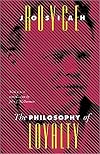
Abandoned after about 150 pages. I liked his writing pretty well, but his main point didn’t work for me - that loyalty is the highest moral good, especially his concept of “loyalty to loyalty.”
Lists
You May Also Like


Associated Authors
Statistics
- Works
- 46
- Also by
- 3
- Members
- 806
- Popularity
- #31,649
- Rating
- 3.5
- Reviews
- 6
- ISBNs
- 120
- Favorited
- 3