
George Santayana (1863–1952)
Author of The Sense of Beauty: Being the Outline of Aesthetic Theory
About the Author
A gentle philosopher-poet, born and reared in Spain, educated at Harvard University and later professor of philosophy there, George Santayana resided in England, France, and Italy after 1914. At the beginning of World War II, he entered the nursing home in Rome managed by nuns known as the Blue show more Sisters and remained there until his death. His last book, The Poet's Testament (1953), contains a few unpublished lyrics, several translations, and two plays in blank verse. The title comes from the poem read at his funeral, which begins: "I give back to the earth what the earth gave/All to the furrow, nothing to the grave." Santayana wrote philosophy in an inimitable prose, enriched with imagery and metaphor. His meanings were always complex and often ironic. In this style, so untypical of the professionalized philosophy common in the English-speaking world during his lifetime, Santayana nevertheless articulated an epistemological critical realism and an ontology of essence and matter that drew the attention and admiration of philosophers and scholars. His first published philosophical book, The Sense of Beauty (1896), was an important contribution in aesthetics, a classic text that is still in use. His multivolume work The Life of Reason expresses his naturalistic philosophy of history and culture. It states the essence of his attitude toward nature, life, and society. Scepticism and Animal Faith (1923) presents his theory of knowledge and also serves as an introduction to his system of philosophy, Realms of Being (1927--40). The titles of the separate volumes of this remarkable work, now out of print, reveal the lineaments of his system: Realm of Essence (1927), Realm of Matter (1930), Realm of Truth (1937), and Realm of Spirit (1940). His ideas were "popularized" in his only novel, The Last Puritan, which became a surprise bestseller overnight. According to the New York Times, "He came into a changing American scene with a whole group of concepts that enormously enriched our thinking. He gave a moving vitality to what had often been obscure abstractions . . . he made the whole relationship of reason and beauty, each to the other, come alive and stay alive." Although Santayana's Complete Poems (1975) is out of print, several volumes of his poetry are available and are listed below. Publication of The Complete Works of George Santayana, under the general editorship of Herman J. Saatkamp, Jr., is in progress. Conforming to the guidelines of a critical edition, The Complete Works is a long-range multivolume project of which a few volumes have already appeared to critical acclaim. (Bowker Author Biography) show less
Image credit: Jorge Agustín Nicolás Ruiz de Santayana y Borrás, known as George Santayana (December 16, 1863 – September 26, 1952), was a philosopher, essayist, poet, and novelist. (wikipedia.org)
Series
Works by George Santayana
Character and Opinion in the United States with Reminiscences of William James and Josiah Royce and Academic Life in America (1920) 104 copies
The Genteel Tradition in American Philosophy and Character and Opinion in the United States (1967) 100 copies
The Letters of George Santayana, Book 1: [1868]-1909 (The Works of George Santayana, Vol. 5) (2001) 17 copies
Santayana on America; essays, notes, and letters on American life, literature, and philosophy (1968) 13 copies
Physical Order and Moral Liberty. Previously Unpublished Essays of George Santayana (1969) 11 copies
Essays in literary criticism 9 copies
The Letters of George Santayana, Book 3: 1921-1927 (The Works of George Santayana, Vol. 5) (2002) 9 copies
The Letters of George Santayana, Book 4: 1928-1932 (The Works of George Santayana, Vol. 5) (2003) 8 copies
George Santayana's Marginalia, A Critical Selection: Book One, Abell--Lucretius (The Works of George Santayana) (Volume 6) (2011) 8 copies
The Letters of George Santayana, Book Seven, 1941-1947: The Works of George Santayana, Volume V, Book Seven (George Santayana: Definitive Works) (Bk. 7, v. 5) (2006) 8 copies, 1 review
The Letters of George Santayana, Book Six, 1937-1940: The Works of George Santayana, Volume V, Book Six (George Santayana: Definitive Works) (2004) 8 copies, 1 review
The Letters of George Santayana, Book 2: 1910-1920 (The Works of George Santayana, Vol. 5) (2001) 8 copies
The Letters of George Santayana, Book Five, 1933-1936: The Works of George Santayana, Volume V, Book Five (George Santayana: Definitive Works) (2003) 8 copies, 1 review
The Letters of George Santayana, Book Eight, 1948-1952: The Works of George Santayana, Volume V, Book Eight (George Santayana: Definitive Works) (Bk. 8) (2008) 8 copies, 1 review
Plantonism and the Spiritual Life 2 copies
The Life of Reason, critical edition, Volume 7: Introduction and Reason in Common Sense, Volume VII, Book One (The Works of George Santayana) (2011) 2 copies
Winds of Doctrine, critical edition, Volume 9: Studies in Contemporary Opinion (The Works of George Santayana) (2023) 2 copies
The Works of George Santayana, Triton Edition, Volume XIV [14]: Realms of Being: The Realm of Essence; The Realm of Matter (1937) 2 copies
System in lectures 1 copy
Güzelliğin Felsefesi 1 copy
EN LA MITAD DEL CAMINO 1 copy
Los reinos del ser 1 copy
Last Puritan, The 1 copy
The Hermit of Carmel 1 copy
Goethe's Faust 1 copy
The works of George Santayana: V.1: The Sense of beauty; Poems; Lucifer; Overheard in Seville 1 copy
Reason in Society 1 copy
Associated Works
World War I and America: Told by the Americans Who Lived It (1918) — Contributor — 227 copies, 1 review
The Glorious American Essay: One Hundred Essays from Colonial Times to the Present (2020) — Contributor — 119 copies
Out of the Best Books: An Anthology of Literature, Vol. 3: Intelligent Family Living (1967) — Contributor — 34 copies
Great companions : critical memoirs of some famous friends (2007) — Contributor — 25 copies, 1 review
Tagged
Common Knowledge
- Canonical name
- Santayana, George
- Legal name
- Santayana y Borrás, Jorge Agustín Nicolás Ruiz de
- Birthdate
- 1863-12-16
- Date of death
- 1952-12-26
- Gender
- male
- Education
- Harvard University (AB|1886|Ph.D|1889)
University of Berlin
University of Cambridge (King's College)
Boston Latin School - Occupations
- philosopher
professor
essayist
poet
novelist
literary critic (show all 7)
playwright - Organizations
- Harvard University
Harvard Monthly (founding member)
Harvard Philosophical Club (president)
Hasty Pudding Club
Harvard Lampoon - Awards and honors
- Benson Medal (1925)
Columbia University Butler Gold Medal (1945)
Honorary degree, University of Wisconsin (1911)
Wallace Stevens dedicated the poem "To An Old Philosopher in Rome" to Santayana
Walker Fellowship
Phi Beta Kappa - Relationships
- James, William (teacher)
Royce, Josiah (teacher)
Eliot, T. S. (student)
Frost, Robert (student)
Stein, Gertrude (student)
Lippmann, Walter (student) (show all 13)
Du Bois, W. E. B. (student)
Kallen, Horace (student)
Brooks, Van Wyck (student)
Aiken, Conrad (student)
Morison, Samuel Eliot (student)
Frankfurter, Felix (student)
Du Bois, W. E. B. (student) - Nationality
- Spain
- Birthplace
- Madrid, Spain
- Places of residence
- Avila, Spain
Madrid, Spain
Boston, Massachusetts, USA
Rome, Italy - Place of death
- Rome, Italy
- Burial location
- Pantheon of the Obra Pía Española, Campo Verano cemetery, Rome, Italy
- Associated Place (for map)
- Spain
Members
Reviews
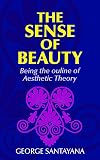
Summary: A philosophical discussion of the nature of beauty, grounding it in the pleasure of the perceiver with an object and its associations.
Classically, philosophy has spoken of three transcendentals: Truth (logic), Goodness (ethics), and Beauty (aesthetics). To satisfy the requirements of tenure at Harvard, George Santayana wrote this book, based on lectures, to offer his own outline of an aesthetic theory in what was his first book. Perhaps the most striking move of Santayana was to show more move beauty from the realm of the transcendental to that of human perception of value in the object perceived. He contrasts physical pleasure, focused on the organ of sensation, with aesthetic sensation, focused on the object from which pleasure arises. He defines beauty as "pleasure objectified."
He then explores this sense of beauty under three headings: the materials of beauty, form, and expression. The materials of beauty focus on the various human senses, chiefly sight, hearing, memory and imagination, through which perception and appreciation of objects occur. Form has to do with both external realities that give rise to sensation and their mental representation. He explores aspects of these that produce pleasure including symmetry, uniformity, and multiplicity, and also the idea of "indeterminate" forms such as landscapes that derive their beauty from the perceptive interpretation of the observe. Finally, Santayana explores the nature of expression which means the qualities one associates with an object. This suggests that one's sense of beauty develops from immediate perception to a deeper perception where past experience, imagination, and other associations shape the kind of aesthetic pleasure one has in the object.
Santayana elaborates each of these elements in a discussion that is highly abstract, that I won't attempt to outline or summarize here. What troubles me in his treatment, which seems to me a sophisticated way of saying, "beauty is in the eye of the beholder," is the elimination of the transcendent aspects of beauty. For those who sense beyond perceived beauty an author of beauty, Santayana would say this is simply one's sense experience, and one's sense of the sublime is simply ecstatic pleasure. There is nothing "beyond" to which beauty points. The sehnsucht or longing that C.S. Lewis writes of in Surprised by Joy when listening to Wagner, or glimpsing a scene in nature, to Santayana signifies nothing more than the interplay between object and sense eventuating in aesthetic pleasure. When Bono says, "I still haven't found what I'm looking for," Santayana might reply, "and you never will. All you may find is what you are looking at."
I find myself wondering how much Santayana's aesthetic has shaped both the making of and the appreciation of art. How might artists pursue their work differently when they do not compose and paint, write and dance, with the object of "Soli Deo Gloria" and instead see their work as evoking aesthetic pleasure in those who partake of them. How are we changed as we are discouraged, when experiencing what we might call the "transcendent" in a work to think of it as nothing more than a confluence of the material of our senses, the form of a work, and its expressive associations. What happens when wonder is turned inward, rather than upward?
These were some of the questions I was left with on reading Santayana. show less
Classically, philosophy has spoken of three transcendentals: Truth (logic), Goodness (ethics), and Beauty (aesthetics). To satisfy the requirements of tenure at Harvard, George Santayana wrote this book, based on lectures, to offer his own outline of an aesthetic theory in what was his first book. Perhaps the most striking move of Santayana was to show more move beauty from the realm of the transcendental to that of human perception of value in the object perceived. He contrasts physical pleasure, focused on the organ of sensation, with aesthetic sensation, focused on the object from which pleasure arises. He defines beauty as "pleasure objectified."
He then explores this sense of beauty under three headings: the materials of beauty, form, and expression. The materials of beauty focus on the various human senses, chiefly sight, hearing, memory and imagination, through which perception and appreciation of objects occur. Form has to do with both external realities that give rise to sensation and their mental representation. He explores aspects of these that produce pleasure including symmetry, uniformity, and multiplicity, and also the idea of "indeterminate" forms such as landscapes that derive their beauty from the perceptive interpretation of the observe. Finally, Santayana explores the nature of expression which means the qualities one associates with an object. This suggests that one's sense of beauty develops from immediate perception to a deeper perception where past experience, imagination, and other associations shape the kind of aesthetic pleasure one has in the object.
Santayana elaborates each of these elements in a discussion that is highly abstract, that I won't attempt to outline or summarize here. What troubles me in his treatment, which seems to me a sophisticated way of saying, "beauty is in the eye of the beholder," is the elimination of the transcendent aspects of beauty. For those who sense beyond perceived beauty an author of beauty, Santayana would say this is simply one's sense experience, and one's sense of the sublime is simply ecstatic pleasure. There is nothing "beyond" to which beauty points. The sehnsucht or longing that C.S. Lewis writes of in Surprised by Joy when listening to Wagner, or glimpsing a scene in nature, to Santayana signifies nothing more than the interplay between object and sense eventuating in aesthetic pleasure. When Bono says, "I still haven't found what I'm looking for," Santayana might reply, "and you never will. All you may find is what you are looking at."
I find myself wondering how much Santayana's aesthetic has shaped both the making of and the appreciation of art. How might artists pursue their work differently when they do not compose and paint, write and dance, with the object of "Soli Deo Gloria" and instead see their work as evoking aesthetic pleasure in those who partake of them. How are we changed as we are discouraged, when experiencing what we might call the "transcendent" in a work to think of it as nothing more than a confluence of the material of our senses, the form of a work, and its expressive associations. What happens when wonder is turned inward, rather than upward?
These were some of the questions I was left with on reading Santayana. show less

The highlight of this fascinating collection of essays is the fourth section of his extended review of Bertrand Russell's philosophy, "Hypostatic Ethics." This is not only beautifully written and well reasoned, it was completely on-target. So much so that Bertrand Russell famously changed his mind and recanted the doctrine he espoused!
This doesn't happen often in philosophy, so this book and this essay in particular are must-reads.
This doesn't happen often in philosophy, so this book and this essay in particular are must-reads.
It is remarkably appropriate that this work on aesthetics should have been written by George Santayana, who is probably the most brilliant philosophic writer and the philosopher with the strongest sense of beauty since Plato. It is not a dry metaphysical treatise, as works on aesthetics so often are, but is itself a fascinating document: as much a revelation of the beauty of language as of the concept of beauty.This unabridged reproduction of the 1896 edition of lectures delivered at Harvard show more College is a study of "why, when, and how beauty appears, what conditions an object must fulfill to be beautiful, what elements of our nature make us sensible of beauty, and what the relation is between the constitution of the object and the excitement of our susceptibility."Santayana first analyzes the nature of beauty, finding it irrational, "pleasure regarded as the quality of a thing." He then proceeds to the materials of beauty, showing what all human functions can contribute: love, social instincts, senses, etc. Beauty of form is then analyzed, and finally the author discusses the expression of beauty. Literature, religion, values, evil, wit, humor, and the possibility of finite perfection are all examined. Presentation throughout the work is concrete and easy to follow, with examples drawn from art, history, anthropology, psychology, and similar areas. show less
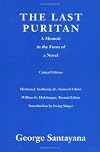
The Last Puritan is both a novel of ideas and one of personalities--real people living real lives. The places, the backgrounds are accurately depicted while the events of the novel are sketched as dramatic incidents. The scenes evoke an America of a certain age and the characters speak with a language that not only conveys ideas but emotions as well. Some of the sections of the novel that I enjoyed the most were the conversations which were, fortunately, not too terribly impeded by the show more trappings of the story's structure with its quotidian details of everyday life.
The protagonist, Oliver, is the masterful character whose individual personality is drawn with all of its perplexity, sensitiveness, and youthful seriousness. The other characters are no less real with both women and men exhibiting believable emotions including love that is both platonic and physical. The novel presents a good story in addition to the ideas that are presented. One may enjoy it for its story but the primary appeal for this reader is the novel of ideas in the robust realization that Santayana brought to his creation of a lifetime. show less
The protagonist, Oliver, is the masterful character whose individual personality is drawn with all of its perplexity, sensitiveness, and youthful seriousness. The other characters are no less real with both women and men exhibiting believable emotions including love that is both platonic and physical. The novel presents a good story in addition to the ideas that are presented. One may enjoy it for its story but the primary appeal for this reader is the novel of ideas in the robust realization that Santayana brought to his creation of a lifetime. show less
Lists
Awards


You May Also Like


Associated Authors
Statistics
- Works
- 124
- Also by
- 23
- Members
- 3,732
- Popularity
- #6,785
- Rating
- 4.0
- Reviews
- 26
- ISBNs
- 364
- Languages
- 8
- Favorited
- 11
