
Abby Norman (1)
Author of Ask Me About My Uterus: A Quest to Make Doctors Believe in Women's Pain
For other authors named Abby Norman, see the disambiguation page.
About the Author
Image credit: via Hachette Book Group
Works by Abby Norman
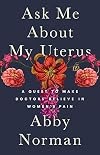
Ask Me About My Uterus: A Quest to Make Doctors Believe in Women's Pain (2018) 204 copies, 13 reviews
Tagged
Common Knowledge
- Gender
- female
- Education
- Sarah Lawrence College
- Organizations
- American Medical Writers Association
Society of Professional Journalists
Maine Public Health Association
National Writers Union - Awards and honors
- Bustle Magazine Rulebreaker (2018)
- Nationality
- USA
- Places of residence
- Maine coast
- Map Location
- USA
Members
Reviews
Ask Me About My Uterus recounts science writer Abby Norman's years-long attempt to get doctors to understand that she is ill. Despite having endometriosis and other debilitating chronic pain conditions, medical professionals have repeatedly dismissed her as a "bright and wound tight" hypochondriac. Norman's story will be familiar in kind, if not in severity, to many women. Studies have repeatedly shown that doctors are less likely to believe women's accounts of their symptoms or suffering.
I show more found the book's subtitle slightly misleading. Norman isn't necessarily on A Quest to Make Doctors Believe in Women's Pain (at least, her activist work isn't as sharply in focus here as other elements of her story are). Much of the book focuses on her dysfunctional family life and her legal emancipation at the age of 16, and the ongoing consequences of her relationships with her mentally ill mother and grandmother. I did hope that there would be more discussion of gynaecological health issues in here than there actually was (though I still learned a lot—endometriosis isn't actually associated with fertility issues! It's not actually a disease of the uterine lining and/or menstruation! Cis men have endometriosis! Foetuses have been found to have endometriosis!). Still, a powerful and important read. show less
I show more found the book's subtitle slightly misleading. Norman isn't necessarily on A Quest to Make Doctors Believe in Women's Pain (at least, her activist work isn't as sharply in focus here as other elements of her story are). Much of the book focuses on her dysfunctional family life and her legal emancipation at the age of 16, and the ongoing consequences of her relationships with her mentally ill mother and grandmother. I did hope that there would be more discussion of gynaecological health issues in here than there actually was (though I still learned a lot—endometriosis isn't actually associated with fertility issues! It's not actually a disease of the uterine lining and/or menstruation! Cis men have endometriosis! Foetuses have been found to have endometriosis!). Still, a powerful and important read. show less
If you want a tale of just how bad endometriosis can get, and what it can do to your life, look no further than Abby Norman. During her first semester of college Norman collapsed in the shower in terrible pain. Her life would never be the same again. What follows is Norman's account of her efforts to get diagnosis and treatment. Her narrative is interspersed with discussions of endometriosis research. There is some, though not nearly the amount one might expect, given the number of people show more who suffer from the condition. It turns out that doctors don't really seem to know what causes endometriosis. Endometrial cells have even been discovered in fetuses. Most medical research seems to focus on preserving fertility, with little attention to the other miseries the condition creates. It certainly has affected Norman's life. She was never able to return to college. Endometriosis has made performing her job difficult. In a different world Norman might have gone to medical school. She might have been a professional actress or dancer. Endometriosis prevented these things. This book is also a memoir of Norman's life before endometriosis. And there was nothing low-key about Norman's childhood. Raised by an abusive, anorexic mother and grandmother, Norman was repeatedly starved, not just because of poverty, but because of her mother's mental illness. Norman was emancipated by sixteen. She had to find her own way to and funding for college. For all of the trauma that Norman has endured, she is clearly very smart, and an engaging writer. Hopefully this book will bring more attention to the problems endometriosis creates. At the very least, hopefully there will be fewer suggestions that women suffering from endometriosis are not hysterical, full of psychosomatic malaise, or similar. show less
This isn't my kind of book. I would never pick it up if it wasn't for my book club and my strict rule that I won't attend if I haven't read the book. I didn't like this book. I hated reading every second of it.
However, my personal feelings aside, you should read this book. If you are a woman, were a woman, hope to be a woman, love a woman, or know a woman. Read this book.
This book made me sick. How women have been and are treated by the medical profession is abismal, abominable, and show more disgusting. Abby's search for answers, the dismissal, the ignorance, the frustration that she has faced in her health journey is criminal. But for the grace of God go anyone of use. And how many of us have suffered in silence because we have faced the same criticisim, disbelief, and the constant refrain of "suck it up' "it can't hurt that bad" "It's all in your head" and the worst "well, ya, your monthly time is supposed to hurt" Sure, it hurts sometimes, but not to the extent that the author is debilitated, they way so many are debilitated by PCOS, by Endometriosis, by undiagnosed appendix.
This book is a hard read. I flew through it in 24 hours but it was a hard read. But it's an important read. and the author writes a captivating, raw, emotional journey infused with so much information that hopefully it will help and inspire others who are suffering to keep trying. show less
However, my personal feelings aside, you should read this book. If you are a woman, were a woman, hope to be a woman, love a woman, or know a woman. Read this book.
This book made me sick. How women have been and are treated by the medical profession is abismal, abominable, and show more disgusting. Abby's search for answers, the dismissal, the ignorance, the frustration that she has faced in her health journey is criminal. But for the grace of God go anyone of use. And how many of us have suffered in silence because we have faced the same criticisim, disbelief, and the constant refrain of "suck it up' "it can't hurt that bad" "It's all in your head" and the worst "well, ya, your monthly time is supposed to hurt" Sure, it hurts sometimes, but not to the extent that the author is debilitated, they way so many are debilitated by PCOS, by Endometriosis, by undiagnosed appendix.
This book is a hard read. I flew through it in 24 hours but it was a hard read. But it's an important read. and the author writes a captivating, raw, emotional journey infused with so much information that hopefully it will help and inspire others who are suffering to keep trying. show less
(You can also find this review on my blog.)
cw: assault, eating disorders, attempted suicide, domestic abuse
Spoiler-free Review of an eARC Provided by the Publisher and Netgalley
It’s kind of strange: when I enter into conversations with medical professionals outside of the office, they ask where I went to medical school. When I was in the office as a patient, however, I just got asked if I ‘Googled a lot’ before coming into the office.
I knew I had to request this the moment I saw it on show more Netgalley. The incredibly gorgeous cover drew me in right away and the blurb cemented my decision to give it a try. And I am so, so glad that I did. This memoir follows Abby Norman in her experiences with endometriosis. I don’t know about y’all, but I knew next to nothing about endo before reading this. I had no idea what a difficult, debilitating disease it was or how little is known about it by modern medicine. To say that this book is extremely educational feels like an understatement.
Was being sick making her depressed or was depression making her sick? How many of us have asked the same question, or ask it almost daily as we slog forward in time? It’s the ouroboros of pain from which we cannot escape, no matter how hard we try, unequivocally felt by us and questioned by everyone else — until we, too, are forced to doubt the veracity of our reality.
Abby specifies right from the start that this book is meant to be a jumping-off point for readers, and not their sole source of information regarding endometriosis. She makes it clear that this is her story, and not meant to speak for anyone else. This explanation includes acknowledging that she comes from a place of relative privilege and urging the reader to seek out more diverse experiences. She also points out that calling endometriosis a women’s disease is a misnomer, as both trans men and cis men can suffer from it.
If history had been told by women, would we not be so in the dark about a disease that has, theoretically, always existed?
Her own experiences are downright heartbreaking to read. When symptoms begin to appear, Abby ignores them as long as possible before going to the hospital, something I can certainly relate to. Her voice is repeatedly silenced by medical professionals, mostly male, who downplay the severity of what she is going through. She is able to intertwine her own story with facts and figures, as well as historical parallels.
First-person accounts by women throughout history are limited by a peculiar social paradox: menstruation is both mundane and wildly taboo.
Abby’s voice comes through strong and clear in her writing and I found this book difficult to put down. She is a strong, sympathetic character and you’re forced to keep turning the pages in the hopes that things will get better. This book feels like a vitally important read, not only because of the information relayed, but also because it is relayed in such a way that the reader can’t help but take it all in. This is not a dry piece of nonfiction, but the compelling story of a woman fighting for her diagnosis.
(All quotes have been taken from an uncorrected proof and may have been changed in the final publication.) show less
cw: assault, eating disorders, attempted suicide, domestic abuse
Spoiler-free Review of an eARC Provided by the Publisher and Netgalley
It’s kind of strange: when I enter into conversations with medical professionals outside of the office, they ask where I went to medical school. When I was in the office as a patient, however, I just got asked if I ‘Googled a lot’ before coming into the office.
I knew I had to request this the moment I saw it on show more Netgalley. The incredibly gorgeous cover drew me in right away and the blurb cemented my decision to give it a try. And I am so, so glad that I did. This memoir follows Abby Norman in her experiences with endometriosis. I don’t know about y’all, but I knew next to nothing about endo before reading this. I had no idea what a difficult, debilitating disease it was or how little is known about it by modern medicine. To say that this book is extremely educational feels like an understatement.
Was being sick making her depressed or was depression making her sick? How many of us have asked the same question, or ask it almost daily as we slog forward in time? It’s the ouroboros of pain from which we cannot escape, no matter how hard we try, unequivocally felt by us and questioned by everyone else — until we, too, are forced to doubt the veracity of our reality.
Abby specifies right from the start that this book is meant to be a jumping-off point for readers, and not their sole source of information regarding endometriosis. She makes it clear that this is her story, and not meant to speak for anyone else. This explanation includes acknowledging that she comes from a place of relative privilege and urging the reader to seek out more diverse experiences. She also points out that calling endometriosis a women’s disease is a misnomer, as both trans men and cis men can suffer from it.
If history had been told by women, would we not be so in the dark about a disease that has, theoretically, always existed?
Her own experiences are downright heartbreaking to read. When symptoms begin to appear, Abby ignores them as long as possible before going to the hospital, something I can certainly relate to. Her voice is repeatedly silenced by medical professionals, mostly male, who downplay the severity of what she is going through. She is able to intertwine her own story with facts and figures, as well as historical parallels.
First-person accounts by women throughout history are limited by a peculiar social paradox: menstruation is both mundane and wildly taboo.
Abby’s voice comes through strong and clear in her writing and I found this book difficult to put down. She is a strong, sympathetic character and you’re forced to keep turning the pages in the hopes that things will get better. This book feels like a vitally important read, not only because of the information relayed, but also because it is relayed in such a way that the reader can’t help but take it all in. This is not a dry piece of nonfiction, but the compelling story of a woman fighting for her diagnosis.
(All quotes have been taken from an uncorrected proof and may have been changed in the final publication.) show less
Lists
You May Also Like


Statistics
- Works
- 1
- Members
- 204
- Popularity
- #108,206
- Rating
- 3.7
- Reviews
- 13
- ISBNs
- 9