
Jonathan Sacks (1948–2020)
Author of Not in God's Name: Confronting Religious Violence
About the Author
Jonathan Sacks is currently visiting Professor at the Hebrew University, Jerusalem, and is an Honorary Fellow of Gonville and Caius College, Cambridge.
Image credit: Rabbi Sir Jonathan Sacks, Chief Rabbi of the United Hebrew Congregations of the Commonwealth
Series
Works by Jonathan Sacks
The Koren Sacks Siddur: A Hebrew/English Prayerbook, Standard Size (Hebrew and English Edition) (2006) — Translation, Introduction, and Commentary — 159 copies, 4 reviews
A Letter in the Scroll: Understanding Our Jewish Identity and Exploring the Legacy of the World's Oldest Religion (2000) 136 copies, 1 review
The Persistence of Faith: Religion, Morality and Society in a Secular Age (1991) 51 copies, 2 reviews
One People?: Tradition, Modernity, and Jewish Unity (Littman Library of Jewish Civilization) (1993) 37 copies
Crisis and Covenant: Jewish Thought After the Holocaust (Sherman Studies of Judaism in Modern Times) (1992) 16 copies
Morals and Markets: Seventh Annual Iea Hayek Memorial Lecture (Occasional Paper, 108) (1999) 15 copies, 1 review
Koren Sacks Sukkot Mahzor, Ashkenaz, Hebrew/English (Hebrew Edition) (Hebrew and English Edition) (2015) 11 copies
The Koren Tanakh Maalot, Magerman Edition, Large (Hebrew and English Edition) (2021) 10 copies, 1 review
Torah Studies Based On Excerpts of Talks By the Lubavitcher Rebbe Rabbi Menachem M. Schneerson Shlita (1986) 9 copies
The Koren Mahzor for Yom Haatzma'ut and Yom Yerushalayim (Hebrew and English Edition) (2015) 7 copies
The Koren Sacks Birkon: A Hebrew/English Grace After Meals (Hebrew Edition) by Jonathan Sacks (2011) Hardcover (2010) 6 copies
Koren Ani Tefilla Shabbat Siddur, Ashkenaz, Compact, Hebrew/English (Hebrew and English Edition) (2016) 4 copies
Koren Shabbat Humash: With Commentary by Rabbi Jonathan Sacks, Ashkenaz (Hebrew and English Edition) (2013) 3 copies
Covenant & Conversations 2 copies
Koren Tanakh Maalot, Magerman Edition, Standard, Leather in Slip Case (Multilingual Edition) (2022) 2 copies
Deuteronomium, boek van de samenleving (Verbond en dialoog - Joodse lezing van de Tora) (2023) 2 copies
The Koren Zimrat Ha'aretz Birkon with Musical CD by World Renowned Cantor Shimon Craimer (2016) 2 copies
Little Books of Big Questions 2 copies
The English Koren Tanakh, Magerman edition, Compact: The Hebrew Bible in a New English Translation (2022) 1 copy
Uma letra da Torá : uma jornada ao ámago do legado espiritual da religião mais antiga do mundo (2002) 1 copy
Koren Tanakh Maalot, Magerman Edition, Large, Leather in Slip Case (Multilingual Edition) (2022) 1 copy
Kol Nidre Appeal, 1994 1 copy
Lessons in Leadership 1 copy
Lições Da Tora 1 copy
Não em Nome de Deus - eBook 1 copy
Koren Sacks Succot Mahzor: Minhag Anglia (Hebrew Edition) (Hebrew and English Edition) (2015) 1 copy
O svobodě a náboženství : třicet šest zamyšlení rabína Sackse nad věčně živými tématy biblických… (2005) 1 copy
Associated Works
Not Just Good, but Beautiful: The Complementary Relationship between Man and Woman (2015) — Contributor — 51 copies
Tagged
Common Knowledge
- Canonical name
- Sacks, Jonathan
- Legal name
- Sacks, Jonathan Henry
- Other names
- Baron Sacks of Aldgate
- Birthdate
- 1948-03-08
- Date of death
- 2020-11-07
- Gender
- male
- Education
- Gonville and Caius College, Cambridge (BA|1969)(honours)
New College, Oxford (MA|1972)
King's College, London (Ph.D|1981) - Occupations
- Chief Rabbi of the United Hebrew Congregations of Britain and the Commonwealth
Member of the Parliament of the United Kingdom (House of Lords) - Awards and honors
- Life Peerage (2009)
Knight Bachelor (2005)
Jerusalem Prize (1995)
American National Jewish Book (2000, 2009, 2013, 2015)
The Grawemeyer Prize for Religion (2004)
The Norman Lamm Prize (2010) (show all 13)
The Abraham Kuyper Prize (2010)
Keter Torah Award (2011
Ladislaus Laszt Ecumenical and Social Concern Award (2011)
The Sanford St Martin's Trust Personal Award for Excellence in Religious Broadcasting (2013)
Templeton Prize (2016)
Genesis Prize Lifetime Achievement Award (2021)
BBC Reith Lecturer (1990) - Agent
- Greenberg, Louise
- Relationships
- Sacks, Oliver (uncle)
- Cause of death
- cancer
- Nationality
- UK
- Birthplace
- London, Middlesex, England, UK
- Places of residence
- London, Middlesex, England, UK
- Place of death
- London, Middlesex, England, UK
- Map Location
- England, UK
Members
Reviews
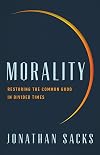
When Great Britain appointed Boris Johnson as prime minister, I took a screenshot and sent it to my husband and asked him who it reminded him of. His response was "Britain has one too??? As time passed, it became apparent that appearances were not the only similarities. But, as Sacks points out in this book, our unnaturally blond-thatched leaders are also not the only struggles our two nations(or, indeed, the Western world itself) face.
Our shared issues include:
-Global Warming
-Shattered show more Families
-Decline of Civility
-Rise in violence, racism, and hatred
-Our inability to see and care for the Other
-Unethical Businesses
-A Rise in Inequality
-Increased Loneliness
-Increased Victimisation
Somehow, they are all woven together to make one cohesive worldview. I particularly liked his reasoned indictment of inequality and capitalism. Not that he believes that Socialism(Marxism) works---don't accuse me of false advertising. His argument is rather that capitalism is created for a certain type of society and, where it may have functioned well in the past, given our current circumstances we are not that type of society.
Superb synthesis of years of personal research and observations, reasoned so that---even when you disagree---you at least understand. It was a book to be savored, which I did for over a month. I'm rather devastated that it's over.
Published in Great Britain as COVID19 was just barely crossing the continent, the US version (published months later) has the bonus of an added introduction and ending sections. I highly recommend that version. Fingers crossed that it isn't his final project and that he gets to finish that commentary on the books of Moses that he was talking about.
Jan 2021 update:
I'm heartbroken that this will be his last official book. But, more so, I'm wary for the future of our dialogue regarding our shared spaces as a society and a world. We have lost a powerful, brave, and courteous voice that was always loyal to the truth that he knew and lived. There is already a hauntingly empty space in my online social media feed. show less
Our shared issues include:
-Global Warming
-Shattered show more Families
-Decline of Civility
-Rise in violence, racism, and hatred
-Our inability to see and care for the Other
-Unethical Businesses
-A Rise in Inequality
-Increased Loneliness
-Increased Victimisation
Somehow, they are all woven together to make one cohesive worldview. I particularly liked his reasoned indictment of inequality and capitalism. Not that he believes that Socialism(Marxism) works---don't accuse me of false advertising. His argument is rather that capitalism is created for a certain type of society and, where it may have functioned well in the past, given our current circumstances we are not that type of society.
Superb synthesis of years of personal research and observations, reasoned so that---even when you disagree---you at least understand. It was a book to be savored, which I did for over a month. I'm rather devastated that it's over.
Published in Great Britain as COVID19 was just barely crossing the continent, the US version (published months later) has the bonus of an added introduction and ending sections. I highly recommend that version. Fingers crossed that it isn't his final project and that he gets to finish that commentary on the books of Moses that he was talking about.
Jan 2021 update:
I'm heartbroken that this will be his last official book. But, more so, I'm wary for the future of our dialogue regarding our shared spaces as a society and a world. We have lost a powerful, brave, and courteous voice that was always loyal to the truth that he knew and lived. There is already a hauntingly empty space in my online social media feed. show less
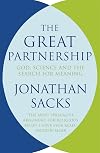
Jonathan Sacks' The Great Partnership, while not short and very far from simplistic, is very readable. His basic premise is that "Science takes things apart to see how they work. Religion puts things together to see what they mean." He argues lucidly and persuasively that the two are complementary, rather than conflicting, and that it is when people use one in the place of the other that things go horribly wrong.
"Both are necessary, but they are very different. … Whole civilisations made show more mistakes because they could not keep these two apart and applied to one the logic of the other.
"When you treat things as if they were people, the result is myth … Science was born when people stopped telling stories about nature and instead observed it; when, in short, they relinquished myth.
"When you treat people as things, the result is dehumanisation: people categorised by colour, class or creed and treated differently as a result. The religion of Abraham was born when people stopped seeing people as objects and began to see each individual as unique, sacrosanct, the image of God.
"One of the most difficult tasks of any civilisation - of any individual life for that matter - is to keep the two separate, but integrated and in balance. … Things are things and people are people. Realising the difference is sometimes harder than we think."
After setting out his basic case, he systematically explores a number of themes including: finding God, human dignity, political power, freedom, morality, relationships, Darwin, the problem of evil and when religion goes wrong.
Sacks argues - rightly - that his argument related primarily to the monotheistic, Abrahamic faiths as a group, but also to each of them individually. While he obviously draws predominantly from the Jewish scriptures and traditions, he does a good job of considering Christianity. However, he doesn't really cover Islam sufficiently well to prevent that becoming an afterthought, which is a pity. Sacks focuses heavily on relationship and covenant at times, and therefore probably needed to consider the Islamic conception of man's relationship with God in contrast to those of Judaism and Christianity.
It is, despite Sacks' efforts to the contrary, a book very much centred on Judaism. There's a helpful summary of rabbinic thought included for those who are unfamiliar with historical Jewish teaching on creation, evolution and the age of the universe. As someone whose understanding of Genesis comes very much from the Christian interpretation, and predominantly the Protestant evangelical tradition, I found Sacks’ analysis of the Jewish perspective on what the book is trying to say enormously helpful. And not merely of the creation stories: Sacks’s analysis of the stories of Abraham and Joseph, as well as of the book of Esther, are both a useful contribution to the book and an interesting insight into the Jewish scriptures.
Where Sacks really shines is his ability to set out his argument clearly, in small blocks, and put those blocks together to create a larger narrative which says something important about the world, science and religion. To do, in other words, precisely what he is claiming that religion does and ought to do. But his argument is as deeply grounded in philosophy as it is in the Jewish scriptures - as is to be expected from a philosopher rabbi.
This is, above all, a thought-provoking book. It is a book—and an argument, and a narrative—which needs to be pondered and wrestled with, rather than assessed on a simple, binary true/false basis. In that, it both embodies its own argument, and repays the effort.
(Also, for further examination of the problem of confusing people and things seen from a slightly different perspective, see Terry Pratchett's Carpe Jugulum.) show less
"Both are necessary, but they are very different. … Whole civilisations made show more mistakes because they could not keep these two apart and applied to one the logic of the other.
"When you treat things as if they were people, the result is myth … Science was born when people stopped telling stories about nature and instead observed it; when, in short, they relinquished myth.
"When you treat people as things, the result is dehumanisation: people categorised by colour, class or creed and treated differently as a result. The religion of Abraham was born when people stopped seeing people as objects and began to see each individual as unique, sacrosanct, the image of God.
"One of the most difficult tasks of any civilisation - of any individual life for that matter - is to keep the two separate, but integrated and in balance. … Things are things and people are people. Realising the difference is sometimes harder than we think."
After setting out his basic case, he systematically explores a number of themes including: finding God, human dignity, political power, freedom, morality, relationships, Darwin, the problem of evil and when religion goes wrong.
Sacks argues - rightly - that his argument related primarily to the monotheistic, Abrahamic faiths as a group, but also to each of them individually. While he obviously draws predominantly from the Jewish scriptures and traditions, he does a good job of considering Christianity. However, he doesn't really cover Islam sufficiently well to prevent that becoming an afterthought, which is a pity. Sacks focuses heavily on relationship and covenant at times, and therefore probably needed to consider the Islamic conception of man's relationship with God in contrast to those of Judaism and Christianity.
It is, despite Sacks' efforts to the contrary, a book very much centred on Judaism. There's a helpful summary of rabbinic thought included for those who are unfamiliar with historical Jewish teaching on creation, evolution and the age of the universe. As someone whose understanding of Genesis comes very much from the Christian interpretation, and predominantly the Protestant evangelical tradition, I found Sacks’ analysis of the Jewish perspective on what the book is trying to say enormously helpful. And not merely of the creation stories: Sacks’s analysis of the stories of Abraham and Joseph, as well as of the book of Esther, are both a useful contribution to the book and an interesting insight into the Jewish scriptures.
Where Sacks really shines is his ability to set out his argument clearly, in small blocks, and put those blocks together to create a larger narrative which says something important about the world, science and religion. To do, in other words, precisely what he is claiming that religion does and ought to do. But his argument is as deeply grounded in philosophy as it is in the Jewish scriptures - as is to be expected from a philosopher rabbi.
This is, above all, a thought-provoking book. It is a book—and an argument, and a narrative—which needs to be pondered and wrestled with, rather than assessed on a simple, binary true/false basis. In that, it both embodies its own argument, and repays the effort.
(Also, for further examination of the problem of confusing people and things seen from a slightly different perspective, see Terry Pratchett's Carpe Jugulum.) show less
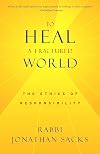
A remarkable piece of writing. Rabbi Dr Sacks is a consummate communicator, and in To Heal a Fractured World he takes his reader deep into the heart of Jewish and indeed human ethics. This is not a book whose readership should or could be limited to Jewish practitioners: underlying the ethos of the entire volume is the belief, stated early in the text, that "Unless the holy leads us outward toward the good, and the good leads us back, for renewal, to the holy, the creative energies of faith show more run dry" (9). With that premise in mind Sacks leads us on a masterful tour through the thoughts of figures from Plato to Beethoven, Yeats to Piaget to Nietzsche to Girard to ... and above all though a sort of applied Moses Maimonides, though the texts of the Hebrew Bible, through the great thoughts of ethicist literature, through the dark labyrinths of the holocaust, into the challenge of being a decent human being. This could be a compulsory text for every practitioner of compassion, regardless of creed, faith or a-faith: this is a spiritual masterpiece. show less
One of the advantages of an e-reader is that you can perfectly check how many times a certain word occurs in a book. In this case, Jonathan Sacks uses the word 'morality' more than 500 times, roughly twice per page. He literally slaps you in the face with it. There is nothing wrong with that, unless the author does not properly explain what he means by that word. And that is somewhat the case here.
Jonathan Sacks (1948-2020) was a prominent voice in the field of societal responsibility. For show more decades he was Chief Rabbi of the Jewish Community in the United Kingdom, and in that capacity also a member of the House of Lords. In other words, someone who was constantly acting on the public stage. And that is clearly noticeable in this book, where he examines the loss of a common morality in our modern society. Using a striking image he speaks of a 'cultural climate change': universal moral values have given way to relativism and 'devaluation' of the common good.
Sacks analyzes how it has come to this, in a very detailed argument, where the emphasis is on the bad consequences of individualism gone too far, and with the cultural revolution of the 1960s and postmodernism in a leading role. He occasionally suggests that the loss of a common moral pedestal threatens to degenerate into decadence and decay, with the obligatory reference to the end of the Roman Empire. Sacks clearly couldn’t avoid the dangerous cliff of the clichés. Moreover, this example makes it clear that he primarily has in mind the social, unifying function of morality. In that sense, his concept of morality is closely related to Emile Durkheim's concept of religion. Hence the suggestion by some reviewers that the title of this book should have been on what is now the subtitle, namely 'restoring the common good in divided times'. By the way, the term 'common good' only appears about 80 times.
It should therefore come as no surprise that at the end of his book Sacks argues for a new covenant, a commitment by citizens in a society to appreciate that collective good, to respect other opinions and try to look for the middle ground, knowing that our society has become far more complex and diverse than, say, 100 years ago: “We can no longer build national identity on religion or ethnicity or culture. But we can build it on covenant. A covenantal politics would speak of how, as a polity, an economy and culture, our fates are bound together. We benefit from each other. And because this is so, we should feel bound to benefit one another. It would speak about the best of our traditions, and how they are a heritage we are charged with honouring and handing on to future generations. It would be warmly inclusive. A nation is enlarged by its new arrivals who carry with them gifts from other places and other traditions. It would acknowledge that, yes, we have differences of opinion and interest, and sometimes that means favouring one side over another. But we will never do so without giving every side a voice and a respectful hearing. The politics of covenant does not demean or ridicule opponents. It honours the process of reasoning together. It gives special concern to those who most need help, and special honour to those who most give help.”
Of course, I can only adhere to such a plea against polarization; it is a necessary condition to help to build up a rightful society. But at the same time it isn't a sufficient one, it’s very clear that it stops short of offering real and helpful proposals to reach that middle ground, of offering a positive project. In other words, Sacks’ discourse remains stuck in vagueness, only pleading for a general kind of tolerance. So, despite its commendable perspective and its discussion of pertinent issues of our society, this book did not live up to its expectations. Maybe that’s also because it also leaves a lot to be desired in terms of form: at various times you seem to be reading a general intellectual treatise, a collection of interesting but divergent reflections, rather than a book focused on a central topic. show less
Jonathan Sacks (1948-2020) was a prominent voice in the field of societal responsibility. For show more decades he was Chief Rabbi of the Jewish Community in the United Kingdom, and in that capacity also a member of the House of Lords. In other words, someone who was constantly acting on the public stage. And that is clearly noticeable in this book, where he examines the loss of a common morality in our modern society. Using a striking image he speaks of a 'cultural climate change': universal moral values have given way to relativism and 'devaluation' of the common good.
Sacks analyzes how it has come to this, in a very detailed argument, where the emphasis is on the bad consequences of individualism gone too far, and with the cultural revolution of the 1960s and postmodernism in a leading role. He occasionally suggests that the loss of a common moral pedestal threatens to degenerate into decadence and decay, with the obligatory reference to the end of the Roman Empire. Sacks clearly couldn’t avoid the dangerous cliff of the clichés. Moreover, this example makes it clear that he primarily has in mind the social, unifying function of morality. In that sense, his concept of morality is closely related to Emile Durkheim's concept of religion. Hence the suggestion by some reviewers that the title of this book should have been on what is now the subtitle, namely 'restoring the common good in divided times'. By the way, the term 'common good' only appears about 80 times.
It should therefore come as no surprise that at the end of his book Sacks argues for a new covenant, a commitment by citizens in a society to appreciate that collective good, to respect other opinions and try to look for the middle ground, knowing that our society has become far more complex and diverse than, say, 100 years ago: “We can no longer build national identity on religion or ethnicity or culture. But we can build it on covenant. A covenantal politics would speak of how, as a polity, an economy and culture, our fates are bound together. We benefit from each other. And because this is so, we should feel bound to benefit one another. It would speak about the best of our traditions, and how they are a heritage we are charged with honouring and handing on to future generations. It would be warmly inclusive. A nation is enlarged by its new arrivals who carry with them gifts from other places and other traditions. It would acknowledge that, yes, we have differences of opinion and interest, and sometimes that means favouring one side over another. But we will never do so without giving every side a voice and a respectful hearing. The politics of covenant does not demean or ridicule opponents. It honours the process of reasoning together. It gives special concern to those who most need help, and special honour to those who most give help.”
Of course, I can only adhere to such a plea against polarization; it is a necessary condition to help to build up a rightful society. But at the same time it isn't a sufficient one, it’s very clear that it stops short of offering real and helpful proposals to reach that middle ground, of offering a positive project. In other words, Sacks’ discourse remains stuck in vagueness, only pleading for a general kind of tolerance. So, despite its commendable perspective and its discussion of pertinent issues of our society, this book did not live up to its expectations. Maybe that’s also because it also leaves a lot to be desired in terms of form: at various times you seem to be reading a general intellectual treatise, a collection of interesting but divergent reflections, rather than a book focused on a central topic. show less
Lists
Awards

A Letter in the Scroll: Understanding Our Jewish Identity and Exploring the Legacy of the World's Oldest Religion (Winner – Jewish Thought – 2000)
The Koren Sacks Siddur: A Hebrew/English Prayerbook, Standard Size (Hebrew and English Edition) (Finalist – Modern Jewish Thought and Experience – 2009)
The Great Partnership: Science, Religion, and the Search for Meaning (Finalist – Modern Jewish Thought and Experience – 2012)
Koren Sacks Rosh HaShana Mahzor (Hebrew and English Edition) (Finalist – Contemporary Jewish Life and Practice – 2011)
The Koren Sacks Pesah Mahzor (Hebrew and English Edition) (Winner – Modern Jewish Thought and Experience – 2013)

You May Also Like


Associated Authors
Statistics
- Works
- 147
- Also by
- 2
- Members
- 4,068
- Popularity
- #6,183
- Rating
- 4.3
- Reviews
- 40
- ISBNs
- 218
- Languages
- 11
- Favorited
- 8