
Sharon Crowley (1)
Author of Ancient Rhetorics for Contemporary Students
For other authors named Sharon Crowley, see the disambiguation page.
About the Author
Sharon Crowley is professor of rhetoric and composition at Arizona State University and a former professor at Penn State and Northern Arizona universities. She received her B.A. and M.A. in English from the University of Nebraska and her Ph.D. from the University of Northern Colorado. She has show more written articles on the history of rhetoric and composition and on postmodernism in the teaching of writing; her work has appeared in Journal of Advanced Composition, Rhetoric Review, and College Composition and Communication. Crowley has served as chair of the Committee on Professional Standards to help improve the working conditions of college writing teachers. This stems from her interest in the history of writing instruction in the U.S. Her book, The Methodical Memory: Invention in Current-traditional Rhetoric, won the 1991 W. Ross Winterowd Award. In it, she explains what current rhetoric is and discusses its development. She has also written Composition in the University: Historical and Polemical Essays, Ancient Rhetorics for Contemporary Students, and A Teacher's Guide to Deconstruction. (Bowker Author Biography) show less
Works by Sharon Crowley
Crowley:Exam Copy_3 (pap w/no LP._6 2 copies
Tagged
Common Knowledge
There is no Common Knowledge data for this author yet. You can help.
Members
Reviews
Composition In The University: Historical and Polemical Essays (Composition, Literacy, and Culture, 163) by Sharon Crowley
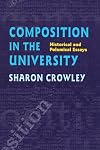
Crowley's 1998 Composition in the University is Crowley's perspective on the history of composition as a discipline and first-year requirement in North American universities. Much of her book explores how Composition has been undervalued in many ways by English departments, with teaching relegated to un-tenured faculty and graduate students, but also how the program was needed by English departments in order to become large departments where faculty to specialized in aspects of literature show more and teach those specialized courses (4, 11).
Crowley uses her history to claim that first-year composition should "become a part of the disciplinary practices of composition studies," and thus part of a sequence of non-required composition courses that students would elect to take (9, 29, 241).
Crowley also chronicles the ideological shifts in the pedagogy of first-year composition, arguing that the humanist approach (which focuses on the improvement of student character through reading great works in literature) is not the best approach. Part of Crowley's reasoning for this is that humanist literary study focuses on completed texts, while composition needs to focus on the production and development of texts, and that humanism is more metaphysical than it is rhetorical (13-14).
To briefly summarize Crowley's history:
• The nineteenth century saw a decline in the study of rhetoric—a "focus on public, civic, discourse"—in the United States and an increased focus on "developing taste in their students" instead (34). This was due in part to the creation of the modern university, modeled after German universities. The developed requirement of freshman composition also helped to legitimize English studies (esp. since freshman composition usually focused on literature) (58-59).
• Part of the legitimizing of literature as an area of study in the late nineteenth century involved alienating students from their language, which Crowley argues was done in three steps: "The first step in the process was to define English as a language from which its native speakers were alienated. The second step was to establish an entrance examination in English that was very difficult to pass. The third step, necessitated by the large number of failures on the exam, was to install a course of study that would remediate the lack demonstrated by the exam" (60).
• Because composition was taught from a humanist/literary perspective, it was easily tied to current-traditional rhetoric, which "is not a rhetoric at all" because it is not situated, but is focused on forms or genres: "exposition, description, narrative, and argument" (94). Humanism and current-traditional rhetoric could be tied together so easily because both required "that students' expression of character be put under the constant surveillance so that they could be 'improved' by correction" (97).
• During World War II, composition began to focus more on communication skills because the military was asking that soldiers be taught communication skills. Because of this, composition teachers created professional associations (CCCC) and some composition teachers turned to rhetorical theory to understand communication (instead of simply expression) (155-156). The 1940s saw an increase in progressive thought (influenced by Dewey) in composition courses, and a focus on education for the benefit of democracy. While the communication skills focus flourished in some ways, it was intellectually demanding on teachers and required administrative support (testing, labs, etc.)—along with these problems, many English departments were resistant to communication skills, and the trend largely faded out by 1960 (183).
• Starting in the 1970s, process pedagogy began to develop, which brought about three changes: 1) the professionalization of teaching FYC with research; 2) the idea that students are writers rather than people whose grammar needs policed; and 3) composition became more fun to teach (191). While there are differences between product pedagogy and process pedagogy, Crowley doubts that this shift was that big: textbooks still espoused current-traditional models, and process pedagogy did little to question modernist notions of a required course and composition's situatedness in the university (212-213). One important effect of process pedagogy, however, is that it altered the ideology of composition programs from conservative to liberal (218)
Crowley closes her book with a few important arguments that she takes out of her history: 1) teaching is always political (Chapter 10); 2) the requirement of FYC produces student subjectivity as "docile student" (217); 3) it's doubtful whether a required course can be turned "to radical purposes" (235); 4) composition as a requirement should be abolished (241). This last point Crowley argues because required FYC exploits part-time teachers and graduate students, as well as students; the curriculum is harmed by trying to reach every student; the classroom environment is harmed by being a requirement; and the requirement harms the discipline of composition because it becomes a gatekeeping course and sits low on the hierarchy at universities (241-243). show less
Crowley uses her history to claim that first-year composition should "become a part of the disciplinary practices of composition studies," and thus part of a sequence of non-required composition courses that students would elect to take (9, 29, 241).
Crowley also chronicles the ideological shifts in the pedagogy of first-year composition, arguing that the humanist approach (which focuses on the improvement of student character through reading great works in literature) is not the best approach. Part of Crowley's reasoning for this is that humanist literary study focuses on completed texts, while composition needs to focus on the production and development of texts, and that humanism is more metaphysical than it is rhetorical (13-14).
To briefly summarize Crowley's history:
• The nineteenth century saw a decline in the study of rhetoric—a "focus on public, civic, discourse"—in the United States and an increased focus on "developing taste in their students" instead (34). This was due in part to the creation of the modern university, modeled after German universities. The developed requirement of freshman composition also helped to legitimize English studies (esp. since freshman composition usually focused on literature) (58-59).
• Part of the legitimizing of literature as an area of study in the late nineteenth century involved alienating students from their language, which Crowley argues was done in three steps: "The first step in the process was to define English as a language from which its native speakers were alienated. The second step was to establish an entrance examination in English that was very difficult to pass. The third step, necessitated by the large number of failures on the exam, was to install a course of study that would remediate the lack demonstrated by the exam" (60).
• Because composition was taught from a humanist/literary perspective, it was easily tied to current-traditional rhetoric, which "is not a rhetoric at all" because it is not situated, but is focused on forms or genres: "exposition, description, narrative, and argument" (94). Humanism and current-traditional rhetoric could be tied together so easily because both required "that students' expression of character be put under the constant surveillance so that they could be 'improved' by correction" (97).
• During World War II, composition began to focus more on communication skills because the military was asking that soldiers be taught communication skills. Because of this, composition teachers created professional associations (CCCC) and some composition teachers turned to rhetorical theory to understand communication (instead of simply expression) (155-156). The 1940s saw an increase in progressive thought (influenced by Dewey) in composition courses, and a focus on education for the benefit of democracy. While the communication skills focus flourished in some ways, it was intellectually demanding on teachers and required administrative support (testing, labs, etc.)—along with these problems, many English departments were resistant to communication skills, and the trend largely faded out by 1960 (183).
• Starting in the 1970s, process pedagogy began to develop, which brought about three changes: 1) the professionalization of teaching FYC with research; 2) the idea that students are writers rather than people whose grammar needs policed; and 3) composition became more fun to teach (191). While there are differences between product pedagogy and process pedagogy, Crowley doubts that this shift was that big: textbooks still espoused current-traditional models, and process pedagogy did little to question modernist notions of a required course and composition's situatedness in the university (212-213). One important effect of process pedagogy, however, is that it altered the ideology of composition programs from conservative to liberal (218)
Crowley closes her book with a few important arguments that she takes out of her history: 1) teaching is always political (Chapter 10); 2) the requirement of FYC produces student subjectivity as "docile student" (217); 3) it's doubtful whether a required course can be turned "to radical purposes" (235); 4) composition as a requirement should be abolished (241). This last point Crowley argues because required FYC exploits part-time teachers and graduate students, as well as students; the curriculum is harmed by trying to reach every student; the classroom environment is harmed by being a requirement; and the requirement harms the discipline of composition because it becomes a gatekeeping course and sits low on the hierarchy at universities (241-243). show less
Toward a Civil Discourse: Rhetoric and Fundamentalism (Composition, Literacy, and Culture, 163) by Sharon Crowley
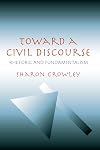
In Toward a Civil Discourse (2006), Sharon Crowley explores and explains the inability for liberal models of rhetoric to be convincing to fundamentalist Christians, and how a rhetorical model of persuasion would help. According to Crowley, liberal models of persuasion are limited because it takes understanding as its primary goal, but understanding doesn't lead to persuasion; it separates values from reasons (36); and it places the blame of failed persuasion on one's "party spirit," passion, show more or subject position (41). She proposes that rhetorical theory, especially as influenced by postmodernism, can assist in persuasion, understanding that beliefs are ideological, deeply held values, with emotional attachments. She understands rhetoric as being about invention, particularly in the classical sense that one intervenes in an attempt to change a community. show less
I loved my English class this semester. But I hated this book. Even my professor admitted that the writers sometimes explain their topics in a very roundabout manner that is hard for a lot of people to understand. I rarely understand ANYthing Crowley and Hawhee talk about, and usually I have to come up with my own way of getting it straight in my head, and cling to that way until I don't have to think about it anymore.
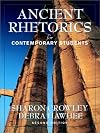
I struggle with whether to give this 2 or 3 stars, but in the end I give it 3. The authors are clearly anti-traditional thought as often as they can manage without much reason. Case in three points: (1) they staunchly but subtley defend in but a few sentences the "Older Sophists" that Plato despised and scorn Plato; (2) "In ancient Greek thought, a person's logos was her name, her history, everything that could be said about her," although ancient Greek thought on such matters probably did show more not frequently include females; (3) they criticize grammar and spelling rules and even postulate that soon we will entirely give over to spelling "bright" as "brite" and so forth. The book also babbles on needlessly, fails to get to the point, bolds several words in each chapter frequently without giving even a hint as to what they mean (providing a glossary in the back), and does not make the reading flow or seem interesting, which is a shame for a book supposedly helping a writer and scrupulous reader be more aware of such things. It does contain much info of great use, however, if you can extract it effectively and sufficiently. show less
Awards


You May Also Like


Associated Authors
Statistics
- Works
- 6
- Members
- 322
- Popularity
- #73,504
- Rating
- 4.0
- Reviews
- 5
- ISBNs
- 17