
Brian Alexander (1) (1959–)
Author of Glass House: The 1% Economy and the Shattering of the All-American Town
For other authors named Brian Alexander, see the disambiguation page.
About the Author
Brian Alexander is the author of Rapture: How Biotech Became the New Religion
Works by Brian Alexander
Glass House: The 1% Economy and the Shattering of the All-American Town (2017) 214 copies, 10 reviews
Greece 1 copy
Tagged
Common Knowledge
- Legal name
- Alexander, Brian Robert
- Birthdate
- 1959-06-15
- Gender
- male
- Occupations
- journalist
- Agent
- BrightSight Speakers Bureau
- Birthplace
- Lancaster, Ohio, USA
- Places of residence
- California, USA
- Associated Place (for map)
- USA
Members
Reviews

Brian Alexander’s provocative book, “Glass House: The 1% Economy and the Shattering of the All-American Town” takes the measure of capital as a malevolent force in American society. He draws a line from the Wall Street raiders of the 1970’s to the decay and decline of the American industrial heartland.
Alexander’s book should be read along side Arlie Russell Hochschield’s “Strangers in Their Own Land: Anger on the American Right.” Hochschield aims her sharpest arrows at the show more American chemical industry for their willful disregard of the ecology of the Deep South, their despoliation of the bayou, the swamps, and the wetlands adjoining their chemical plants and depots.
In “Glass House” we have an Ohio town that struck it rich in the early 1900’s when landowners discovered a rich and cheap reservoir of natural gas and parlayed it into a strong glass industry. They built their plants, they hired their workers, and things seemed to be going along tickety-boo until Carl Icahn arrived with a plan to blast open their companies to “unlock shareholder value” trapped in the aging corporations.
After a series of mismanaged takeovers, plant closures, and bankruptcies, the workers are left with worse wages, few benefits, and no security. Their municipality having given huge tax concessions to the new shareholders are facing bankruptcy as well. And community services consist largely of jailing drug abusers and drug dealers. There is little opportunity for the residents, so they either drift into crime and they drift to nearby Columbus.
Then business turns south, the outsiders blame government taxes, greedy unions, foreign competition, and lazy workers for their misfortunes.
Alexander has a good point. There is a connection between business and the communities they serve. I emphasize the communities they SERVE. The community isn’t just another asset to squeeze.
But is this the whole story?
Just before reading this book I also read “The Idea Factory: Bell Labs and the Great Age of American innovation,” by Jon Gertner. Long before AT&T was broken up by fiat of Congress, the telephone monopoly’s research subsidiary, Bell Labs, assembled the most extraordinary group of engineers, physicists, and chemists to tackle the thorniest problems the telephone company faced.
Bell’s scientists discovered the transistor, found ways to pump information through fibre optic cables, pioneered satellite communications, and developed the first cellphone network. While an employee of Bell Labs, Claude Shannon first put down his Information Theory and opened people’s eyes on how to convert all information into zero’s and ones, one of the foundations of today’s computer industry.
In the American context, capital has helped create some of the greatest wonders of the 20th and now the 21st century. Not always malevolent, you say.
The “All American town” of Alexander’s story, Lancaster, Ohio, is not so squeaky clean. It has a history of race baiting and social exclusion. Alexander starts the story long after the plains have been cleared of Amerindians, after Europeans stole the land for their own farmers.
The ugly side of America is also part of its heritage. Winner take all is as sacred as the Second Amendment. Are we so surprised it has spawned a predatory culture that feeds upon itself? show less
Alexander’s book should be read along side Arlie Russell Hochschield’s “Strangers in Their Own Land: Anger on the American Right.” Hochschield aims her sharpest arrows at the show more American chemical industry for their willful disregard of the ecology of the Deep South, their despoliation of the bayou, the swamps, and the wetlands adjoining their chemical plants and depots.
In “Glass House” we have an Ohio town that struck it rich in the early 1900’s when landowners discovered a rich and cheap reservoir of natural gas and parlayed it into a strong glass industry. They built their plants, they hired their workers, and things seemed to be going along tickety-boo until Carl Icahn arrived with a plan to blast open their companies to “unlock shareholder value” trapped in the aging corporations.
After a series of mismanaged takeovers, plant closures, and bankruptcies, the workers are left with worse wages, few benefits, and no security. Their municipality having given huge tax concessions to the new shareholders are facing bankruptcy as well. And community services consist largely of jailing drug abusers and drug dealers. There is little opportunity for the residents, so they either drift into crime and they drift to nearby Columbus.
Then business turns south, the outsiders blame government taxes, greedy unions, foreign competition, and lazy workers for their misfortunes.
Alexander has a good point. There is a connection between business and the communities they serve. I emphasize the communities they SERVE. The community isn’t just another asset to squeeze.
But is this the whole story?
Just before reading this book I also read “The Idea Factory: Bell Labs and the Great Age of American innovation,” by Jon Gertner. Long before AT&T was broken up by fiat of Congress, the telephone monopoly’s research subsidiary, Bell Labs, assembled the most extraordinary group of engineers, physicists, and chemists to tackle the thorniest problems the telephone company faced.
Bell’s scientists discovered the transistor, found ways to pump information through fibre optic cables, pioneered satellite communications, and developed the first cellphone network. While an employee of Bell Labs, Claude Shannon first put down his Information Theory and opened people’s eyes on how to convert all information into zero’s and ones, one of the foundations of today’s computer industry.
In the American context, capital has helped create some of the greatest wonders of the 20th and now the 21st century. Not always malevolent, you say.
The “All American town” of Alexander’s story, Lancaster, Ohio, is not so squeaky clean. It has a history of race baiting and social exclusion. Alexander starts the story long after the plains have been cleared of Amerindians, after Europeans stole the land for their own farmers.
The ugly side of America is also part of its heritage. Winner take all is as sacred as the Second Amendment. Are we so surprised it has spawned a predatory culture that feeds upon itself? show less
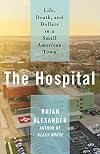
This has to be one of the most important books of our time. Alexander explains the history of health care in the U.S. and then focuses on one small Ohio hospital and the people who staff it. Every person in this country should read “The Hospital” in order to understand fully the sorry shape of a system that affects each and every one of us. The ending of the book talks about the covid crisis and how this broken health care system collapsed even more, largely due to the incompetence of a show more president who was encouraging people to ingest disinfectant and put bright lights inside your body. I’ll leave it to you to imagine how that may be possible. In the early months of 2020 this country was a perfect storm for infectious disease disaster. Add to that a megalomaniac whose only goal was to be reelected to a second term even if it meant he’d have to stage a coup, and the results were disastrous. Brian Alexander provides a public service of the highest order by researching and writing “The Hospital: Life, Death, and Dollars in a Small American Town.” We are in his debt. show less
Journalist Brian Alexander was given unprecedented access to the inner workings of a small town Ohio hospital. He had multiple interviews with staff, including the CEO over an extended period of time, ending after the first summer of covid. Stories of multiple patients are also covered. The book focuses on the crisis in healthcare--Obama Care has helped a lot, but has by no means ended the crisis. But Alexander also uses the hospital as a lens to focus on some of the larger problems in our show more society, primarily poverty, the loss of good jobs, and income inequality, which, not surprisingly have a huge impact on many ongoing health issues. One phrase in particular stood out to me: "new capitalism is killing people." Studies have shown that the decline in the health and longevity of Americans has been abetted by deliberate government policies: "People in states that passed labor, wage, environmental and health laws that were often opposed by ALEC (funded by the Koch Brothers et al) and business interests lived longer than people in states who adopted ALEC-like policies."
But this is not a dry polemical. It is a fascinating look into the ongoing crises in health care, with lots of stories about interesting and dedicated people.
Highly recommended.
4 stars show less
But this is not a dry polemical. It is a fascinating look into the ongoing crises in health care, with lots of stories about interesting and dedicated people.
Highly recommended.
4 stars show less
Everything Wrong with American Healthcare
As the Covid pandemic has clearly demonstrated, a large segment of the American population lives in a delusional world completely divorced from reality. Here, in The Hospital, Brian Alexander lays bare one of the great delusions. It’s not that America has a good healthcare system that with a few tweaks and enhancements could serve the majority of the population. No, the delusion is that America has anything that can be called a real healthcare show more system.
At the root, as his time spent in a small American town shows, are two deadly ideas: that all Americans not only are personally responsible for their own healthcare, but that the sickest among us bear full responsibility for their bad health and early death due to some defect in their character. And that America’s obsession with raw, unfettered capitalism must encompass all aspects of American life, including healthcare. These ideas, shared by the well-off, the poorest, and everybody in-between, deliver to Americans a hodgepodge collection of medical services that only those with the deepest pockets can afford, a system that not even the commercial medical insurance available to those employed can afford, as evidenced by some of the sorry stories in this book.
This is not to say that those involved in the healthcare industry, and make no mistake it is an industry that happens to have as its end product the delivery of healing services; it’s not to say these people don’t care and want to do their best. It’s that they operate in a system that prevents them from delivering the best care and treatment to all but the well-off. Alexander gained access to the boardroom discussions in Bryan, Ohio’s small, independent hospital. As readers will see firsthand, CEO Phil Ennen and his team spent a good deal of their time devising strategies for fending off the large hospital systems from Fort Wayne, Toledo, and as distant as Pittsburgh, who wished to take them over as part of their consolidation efforts. The struggle never seems to cease: how to attract medical talent and hold onto it; how to add the most profitable speciality services; how to generate the surplus income that constitutes profits and fuels independence, salaries, and the like. Make no mistake as the annual reports of nonprofit hospitals show, nonprofits can be very profitable, as a perusal of your large regional nonprofit hospitals will clearly show.
Probably the most enlightening chapter is Chapter 6: What Free Market? The Myth of Free-Market Medicine. Here you’ll learn about profit and loss, about regional consolidation and the building of medical oligarchies, about pricing; generally about the economics of hospitals and medical practice in a system fiercely devoted to capitalism in every aspect of American life. If you read nothing else in this book, spend some time with this chapter.
Some reviewers have accused Alexander of sounding angry on the page. Some say this is an exercise in support of socialized medicine. Well, if he’s angry about a so-called system that eats up nearly twenty percent of American GDP, more than twice as much as any developed country, and delivers abysmal results for the majority of Americans, and especially for those most in need, well, he, and more importantly you, should be angry. And as for socialism, nonsense. How about an orderly system that delivers the best possible care to the most people at reasonable cost? Can’t do it? We already do it, but only for a segment of the population. We call it Medicare and Medicaid.
Please read The Hospital with an open mind and then demand something better for your sake and that of your family, and for your fellow Americans who may not be as well off as you. show less
As the Covid pandemic has clearly demonstrated, a large segment of the American population lives in a delusional world completely divorced from reality. Here, in The Hospital, Brian Alexander lays bare one of the great delusions. It’s not that America has a good healthcare system that with a few tweaks and enhancements could serve the majority of the population. No, the delusion is that America has anything that can be called a real healthcare show more system.
At the root, as his time spent in a small American town shows, are two deadly ideas: that all Americans not only are personally responsible for their own healthcare, but that the sickest among us bear full responsibility for their bad health and early death due to some defect in their character. And that America’s obsession with raw, unfettered capitalism must encompass all aspects of American life, including healthcare. These ideas, shared by the well-off, the poorest, and everybody in-between, deliver to Americans a hodgepodge collection of medical services that only those with the deepest pockets can afford, a system that not even the commercial medical insurance available to those employed can afford, as evidenced by some of the sorry stories in this book.
This is not to say that those involved in the healthcare industry, and make no mistake it is an industry that happens to have as its end product the delivery of healing services; it’s not to say these people don’t care and want to do their best. It’s that they operate in a system that prevents them from delivering the best care and treatment to all but the well-off. Alexander gained access to the boardroom discussions in Bryan, Ohio’s small, independent hospital. As readers will see firsthand, CEO Phil Ennen and his team spent a good deal of their time devising strategies for fending off the large hospital systems from Fort Wayne, Toledo, and as distant as Pittsburgh, who wished to take them over as part of their consolidation efforts. The struggle never seems to cease: how to attract medical talent and hold onto it; how to add the most profitable speciality services; how to generate the surplus income that constitutes profits and fuels independence, salaries, and the like. Make no mistake as the annual reports of nonprofit hospitals show, nonprofits can be very profitable, as a perusal of your large regional nonprofit hospitals will clearly show.
Probably the most enlightening chapter is Chapter 6: What Free Market? The Myth of Free-Market Medicine. Here you’ll learn about profit and loss, about regional consolidation and the building of medical oligarchies, about pricing; generally about the economics of hospitals and medical practice in a system fiercely devoted to capitalism in every aspect of American life. If you read nothing else in this book, spend some time with this chapter.
Some reviewers have accused Alexander of sounding angry on the page. Some say this is an exercise in support of socialized medicine. Well, if he’s angry about a so-called system that eats up nearly twenty percent of American GDP, more than twice as much as any developed country, and delivers abysmal results for the majority of Americans, and especially for those most in need, well, he, and more importantly you, should be angry. And as for socialism, nonsense. How about an orderly system that delivers the best possible care to the most people at reasonable cost? Can’t do it? We already do it, but only for a segment of the population. We call it Medicare and Medicaid.
Please read The Hospital with an open mind and then demand something better for your sake and that of your family, and for your fellow Americans who may not be as well off as you. show less
Lists
Awards


You May Also Like


Associated Authors
Statistics
- Works
- 8
- Members
- 664
- Popularity
- #37,984
- Rating
- 3.8
- Reviews
- 30
- ISBNs
- 42
- Languages
- 4
