
Fredric Brown (1906–1972)
Author of Martians, Go Home
About the Author
Series
Works by Fredric Brown
From These Ashes: The Complete Short SF (Science Fiction) of Fredric Brown (2001) 254 copies, 5 reviews
Night of the Jabberwock; The Screaming Mimi; Knock Three-One-Two; The Fabulous Clipjoint - 4 Novels (Black Box Thrillers) (1983) 52 copies, 1 review
Memory of Fire II: 46 copies
The Second Fredric Brown Megapack: 27 Classic Science Fiction Stories (The Fredric Brown Megapack Book 2) (2014) 21 copies
Huwelijksexperiment op de maan 18 copies
Smekmånad i helvetet 11 copies
Nooit gebeurd. 9 copies
Strangers No More: Tales of Alien Life by Science Fiction Masters Isaac Asimov, Philip José Farmer, Marion Zimmer Bradley and More! (2017) 9 copies
Assurdo universo - Progetto Giove - Il vagabondo dello spazio - Gli strani suicidi di Bartlesville (1989) 7 copies
Millemondinverno 1973 6 copies
The Last Martian 6 copies
The Classic Collection of Fredric Brown (11 Novels and 60 Short Stories). Illustrated: Detectives, Thrillers, Science Fiction (2025) 5 copies
Placet Is A Crazy Place 5 copies
Os Marcianos Divertem-se 4 copies
Dark Interlude [short story] 4 copies
The Angelic Angleworm 4 copies
Expedition [Short Story] 4 copies
La sentinella e altri racconti 4 copies
Intruz 3 copies
Double Standard [Short Story] 3 copies
L'angelico lombrico 3 copies
Sex life on the planet Mars (Fredric Brown in the detective pulps) (Fredric Brown in the detective pulps) (1986) 3 copies
Extraños en la tierra 3 copies
The Hobbyist [short story] 3 copies
Short Science Fiction Collection 053 2 copies
O Espaço Será Pequeno 2 copies
Paradoxul pierdut 2 copies
Cinque giorni d'incubo 2 copies
Loucura no Universo 2 copies
Naturally [Short Story] 2 copies
Rustle of Wings [Short Story] 2 copies
宇宙をぼくの手の上に (創元推理文庫 605-5) 2 copies
Nightmare in Green [Short Story] 2 copies
Blood [Short Story] 2 copies
Murder Set to Music 2 copies
Short Science Fiction Collection 076 2 copies
Short Science Fiction Collection 059 2 copies
Short Science Fiction Collection 057 2 copies
Millennium [Short Story] 2 copies
The Little Lamb [Short Story] 2 copies
Short Science Fiction Collection 051 2 copies
Bear Possibility {short story} 2 copies
Who was that blonde I saw you kill last night? (Fredric Brown in the detective pulps) (Fredric Brown in the detective pu (1988) 2 copies
Voodoo 2 copies
The Joke 2 copies
Short Science Fiction Collection 056 2 copies
Statuetten som skrek 1 copy
フレドリック・ブラウンSF短編全集3 最後の火星人 1 copy
フレドリック・ブラウンSF短編全集2 すべての善きベムが 1 copy
Luna de miel en el infierno 1 copy
2000x: Knock 1 copy
Noche de brujas 1 copy
フレドリック・ブラウンSF短編全集1 星ねずみ 1 copy
Elsie sehen und sterben 1 copy
In den Strassen von Chicago 1 copy
Pozemšťané a mimozemšťané 1 copy
The Classic Thrillers of Fredric Brown. Illustrated: The Screaming Mimi, Knock Three-One-Two, Night of the Jabberwock (2025) 1 copy
Nachtmerrie in groen 1 copy
Loucura no Universo 1 copy
フレドリック・ブラウンSF短編全集4 最初のタイムマシン 1 copy
*** Brown, Frederic *** 1 copy
Short Fiction Collection 1 copy
No mires hacia atras 1 copy
Starshine 1 copy
Moord Maniak 1 copy
Atingerea spaţiului 1 copy
The House {short story} 1 copy
Dead Letter [short story] 1 copy
Vengeance Fleet 1 copy
Fatal Error [short story] 1 copy
Bright Beard [short story] 1 copy
Second Chance [Short Story] 1 copy
Fish Story {Short Story} 1 copy
Runaround [Short Story] 1 copy
Entity Trap [short story] 1 copy
Paradox Lost [Short Story] 1 copy
The Hat Trick 1 copy
Witness In The Dark 1 copy
Search 1 copy
Daisies 1 copy
Sentence 1 copy
Solipsist 1 copy
4 Titles By Fredric Brown : What Mad Universe - Martians, Go Home - Rogue in Space - The Mind Thing 1 copy
The Dome [short story] 1 copy
Unfortunately 1 copy
Sentry [short story] 1 copy
Un caso su mille 1 copy
Ça ne se refuse pas 1 copy
La vie sexuelle sur mars 1 copy
The Dangerous People 1 copy
Blue Murder [short story] 1 copy
Nasty [short story] 1 copy
Black Lizard 1 copy
Cartoonist [short story] 1 copy
Caïn 1 copy
The Collection 1 copy
Associated Works
The Science Fiction Hall of Fame, Volume One: The Greatest Science Fiction Stories of All Time (1970) — Contributor — 2,096 copies, 34 reviews
Devils & Demons: A Treasury of Fiendish Tales Old & New (1991) — Contributor — 288 copies, 2 reviews
The Arbor House Treasury of Horror and the Supernatural (1981) — Contributor — 218 copies, 3 reviews
The Vampire Archives: The Most Complete Volume of Vampire Tales Ever Published (2007) — Contributor — 213 copies, 5 reviews
McSweeney's 45: Hitchcock and Bradbury Fistfight in Heaven (2013) — Contributor — 119 copies, 6 reviews
Analog Anthology #1: Fifty Years of the Best Science Fiction From Analog (1980) — Contributor — 117 copies, 1 review
Isaac Asimov's Magical Worlds of Fantasy, Volume 8: Devils (1987) — Contributor — 106 copies, 2 reviews
Isaac Asimov Presents : The Golden Years of Science Fiction, 4th Series (1984) — Contributor — 101 copies, 1 review
The Prentice Hall Anthology of Science Fiction and Fantasy (2000) — Contributor — 99 copies, 2 reviews
Rivals of Weird Tales: 30 Great Fantasy & Horror Stories from the Weird Fiction Pulps (1990) — Contributor — 97 copies, 1 review
Isaac Asimov's Magical Worlds of Fantasy, Volume 7: Magical Wishes (1891) — Contributor — 95 copies, 1 review
Bug-Eyed Monsters: 13 Stories of Dripping, Creeping, Gurgling, Purling, Trilling, Oozing, Seeping, Gushing Deadly Monsters (1980) — Contributor — 78 copies, 2 reviews
The Science Fiction Megapack: 25 Classic Science Fiction Stories by Masters (2011) — Author — 66 copies, 3 reviews
Lovers & Other Monsters: A Collection of Amorous Tales of Fantasy, Old and New (1993) — Contributor — 64 copies, 1 review
Antologia del Relato Policial (Aula de Literatura) (1991) — Author, some editions — 61 copies, 1 review
Isaac Asimov Presents : The Golden Years of Science Fiction, 3rd Series (1984) — Contributor — 60 copies
The Arbor House Treasury of Detective and Mystery Stories from the Great Pulps (1983) — Contributor — 53 copies, 3 reviews
The Mystery Hall of Fame: An Anthology of Classic Mystery and Suspense Stories (1984) — Contributor — 36 copies, 1 review
Van Jules Verne tot Isaac Asimov de vijftig beste science fiction verhalen (1981) — Contributor — 16 copies, 1 review
Special Wonder: The Anthony Boucher Memorial Anthology of Fantasy and Science Fiction (1970) — Contributor — 12 copies
Science Fiction Omnibus: The Best Science Fiction Stories: 1949, 1950 (1952) — Contributor — 11 copies
Crimes and Misfortunes: The Anthony Boucher Memorial Anthology of Mysteries — Contributor — 5 copies
Science fiction omnibus 5 copies
Bruin's Midnight Reader: Strange and Engaging Stories for the Curious (2022) — Contributor — 3 copies
Fantastrenna — Contributor — 3 copies
Short Science Fiction Collection 045 2 copies
Short Science Fiction Collection 047 — Contributor — 2 copies
Short Science Fiction Collection 072 — Contributor — 2 copies
Configurations: American Short Stories for the EFL Classroom, Advanced Level (1984) — Contributor — 1 copy
Short Science Fiction Collection 043 — Author — 1 copy
Thrilling Science Fiction, Spring 1971 — Contributor — 1 copy
Short Science Fiction Collection 040 — Contributor — 1 copy
Tagged
Common Knowledge
- Legal name
- Brown, Fredric William (birth name)
- Other names
- McFail, A.
Graham, Felix
Arthur, Robert - Birthdate
- 1906-10-29
- Date of death
- 1972-03-11
- Gender
- male
- Education
- Hanover College
University of Cincinnati - Occupations
- journalist
science fiction writer - Awards and honors
- Cordwainer Smith Rediscovery Award (2012)
- Agent
- Harry Altshuler
- Relationships
- Brown, Elizabeth (spouse)
- Short biography
- Fredric Brown is geboren in 1906 en gestorven in 1972. Zijn oeuvre bevat drie verschillende soorten werk detectives, Science fiction en humor
- Nationality
- USA
- Birthplace
- Cincinnati, Ohio, USA
- Places of residence
- Milwaukee, Wisconsin, USA
New York, New York, USA
Taos, New Mexico, USA
Venice, California, USA - Place of death
- Tucson, Arizona, USA
- Associated Place (for map)
- USA
Members
Discussions
Is it a metaphor? in Good Show Sir! — bad science fiction and fantasy covers (September 2025)
Science fiction, short story, time travel & dinosaurs in Name that Book (November 2015)
short story w/ twist ending in Name that Book (August 2015)
Reviews
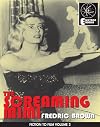
Psychiatry was all the rage in late 1940s popular culture, very au courant, as witness films such as Spellbound and The Snake Pit, or the three dazzling novels that John Franklin Bardin published between 1946 and 1948, The Deadly Percheron, The Last of Philip Banter, and Devil Take the Blue-Tail Fly. So when a character early in Fredric Brown's equally dazzling The Screaming Mimi makes a seemingly casual reference to having had psychiatric training, you may be sure it is a significant show more moment.
Fredric Brown (1906-1972) is one of the rare authors to distinguish himself in both crime fiction and science fiction, and he brought an offbeat sense of humor to both. The Screaming Mimi (1949) is a standalone hard-boiled mystery with a newspaper reporter rather than a detective as its protagonist. Bill Sweeney is an unmarried Irish-American scribe in his early 40s who claims not to be an alcoholic (right) but who goes on benders during which he winds up on park benches with other drunks - which is how the novel opens, as a matter of fact, and it gives nothing away to say that is how it ends, as well. Loop the loop!
Brown says on the opening page, "it isn't a nice story. It's got murder in it, and women and liquor and gambling and even prevarication" (love that "even," a neat specimen of Brown's puckishness). Sweeney will witness the aftermath of an attempted killing and become obsessed with the victim, who just happens to be a stripper who performs an act with a large and ferocious-looking dog. You can already see how this gets psychological.
The "Screaming Mimi" of the title is a semi-mass-produced "fine art" statuette of a terrified nude woman, which figures heavily in the narrative: "The mouth was wide open in a soundless scream. The arms were thrust out, palms forward, to hold off some approaching horror." Believe me that I know that the phrase "semi-mass-produced 'fine art' statuette" is rife with internal contradictions, which happen to be completely germane to the story. Sweeney is a high-culture snob who dotes on his semi-mass-produced classical music 78s and shudders when he hears Irving Berlin mentioned. (This is funny, since Berlin and his "Great American Songbook" colleagues are now considered classical composers, just about.)
It gets better. The statuette looks like it is made of ebony, but it's not. "It is made of a new plastic that can't be told from ebony, unless you pick it up. The dull gloss is the same as ebony's, to the eye." Things are not what they seem!, check. Repros and knock-offs.
Then when Sweeney's apartment is burgled, the thief fails to take "a stickpin with a zircon in it that [he] could not have been sure wasn't a diamond." Who can be sure of anything, those days or these days?
In case you're wondering, Walter Benjamin's seminal 1936 essay "The Work of Art in the Age of Mechanical Reproduction" would not be published in English translation until 1968, but in 1949 Brown is already channeling its spirit, big-time.
I don't want to go any further with the plot of The Screaming Mimi; you really need to read it. It is an absolute classic of its kind, easily as good as Raymond Chandler when he was cooking. It has a coterie reputation, but is not as well-known as it should be (although you know about it now, and that's all that really counts). No Brown title was included in the Library of America's big two-volume set of noir novels of the 1930s, 1940s, and 1950s, and that was a criminal oversight.
The Screaming Mimi has been adapted for the movies twice, by Gerd Oswald as Screaming Mimi in 1958, and by Dario Argento as The Bird with the Crystal Plumage in 1970. I haven't seen either, but I feel confident that the Oswald film, at least, must have considerably altered Brown's overall thrust, because there is no way that a 1958 movie, even luridly put forward as "The strip-tease murder case!" and featuring Gypsy Rose Lee in a supporting role, could have encompassed some of the twists of the original.
Yes, I have been mimicking Brown's Mimi style throughout this piece. Sharp of you to notice. show less
Fredric Brown (1906-1972) is one of the rare authors to distinguish himself in both crime fiction and science fiction, and he brought an offbeat sense of humor to both. The Screaming Mimi (1949) is a standalone hard-boiled mystery with a newspaper reporter rather than a detective as its protagonist. Bill Sweeney is an unmarried Irish-American scribe in his early 40s who claims not to be an alcoholic (right) but who goes on benders during which he winds up on park benches with other drunks - which is how the novel opens, as a matter of fact, and it gives nothing away to say that is how it ends, as well. Loop the loop!
Brown says on the opening page, "it isn't a nice story. It's got murder in it, and women and liquor and gambling and even prevarication" (love that "even," a neat specimen of Brown's puckishness). Sweeney will witness the aftermath of an attempted killing and become obsessed with the victim, who just happens to be a stripper who performs an act with a large and ferocious-looking dog. You can already see how this gets psychological.
The "Screaming Mimi" of the title is a semi-mass-produced "fine art" statuette of a terrified nude woman, which figures heavily in the narrative: "The mouth was wide open in a soundless scream. The arms were thrust out, palms forward, to hold off some approaching horror." Believe me that I know that the phrase "semi-mass-produced 'fine art' statuette" is rife with internal contradictions, which happen to be completely germane to the story. Sweeney is a high-culture snob who dotes on his semi-mass-produced classical music 78s and shudders when he hears Irving Berlin mentioned. (This is funny, since Berlin and his "Great American Songbook" colleagues are now considered classical composers, just about.)
It gets better. The statuette looks like it is made of ebony, but it's not. "It is made of a new plastic that can't be told from ebony, unless you pick it up. The dull gloss is the same as ebony's, to the eye." Things are not what they seem!, check. Repros and knock-offs.
Then when Sweeney's apartment is burgled, the thief fails to take "a stickpin with a zircon in it that [he] could not have been sure wasn't a diamond." Who can be sure of anything, those days or these days?
In case you're wondering, Walter Benjamin's seminal 1936 essay "The Work of Art in the Age of Mechanical Reproduction" would not be published in English translation until 1968, but in 1949 Brown is already channeling its spirit, big-time.
I don't want to go any further with the plot of The Screaming Mimi; you really need to read it. It is an absolute classic of its kind, easily as good as Raymond Chandler when he was cooking. It has a coterie reputation, but is not as well-known as it should be (although you know about it now, and that's all that really counts). No Brown title was included in the Library of America's big two-volume set of noir novels of the 1930s, 1940s, and 1950s, and that was a criminal oversight.
The Screaming Mimi has been adapted for the movies twice, by Gerd Oswald as Screaming Mimi in 1958, and by Dario Argento as The Bird with the Crystal Plumage in 1970. I haven't seen either, but I feel confident that the Oswald film, at least, must have considerably altered Brown's overall thrust, because there is no way that a 1958 movie, even luridly put forward as "The strip-tease murder case!" and featuring Gypsy Rose Lee in a supporting role, could have encompassed some of the twists of the original.
Yes, I have been mimicking Brown's Mimi style throughout this piece. Sharp of you to notice. show less
Olafur Eliasson : the blind pavilion : 50th Venice Biennale 2003--Danish Pavilion, 15th of June until 2nd of November 2003 by Frederic Brown
In Olafur Eliasson's exhibition The Blind Pavilion for the Danish pavilion at the most recent Venice Biennale, virtually all the strategies that the artist had employed up until now were activated: mirror reflections, glass kaleidoscopes, stretches of stairway, architectural interventions, and camera obscuras. An all-encompassing exhibition, it cancelled out the dividing lines between work and viewer, between outside and inside, between art and science. A parallel counterpart to the show more pavilion, rather than a mere representation of it, is the book The Blind Pavilion. Created by Eliasson in close collaboration with Danish author Svend Uge Madsen, who has persistently challenged our notions of time and space in his writings, The Blind Pavilion gathers writing by authors, poets, and theoreticians who were invited to contribute texts that explore our constantly shifting and ever-evolving capacity for "orienting" ourselves. The texts serve as contributions to an examination of how we physically and psychologically orient ourselves to the world--and of what happens when we are deprived of one or more of our orientation possibilities, for example our ability to hear and remember, to expect something, or to experience the passage of time show less

Willy Griff is a struggling actor trying to make a go of it in Hollywood. He lives in a room in a boarding house filled with similarly marginal characters and nags his agent for work. He does have a married woman he's been meeting in motel rooms, at least until her husband visits him to demand he stop. Which is when Willy comes up with the idea of killing the husband so that he and Doris can continue their relationship and have her husband's money. So a banal reason to commit an show more uninteresting crime. The plans become more complex as time passes. Willy is determined to not get caught and he knows that having been Doris's lover makes him an automatic suspect. Then a solution presents itself, it's one we've seen before, but the way Brown puts the story together makes for a highly entertaining read. What makes this noir sing is how Brown writes the characters, none of whom you'd want to meet, and for the absolute amazing jaw-dropping ending. show less
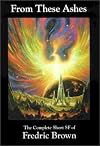
This book collects the complete short fiction of Fredric Brown, originally published between 1941 and 1965, arranged in chronological order. Brown was a midwesterner, never much involved in the SF author/fan culture that sprang up on both coasts in the genre's early years. While it's not unusual to find SF or mystery writers who've dabbled in the other genre, Brown is one of the few to be a genuinely significant figure in both.
Within SF, Brown is better known for his short fiction than for show more his novels, and I do mean short. He specialized, especially in the latter half of his career, in short-shorts, stories of one or two pages. From 1954 to 1963, this collection includes 62 stories, totaling 130 pages.
At that length, he's not writing stories so much as jokes, single ideas that build to a clever twist or punch line. And Brown's final twists could be clever indeed. "Millennium" is one of my favorite "deal with the devil" stories; "Rebound" is a precisely structured miniature that puts all the punch in the next-to-last word; "Hobbyist," really more of a crime story than SF, builds quickly to a delightful just-desserts ending.
Of his longer stories, the best known these days is probably "Arena," which was the inspiration for a Star Trek episode. (Well, sort of. Trek writer Gene Coon came up with the story, having apparently forgotten the Brown story he'd read earlier. Coon's version wasn't exactly like Brown's, but the basic concept is identical. The Trek lawyers caught the similarity, contacted Brown, paid him for the rights, and gave him screen credit.)
Had I been in charge of this book, I might have chosen not to arrange the stories chronologically. Putting all of the short-shorts at the end might leave the reader with the final impression that Brown was merely clever, skilled with a quick punchline or sharp pun. But he's more than that (though that's not nothing). His prose is crisp and graceful, even after eighty years; he carries his ideas to their logical conclusions in creative ways; and he finds unexpected resolutions to his stories. The ending to "Etaoin Shrdlu," for instance, is not only an unexpected victory over the story's menace, but shows an unusually cosmopolitan worldview for 1942.
When you collect the complete works of any artist, there's bound to be a bit of slush in the pile. But Brown is never so bad as to be unreadable. At worst, his stories are a bit unoriginal, and even that is probably exaggerated for the modern reader, who's read a half-century or more more of variations on the same familiar tropes. show less
Within SF, Brown is better known for his short fiction than for show more his novels, and I do mean short. He specialized, especially in the latter half of his career, in short-shorts, stories of one or two pages. From 1954 to 1963, this collection includes 62 stories, totaling 130 pages.
At that length, he's not writing stories so much as jokes, single ideas that build to a clever twist or punch line. And Brown's final twists could be clever indeed. "Millennium" is one of my favorite "deal with the devil" stories; "Rebound" is a precisely structured miniature that puts all the punch in the next-to-last word; "Hobbyist," really more of a crime story than SF, builds quickly to a delightful just-desserts ending.
Of his longer stories, the best known these days is probably "Arena," which was the inspiration for a Star Trek episode. (Well, sort of. Trek writer Gene Coon came up with the story, having apparently forgotten the Brown story he'd read earlier. Coon's version wasn't exactly like Brown's, but the basic concept is identical. The Trek lawyers caught the similarity, contacted Brown, paid him for the rights, and gave him screen credit.)
Had I been in charge of this book, I might have chosen not to arrange the stories chronologically. Putting all of the short-shorts at the end might leave the reader with the final impression that Brown was merely clever, skilled with a quick punchline or sharp pun. But he's more than that (though that's not nothing). His prose is crisp and graceful, even after eighty years; he carries his ideas to their logical conclusions in creative ways; and he finds unexpected resolutions to his stories. The ending to "Etaoin Shrdlu," for instance, is not only an unexpected victory over the story's menace, but shows an unusually cosmopolitan worldview for 1942.
When you collect the complete works of any artist, there's bound to be a bit of slush in the pile. But Brown is never so bad as to be unreadable. At worst, his stories are a bit unoriginal, and even that is probably exaggerated for the modern reader, who's read a half-century or more more of variations on the same familiar tropes. show less
Lists
Awards


You May Also Like


Associated Authors
Statistics
- Works
- 339
- Also by
- 204
- Members
- 7,975
- Popularity
- #3,038
- Rating
- 3.7
- Reviews
- 229
- ISBNs
- 409
- Languages
- 16
- Favorited
- 25