
Broughton Coburn
Author of Everest : Mountain Without Mercy
About the Author
Broughton Coburn has lived in the Himalaya for two of the past three decades, and is the author of five books. He is the Special Projects Director for the American Himalayan Foundation
Image credit: from BroughtonCoburn.com
Works by Broughton Coburn
Associated Works
Touching My Father's Soul: A Sherpa's Journey to the Top of Everest (2001) — Author — 389 copies, 1 review
Tagged
Common Knowledge
- Birthdate
- 1951-06-02
- Gender
- male
- Nationality
- USA
- Associated Place (for map)
- USA
Members
Reviews

“The Vast Unknown” is a study in uncertainty and an insightful look back to era of collegial expeditionary mountaineering that has unfortunately passed. It is a great tribute to a team that that made decision together in a collaborative fashion. But there was no certainty of success for this team, Mt. Everest was not yet the guided peak of every-man it is today, in 1963 twice as many people died as had reached the summit.
It was the tail end of the age of exploration on the 8000 meter show more peaks and nations were still competing with one another for claiming “first ascent” by “my country”. The Cold War was at its height and the stakes for America were high. Yet somehow the Americans were strangely absent on this world stage of mountaineering as politics. In his proposal for funding, expedition leader Norman Dyhrenfurth expressed it like this, “The first American go at Everest will be an event. If we succeed it will be a feather in our cap, a booster to our prestige, a refutation beyond argument of our detractor’s taunt that we are a nation gone soft and gutless.” (p. 39).
Sweeping in scope Coburn tries to paint the historical context for this period of mountaineering history. Some will find the references to the Kennedy era, the Cold War, the Space race, Intelligence agencies spying efforts and the emerging geopolitics between China and India to be overreaching. If this is not your cup of tea just skip these chapters as there is more than enough meat on the actual ascent narrative.
There are great profiles of the climbers, what they were doing in the American climbing scene before they were recruited, and what became of them in the fifty years that followed. The attempt to understand the inner workings of the mind of Willi Unsoeld was particularly interesting.
Best single insight into this team were their discussions on which route they should take up the mountain. Consider these three facts (as of 1963)…
• Only two expeditions had every succeeded
• Only six people had summited
• But those groups had both taken the same route (the South Col)
…But the majority of this American team viewed the South Col as the “walk up” route! They wanted to do something new, something that had not been done before. This is a glimpse into the very sole of American mountaineering psyche.
Most American people recognize the name Jim Whittaker. Usually only serious mountaineers will recognize the names Willi Unsoeld or Tom Hornbein. Perhaps this book can help these two receive a bit more of the recognition they deserve, as they were the true pioneers in Himalayan climbing history. Their route on the West Ridge remains a true classic fifty years later, as it still has only been followed by another 12 people. If that is not telling enough, consider the morbidity rates. On Everest as a whole there have been 240 deaths for 6150 summits by 3750 people (or 1 death per 25 successful summits) – But on the West Ridge the toll is 16 deaths for a measly 14 summits (Afterword, pp. 246-247).
There were some notable “firsts” on this expedition:
• Overlaying scientific research on the climbing endeavor to sweeten the fundraising appeal [chapter 7]
• Extensive use of “local” (Solu Khumbu) Sherpas vs. “Darjeeling” (Indian) Sherpas
• Recognition that there was a role for lightweight mountaineering equipment for “trekkers” and the creation of the trekking industry by Colonel Jimmy Roberts (pp. 249-250)
Recommended for armchair adventurers who want to understand what transpired on the mountain and to get a historical sense of why these individuals went on the first American expedition to Mt. Everest. Highly recommended for serious national students of mountaineering who want to really dig in to understand the personal and national motivations in the context of history. show less
It was the tail end of the age of exploration on the 8000 meter show more peaks and nations were still competing with one another for claiming “first ascent” by “my country”. The Cold War was at its height and the stakes for America were high. Yet somehow the Americans were strangely absent on this world stage of mountaineering as politics. In his proposal for funding, expedition leader Norman Dyhrenfurth expressed it like this, “The first American go at Everest will be an event. If we succeed it will be a feather in our cap, a booster to our prestige, a refutation beyond argument of our detractor’s taunt that we are a nation gone soft and gutless.” (p. 39).
Sweeping in scope Coburn tries to paint the historical context for this period of mountaineering history. Some will find the references to the Kennedy era, the Cold War, the Space race, Intelligence agencies spying efforts and the emerging geopolitics between China and India to be overreaching. If this is not your cup of tea just skip these chapters as there is more than enough meat on the actual ascent narrative.
There are great profiles of the climbers, what they were doing in the American climbing scene before they were recruited, and what became of them in the fifty years that followed. The attempt to understand the inner workings of the mind of Willi Unsoeld was particularly interesting.
Best single insight into this team were their discussions on which route they should take up the mountain. Consider these three facts (as of 1963)…
• Only two expeditions had every succeeded
• Only six people had summited
• But those groups had both taken the same route (the South Col)
…But the majority of this American team viewed the South Col as the “walk up” route! They wanted to do something new, something that had not been done before. This is a glimpse into the very sole of American mountaineering psyche.
Most American people recognize the name Jim Whittaker. Usually only serious mountaineers will recognize the names Willi Unsoeld or Tom Hornbein. Perhaps this book can help these two receive a bit more of the recognition they deserve, as they were the true pioneers in Himalayan climbing history. Their route on the West Ridge remains a true classic fifty years later, as it still has only been followed by another 12 people. If that is not telling enough, consider the morbidity rates. On Everest as a whole there have been 240 deaths for 6150 summits by 3750 people (or 1 death per 25 successful summits) – But on the West Ridge the toll is 16 deaths for a measly 14 summits (Afterword, pp. 246-247).
There were some notable “firsts” on this expedition:
• Overlaying scientific research on the climbing endeavor to sweeten the fundraising appeal [chapter 7]
• Extensive use of “local” (Solu Khumbu) Sherpas vs. “Darjeeling” (Indian) Sherpas
• Recognition that there was a role for lightweight mountaineering equipment for “trekkers” and the creation of the trekking industry by Colonel Jimmy Roberts (pp. 249-250)
Recommended for armchair adventurers who want to understand what transpired on the mountain and to get a historical sense of why these individuals went on the first American expedition to Mt. Everest. Highly recommended for serious national students of mountaineering who want to really dig in to understand the personal and national motivations in the context of history. show less
 This review was written for LibraryThing Early Reviewers.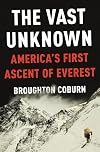
This account of America's first ascent of Everest was great. The author has done extensive research and interviews. The attention given to each individual climber really elevated the book. The Kennedy era backdrop was also an interesting way to put the time of the adventure into prospective. The last chapter details what it is like to climb Everest in today's world... not at all comparable.
There is little information on the technical aspect of the climb. The focus is on the individuals and show more team. I am a little closer to understanding what drives some people to attempt the near impossible.I am looking forward to reading more about this climb, these mountaineers, Sherpas, Everest and the Himalayas in general. I think that is a very good sign that I enjoyed the book. show less
There is little information on the technical aspect of the climb. The focus is on the individuals and show more team. I am a little closer to understanding what drives some people to attempt the near impossible.I am looking forward to reading more about this climb, these mountaineers, Sherpas, Everest and the Himalayas in general. I think that is a very good sign that I enjoyed the book. show less
This review was written for LibraryThing Early Reviewers.“The Vast Unknown” takes you step by step from the initial inspiration to the final achievement of becoming the first Americans to climb Mt. Everest. Broughton Coburn makes you feel as though you are part of the actual team. You learn how to choose your fellow climbers, obtain sponsorship, organize the vast and sundry details, adjust to setbacks and manage a coalition of disparate individuals. Coburn brings all these elements together in an engaging true account. Sometimes humorous, show more sometimes heart-wrenching, always inspiring, you are drawn along into the quest.
The book revolves around the men who lived this adventure. Their individual stories are riveting. Together they fought the elements as well as their occasional doubts and fears. Tensions evolve over which path to pursue to the top. Ultimately it is the togetherness of the team that helps resolve all issues.Together with the Sherpa’s and porters who accompany them, they manage to accomplish their objective.
If you’ve ever contemplated why anyone would want to climb a mountain, this book will provide answers. Perhaps it may even inspire you to climb a mountain of your own or at least to read more of the original accounts listed at the back of the book.
My only regret was that the preview copy didn’t have a map of Everest or the pictures. The Cast of Characters in the front of the book was very helpful. show less
The book revolves around the men who lived this adventure. Their individual stories are riveting. Together they fought the elements as well as their occasional doubts and fears. Tensions evolve over which path to pursue to the top. Ultimately it is the togetherness of the team that helps resolve all issues.Together with the Sherpa’s and porters who accompany them, they manage to accomplish their objective.
If you’ve ever contemplated why anyone would want to climb a mountain, this book will provide answers. Perhaps it may even inspire you to climb a mountain of your own or at least to read more of the original accounts listed at the back of the book.
My only regret was that the preview copy didn’t have a map of Everest or the pictures. The Cast of Characters in the front of the book was very helpful. show less
This review was written for LibraryThing Early Reviewers.Coburn's account of the first American expedition of Mount Everest is well researched, thorough, and evocative of the romantic Everest that existed before corporations providing guided summits for profit. For me, the best part was the detailed description of Hornbein and Unsoeld's summit from the West Ridge, it really made me feel like I needed to get outdoors and flee the convolution of modern gadgetry and be surrounded by nature. There is some description through the eyes of a former 1963 show more team member of what Everest has devolved into, which is how most people my age I think see the mountain; an expensive resume builder. Even though 9 people had successfully summitted Everest before the American expedition of 1963, 17 had died trying and success was far from assured. The logistics, leadership, teamwork, relationships and ingenuity that it took to summit the highest peak in the world is the real story of America's 1963 feat, not pure athleticism or strength.
Editorially speaking, Coburn's layout can be confusing; jumping around without notice along the timeline, or between players in the story, but the detail and background given make up somewhat for the disjointedness. I also don't appreciate the repeating of sub text and details that were given previously, as if being told for the first time, when you just read it a chapter ago. I understand that I am reading it much faster than the author wrote it, and in many cases the order I am reading it is not the order written, but I am usually critical of authors and editors who overlook these details and repeat basic exposition in subsequent chapters.
I enjoyed The Vast Unknown and am inspired to get back out on the trail and put in some much needed backpacking time. show less
Editorially speaking, Coburn's layout can be confusing; jumping around without notice along the timeline, or between players in the story, but the detail and background given make up somewhat for the disjointedness. I also don't appreciate the repeating of sub text and details that were given previously, as if being told for the first time, when you just read it a chapter ago. I understand that I am reading it much faster than the author wrote it, and in many cases the order I am reading it is not the order written, but I am usually critical of authors and editors who overlook these details and repeat basic exposition in subsequent chapters.
I enjoyed The Vast Unknown and am inspired to get back out on the trail and put in some much needed backpacking time. show less
This review was written for LibraryThing Early Reviewers.Lists
Awards


You May Also Like


Associated Authors
Statistics
- Works
- 7
- Also by
- 1
- Members
- 853
- Popularity
- #30,000
- Rating
- 3.9
- Reviews
- 19
- ISBNs
- 38
- Languages
- 3
- Favorited
- 1
