
Gerald R. Cragg (1906–1976)
Author of The Church and the Age of Reason, 1648-1789
About the Author
Works by Gerald R. Cragg
From Puritanism to the Age of Reason: A Study of Changes in Religious Thought within the Church of England 1660 to 1700 (1967) 31 copies
The Works of John Wesley, Vol. 11: The Appeals to Men of Reason and Religion and Certain Related Open Letters (1975) 29 copies
The church & the world 3 copies
The Cambridge Platonists / 1 copy
Associated Works
Tagged
Common Knowledge
- Canonical name
- Cragg, Gerald R.
- Legal name
- Cragg, Gerald Robertson
- Birthdate
- 1906-10-06
- Date of death
- 1976-05-13
- Gender
- male
- Education
- Victoria College, University of Toronto (philosophy, English, history)
University of Cambridge (Trinity College)
Westminster College, Cambridge, England
McGill University (Ph.D.) (1946) - Occupations
- professor of systematic theology
lecturer in Christian ethics
minister, United Church of Canada - Organizations
- McGill University
United Theological College, Montreal, Canada - Nationality
- Canada
- Birthplace
- Frankford, Hastings, Ontario, Canada
- Place of death
- Ottawa, Ontario, Canada
- Associated Place (for map)
- Ontario, Canada
Members
Reviews
The Penguin History of the Church, Vol.4: The Church And the Age of Reason, 1648-1789 (Penguin History of the Church S.) by Gerald R. Cragg
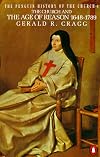
I had begun to think this book had taught me nothing at all--Cragg works in the historiographical tradition of "allude to names, ignore biography", so there's lots of "The evidence that a new day had dawned was furnished by the respect with which Cardinal Consalvi was received at the Congress of Vienna." Aside from the slightly tortuous syntax, that's the only mention of Cardinal Consalvi in this book, and it comes in the Epilogue. So a fair bit went over my head.
That said, I was able to show more work out a reasonable narrative from the book as a whole: the power of the state rises throughout this period, with the church often losing power (even, he suggests, in places like Spain, otherwise a strong supporter of Rome). This is aided by the tide of rationalism, deism and so on, which undermined the justifications for church power. And then, after the French revolution and its consequences, the restored monarchies or states took on the solid-seeming traditionalist mantle of religion: Catholicism in France, Protestantism elsewhere.
So, in the eighteenth century, we see Christian churches slowly lose power and influence, while the state gains it; after the revolutions, the church and state come together to create a very new, 'traditional' body of power. And that works wherever you look--the nineteenth century Anglican church was buried deep in the political structures of England; Catholicism was buried deep in the political structures of France and Spain, and so on and so forth.
No doubt this is the kind of wild generalization that will infuriate better informed contemporary scholars, but at least I got something from the book other than a chuckle at Cragg's deep repugnance for Unitarianism. Poor unitarianism. show less
That said, I was able to show more work out a reasonable narrative from the book as a whole: the power of the state rises throughout this period, with the church often losing power (even, he suggests, in places like Spain, otherwise a strong supporter of Rome). This is aided by the tide of rationalism, deism and so on, which undermined the justifications for church power. And then, after the French revolution and its consequences, the restored monarchies or states took on the solid-seeming traditionalist mantle of religion: Catholicism in France, Protestantism elsewhere.
So, in the eighteenth century, we see Christian churches slowly lose power and influence, while the state gains it; after the revolutions, the church and state come together to create a very new, 'traditional' body of power. And that works wherever you look--the nineteenth century Anglican church was buried deep in the political structures of England; Catholicism was buried deep in the political structures of France and Spain, and so on and so forth.
No doubt this is the kind of wild generalization that will infuriate better informed contemporary scholars, but at least I got something from the book other than a chuckle at Cragg's deep repugnance for Unitarianism. Poor unitarianism. show less
from westphalia to the frech revolution

"Gerald Cragg's elegant and stimulating assessment of this formative period ranges from the Church life of France under Louis XIV to the high noon of rationalism and beyond, and also includes a chapter on Christianity and culture in the Baroque age." -
Aug 30, 2020Dutch

THE CHURCH AND THE
AGE OF REASON 1648-1789
This span in the history of the Christian Church stretches from the age of religious
and civil strife which existed before the middle of the seventeenth century to the age of industrialism and republicanism which followed the French Revolution and the beginning of the Napoleonic wars.
The Church in general, reacting strongly against the turbulences of the Civil War
and the Thirty Years War, placed a premium on order, moderation, and stability.
Movements show more suspected of enthusiasm, such as Puritanism, Quietism, and Jansenism, fell into disrepute, and the authority exercised by the state in religious affairs became more pronounced.
It was an age dominated by Reason, which, until it
provoked a reaction in such movements as Pietism and Evangelicism, posed a
formidable challenge to Christianity.
In art and architecture, Baroque gave way to Rococo and then to neo-classicism
while church music was enriched by men like Vivaldi, Bach, and Handel. show less
AGE OF REASON 1648-1789
This span in the history of the Christian Church stretches from the age of religious
and civil strife which existed before the middle of the seventeenth century to the age of industrialism and republicanism which followed the French Revolution and the beginning of the Napoleonic wars.
The Church in general, reacting strongly against the turbulences of the Civil War
and the Thirty Years War, placed a premium on order, moderation, and stability.
Movements show more suspected of enthusiasm, such as Puritanism, Quietism, and Jansenism, fell into disrepute, and the authority exercised by the state in religious affairs became more pronounced.
It was an age dominated by Reason, which, until it
provoked a reaction in such movements as Pietism and Evangelicism, posed a
formidable challenge to Christianity.
In art and architecture, Baroque gave way to Rococo and then to neo-classicism
while church music was enriched by men like Vivaldi, Bach, and Handel. show less
You May Also Like


Associated Authors
Statistics
- Works
- 12
- Also by
- 1
- Members
- 894
- Popularity
- #28,652
- Rating
- 3.5
- Reviews
- 4
- ISBNs
- 14