
Julian Gough
Author of Rabbit's Bad Habits
About the Author
Image credit: Photo of Julian Gough by Phil Rose
Series
Works by Julian Gough
Associated Works
Beta-Life: Short Stories from an A-Life Future (Science-Into-Fiction) (2014) — Contributor — 15 copies
Tagged
Common Knowledge
- Birthdate
- 1966
- Gender
- male
- Education
- University of Galway, Ireland
- Nationality
- Ireland
- Birthplace
- London, England, UK
- Associated Place (for map)
- London, England, UK
Members
Reviews
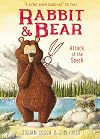
I've not come across the author Julian Gough before, but Jim Field is one of my favourite illustrators (we have all of his Oi! children's books and they are a big hit in this house!), and Neil Gaiman has given a glowing quote for the back cover, so I was looking forward to this very much. And it didn't disappoint! This is actually the third book in the series, and I'll be looking out for the other ones. Rabbit and Bear are two friends, and in this book their tranquil life is disturbed by the show more sudden appearance of a small, dazed baby owl. Bear wants to help, but Rabbit immediately remembers his dad's tales of scary huge owls, and instantly jumps to the conclusion that the owl is dangerous and needs to be imprisoned. Basically this is a fable about 'fake news', and about how easy it is to be deceived by loud voices and people jumping up and down labelling 'others' (there's even a fleeting, but unmissable, throwaway nod to the current occupant of the White House). (NB don't worry, there's a happy ending!) Highly recommended! show less
An ambitious, simplistic, entertaining, frustrating, sincere, cliche-ridden, brave, incoherent book. I don't know whether Gough lacks trust in his readers, or simply bit off more than he could chew, but he ends up spending more time telling us about his big ideas than using his world and his characters to make them real. By the final stretch he's in full didactic mode, and unfortunately the curriculum is unoriginal and superficial. I admire his decisions to give his characters a happy show more ending, and to write what was presumably a heartfelt paean to the power of love -- but the reason those things are brave is because it's easy to look silly while doing them, which unfortunately Gough sort of does.
I called the novel 'incoherent' because its disparate elements merely coexist, rather than reinforcing each other to form a stronger, more complex whole. The result is not quite believable, not quite as moving as it tries to be, and not quite narratively satisfying. The two main characters are actually pretty compelling to begin with, but the way their stories play out is mostly unsatisfying, and sometimes frankly cringe-inducing: I also admire Gough's willingness to make himself vulnerable by writing about sex in a way that risks scorn, but the part whereColt's mother softens the heart of his homicidal ideologue father by finally uttering the safeword that she never used during their BDSM sessions was a bit much. And generally the resolution of the story is a weird mishmash of metaphor, techno-handwaving and implausible interpersonal dynamics.
The prose is functional and simple in a way that I rather like, but it is often too on the nose: sometimes obvious things are spelled out because they're not obvious to the main character, who has to consciously piece them together; but sometimes Gough just seems worried that we might not have understood him the first time, or unsure that he can convey the intended plot point or emotional state with any subtlety.
The big advantage of telling rather than showing -- the main reason the standard advice is sometimes wrong -- is that by attacking an idea directly you can often explore it more deeply, or at least in a more detailed and rigorous way. Unfortunately, while Gough has some genuinely interesting ideas, they all culminate in some post-GFC-thinkpiece-level 'what's wrong with the world' pontificating, and the aforementionedlove will save us stuff, which I would write off as lazy pandering if I hadn't already come to trust the author's sincerity and bravery. (To be clear, I would love to read convincing versions of those things; the problem is that when they're done badly, the former is boring and unconvincing, and the latter makes me feel more cynical rather than less.)
It's a small world, really, and somehow our handful of named characters are able to decide its fate with remarkably little interference from outside the narrow point of view granted to the reader. The sense of scale -- physical and conceptual -- is lacking, and the major characters aren't rich or believable enough to carry all of the book's weight by themselves. I don't at all regret reading this; it was entertaining and often pleasingly idiosyncratic, for all my complaints about where it went wrong. But I'm not sure who I could recommend it to. show less
I called the novel 'incoherent' because its disparate elements merely coexist, rather than reinforcing each other to form a stronger, more complex whole. The result is not quite believable, not quite as moving as it tries to be, and not quite narratively satisfying. The two main characters are actually pretty compelling to begin with, but the way their stories play out is mostly unsatisfying, and sometimes frankly cringe-inducing: I also admire Gough's willingness to make himself vulnerable by writing about sex in a way that risks scorn, but the part where
The prose is functional and simple in a way that I rather like, but it is often too on the nose: sometimes obvious things are spelled out because they're not obvious to the main character, who has to consciously piece them together; but sometimes Gough just seems worried that we might not have understood him the first time, or unsure that he can convey the intended plot point or emotional state with any subtlety.
The big advantage of telling rather than showing -- the main reason the standard advice is sometimes wrong -- is that by attacking an idea directly you can often explore it more deeply, or at least in a more detailed and rigorous way. Unfortunately, while Gough has some genuinely interesting ideas, they all culminate in some post-GFC-thinkpiece-level 'what's wrong with the world' pontificating, and the aforementioned
It's a small world, really, and somehow our handful of named characters are able to decide its fate with remarkably little interference from outside the narrow point of view granted to the reader. The sense of scale -- physical and conceptual -- is lacking, and the major characters aren't rich or believable enough to carry all of the book's weight by themselves. I don't at all regret reading this; it was entertaining and often pleasingly idiosyncratic, for all my complaints about where it went wrong. But I'm not sure who I could recommend it to. show less
A wonderful satire on life in Ireland in the 90's. I definitely got a lot of enjoyment from recognising aspects of life in Galway and Dublin that I knew myself, but the story as a whole kept me amused throughout. Definitely well worth reading, though I think readers who are more familiar with Ireland will get more out of the satire.

Bear is sound asleep in her den, when a thief on his way out wakes her up. Bear gets up - in winter! - to investigate the thief who has stolen her salmon, honey, and beetles' eggs, and finds Rabbit. The two have a conversation about gravity, making snowmen, and friendship, until Rabbit retreats to his hole, annoyed by Bear's stupidity (and not wanting her to figure out that he's the thief). Bear sticks her head into the hole to say thanks for the moldy carrot Rabbit gave her and sees show more Rabbit... eat his own poop? A discussion about animal habits ensues and Bear ends up saving Rabbit from the wolf, whereupon the two become friends and Rabbit Confesses All. In the end, Rabbit decides he'd rather be a bear and the two settle down into Bear's cozy den together.
The book is heavily illustrated with aqua blue and shades of gray, as well as black and white. The illustrations are cartoon in style, with a pop-eyed rabbit, kindly but rather dim-looking bear, and crafty wolf. The font is clear and slightly larger than average, a good choice for beginning chapter readers, and the book is between a 2nd and 3rd grade level.
I'm always looking for new beginning chapter books and I think kids might find this funny, but it was a weird conglomeration of different types of story. The animals are anthropomorphic, talking, stealing, feeling shame and guilt, but they are also portrayed with actual animal habits, like Rabbit being coprophagic. But not all of them, since bears are omnivorous and would happily chow down on a nice, accessible bunny. Not to mention that if you're going to be grossed out by rabbits eating poop (coprophagy is a very common habit among many different animals) then you should be aware that bears eat carcasses, a variety of bugs, grubs, and insects, and pretty much anything they can scavenge.
Verdict: This was ok, but didn't really stand out to me. It felt like it needed tighter editing and a clearer plot thread, as well as a distinction between narrative nonfiction and funny cartoon animals. Of course, as a nonfiction devotee I'm biased, but I don't find it helpful to give kids books that encourage them to be grossed out by natural animal behavior. On the other hand, what kid doesn't like poop jokes? In the end, know your audience.
ISBN: 9781684125883; Published January 2019 by Silver Dolphin; Review copy provided by publisher show less
The book is heavily illustrated with aqua blue and shades of gray, as well as black and white. The illustrations are cartoon in style, with a pop-eyed rabbit, kindly but rather dim-looking bear, and crafty wolf. The font is clear and slightly larger than average, a good choice for beginning chapter readers, and the book is between a 2nd and 3rd grade level.
I'm always looking for new beginning chapter books and I think kids might find this funny, but it was a weird conglomeration of different types of story. The animals are anthropomorphic, talking, stealing, feeling shame and guilt, but they are also portrayed with actual animal habits, like Rabbit being coprophagic. But not all of them, since bears are omnivorous and would happily chow down on a nice, accessible bunny. Not to mention that if you're going to be grossed out by rabbits eating poop (coprophagy is a very common habit among many different animals) then you should be aware that bears eat carcasses, a variety of bugs, grubs, and insects, and pretty much anything they can scavenge.
Verdict: This was ok, but didn't really stand out to me. It felt like it needed tighter editing and a clearer plot thread, as well as a distinction between narrative nonfiction and funny cartoon animals. Of course, as a nonfiction devotee I'm biased, but I don't find it helpful to give kids books that encourage them to be grossed out by natural animal behavior. On the other hand, what kid doesn't like poop jokes? In the end, know your audience.
ISBN: 9781684125883; Published January 2019 by Silver Dolphin; Review copy provided by publisher show less
Lists
Awards


You May Also Like


Associated Authors
Statistics
- Works
- 24
- Also by
- 4
- Members
- 921
- Popularity
- #27,851
- Rating
- 3.4
- Reviews
- 25
- ISBNs
- 109
- Languages
- 11