
About the Author
Ira Katznelson is interim provost, Ruggles Professor of Political Science and History, and deputy director of Columbia World Projects at Columbia University. He is the author of many acclaimed books, including When Affirmative Action Was White (2005) and Fear Itself: The New Deal and the Origins of show more Our Time (2013). show less
Works by Ira Katznelson
When Affirmative Action Was White: An Untold History of Racial Inequality in Twentieth-Century America (2005) 490 copies, 4 reviews
Working-Class Formation: Nineteenth-Century Patterns in Western Europe and the United States (1986) 37 copies
Desolation and Enlightenment: Political Knowledge After Total War, Totalitarianism, and the Holocaust (2003) 32 copies
Associated Works
The Democratic Experiment: New Directions in American Political History (2003) — Contributor — 31 copies
Tagged
Common Knowledge
- Canonical name
- Katznelson, Ira
- Birthdate
- 1944
- Gender
- male
- Occupations
- political scientist
historian
professor - Organizations
- Columbia University (Ruggles Professor of Politcal Science and History)
- Nationality
- USA
- Associated Place (for map)
- USA
Members
Reviews
When Affirmative Action Was White: An Untold History of Racial Inequality in Twentieth-Century America by Ira Katznelson
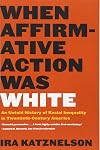
The New Deal was a devil’s bargain: major programs to alleviate the suffering of the Depression, but with Southern-demanded local control so that whites could continue to control blacks and deny them the benefits of government intervention. This or none, they said, and the good white people of the north and west chose this. When the pro-union national law started to enable unions to make gains in the South, threatening to improve blacks’ relative positions, Southern Democrats switched show more sides and joined Republicans to write laws that deterred unionization in agriculture and stemmed the union tide in general. And while the GI Bill provided major benefits for some black men—as did participating in the WWII armed forces even under segregated conditions—the national Democrats didn’t even try very hard to avoid local control, meaning that black veterans were regularly denied the educational, vocational, and mortgage/business help that whites received. White middle-class wealth increased tenfold; black middle-class wealth did not, even as incomes by class/occupation started to equalize. Katznelson ends with a call to recognize current affirmative action for African-Americans as a response to deliberate exclusion from government benefits in the past, whether done on the retail level or wholesale (by excluding “domestics” and agricultural workers from Social Security at its inception, for example). show less

The South has had an oversized influence on American history, rarely for the better. For a number of reasons (the culture of the initial Scotch-Irish founding population, the more aristocracy-friendly agricultural economy, the harsh system of racial apartheid), the South has remained stubbornly distinct as a society, and its representatives in the federal government have been ferocious about opposing any initiatives they saw as counter to the South's interests and values. Katznelson's focus show more here is on how important the South's representatives were to shaping the New Deal, America's conduct in World War 2, and the immediate Cold War aftermath, a thesis which rarely gets the attention it deserves.
Even though FDR was an aristocratic Northerner, Southern representatives were crucial to his legislative agenda. Because the South was basically a one-party region, once Southern Democrats made it through their primaries they were assured of winning elections. In an era of the seniority system, that meant that after the big Democratic waves of the New Deal coalition, they occupied a disproportionately large percentage of the leadership spots, as well as frequently remaining a majority of the party caucus. Additionally, Southern Democrats were often able to cast the deciding votes in disputes between Republicans and nonsouthern Democrats, able to extract whatever concessions they needed from bills that threatened the Jim Crow system or white superiority in general.
An example that Katznelson doesn't use is in my hometown of Austin: while the Santa Rita Courts were the first public housing in the country, there were three separate projects that were segregated by race in accordance with Southern values. I was surprised to read that Southern representatives were initially fairly economically progressive in terms of big public works projects like the TVA or the LCRA, but they inevitably dissented whenever a piece of economic legislation threatened to treat blacks and whites equally. Labor unions were nearly the only institution that was making progress in the fight for racial equality, and much of the modern South's antipathy to unions can be traced back to this period. Katznelson quotes a contemporary magazine article thus: "The only local institution that southern whites and Negroes have in common today is the labor union" and shows that over time, as the New Deal's economic component became more important, Southern Congressmen voted increasingly with Republicans to frustrate Roosevelt and other liberals.
The South has always been more militaristic than the rest of the country (if not quite as good at actually winning wars), and when World War 2 finally reached America Southern Congressmen were oddly eager to give the federal government vast powers to fight the Axis. Katznelson's explanations for why German efforts to promote solidarity between their similar racial ideologies during the runup to the war didn't take aren't very convincing to me, but he does a good job of showing the efforts of the Southerners to get disproportionate defense spending in their districts. I wish he had pointed out that this legacy lingers in the fact that Southerners like Stennis and Vinson got aircraft carriers named after them despite their frequently-deplorable records on civil rights and other issues. Regardless, the South's peculiar combination of nationalism and xenophobia fit perfectly into the paranoid Cold War period, when Southerners were exceptionally diligent in Red Scare witch hunts (though of course Joseph McCarthy was not a Southerner).
The overall lessons that I took away from Katznelson included a new respect for how LBJ was able to transcend his background and get through so much good legislation in the Great Society. His compatriots were clever and tenacious in their ability to water down laws to protect Jim Crow; that the Voting Rights Act of 1965 eventually passed is a miracle. The way that the fear caused by economic and military crises can shape responses to them is well done here in the contrasts drawn between the US and the European dictatorships that abandoned democracy in a way the US never did. Additionally, I appreciated his focus on Congress, in contrast to so much literature that treats the President as a powerful sovereign and Congress as a faceless bill-generating machine. That makes his exploration of the South's attitude towards the way that things like trade policies and treaties should be negotiated very good. Furthermore, I was struck by how the South maintained its particular identity over many decades and despite many large demographic changes - Canadian Prime Minister Stephen Harper once gave an interesting if predictably partisan speech to the US Council for National Policy in June 1997 where he analogized the US South to Quebec, and I think further study of the similarities and differences between the two in the effects of the regions on their respective national politics would be extremely enlightening.
Overall this book is an important contribution to understanding how the legacy of the South's unique culture has affected American history. While non-Southerners might rightly question why such a backwards region is able to have such a pernicious effect on the national discourse, continued population flows to Southern states make understanding why its legislators have such regressive and reactionary views more important than ever. show less
Even though FDR was an aristocratic Northerner, Southern representatives were crucial to his legislative agenda. Because the South was basically a one-party region, once Southern Democrats made it through their primaries they were assured of winning elections. In an era of the seniority system, that meant that after the big Democratic waves of the New Deal coalition, they occupied a disproportionately large percentage of the leadership spots, as well as frequently remaining a majority of the party caucus. Additionally, Southern Democrats were often able to cast the deciding votes in disputes between Republicans and nonsouthern Democrats, able to extract whatever concessions they needed from bills that threatened the Jim Crow system or white superiority in general.
An example that Katznelson doesn't use is in my hometown of Austin: while the Santa Rita Courts were the first public housing in the country, there were three separate projects that were segregated by race in accordance with Southern values. I was surprised to read that Southern representatives were initially fairly economically progressive in terms of big public works projects like the TVA or the LCRA, but they inevitably dissented whenever a piece of economic legislation threatened to treat blacks and whites equally. Labor unions were nearly the only institution that was making progress in the fight for racial equality, and much of the modern South's antipathy to unions can be traced back to this period. Katznelson quotes a contemporary magazine article thus: "The only local institution that southern whites and Negroes have in common today is the labor union" and shows that over time, as the New Deal's economic component became more important, Southern Congressmen voted increasingly with Republicans to frustrate Roosevelt and other liberals.
The South has always been more militaristic than the rest of the country (if not quite as good at actually winning wars), and when World War 2 finally reached America Southern Congressmen were oddly eager to give the federal government vast powers to fight the Axis. Katznelson's explanations for why German efforts to promote solidarity between their similar racial ideologies during the runup to the war didn't take aren't very convincing to me, but he does a good job of showing the efforts of the Southerners to get disproportionate defense spending in their districts. I wish he had pointed out that this legacy lingers in the fact that Southerners like Stennis and Vinson got aircraft carriers named after them despite their frequently-deplorable records on civil rights and other issues. Regardless, the South's peculiar combination of nationalism and xenophobia fit perfectly into the paranoid Cold War period, when Southerners were exceptionally diligent in Red Scare witch hunts (though of course Joseph McCarthy was not a Southerner).
The overall lessons that I took away from Katznelson included a new respect for how LBJ was able to transcend his background and get through so much good legislation in the Great Society. His compatriots were clever and tenacious in their ability to water down laws to protect Jim Crow; that the Voting Rights Act of 1965 eventually passed is a miracle. The way that the fear caused by economic and military crises can shape responses to them is well done here in the contrasts drawn between the US and the European dictatorships that abandoned democracy in a way the US never did. Additionally, I appreciated his focus on Congress, in contrast to so much literature that treats the President as a powerful sovereign and Congress as a faceless bill-generating machine. That makes his exploration of the South's attitude towards the way that things like trade policies and treaties should be negotiated very good. Furthermore, I was struck by how the South maintained its particular identity over many decades and despite many large demographic changes - Canadian Prime Minister Stephen Harper once gave an interesting if predictably partisan speech to the US Council for National Policy in June 1997 where he analogized the US South to Quebec, and I think further study of the similarities and differences between the two in the effects of the regions on their respective national politics would be extremely enlightening.
Overall this book is an important contribution to understanding how the legacy of the South's unique culture has affected American history. While non-Southerners might rightly question why such a backwards region is able to have such a pernicious effect on the national discourse, continued population flows to Southern states make understanding why its legislators have such regressive and reactionary views more important than ever. show less
A history of the FDR era, focusing on the big threats Americans perceived—unemployment and the Axis, mainly—and the compromises FDR made with Southern Democrats to fight them—accepting discrimination against African-Americans. As he puts it near the end, in the fight against radical evil (the Nazis), many compromises with lesser evils may have been justified, but the compromises with white supremacists on internal social policy can reasonably be described as wicked. These compromises show more included devolving control over relief programs to the states, which could then exclude African-Americans; excluding farm workers and domestic servants from the scope of pro-unionization federal law; and later in the Taft-Hartley Act, barring secondary boycotts so the Teamsters couldn’t encourage farmworker unionization by refusing to haul non-union-picked produce. Ultimately, these compromises—designed to protect the low-wage South from unionization and racial equality—may have brought down the New Deal entirely. show less
When Affirmative Action Was White: An Untold History of Racial Inequality in Twentieth-Century America by Ira Katznelson
Critical to understanding the existing gaps between African Americans and whites in today's society, this book addresses the deliberate policy decisions made during the New Deal and the Fair Deal to exclude the vast majority of African Americans from the benefits of Social Security and fair labor reforms. While Congress was under control of the Southern Democrats, neither Roosevelt nor Truman was able to win gains for a social safety net without exclusions that basically upheld Jim Crow in show more the South. Even fairer public policies enacted by the federal government were guaranteed to be administered by state and local governments -- in the hands of white administrators in the South and most of the North. Because of discrimination in the military in both World Wars, even the liberal GI Bill, which supposedly benefitted all GIs helped only a handful of African Americans, while enabling most "white" GIs (now including Jews and Italians post-war) to gain a governement-financed education and government-guaranteed loans. Today's existing wealth gaps were built on this foundation of "white affirmative action." show less
Lists
Awards


You May Also Like


Associated Authors
Statistics
- Works
- 22
- Also by
- 2
- Members
- 1,261
- Popularity
- #20,345
- Rating
- 4.0
- Reviews
- 9
- ISBNs
- 77
- Favorited
- 1
