
Liaquat Ahamed
Author of Lords of Finance: The Bankers Who Broke the World
About the Author
Image credit: Photography Bleacher + Everard
Works by Liaquat Ahamed
1873: The Rothschilds, the First Great Depression, and the Making of the Modern World (2026) 46 copies, 2 reviews
Tagged
Common Knowledge
- Birthdate
- 1953
- Gender
- male
- Education
- Harvard University
University of Cambridge
Rugby School - Occupations
- banker
- Organizations
- World Bank
BNP Paribas
Fischer Francis Trees and Watts - Nationality
- UK
- Birthplace
- Kenya
Members
Reviews
Lords of Finance: 1929, The Great Depression - and the Bankers Who Broke the World by Liaquat Ahamed
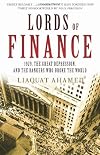
An account of the Great Depression of the 1920s/30s and the economic policies and misunderstandings which led up to it. There's a lot here which seems jarringly relevant to the 21st century (both the global crash which was happening when Liaquat Ahamed published this in 2008, and a lot of the fuckery which is happening today), quite a bit that's informative to me as someone who knows little about economic policy and honestly picked this up more out of a sense of duty to be informed rather show more than genuine burning interest (though hey now I have some knowledge of why the gold standard is a bad idea), but an awful lot that's extraneous. With a little reorganising and a filleting out of a good 100-150 pages, this would have been a much stronger work, but Ahamed seems to have never met an anecdote he didn't want to include. And to be fair he often has a good idea for an anecdote or a pithy quotation or a colourful character! But while this book is good on narrative yap, it's less strong when considered in terms of structure or analysis. show less
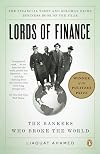
This is the best non-fiction book I've read, or am likely to read, this year. I bought this in 2010 while I was reading several books about the financial crisis. It had lots of good reviews and won several prizes, including the Pulitzer Prize for history in 2010 and the FT/Goldman Sachs Business Book of the Year for 2009. It's Liaquat Ahamed's first book, and he was interviewed on the Guardian Books podcast and sounded like a genuinely nice guy, which always makes me more likely to read show more something. It's 500 pages, so it sat there for ages till I was in the mood for a solid non-fiction read again. I will be forcing it on my real life friends who like economics, history, or politics, work for central banks, or are interested in the causes of WW2. You don't need to have an economics background to read it, but it will definitely make it an easier read.
Ahamed starts his book at the end of World War 1 and tells the story of how the western world ended up in a series of financial disasters that lasted through the 1920s and well into the 1930s. He does this by focusing on four central bankers: Montagu Norman, Governor of the Bank of England, Hjalmar Schacht, at the Reichsbank, Emile Moreau at the Banque de France, and Benjamin Strong, Governor at the New York Fed. All four were interesting guys with plenty of eccentricities to liven up the book. Norman and Strong became very good friends. Their decisions, and indecision at critical times, contributed to an imbalanced global economy tipping over into chaos again and again. It has huge parallels to what's going on today in the US and in the Eurozone.
The book has a great blend of economics and anecdote - I have dogeared so many pages. Some other reviewers have found the anecdotes offputting, but I loved them.
The story goes something like this (and without Ahamed's eloquence): Before World War 1, most world economies operated fixed exchange rates under a system called the gold standard. Money was backed by gold - you could rock up to the central bank, present your francs or dollar notes, and ask for a gold ingot. This worked well enough, and was treated as the holy grail of macroeconomics by central bankers and politicians. Trying to stick to the gold standard after World War 1 made already serious economic problems insurmountable.
The Allies were enormously in debt to the US, which had entered the war much later, and Germany was even more enormously in debt to the Allies because of the level of reparations payments assigned at Versailles. The US already had much more gold than it needed, and it kept getting more. Ahamed covers the endless negotiations about Germany's reparations really well, and goes through everything that followed - Germany's hyperinflation, France's surprising economic bounce-back until the 1930s by fixing their exchange rate lower than sustainable (making its exports recover quickly), the UK getting back onto the gold standard at too high a rate, Germany's financial crisis in 1929, the US stock market crash, then a series of banking crises from 1931-33.
In the end, but too late to avoid the massive hardship of the depression, the US abandoned the gold standard and let the value of the US dollar fall. The central bankers come out of the book looking fairly useless (albeit when faced with extremely difficult problems - hindsight is a wonderful thing), and so do most of the politicians. FDR and Keynes look pretty good overall. show less
Ahamed starts his book at the end of World War 1 and tells the story of how the western world ended up in a series of financial disasters that lasted through the 1920s and well into the 1930s. He does this by focusing on four central bankers: Montagu Norman, Governor of the Bank of England, Hjalmar Schacht, at the Reichsbank, Emile Moreau at the Banque de France, and Benjamin Strong, Governor at the New York Fed. All four were interesting guys with plenty of eccentricities to liven up the book. Norman and Strong became very good friends. Their decisions, and indecision at critical times, contributed to an imbalanced global economy tipping over into chaos again and again. It has huge parallels to what's going on today in the US and in the Eurozone.
The book has a great blend of economics and anecdote - I have dogeared so many pages. Some other reviewers have found the anecdotes offputting, but I loved them.
The story goes something like this (and without Ahamed's eloquence): Before World War 1, most world economies operated fixed exchange rates under a system called the gold standard. Money was backed by gold - you could rock up to the central bank, present your francs or dollar notes, and ask for a gold ingot. This worked well enough, and was treated as the holy grail of macroeconomics by central bankers and politicians. Trying to stick to the gold standard after World War 1 made already serious economic problems insurmountable.
The Allies were enormously in debt to the US, which had entered the war much later, and Germany was even more enormously in debt to the Allies because of the level of reparations payments assigned at Versailles. The US already had much more gold than it needed, and it kept getting more. Ahamed covers the endless negotiations about Germany's reparations really well, and goes through everything that followed - Germany's hyperinflation, France's surprising economic bounce-back until the 1930s by fixing their exchange rate lower than sustainable (making its exports recover quickly), the UK getting back onto the gold standard at too high a rate, Germany's financial crisis in 1929, the US stock market crash, then a series of banking crises from 1931-33.
In the end, but too late to avoid the massive hardship of the depression, the US abandoned the gold standard and let the value of the US dollar fall. The central bankers come out of the book looking fairly useless (albeit when faced with extremely difficult problems - hindsight is a wonderful thing), and so do most of the politicians. FDR and Keynes look pretty good overall. show less
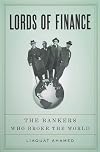
This book has won several awards, including the 2010 Pulitzer for history; it is well-deserving. This is the third book on the Great Depression era that I have read this year and I would recommend reading this book and Amity Schlaes' The Forgotten Man (my review) back-to-back. You can't understand how we got to the Great Depression without this book.
In my Money & Banking courses, I would always play the "Anatomy of a Crisis" episode of Milton Friedman's Free to Choose series. In it, Friedman show more laments that Benjamin Strong died in 1928, believing that Strong would have pushed the Federal Reserve to take the steps necessary to inject liquidity into the American system. It was Friedman and Schwartz's work that showed the U.S. needlessly hoarded gold, keeping monetary policy tight and forcing a chokehold on the U.S. economy. This book tells that part of the story well, including the insights of why France did the same thing. I see nothing to contradict Friedman's assertion that the Great Depression was a monetary phenomenon.
But one cannot understand that period without understanding the role that German reparations had on the entire system. That becomes the snowball that starts the avalanche. Ahamed gives a biography of the central bankers who propped up the gold standard after World War I, their context, psychology, and their interpersonal relationships. He details the decisions in monetary policy made throughout the twenties and early thirties. The life and writings of J.M. Keynes during this period is also chronicled and other prominent economists, such as Irving Fisher, are mentioned as well. Presidents and Prime Ministers are viewed through the lens of monetary policy and international finance. The book is not boring at all, the narrative is quite riveting.
I give this book 5 of 5 stars, it is a must-read for anyone interested in economics of the 1920s and 1930s. I learned a great deal. show less
In my Money & Banking courses, I would always play the "Anatomy of a Crisis" episode of Milton Friedman's Free to Choose series. In it, Friedman show more laments that Benjamin Strong died in 1928, believing that Strong would have pushed the Federal Reserve to take the steps necessary to inject liquidity into the American system. It was Friedman and Schwartz's work that showed the U.S. needlessly hoarded gold, keeping monetary policy tight and forcing a chokehold on the U.S. economy. This book tells that part of the story well, including the insights of why France did the same thing. I see nothing to contradict Friedman's assertion that the Great Depression was a monetary phenomenon.
But one cannot understand that period without understanding the role that German reparations had on the entire system. That becomes the snowball that starts the avalanche. Ahamed gives a biography of the central bankers who propped up the gold standard after World War I, their context, psychology, and their interpersonal relationships. He details the decisions in monetary policy made throughout the twenties and early thirties. The life and writings of J.M. Keynes during this period is also chronicled and other prominent economists, such as Irving Fisher, are mentioned as well. Presidents and Prime Ministers are viewed through the lens of monetary policy and international finance. The book is not boring at all, the narrative is quite riveting.
I give this book 5 of 5 stars, it is a must-read for anyone interested in economics of the 1920s and 1930s. I learned a great deal. show less
Before I started this book, I thought I had a pretty good understanding of what caused the Great Depression as an international phenomenon. I was not very far into this read to be seriously disabused of that notion. This book does show that the severe war reparations demanded from Germany following World War I was a primary contribution to the problem. But it also shows other keen delays and errors that also contributed as significantly as reparations: the insistence that currency be held to show more a gold standard; an unwillingness to seriously reduce, delay or even fully forgive war debt in order to bolster various national economies; and a reluctance for national banks to help inject funds into various economies early enough to do any good.
One part that intrigued me is the discussion of France as it attempted to bolster its economy. France owed a significant debt to the United States. The US agreed to a reduction in that debt, but France was angry the US did not forgive the debt altogether. And, although it wanted mercy from the US, France was absolutely unwilling to show to Germany one iota of the mercy France expected the USS to show to France. What was good for the goose was totally unacceptable for the gander.
For one question we all have, could this happen again, the answer is also complex. Because of lessons learned, national banks are far less likely to take a "sit back and watch" approach. Because access to banking and investing resources is now electronic, the impact of panic can be faster and more wide spread. In short, the answer is ... yes. show less
One part that intrigued me is the discussion of France as it attempted to bolster its economy. France owed a significant debt to the United States. The US agreed to a reduction in that debt, but France was angry the US did not forgive the debt altogether. And, although it wanted mercy from the US, France was absolutely unwilling to show to Germany one iota of the mercy France expected the USS to show to France. What was good for the goose was totally unacceptable for the gander.
For one question we all have, could this happen again, the answer is also complex. Because of lessons learned, national banks are far less likely to take a "sit back and watch" approach. Because access to banking and investing resources is now electronic, the impact of panic can be faster and more wide spread. In short, the answer is ... yes. show less
Lists
Awards


You May Also Like


Statistics
- Works
- 5
- Members
- 1,826
- Popularity
- #14,087
- Rating
- 4.0
- Reviews
- 45
- ISBNs
- 27
- Languages
- 6