
A. J. Barker (1918–1981)
Author of Pearl Harbor
About the Author
Lieutenant Colonel AJ Barker was born in Hull in 1918 and joined the Regular Army in 1936. Commissioned into the East Yorkshire Regiment, he served in Europe, the Middle East and Far Fast. He was a graduate of both the Staff College (Quetta) and The Royal Military College of Science. He retired show more from the Army in 1958 and took up an appointment with the United Kingdom Atomic Energy Authority. His published works include The March on Delhi (1963): Suez: The Seven Day War (1964): Erithea 1941 (1966); a work on the Mesopotamian Campaign, The Neglected War (1967); and a study of Major General Sir Charles Townshend, Townshend of Kut, Lieutenant Colonel Barker died in 1981. show less
Works by A. J. Barker
Tagged
Common Knowledge
- Legal name
- Barker, Arthur James
- Other names
- Barker, Lt. Col. A. J.
- Birthdate
- 1918-09-20
- Date of death
- 1981-06-10
- Gender
- male
- Occupations
- military officer
author - Organizations
- British Army
- Nationality
- UK
- Associated Place (for map)
- UK
Members
Reviews
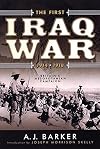
Originally published in 1967 as The Neglected War in the UK and The Bastard War in the US, then reprinted in 2009 with the title The First Iraq War: 1914-1918. It was, of course, not the first Iraq war, which must have happened in 9000 BCE or so; there probably aren’t many places on the planet more blood-soaked than the plains of the Tigris and Euphrates.
Colonel A. J. Barker (I assume he’s not still with us, but I can’t find his dates anywhere*) cranked out dozens of workmanlike show more military history books, especially in the Ballentine’s series. This is a longer work; Barker must have had some special fondness for the subject. Barker isn’t the slightest bit afraid of cutting into the British military here, and has pretty harsh words for everybody involved short of General Maude.
The WWI Mesopotamian Campaign started out with a very minor objective – the capture of the port of Basra to ensure the safety of British oil fields in Persia – and ended up absorbing millions of pounds of treasure and thousands of gallons of blood. Sort of like the British Empire, come to think of it. The whole thing started out under the auspices of the Indian Army, and was run initially from Delhi rather than London. Barker begins his gripe session by pointing out that “port” was extremely optimistic applied to Basra – it was a wide spot in the river where an ocean-going vessel could anchor and be unloaded by lighter. Not exactly a promising supply head for an army. Nevertheless, a brigade of the 6th Poona Division showed up, landed on a muddy river bank, and promptly began to learn the validity of the Arab proverb “When Allah created Hell, it wasn’t bad enough, so He made Mesopotamia and added flies”. Things consistently got worse; the troops on the ground kept deciding they needed to strengthen their position by advancing just a little further upriver; the supply officers in Delhi kept sending stuff that couldn’t be unloaded and then couldn’t be transported upriver when it was unloaded and then really wasn’t of much use when it finally got to the front. Excursion boats were requisitioned from the Thames and sent out as being suitable for river transport; they might well have been but they were not suitable for the Atlantic Ocean and almost all of them went down before reaching Iraq. The annoying Turks wouldn’t stand and fight, but kept retreating just a little further up river, and when they did stand and fight they turned out to have learned the lessons of trench warfare a whole lot better than the British and Indian troops involved, leading to endless frontal assaults against entrenched Turks.
Barker notes that it would seem that Mesopotamia would be ideal maneuver country; vast alluvial plains that couldn’t be adequately covered by the Turkish troops on hand. The geography actually conspired against it. The only source of water** and supply was the rivers; troops couldn’t venture too far away. And the lack of cover made it difficult to conduct any sort of surprise sweep around the flanks, especially since the Turks had air superiority in the early part of the war. Barker has particularly hard words for the cavalry, and they seem justified – at several battles, the cavalry was sent out to sweep around Turkish flanks only to return some hours later to water their horses: Barker repeatedly calls this “swanning about in the desert”. Eventually the Turks were pushed back almost to Baghdad, resulting in the Battle of Ctesiphon (not the first one there, either). This was a tactical victory for the British but a strategic defeat; General Townshend apparently suddenly realized he was at the end of a long, tenuous and inadequate supply line and began a retreat. He didn’t get too far; the Turks now were no longer local Iraqi militia but Anatolian veterans of Gallipoli, and were not at all in the mood to be “chased all the way to Baghdad”. Geography was on their side again; the river meanders all over the place and Townsend was given the choice of marching overland across the bends and potentially being cut off from the river or maintaining contact with the river and marching three times the distance. He chose the latter and ended up cut off in a bend at the village of Kut.
It was sort of Gordon at Khartoum all over again; the relief column needed to get organized and supplied and march up river and there had to be adequate river transport and positions gained had to be fortified and etc. etc. etc.; Townshend apparently didn’t understand that he was supposed to break out and meet the relief force (to be fair, after a while he no longer had the supplies or troop strength that would have been necessary) and Kut surrendered to Khalil Pasha. The last time a British force this large had surrendered was at Yorktown. General Townshend took a whole lot of grief from home; he was housed in comfort as a guest while his troops – well, were not.
The rest of the war was anticlimactic; “our orders was to break you, an' of course we went an' did.” It might not have seemed anticlimactic to the soldiers dying there, of course. There was a strange interlude involving the Russians, who at one point seemed likely to reach Baghdad before the British did – but 1917 intervened. At least Iraq is now at peace. (There are some haunting mentions of places now back in the news – the 1916 Battle of Ramadi, for example).
I was disturbed a claim by a reviewer on Amazon who says Barker plagiarized a good portion of this book; I haven’t read the putative source, so I can’t comment. Doesn’t seem like the thing for a retired Royal Army officer, somehow. Assuming the writing is his own, Barker belongs in the middle ranks of military historians – no flights of prose, just solid description. The maps are confined to the endpapers, are based on original drawings from WWI staff officers, and are small and difficult to interpret; fortunately there isn’t a lot of maneuver going on.
---------------------------------------------------------------------------------------------------------------------------------------
*Well, I can’t find my own dates anywhere either.
**Barker doesn’t mention it but the cover story for WWI armored vehicle development was that they were some sort of portable water supply for the Mesopotamian campaign. The name originally proposed was “Water Carriers”; presumably someone noted that this would inevitably be abbreviated to “WC” and, to the eternal gratitude of English-speaking military everywhere, “Tanks” won out. show less
Colonel A. J. Barker (I assume he’s not still with us, but I can’t find his dates anywhere*) cranked out dozens of workmanlike show more military history books, especially in the Ballentine’s series. This is a longer work; Barker must have had some special fondness for the subject. Barker isn’t the slightest bit afraid of cutting into the British military here, and has pretty harsh words for everybody involved short of General Maude.
The WWI Mesopotamian Campaign started out with a very minor objective – the capture of the port of Basra to ensure the safety of British oil fields in Persia – and ended up absorbing millions of pounds of treasure and thousands of gallons of blood. Sort of like the British Empire, come to think of it. The whole thing started out under the auspices of the Indian Army, and was run initially from Delhi rather than London. Barker begins his gripe session by pointing out that “port” was extremely optimistic applied to Basra – it was a wide spot in the river where an ocean-going vessel could anchor and be unloaded by lighter. Not exactly a promising supply head for an army. Nevertheless, a brigade of the 6th Poona Division showed up, landed on a muddy river bank, and promptly began to learn the validity of the Arab proverb “When Allah created Hell, it wasn’t bad enough, so He made Mesopotamia and added flies”. Things consistently got worse; the troops on the ground kept deciding they needed to strengthen their position by advancing just a little further upriver; the supply officers in Delhi kept sending stuff that couldn’t be unloaded and then couldn’t be transported upriver when it was unloaded and then really wasn’t of much use when it finally got to the front. Excursion boats were requisitioned from the Thames and sent out as being suitable for river transport; they might well have been but they were not suitable for the Atlantic Ocean and almost all of them went down before reaching Iraq. The annoying Turks wouldn’t stand and fight, but kept retreating just a little further up river, and when they did stand and fight they turned out to have learned the lessons of trench warfare a whole lot better than the British and Indian troops involved, leading to endless frontal assaults against entrenched Turks.
Barker notes that it would seem that Mesopotamia would be ideal maneuver country; vast alluvial plains that couldn’t be adequately covered by the Turkish troops on hand. The geography actually conspired against it. The only source of water** and supply was the rivers; troops couldn’t venture too far away. And the lack of cover made it difficult to conduct any sort of surprise sweep around the flanks, especially since the Turks had air superiority in the early part of the war. Barker has particularly hard words for the cavalry, and they seem justified – at several battles, the cavalry was sent out to sweep around Turkish flanks only to return some hours later to water their horses: Barker repeatedly calls this “swanning about in the desert”. Eventually the Turks were pushed back almost to Baghdad, resulting in the Battle of Ctesiphon (not the first one there, either). This was a tactical victory for the British but a strategic defeat; General Townshend apparently suddenly realized he was at the end of a long, tenuous and inadequate supply line and began a retreat. He didn’t get too far; the Turks now were no longer local Iraqi militia but Anatolian veterans of Gallipoli, and were not at all in the mood to be “chased all the way to Baghdad”. Geography was on their side again; the river meanders all over the place and Townsend was given the choice of marching overland across the bends and potentially being cut off from the river or maintaining contact with the river and marching three times the distance. He chose the latter and ended up cut off in a bend at the village of Kut.
It was sort of Gordon at Khartoum all over again; the relief column needed to get organized and supplied and march up river and there had to be adequate river transport and positions gained had to be fortified and etc. etc. etc.; Townshend apparently didn’t understand that he was supposed to break out and meet the relief force (to be fair, after a while he no longer had the supplies or troop strength that would have been necessary) and Kut surrendered to Khalil Pasha. The last time a British force this large had surrendered was at Yorktown. General Townshend took a whole lot of grief from home; he was housed in comfort as a guest while his troops – well, were not.
The rest of the war was anticlimactic; “our orders was to break you, an' of course we went an' did.” It might not have seemed anticlimactic to the soldiers dying there, of course. There was a strange interlude involving the Russians, who at one point seemed likely to reach Baghdad before the British did – but 1917 intervened. At least Iraq is now at peace. (There are some haunting mentions of places now back in the news – the 1916 Battle of Ramadi, for example).
I was disturbed a claim by a reviewer on Amazon who says Barker plagiarized a good portion of this book; I haven’t read the putative source, so I can’t comment. Doesn’t seem like the thing for a retired Royal Army officer, somehow. Assuming the writing is his own, Barker belongs in the middle ranks of military historians – no flights of prose, just solid description. The maps are confined to the endpapers, are based on original drawings from WWI staff officers, and are small and difficult to interpret; fortunately there isn’t a lot of maneuver going on.
---------------------------------------------------------------------------------------------------------------------------------------
*Well, I can’t find my own dates anywhere either.
**Barker doesn’t mention it but the cover story for WWI armored vehicle development was that they were some sort of portable water supply for the Mesopotamian campaign. The name originally proposed was “Water Carriers”; presumably someone noted that this would inevitably be abbreviated to “WC” and, to the eternal gratitude of English-speaking military everywhere, “Tanks” won out. show less
Rape of Ethiopia, 1936 (Ballantine's illustrated history of the violent century. Politics in action) by A. J. Barker

'The Rape of Ethiopia 1936' provided a short, but solid overview of Mussolini's colonial war against Ethiopia, detailing just how one-sided the conflict was. Being that this is one of the events that steadily pushed the Duce into Hitler's arms, I can't help but be fascinated.

Probably the best, and most concise accounting (save for Moberly's Official History) of the Mesopotamian Campaign. Well written and a good accounting of the actions both pre and post Kut.

Excellent book on Leopard MBT. It is very interesting read not just because of details on the tank itself but for details related to production process (number of companies involved is truly mind boggling), maintenance and operational use.
Book was released when Leopard 1 was already a mature weapon system, and Leopard 2 was just introduced. Therefore while Leopard 2 is also covered, book is mainly about Leopard 1 and its various versions, including Gepard anti-aircraft system and various show more engineer vehicles.
Lots of very detailed pictures and schematics. I am definitely on a lookout for additional books from this series.
Highly recommended to all mechanized warfare fans. show less
Book was released when Leopard 1 was already a mature weapon system, and Leopard 2 was just introduced. Therefore while Leopard 2 is also covered, book is mainly about Leopard 1 and its various versions, including Gepard anti-aircraft system and various show more engineer vehicles.
Lots of very detailed pictures and schematics. I am definitely on a lookout for additional books from this series.
Highly recommended to all mechanized warfare fans. show less
You May Also Like


Associated Authors
Statistics
- Works
- 47
- Members
- 1,140
- Popularity
- #22,523
- Rating
- 3.6
- Reviews
- 11
- ISBNs
- 126
- Languages
- 5