
Gordon W. Prange (1910–1980)
Author of At Dawn We Slept: The Untold Story of Pearl Harbor
About the Author
Image credit: Bob Mitchell
Works by Gordon W. Prange
Associated Works
Secrets & Spies: Behind the Scenes Stories of World War II (1964) — Contributor — 207 copies, 2 reviews
Fading Victory: The Diary of Admiral Matome Ugaki, 1941-1945 (1991) — Foreword, some editions — 48 copies, 1 review
Tagged
Common Knowledge
- Canonical name
- Prange, Gordon W.
- Legal name
- Prange, Gordon William
- Birthdate
- 1910-07-16
- Date of death
- 1980-05-15
- Gender
- male
- Education
- University of Iowa (BA|MA|1934|Ph.D|1937)
- Occupations
- historian
professor (History)
naval officer
chief historian (General Douglas MacArthur's staff, 1946-1951)
technical consultant (Tora! Tora! Tora!, 1970) - Organizations
- University of Maryland, College Park (1937-1980)
United States Navy (WWII) - Cause of death
- cancer
- Nationality
- USA
- Birthplace
- Pomeroy, Iowa, USA
- Places of residence
- Baltimore, Maryland, USA
- Place of death
- Baltimore, Maryland, USA
- Map Location
- Maryland, USA
Members
Reviews

The previous book “At Dawn We Slept” was a re-creation of the apocalyptic events of December 7, 1941. This provocative sequel delves even further to examine the underlying causes of Pearl Harbor and the revisionist theories that Roosevelt and other high officials knew about the attack.
With the same imposing scholarship and narrative drive that distinguished its predecessor, Pearl Harbor uncovers the secret roles played by the president, his cabinet secretaries, admirals, and generals in show more the weeks before the attack. Based on more than forty years of research, extensive interviews, and an insider's knowledge of the military, this book poses an explosive and highly convincing new theory of America's entry into the Pacific War. Like the very best works of history, it not only expands but dramatically deepens our understanding of the events that were once the province of myth and rumor. show less
With the same imposing scholarship and narrative drive that distinguished its predecessor, Pearl Harbor uncovers the secret roles played by the president, his cabinet secretaries, admirals, and generals in show more the weeks before the attack. Based on more than forty years of research, extensive interviews, and an insider's knowledge of the military, this book poses an explosive and highly convincing new theory of America's entry into the Pacific War. Like the very best works of history, it not only expands but dramatically deepens our understanding of the events that were once the province of myth and rumor. show less

Richard Sorge was one of the greatest spies of all times. For 8 years he orchestrated a top-level Soviet operation in Tokyo, literally operating out of the German Embassy. He was a close confidant of Ambassador Ott, his top Japanese source Hotsumi Ozaki was a member of elite Japanese think-tanks and part of a weekly breakfast with the Prime Minister. Sorge and Ozaki both pursued their covers with dedicate, maintaining a reputation as insightful journalists. Sorge's information may have show more provided warnings of Operation Barbarossa, and reassurances that Japan would not attack Siberia while the USSR was occupied by Germany. The unwinding of the spy ring, and the slow march to execution, is also tragic.
This book is a nearly month by month account of the Sorge ring, and the man himself. Sorge was brilliant, an alcoholic, a womanizer, a scandalous loudmouth beloved of the German expat community in Tokyo, and a charismatic man who inspired loyalty even in those he betrayed. The workings of his relationships with his mistress Hanako, radioman Max Clausen, and with the distant 4th Directorate in Moscow, swirl around the tensions and secrets of his life. Prange is a dedicated and detailed historian, and this is a fascinating subject, but somehow this book was a slog, a real life spy story of narrow escapes and information that disappeared into the void of the Soviet strategic apparatus. show less
This book is a nearly month by month account of the Sorge ring, and the man himself. Sorge was brilliant, an alcoholic, a womanizer, a scandalous loudmouth beloved of the German expat community in Tokyo, and a charismatic man who inspired loyalty even in those he betrayed. The workings of his relationships with his mistress Hanako, radioman Max Clausen, and with the distant 4th Directorate in Moscow, swirl around the tensions and secrets of his life. Prange is a dedicated and detailed historian, and this is a fascinating subject, but somehow this book was a slog, a real life spy story of narrow escapes and information that disappeared into the void of the Soviet strategic apparatus. show less
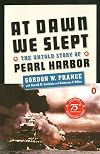
It’s not often that I get to use the word, definitive, but it certainly fits [At Dawn We Slept]. This book offers its readers everything they could possibly want with regard to the who, what, when, where, and why of the planning and execution of the raid, as well as the who, what, when, where, and why of how the U. S. failed to anticipate their actions and protect Pearl Harbor from a likely attack. It is filled with the incredible research done by Gordon Prange over almost 40 years, show more tracing down not only written information in letters, diaries, newspapers, magazines, and government records, but finding and interviewing well over 100 people, both in the U. S. and Japan.
I was surprised that I grew to be so interested in some of the major players in this moment in history that I actually felt for them a great deal of sympathy or, in the case, of some, cheered them on. Through this very long book they became like family or close friends.
Of course, I’ve lived my entire life knowing much about the Pearl Harbor attack. The following are some of the things I learned which were new to me or different than I had come to believe:
Yamamoto clearly understood that Japan had no hope of ultimate victory over the United States. He perceived Pearl Harbor as a knockout punch – damage and temporary containment.
The Japanese gathered mounds of information about Pearl Harbor merely by having one of their agents drive around the area and take notes. Security was so lax that the comings and goings of all ships were published in the newspapers every morning.
Neither Short nor Kimmel were privy to the Honolulu intercepts of Japanese coded transmissions, which were translated daily, and delivered to a very select few.
The Japanese originally estimated that the Pearl Harbor attack would cost them one third of their task force because they anticipated that the U. S. would discover them and respond accordingly.
Ambassador Nomura had no knowledge of the planning of Pearl Harbor. He only learned of it after he had returned from his final trip to the U. S. Ambassador. The Japanese government purposely kept him in the dark.
As early as October 11 Japan chose the date of December 7 (Hawaii time) for the attack.
FDR did not know about Pearl Harbor prior to its occurrence. He did not intentionally suppress information in order to bring it about.
The first blood spilt was by a Japanese and first shot fired was by the U. S.
On a personal note, the book was too inclusive. The editors did the reader no favors by putting in all that was gathered. Also, I found it very annoying that they used [sic] so often when the text was grammatically incorrect, especially since Prange misused forms of bring and take. show less
I was surprised that I grew to be so interested in some of the major players in this moment in history that I actually felt for them a great deal of sympathy or, in the case, of some, cheered them on. Through this very long book they became like family or close friends.
Of course, I’ve lived my entire life knowing much about the Pearl Harbor attack. The following are some of the things I learned which were new to me or different than I had come to believe:
Yamamoto clearly understood that Japan had no hope of ultimate victory over the United States. He perceived Pearl Harbor as a knockout punch – damage and temporary containment.
The Japanese gathered mounds of information about Pearl Harbor merely by having one of their agents drive around the area and take notes. Security was so lax that the comings and goings of all ships were published in the newspapers every morning.
Neither Short nor Kimmel were privy to the Honolulu intercepts of Japanese coded transmissions, which were translated daily, and delivered to a very select few.
The Japanese originally estimated that the Pearl Harbor attack would cost them one third of their task force because they anticipated that the U. S. would discover them and respond accordingly.
Ambassador Nomura had no knowledge of the planning of Pearl Harbor. He only learned of it after he had returned from his final trip to the U. S. Ambassador. The Japanese government purposely kept him in the dark.
As early as October 11 Japan chose the date of December 7 (Hawaii time) for the attack.
FDR did not know about Pearl Harbor prior to its occurrence. He did not intentionally suppress information in order to bring it about.
The first blood spilt was by a Japanese and first shot fired was by the U. S.
On a personal note, the book was too inclusive. The editors did the reader no favors by putting in all that was gathered. Also, I found it very annoying that they used [sic] so often when the text was grammatically incorrect, especially since Prange misused forms of bring and take. show less

This is an excellent, well written account of one of the most importnat battles of the 20th century. While many battles have been described as 'turning points' the battle of Midway truly can be described as a pivotal moment in recent history. Prange was probably one of the most knowledgeable writers dealing with the events leading up to Pearl Harbor and the ensuing battles and events that occurred in the Pacific War between the forces of the Empire of Japan and the United States. Prange's show more description of the events, strategies, tactics and ultimate outcome provide the reader with a stirring and comprehensive understanding of the magnitude of the stakes involved and the ultimate (and to pardon Walter Lord's description) ' incredible' victory achieved by the U.S. Navy. Pange provides several explanations for the American's improbable victory: superior intelligence; Japan's over confidence and luck, but what one understands from reading Prange's compelling narration is that victory was truly the result of the brave and dedicated men of the United States Navy: those members of what was truly were and remain in all our memories - the Greatest Generation. show less
Lists
Awards


You May Also Like


Associated Authors
Statistics
- Works
- 16
- Also by
- 2
- Members
- 3,644
- Popularity
- #6,946
- Rating
- 4.0
- Reviews
- 33
- ISBNs
- 76
- Languages
- 4
- Favorited
- 3