

Richard Evelyn Byrd (1888–1957)
Author of Alone
About the Author
Rear Admiral Richard E. Byrd was a U.S. naval officer and aviator-the only person of his time who had flown over both the North Pole and the South Pole and one of the first men to fly the Atlantic. During World War I, he was lieutenant commander of the U.S. air forces in Canada. Skyward (1928) show more tells of the first airplane flight made over the North Pole with Floyd Bennett in 1926. Little America (1930) is a detailed record of Byrd's flight over the South Pole. Alone (1938) is his remarkable tale of fortitude during his self-imposed isolation at Advance Base in the Antarctic in 1934. In the spring of 1947, Byrd returned from his fifth and largest polar expedition, the largest exploring expedition ever organized-13 ships staffed by 4,000 men, entirely naval in personnel. Byrd received a special medal of the National Geographic Society from President Herbert Hoover in 1930, the Legion of Merit for outstanding services from President Franklin D. Roosevelt in 1945, and the Defense Department's Medal of Freedom in 1957. President Dwight Eisenhower placed Byrd in charge of all Antarctic activities of the United States. Admiral Byrd was in over-all command of the Naval task force that, between 1955 and 1959, was to prepare, supply and maintain a series of scientific stations in Antarctica. Byrd died in 1957. He was buried with full military honors in the Arlington National Cemetery. (Bowker Author Biography) show less
Image credit: George Grantham Bain Collection,
LoC Prints and Photographs Division
(LC-DIG-ggbain-32880)
LoC Prints and Photographs Division
(LC-DIG-ggbain-32880)
Works by Richard Evelyn Byrd
The North Pole and Inner Earth Chronicles: The Smoky God: A Voyage to the Inner World + The Secret Diary of Admiral Richard E. Byrd | Two Books in One ... Earth, Inner Earth,… (2023) — Contributor — 4 copies
Flieger über den sechsten Erdteil: Meine Südpolarexpedition (Edition Erdmann) (German Edition) (2014) 3 copies
Crises in Faith 2 copies
Associated Works
The Ends of the Earth: An Anthology of the Finest Writing on the Arctic and the Antarctic (2007) — Contributor — 136 copies, 8 reviews
Worlds to Explore: Classic Tales of Travel and Adventure from National Geographic (2006) — Contributor — 118 copies, 1 review
Tagged
Common Knowledge
- Other names
- Byrd, Richard Evelyn, Jr. (birth name)
- Birthdate
- 1888-10-25
- Date of death
- 1957-03-11
- Gender
- male
- Education
- Virginia Military Institute
University of Virginia
U.S. Naval Academy (1912) - Occupations
- naval officer
explorer
pilot - Organizations
- U.S. Navy
- Awards and honors
- Congressional Medal of Honor (1926)
Congressional Life Saving Medal
Navy Distinguished Service Medal
Distinguished Flying Cross
Navy Cross - Nationality
- USA
- Birthplace
- Winchester, Virginia, USA
- Place of death
- Boston, Massachusetts, USA
- Burial location
- Arlington National Cemetery, Arlington, Virginia, USA
- Associated Place (for map)
- Virginia, USA
Members
Reviews

SUMMARY
In 1934 Admiral Richard Byrd set up an observation station near the South Pole "where weather is born". The original plan had been for a three-man team to occupy the base but seeing how short the supplies were, and yearning for introspection, Byrd made the decision to stay there alone. This book is an account of the six months he spent in the polar night, without sunshine or the warmth of human companionship. We are with him as he struggles with the brutal cold, his loneliness and the show more realization that his only source of warmth is slowly killing him.
REVIEW
I picked up this book at a Friends of the Library sale. I knew absolutely nothing about Admiral Byrd but as I browsed through its pages I was immediately taken with his lyrical prose. Even though it was a far cry from my normal reading fare, I purchased the book and brought it home, telling myself it was the perfect book to read in winter. I fit this book into my Travelogue category although it's really more of a memoir.
Reading this journal made me physically cold. I could not get warm enough. Blankets, hot baths, nothing could take away the pervasive chill I had acquired. I think I identified with Byrd too thoroughly. Honestly, how the man lived, much less slept, in those temperatures is beyond my comprehension.
It is hard to fathom a man who would want to spend half a year in a small, one-room shack buried in the snow in Antarctica. Much less, a man who would leave that shack several times a day to adjust weather machinery, even in the blinding snow. He was a scientist, an adventurer, but also a romantic, taking long walks on still nights under the stars. This journal puts the reader directly inside Byrd’s head as he searches his soul, as he witnesses the beauty of nature as few ever will and as he struggles with his own mortality.
As his health declines, the journal becomes more utilitarian and sparse. Even so, it seems to heighten the suspense of the book, to make you feel both his desperation and his hope at the same time. I found the passages where he affirms his faith to be beautifully written. He must have been a very strong man.
RECOMMENDATION:
I would recommend this book to readers of memoirs, biographies or travel books. show less
In 1934 Admiral Richard Byrd set up an observation station near the South Pole "where weather is born". The original plan had been for a three-man team to occupy the base but seeing how short the supplies were, and yearning for introspection, Byrd made the decision to stay there alone. This book is an account of the six months he spent in the polar night, without sunshine or the warmth of human companionship. We are with him as he struggles with the brutal cold, his loneliness and the show more realization that his only source of warmth is slowly killing him.
REVIEW
I picked up this book at a Friends of the Library sale. I knew absolutely nothing about Admiral Byrd but as I browsed through its pages I was immediately taken with his lyrical prose. Even though it was a far cry from my normal reading fare, I purchased the book and brought it home, telling myself it was the perfect book to read in winter. I fit this book into my Travelogue category although it's really more of a memoir.
Reading this journal made me physically cold. I could not get warm enough. Blankets, hot baths, nothing could take away the pervasive chill I had acquired. I think I identified with Byrd too thoroughly. Honestly, how the man lived, much less slept, in those temperatures is beyond my comprehension.
It is hard to fathom a man who would want to spend half a year in a small, one-room shack buried in the snow in Antarctica. Much less, a man who would leave that shack several times a day to adjust weather machinery, even in the blinding snow. He was a scientist, an adventurer, but also a romantic, taking long walks on still nights under the stars. This journal puts the reader directly inside Byrd’s head as he searches his soul, as he witnesses the beauty of nature as few ever will and as he struggles with his own mortality.
As his health declines, the journal becomes more utilitarian and sparse. Even so, it seems to heighten the suspense of the book, to make you feel both his desperation and his hope at the same time. I found the passages where he affirms his faith to be beautifully written. He must have been a very strong man.
RECOMMENDATION:
I would recommend this book to readers of memoirs, biographies or travel books. show less

I read a condensed version. It was very interesting to hear about the extremes to which the workers pushed themselves, working despite frostbite or other weather injuries. Traveling in Antarctica often required them to repair broken machines, and then there are the tons of food, fuel, and other supplies that had to be manually moved between bases.
You might expect Byrd to make himself look good, but he is quite open about the errors he made. He humbly talks about his awareness of the show more importance of family, overtopping any ego-building dreams of being a renowned hero, as the one thing that kept him going through the months when he was struggling with carbon monoxide poisoning. show less
You might expect Byrd to make himself look good, but he is quite open about the errors he made. He humbly talks about his awareness of the show more importance of family, overtopping any ego-building dreams of being a renowned hero, as the one thing that kept him going through the months when he was struggling with carbon monoxide poisoning. show less

In 1934, the author headed to Antarctica to spend a few months on his own inland (while people he was working with were a ways away, and they were in radio contact on specific days/times), while taking weather readings at various times throughout the days. They had built him an underground shelter to live in. In June, as it got colder outside, things started to get dicey for the author. This book includes his memories, as well as some excerpts from his diary while there.
It took a little bit show more to get going, as I wasn’t as interested in the technology in how they built his shelter and such, but once it was built and the rest of the crew left Byrd alone, it got much more interesting. The cold, oh, the cold! Described very well. (Of course, it’s relative when anywhere from 0 to -30F was “warm”! The coldest day was -83F) He was there over winter, so between April and October (this book covers April through August when he was on his own). It read in kind of a conversational tone, which I liked. show less
It took a little bit show more to get going, as I wasn’t as interested in the technology in how they built his shelter and such, but once it was built and the rest of the crew left Byrd alone, it got much more interesting. The cold, oh, the cold! Described very well. (Of course, it’s relative when anywhere from 0 to -30F was “warm”! The coldest day was -83F) He was there over winter, so between April and October (this book covers April through August when he was on his own). It read in kind of a conversational tone, which I liked. show less
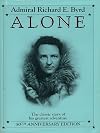
I realized from the afterward that this is not the entire story. But I still though there was some absolutely amazing transcendent writing here.
‘Alone’ reminded me a little bit of two other books. First of ‘Into the Wild’. Just like Chris McCandless he risked life and limb in his search for solitary enlightenment. And just like McCandless, Byrd encountered life threatening peril in his pursuit of the divine. ‘Alone’ also reminded me a tiny bit of ‘Eat, Pray, Love’ that in show more only by removing themselves from society did Byrd and Gilbert feel like they could be mindful enough to experience God. While I’m a big believer in finding peace in quiet, I don’t think it’s really necessary to be completely isolated to regain that childlike sense of wonder and awe of the world. And as we all know the real trick is holding onto that awareness while going about our everyday life.
It does boggle the mind to think what a man will do to escape his family. He traveled halfway around the world to sit alone in a shack where the temperature could be 75 degrees below. Don’t you wonder about the fortitude of his wife at home with the four children and the unpaid bills?
If I could I’d quote the entire first five pages of the book as they are so evocatively illuminating.
We are caught up in the winds that blow every which way. And in the hullabaloo the thinking man is driven to ponder where he is being blown and to long desperately for some quiet place where he can reason undisturbed and take inventory. It may be that I exaggerate that need for occasional sanctuary, but I do not think so—at least speaking for myself, since it has always taken me longer than the average person to think things out.
In my opinion, Byrd is apologizing for being an introvert in this passage. Extroversion-getting your energy from being with people is still the norm. Those who can only replenish their energy by being alone are still looked upon as being a little odd.
And all this was mine: the stars, the constellations, even the earth as it turned on its axis. If great inward peace and exhilaration can exist together, then this, I decided my first night alone, was what should possess the senses.
The day was dying, the night being born—but with great peace. Here were the imponderable processes and forces of the cosmos, harmonious and soundless. Harmony, that was it! That was what came out of the silence—a gentle rhythm, the strain of a perfect chord, the music of the spheres, perhaps.
The last half of the walk is the best part of the day, the time when I am most nearly at peace with myself and circumstances. Thoughts of life and the nature of things flow smoothly, so smoothly and so naturally as to create an illusion that one is swimming harmoniously in the broad current of the cosmos.
…a man can live a lifetime in a few half dreaming moments of introspection between going to bed and falling asleep: a lifetime reordered and edited to satisfy the every-changing demands of the mind.
I would be straining to listen—for nothing, really nothing but the sheer excitement of silence.
There were moments when I felt more alive than at any other tie in my life. Freed from the materialistic distractions, my senses sharpened in new directions, and the random or commonplace affairs of the sky and earth and the spirit, which ordinarily I would have ignored if I had noticed them at all, became exciting and portentous.
This following paragraph I found indescribably beautiful;
The human race, my intuition tells me, is not outside the cosmic process and is not an accident. It is as much a part of the universe as the trees, the mountains, the aurora, and the stars. My reason approves this; and the findings of science, as I see them, point in the same direction. And, since man is a part of the cosmos and subject to its laws, I see no reason to doubt that these same natural laws operate in the psychological as well as in the physical sphere and that their operation is manifest in the workings of the consciousness.
”The universe is an almost untouched reservoir of significance and value,” and man need not be discouraged because he cannot fathom it. His view of life is no more than a flash in time. The details and distractions are infinite. It is only natural, therefore that we should never see the picture whole. But the universal goal—the attainment of harmony—is apparent. The very act of perceiving this goal and striving constantly toward it does much in itself to bring us closer and, therefore, becomes an end in itself.
Few men during their lifetime come anywhere near exhausting to resources dwelling within them. There are deep wells of strength that that are never used. show less
‘Alone’ reminded me a little bit of two other books. First of ‘Into the Wild’. Just like Chris McCandless he risked life and limb in his search for solitary enlightenment. And just like McCandless, Byrd encountered life threatening peril in his pursuit of the divine. ‘Alone’ also reminded me a tiny bit of ‘Eat, Pray, Love’ that in show more only by removing themselves from society did Byrd and Gilbert feel like they could be mindful enough to experience God. While I’m a big believer in finding peace in quiet, I don’t think it’s really necessary to be completely isolated to regain that childlike sense of wonder and awe of the world. And as we all know the real trick is holding onto that awareness while going about our everyday life.
It does boggle the mind to think what a man will do to escape his family. He traveled halfway around the world to sit alone in a shack where the temperature could be 75 degrees below. Don’t you wonder about the fortitude of his wife at home with the four children and the unpaid bills?
If I could I’d quote the entire first five pages of the book as they are so evocatively illuminating.
We are caught up in the winds that blow every which way. And in the hullabaloo the thinking man is driven to ponder where he is being blown and to long desperately for some quiet place where he can reason undisturbed and take inventory. It may be that I exaggerate that need for occasional sanctuary, but I do not think so—at least speaking for myself, since it has always taken me longer than the average person to think things out.
In my opinion, Byrd is apologizing for being an introvert in this passage. Extroversion-getting your energy from being with people is still the norm. Those who can only replenish their energy by being alone are still looked upon as being a little odd.
And all this was mine: the stars, the constellations, even the earth as it turned on its axis. If great inward peace and exhilaration can exist together, then this, I decided my first night alone, was what should possess the senses.
The day was dying, the night being born—but with great peace. Here were the imponderable processes and forces of the cosmos, harmonious and soundless. Harmony, that was it! That was what came out of the silence—a gentle rhythm, the strain of a perfect chord, the music of the spheres, perhaps.
The last half of the walk is the best part of the day, the time when I am most nearly at peace with myself and circumstances. Thoughts of life and the nature of things flow smoothly, so smoothly and so naturally as to create an illusion that one is swimming harmoniously in the broad current of the cosmos.
…a man can live a lifetime in a few half dreaming moments of introspection between going to bed and falling asleep: a lifetime reordered and edited to satisfy the every-changing demands of the mind.
I would be straining to listen—for nothing, really nothing but the sheer excitement of silence.
There were moments when I felt more alive than at any other tie in my life. Freed from the materialistic distractions, my senses sharpened in new directions, and the random or commonplace affairs of the sky and earth and the spirit, which ordinarily I would have ignored if I had noticed them at all, became exciting and portentous.
This following paragraph I found indescribably beautiful;
The human race, my intuition tells me, is not outside the cosmic process and is not an accident. It is as much a part of the universe as the trees, the mountains, the aurora, and the stars. My reason approves this; and the findings of science, as I see them, point in the same direction. And, since man is a part of the cosmos and subject to its laws, I see no reason to doubt that these same natural laws operate in the psychological as well as in the physical sphere and that their operation is manifest in the workings of the consciousness.
”The universe is an almost untouched reservoir of significance and value,” and man need not be discouraged because he cannot fathom it. His view of life is no more than a flash in time. The details and distractions are infinite. It is only natural, therefore that we should never see the picture whole. But the universal goal—the attainment of harmony—is apparent. The very act of perceiving this goal and striving constantly toward it does much in itself to bring us closer and, therefore, becomes an end in itself.
Few men during their lifetime come anywhere near exhausting to resources dwelling within them. There are deep wells of strength that that are never used. show less
Lists
Awards


You May Also Like


Associated Authors
Statistics
- Works
- 24
- Also by
- 10
- Members
- 1,183
- Popularity
- #21,723
- Rating
- 3.8
- Reviews
- 14
- ISBNs
- 48
- Languages
- 4


