
Christian Humberg
Author of Prometheus: Fire with Fire
About the Author
Image credit: Writer Christian Humberg at the sci-fi convention FedCon in Bonn, Germany, 2017. By DianeAnna - Own work, CC BY-SA 3.0, https://commons.wikimedia.org/w/index.php?curid=59868371
Series
Works by Christian Humberg
Starportait: Neues von Dr. House 2 copies
Bondify Your Life: Wie man(n) Bomben entschärft, Frauen aufreißt und nebenbei die Welt rettet (2015) 2 copies
Sagenhaft Eifel! - Abenteuer in einer fantastischen Region: Der Schrecken der Teufelsschlucht (2017) 1 copy
Die Primeln einer Mörderin 1 copy
Der Schatz im Kräuterbeet 1 copy
Ein dicker Fisch 1 copy
Sagenhaft Eifel! - Abenteuer in einer fantastischen Region: Das Schloss am Maaresgrund (2015) 1 copy
Tote kompostiert man nicht 1 copy
Associated Works
Tagged
Common Knowledge
- Legal name
- Humberg, Christian
- Birthdate
- 1976-09-06
- Gender
- male
- Nationality
- Germany
- Birthplace
- Gerolstein, Rheinland-Pfalz, Deutschland
- Map Location
- Deutschland
Members
Reviews

Okay, so here we have another Prometheus novel that felt like it could have been a third of a novel. Let's tackle this one a bit differently. I want to move through it in order, not quite chapter-by-chapter, but significant chapter by significant chapter.
Continuity Notes:
- Chapter 2: A recap of where we're at so far, which is mostly characters talking about how they haven't actually learned anything yet.
- Chapter 4: A chapter set on the Klingon ship. On the one hand, these kind of feel like distractions; on
- the other hand, they almost read like they're by a different writer(s) to the rest of the book, because these characters actually have personalities and are trying to do things that bring them into conflict with one another.
- Chapter 5: For some reason, Lwaxana Troi is in this book.
- Chapter 6: The Klingon High Council meets to complain about how little is happening in this book.
- Chapter 7: One of the trilogy's ongoing subplots is about how women shouldn't be just having casual but enthusiastic sex all the time.
-
Chapter 12: One of the very annoying things in the first book were a large number of chapters where boring people did boring things and then at the end they all blew up. Here's another one, alas, but thankfully it's the only one in this book.
- Chapter 13: The Klingon High Council meets to have the same conversation over again as in chapter 6. I don't think you need either of these two chapters, but you certainly didn't need both of them.
- Chapter 14: Over 150 pages into the second book in this trilogy, Captain Adams finally makes an interesting decision. The Klingon captain, Kromm, decides he is going to bombard innocent civilians in order to get some answers. Adams places Prometheus between the Bortas and the planet to stop him. How is Adams going to deescalate this situation and save the innocent civilians?
- Chapter 15: Don't worry, Captain Adams is in no danger of joining the pantheon of clever Star Trek captains. The showdown fizzles out when Lwaxana on Earth calls in a favor from Picard who calls in a favor from Worf who calls in a favor from Martok who orders Kromm to stand down. And that's it.
- Chapter 18: Another meeting where people complain about how little has happened, but in this case it's the Federation Council. So many interminable meeting scenes in these books.
-
Chapter 19: Finally the characters figure out something that's been obvious the entire book, which is that some kind of external influence is making everyone more aggressive and xenophobic.
-
Chapter 22: Lwaxana figures out that what's happening now is linked to the disappearance of the Valiant a century ago. I am not sure why she is making every significant plot breakthrough and not our supposed main characters.
- Chapters 24-5: The main characters do a lot of technobabble to figure out where the crashed Valiant is. It's a very undramatic way to climax your novel.
- Chapter 27: Spock is the one who makes a key breakthrough in the subplot on the Klingon ship.
- Chapter 30: Spock figures out that the cause of everything here is the entity from "Day of the Dove." This is doubly frustrating: one, the attentive reader could have figured this out six hundred pages ago from the prologue to the first book, and two, it's yet another breakthrough by literally anyone other than the crew of the Prometheus.
Continuity Notes:
- Not as reference-heavy as the first book, but the book does recap what we learned about the "Day of the Dove" entity from The Q Continuum, even carrying over the name that book gave it, (*).
- Not sure what I think of a book whose moral is clearly "don't be a xenophobe" also having one of its few significant breakthroughs coming from gratuitous torture.
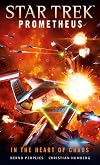
This book was one of the ones I picked up at a library book sale. I've not read any other Star Trek Prometheus titles and was concerned I would be lost or that I wouldn't care about these ST characters. I was surprised to find quite a few references to ST characters I did know--Ambassador Spock plays a key role as does Alexander Rozshenko, Kosinski and Wesley Crusher have minor but important roles, Picard is mentioned.
The book plays off of an Original Series episode where an entity creates show more hatred and encourages the humans and Klingons to fight each other. As best I can tell this is a different entity but has similar traits. The book mentions that Picard faced a similar entity, but I haven't been able to identify if that was from a Next Generation episode or in a book or just written into this storyline as a way to discuss a known character from the ST universe.
The plot is a bit plodding at times as they (Federation and Klingons) try to unravel the mystery. I wish Raspin had been put into the escape pod too. I was glad the vessel of the white guardian survived--though I suspected he would before it was revealed.
All-in-all, I was pleasantly surprised. show less
The book plays off of an Original Series episode where an entity creates show more hatred and encourages the humans and Klingons to fight each other. As best I can tell this is a different entity but has similar traits. The book mentions that Picard faced a similar entity, but I haven't been able to identify if that was from a Next Generation episode or in a book or just written into this storyline as a way to discuss a known character from the ST universe.
The plot is a bit plodding at times as they (Federation and Klingons) try to unravel the mystery. I wish Raspin had been put into the escape pod too. I was glad the vessel of the white guardian survived--though I suspected he would before it was revealed.
All-in-all, I was pleasantly surprised. show less

In my review of the audiobook, I praised this installment. Well, I said it was the best one, which isn't the same thing. Indeed, it starts a bit excitingly for once, with some desperate actions by the crews of the Prometheus and Bortas to escape the chaos zone they entered into at the end of the previous book.
Unfortunately, the book is still fully capable of frittering away its narrative energy because then we're back into, buckle up, a meeting scene! A whole chapter is devoted to a meeting show more where the main takeaway is that Spock thinks they should look something up in Memory Alpha. This should have been two lines of dialogue, tops! No one wants to read a debate about whether or not someone should send an e-mail!
So then we pop over to Memory Alpha of course, and here's your final big cameo for Star Trek's fiftieth anniversary... freaking Kosinski from "Where No One Has Gone Before." Wow, how did they get him back? No, the question is why? Why in the middle of this novel do we have to squander a chapter on this guy updating us on his life story, watching the news, and looking at maps in a library!? (Okay, he's not really the last big cameo, that's Wesley Crusher... a moment that is totally gratuitous... but hey so is everything else in this book.)
The problem is (and here I disagree with my 2019 self when he reviewed the audiobook) that then the Prometheus and Bortas split up, and now all the Prometheus is doing is flying to the origin of the Ancient Reds, picking up one of them, and flying back to Lembatta. You might think, That's not enough content to fill up a 350-page novel, and well, you'd be right. It feels like the Prometheus crew is barely in this one... but maybe that's a blessing in disguise. It certainly feels like they barely do anything in it, basically just being a ferry service. At a time when things should be escalating, there's actually less going on.
So how can they fill up the book's pages? By suddenly giving us the adventures of a new set of boring characters, some Rigellian chelon admiral and the ship he's on. One whole chapter is about trying to figure out a guy's password. None of it is ever really relevant to anything.
Overall, this book reads like someone took all the least interesting aspects of Destiny-era fiction—mediocre original characters, tedious political plots, gratuitous continuity references—and amped them up as far as they would go. So I guess it fits in with its era... mission accomplished? But there's a base level of enjoyment in even this era's worst book that I just could not find in the Prometheus trilogy, with its stilted dialogue and tedious prose.
Continuity Notes:
Unfortunately, the book is still fully capable of frittering away its narrative energy because then we're back into, buckle up, a meeting scene! A whole chapter is devoted to a meeting show more where the main takeaway is that Spock thinks they should look something up in Memory Alpha. This should have been two lines of dialogue, tops! No one wants to read a debate about whether or not someone should send an e-mail!
So then we pop over to Memory Alpha of course, and here's your final big cameo for Star Trek's fiftieth anniversary... freaking Kosinski from "Where No One Has Gone Before." Wow, how did they get him back? No, the question is why? Why in the middle of this novel do we have to squander a chapter on this guy updating us on his life story, watching the news, and looking at maps in a library!? (Okay, he's not really the last big cameo, that's Wesley Crusher... a moment that is totally gratuitous... but hey so is everything else in this book.)
The problem is (and here I disagree with my 2019 self when he reviewed the audiobook) that then the Prometheus and Bortas split up, and now all the Prometheus is doing is flying to the origin of the Ancient Reds, picking up one of them, and flying back to Lembatta. You might think, That's not enough content to fill up a 350-page novel, and well, you'd be right. It feels like the Prometheus crew is barely in this one... but maybe that's a blessing in disguise. It certainly feels like they barely do anything in it, basically just being a ferry service. At a time when things should be escalating, there's actually less going on.
So how can they fill up the book's pages? By suddenly giving us the adventures of a new set of boring characters, some Rigellian chelon admiral and the ship he's on. One whole chapter is about trying to figure out a guy's password. None of it is ever really relevant to anything.
Overall, this book reads like someone took all the least interesting aspects of Destiny-era fiction—mediocre original characters, tedious political plots, gratuitous continuity references—and amped them up as far as they would go. So I guess it fits in with its era... mission accomplished? But there's a base level of enjoyment in even this era's worst book that I just could not find in the Prometheus trilogy, with its stilted dialogue and tedious prose.
Continuity Notes:
- This book is clearly dated to overlapping with Takedown by a reference to the opening of the Far Embassy. Only here it's called the "Embassy of Distance"—I guess neither translator nor editor picked up on it being a reference, so the term got translated back into English out of German.
- So in my "continuity notes" on all these November 2385–set novels (of which there are a lot), I've been making snarky comments about their lack of mention of the Lembatta crisis. I hope it's clear that this isn't really a rag on those books, as the Prometheus trilogy was written much later. Rather, it's a rag on this trilogy for its totally nonsensical chronological placement. Overlapping with Takedown seals the deal: at no point in the middle of this trilogy do communications go out across the galaxy; when Takedown opens, clearly nothing like a galactic terrorism crisis is underway. Why did the writers pick such a packed month... a month where the events of this trilogy clearly cannot happen? It's an unforced error. Even if it was set one month later in December, that would be fine; the trilogy would only overlap with a couple Deep Space Nine stories that give no sense of the greater galactic situation. Or, though this would require more changes, what if the whole thing took place in the run-up to The Fall, thus neatly explaining why Ishan's more militaristic message might be appealing to the Federation? But placing it here makes no sense.

Great fun on the Final Frontier!
While many of the Trek novels have been translated - it's always been *from* English. This book is a first - a German Trek novel, now translated into English, and it's great fun. Lots of action, and - perhaps with an eye to tensions in our time - intrigue around terrorist acts. It's part of a new series by these authors and happily I already have next installment in hand!
While many of the Trek novels have been translated - it's always been *from* English. This book is a first - a German Trek novel, now translated into English, and it's great fun. Lots of action, and - perhaps with an eye to tensions in our time - intrigue around terrorist acts. It's part of a new series by these authors and happily I already have next installment in hand!
Lists
Awards

You May Also Like


Associated Authors
Statistics
- Works
- 43
- Also by
- 19
- Members
- 359
- Popularity
- #66,804
- Rating
- 3.6
- Reviews
- 8
- ISBNs
- 55
- Languages
- 1
- Favorited
- 1