
Dayton Ward
Author of A Time to Sow
Series
Works by Dayton Ward
Captain America: Steve Rogers Declassified: Notes, Interviews, and Files from the Avengers’ Archives (2024) 13 copies
Iron Man: Tony Stark Declassified: Notes, Interviews, and Files from the Avengers' Archives (2023) 12 copies
Associated Works
Tagged
Common Knowledge
- Birthdate
- 1967-06-07
- Gender
- male
- Occupations
- United States Marine Corps
- Nationality
- USA
- Places of residence
- Kansas City, Missouri, USA
- Associated Place (for map)
- Missouri, USA
Members
Reviews

This book essentially has two totally separate plotlines. One is very familiar; this is our fourth Dayton Ward–penned exploring-the-Odyssean-Pass-after-The Fall novel, and so you'll know the vibe by now. The Enterprise comes across an interesting situation, there's some conflict, T'Ryssa Chen is in it a lot, Taurik is there. Ward is good at coming up with premises that feel like lost TNG episodes; in this one, the Enterprise and a group of scavengers come upon a derelict spaceship that show more seems like it ought to have a lot of people aboard... but where are they? There are some clever concepts here and interesting spins on Star Trek technology. As I have with almost all of these books, I found myself thinking about how I would adapt it to serve as a Star Trek Adventures scenario, which is always a good sign.
I don't think there's anything bad about these four books per se, but they have felt a bit... stasis-y. Like, all the characters are present and correct, but there's not the vibe you got back at the height of the Deep Space Nine relaunch or in the early days of New Frontier and Titan, that you were watching these characters evolve and grow. It almost reads like a tie-in to a tv show that doesn't exist, like all the characters have to be maintained as they are. Worf does Worf things, La Forge does La Forge things, T'Ryssa Chen does T'Ryssa Chen things, Joanna Faur continues to exist, Beverly isn't in it except as Picard's wife. I don't think I would say I disliked any of the post-Fall TNG novels on their own merits, but unfortunately I do feel like the best one was the first, Armageddon's Arrow; it had a sense that we were moving forward and going somewhere that ended up missing from Headlong Flight, Hearts and Minds, and this book.
The other half of the book is the fallout from Section 31: Control, which is really the fallout from A Time to Heal, a book that came out fifteen years prior! Section 31's existence is now public, but along with this, so is Picard's role in the coup that deposed President Min Zife. This half has its own two halves. In one, we see what's going on back on Earth: how are the politicians and the people dealing with all the revelations about S31, particularly that everything that everything the Federation has ever accomplished in its utopia-building was really the result of unsanctioned black ops? Mostly this is told from the perspective of Philippa Louvois (of "Measure of a Man" fame), now Federation Attorney General, as she begins carrying out investigations and prosecutions. It's fine; I did have the feeling that maybe the revelations of Control were a bit too big to realistically be accommodated into a tie-in book series at all, much less as a B-plot. The Federation has had yet another existential shock but I just don't think you can adequately deal with that and maintain the status quo needed for this to also be a series of books about people having fun space adventures. At this point, is it even realistic that the Federation continues to function? Akaar gives like five different speeches about how human choices do matter but they all feel a bit hollow.
I'm not sure about a couple choices here, like one where a trained Starfleet officer turns into a cold-blooded killer trying to get Admiral Ross because her husband died due to a Section 31 op. Also what's up with all the characters' insistence that Ross was a key player in S31? To the extent that an organization like S31 has formal members, I never had the sense that he was one; I certainly didn't feel like he was guiding policy. He was more just a guy the real players knew they could count on to throw things their way when needed.
The other half of this half is the personal fallout for Picard himself. This I found profoundly disappointing. What is the reaction of every key character finding out that Picard had a role in the illegal takedown of a democratically elected leader. Basically everyone shrugs and says, "oh well sometimes you just have to do a coup i guess." I could buy this of some characters (I can certainly imagine it of Worf, a man who previously killed a democratically elected leader)... but everyone? No one is upset to learn that the principled Jean-Luc Picard totally abandoned his principles? Not Beverly, not La Forge, not T'Ryssa, not Will Riker? I found this disappointing because 1) so much for Federation ideals, and 2) it seems a bizarre dramatic choice. This thing happens that could totally upend your characters' relationships, and you basically just ignore it?
The book ends with Picard deciding to be accountable for his decision and return to Earth, which I appreciate, but it feels pretty random; I wish it had been a natural outgrowth of the way something from this storyline intersected with the A-plot.
Notes on continuity and other issues on my blog. show less
I don't think there's anything bad about these four books per se, but they have felt a bit... stasis-y. Like, all the characters are present and correct, but there's not the vibe you got back at the height of the Deep Space Nine relaunch or in the early days of New Frontier and Titan, that you were watching these characters evolve and grow. It almost reads like a tie-in to a tv show that doesn't exist, like all the characters have to be maintained as they are. Worf does Worf things, La Forge does La Forge things, T'Ryssa Chen does T'Ryssa Chen things, Joanna Faur continues to exist, Beverly isn't in it except as Picard's wife. I don't think I would say I disliked any of the post-Fall TNG novels on their own merits, but unfortunately I do feel like the best one was the first, Armageddon's Arrow; it had a sense that we were moving forward and going somewhere that ended up missing from Headlong Flight, Hearts and Minds, and this book.
The other half of the book is the fallout from Section 31: Control, which is really the fallout from A Time to Heal, a book that came out fifteen years prior! Section 31's existence is now public, but along with this, so is Picard's role in the coup that deposed President Min Zife. This half has its own two halves. In one, we see what's going on back on Earth: how are the politicians and the people dealing with all the revelations about S31, particularly that everything that everything the Federation has ever accomplished in its utopia-building was really the result of unsanctioned black ops? Mostly this is told from the perspective of Philippa Louvois (of "Measure of a Man" fame), now Federation Attorney General, as she begins carrying out investigations and prosecutions. It's fine; I did have the feeling that maybe the revelations of Control were a bit too big to realistically be accommodated into a tie-in book series at all, much less as a B-plot. The Federation has had yet another existential shock but I just don't think you can adequately deal with that and maintain the status quo needed for this to also be a series of books about people having fun space adventures. At this point, is it even realistic that the Federation continues to function? Akaar gives like five different speeches about how human choices do matter but they all feel a bit hollow.
I'm not sure about a couple choices here, like one where a trained Starfleet officer turns into a cold-blooded killer trying to get Admiral Ross because her husband died due to a Section 31 op. Also what's up with all the characters' insistence that Ross was a key player in S31? To the extent that an organization like S31 has formal members, I never had the sense that he was one; I certainly didn't feel like he was guiding policy. He was more just a guy the real players knew they could count on to throw things their way when needed.
The other half of this half is the personal fallout for Picard himself. This I found profoundly disappointing. What is the reaction of every key character finding out that Picard had a role in the illegal takedown of a democratically elected leader. Basically everyone shrugs and says, "oh well sometimes you just have to do a coup i guess." I could buy this of some characters (I can certainly imagine it of Worf, a man who previously killed a democratically elected leader)... but everyone? No one is upset to learn that the principled Jean-Luc Picard totally abandoned his principles? Not Beverly, not La Forge, not T'Ryssa, not Will Riker? I found this disappointing because 1) so much for Federation ideals, and 2) it seems a bizarre dramatic choice. This thing happens that could totally upend your characters' relationships, and you basically just ignore it?
The book ends with Picard deciding to be accountable for his decision and return to Earth, which I appreciate, but it feels pretty random; I wish it had been a natural outgrowth of the way something from this storyline intersected with the A-plot.
Notes on continuity and other issues on my blog. show less

Parallel universes are, of course, an old standby of Star Trek in specific and popular science fiction in general. What can we learn by seeing the road untaken, other universes where people made different choices or things went different ways? This book sees the Enterprise-E returning to its mission of exploration, which eventually brings it into contact with the Enterprise-D from 2367... but an Enterprise-D from a reality where Picard died during the events of "The Best of Both Worlds, Part show more II" and Riker became captain; other differences include the continued existence of Tasha Yar, Pulaski still serving as CMO, and Wesley working as a civilian specialist on the Enterprise.
The book invites comparisons with any number of parallel universe stories, from TNG's "Parallels" onwards, but the one that jumped out at me was Peter David's Q-Squared, because Dayton Ward performs a similar trick to David. In Q-Squared, some clever work with pronouns makes it unclear during one of the book's earlier scenes that we're in an alternate timeline; we at first thing we're reading about Picard and Beverly Crusher when it turns out to be Picard and a still-living Jack Crusher. In an early E-D scene, Ward has the crew at a card game, and some vague references to "the captain" make you think Picard is the captain when in fact it's Riker.
David deploys the revelation to dramatic effect, dropping it in (if I recall correctly, it's been at least two decades since I read Q-Squared) at the end of a scene, upending the mental image you had built up over the preceding several pages.The problem here is that the next time we go to the alternative Enterprise-D, we're just told that Riker is captain; there's no drama to the reveal. So why defer it?
An inexplicable lack of drama is consistent through all the alternative timeline stuff. It takes absolutely forever before the two crews are even aware of each other; I felt like the first one hundred pages were just people scanning nebulas. And while in Armageddon's Arrow, Ward built in a lot of nice little moments and small arcs for the E-E crew, here I felt I was just reading about them doing their jobs in the most humdrum fashion. T'Ryssa Chen has a boyfriend... and that's it, nothing is at stake for her. Once the two crews meet, they do so without much drama or interest. Does the discovery of this other Enterprise do anything other than make the crew from the future nostalgic about the old LCARS format and bridge layout? Not really. It doesn't raise any questions for Picard about his life, or La Forge, or Worf, or anyone.
The closest we get is that the alternative Riker gets a bit of closure... but to be honest, why do I care if that guy gets some closure? Again, compare Q-Squared, where if nothing else, Jack Crusher undergoes an existential crisis from learning about his fate in the "Prime" timeline. At the end, Picard makes a potentially interesting decision in giving the alternative Enterprise-D metaphasic torpedoes, but this decision entirely happens off-screen, and its consequences seem to be limited to the fact that if he is found out, he will receive a sternly worded letter from a bureaucrat.
Outside of the alternative timeline stuff, there is unfortunately little going on in the novel. The main antagonists are Romulans from a century ago; unsurprisingly, they are little threat, even aside from the fact they mostly seem to sit around talking replaying beats from "Balance of Terror." I was not able to get worked up about the fate of the aliens in any way, shape, or form, and it's all resolved with surprising ease.
In both cases, information is often imparted to the reader in the least dramatic fashion possible. Rather than learn about the alternative Enterprise-D's history along with the Enterprise-E crew, it's simply given to us in exposition. Rather than have the Romulans dramatically decloak to make things worse, they simply pop up in a chapter from their viewpoint where they just sit around watching people. There's no dramatic reveals, no suspense mind from almost anything here. To be honest, I wasn't even sure what the book was going for. The basic premise seems to be "two alternative crews meet each other... and everyone is terribly nice about it." Perhaps it's a realistic take in a Star Trekky sense, but it hardly makes for interesting reading.
Continuity Notes:
Other Notes:
The book invites comparisons with any number of parallel universe stories, from TNG's "Parallels" onwards, but the one that jumped out at me was Peter David's Q-Squared, because Dayton Ward performs a similar trick to David. In Q-Squared, some clever work with pronouns makes it unclear during one of the book's earlier scenes that we're in an alternate timeline; we at first thing we're reading about Picard and Beverly Crusher when it turns out to be Picard and a still-living Jack Crusher. In an early E-D scene, Ward has the crew at a card game, and some vague references to "the captain" make you think Picard is the captain when in fact it's Riker.
David deploys the revelation to dramatic effect, dropping it in (if I recall correctly, it's been at least two decades since I read Q-Squared) at the end of a scene, upending the mental image you had built up over the preceding several pages.The problem here is that the next time we go to the alternative Enterprise-D, we're just told that Riker is captain; there's no drama to the reveal. So why defer it?
An inexplicable lack of drama is consistent through all the alternative timeline stuff. It takes absolutely forever before the two crews are even aware of each other; I felt like the first one hundred pages were just people scanning nebulas. And while in Armageddon's Arrow, Ward built in a lot of nice little moments and small arcs for the E-E crew, here I felt I was just reading about them doing their jobs in the most humdrum fashion. T'Ryssa Chen has a boyfriend... and that's it, nothing is at stake for her. Once the two crews meet, they do so without much drama or interest. Does the discovery of this other Enterprise do anything other than make the crew from the future nostalgic about the old LCARS format and bridge layout? Not really. It doesn't raise any questions for Picard about his life, or La Forge, or Worf, or anyone.
The closest we get is that the alternative Riker gets a bit of closure... but to be honest, why do I care if that guy gets some closure? Again, compare Q-Squared, where if nothing else, Jack Crusher undergoes an existential crisis from learning about his fate in the "Prime" timeline. At the end, Picard makes a potentially interesting decision in giving the alternative Enterprise-D metaphasic torpedoes, but this decision entirely happens off-screen, and its consequences seem to be limited to the fact that if he is found out, he will receive a sternly worded letter from a bureaucrat.
Outside of the alternative timeline stuff, there is unfortunately little going on in the novel. The main antagonists are Romulans from a century ago; unsurprisingly, they are little threat, even aside from the fact they mostly seem to sit around talking replaying beats from "Balance of Terror." I was not able to get worked up about the fate of the aliens in any way, shape, or form, and it's all resolved with surprising ease.
In both cases, information is often imparted to the reader in the least dramatic fashion possible. Rather than learn about the alternative Enterprise-D's history along with the Enterprise-E crew, it's simply given to us in exposition. Rather than have the Romulans dramatically decloak to make things worse, they simply pop up in a chapter from their viewpoint where they just sit around watching people. There's no dramatic reveals, no suspense mind from almost anything here. To be honest, I wasn't even sure what the book was going for. The basic premise seems to be "two alternative crews meet each other... and everyone is terribly nice about it." Perhaps it's a realistic take in a Star Trekky sense, but it hardly makes for interesting reading.
Continuity Notes:
- Picard thinks of the Briar Patch as a place that gave the Enterprise trouble years earlier... not months earlier!
- The ship class names for the Romulan ships in this book all come from the FASA RPG sourcebooks.
- Picard recalls that the Enterprise-E was originally called the USS Honorius while under construction, being redesignated after the crash of the Enterprise-D on Veridian III. While the origins of this name are obscure, its first mention in prose fiction came in the S.C.E. novella The Future Begins by... oh, how interesting. (Not, contrary to the claims of Wikipedia, in Diane Carey's Ship of the Line.)
Other Notes:
- In a bit about how Chen seems to do everything on the ship but her job as contact specialist, we're told that what she spends her time doing includes "composing... detailed analysis of whatever new species the Enterprise might encounter, and recommendations for next steps... with respect to a newly discovered civilization" (p. 27). But if composing such materials isn't part of the duties of a contact specialist, what even are the duties of a contact specialist?
- There is for some reason a totally irrelevant two-page recap of the events of "The Pegasus."
- There is also a whole page-long thing that establishes that Christopher L. Bennett is an in-universe professor at Starfleet Academy. He likes to talk a lot about time travel theories, spinning a lot out of very small comments by other people and unable to stop talking. Hard to imagine, to be honest.
- Doug Drexler's cover image is as undramatic and humdrum as the book it illustrates. And doesn't that Enterprise-D look a bit wonky to you?
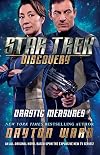
Few tragedies had a greater impact on the history of the Federation than the massacre on Tarsus IV. There, in response to the devastation to the colony's food supplies caused by a fungus, the colony's governor, Adrian Kodos, ordered the execution of half of the colony's population so that the other half could survive on the remaining stocks. Accentuating the horror of Kodos's decision was the needlessness of it, as the unexpectedly rapid Starfleet response led by Commander Philippa Georgiou show more meant that the anticipated famine never would have happened. With the crisis alleviated Kodos and his supporters are on the run, chased by a determined lieutenant commander named Gabriel Lorca who is determined to bring Kodos to justice for the deaths he ordered — including those of the members of the Starfleet monitoring post on the planet and a woman close to his heart.
One of the opportunities provided by the setting of the recently-added Star Trek: Discovery series to the Star Trek franchise is that of exploring the events prior to those of the storied original series. While the series itself provided a depiction of the Federation-Klingon War referenced in "Errand of Mercy," Dayton Ward takes the opportunity in this novel to develop the events referenced in "The Conscience of the King," one of the first episodes of the show. There’s a lot to like about the novel, as Ward writes a suspenseful story and he knows how to pen effective action scenes. He also has an unusual opportunity to craft a different Gabriel Lorca from the one shown in the first season, and he balances his portrayal of the more moral and upright figure one would expect in the Star Trek universe while hinting nicely at the elements evident in the Mirror Universe counterpart from the show.
Yet while his novel is entertaining and his incorporation of both Georgiou and Lorca are effective, many of the elements of his plot are an awkward fit with the original series episode on which it's based. While part of the problem in this regard that Ward doesn't adhere to the scattered details of the massacre provided in the episode, the main issue ironically enough is his effort to conform to one major point from it: the problem of recognizing Kodos. Given all of the ways of identifying people that have emerged in just the half-century since the episode was written, Ward had to work out how a figure as public as Kodos could have remained unidentified after his death. This ends up consuming far more of the novel than it should, to the point of disrupting the story's pacing for the sake of an awkward and not entirely satisfying resolution. It's an unfortunate burden for what could have been a powerful story of Federation morals tested by circumstance, rather than an awkward fit that somehow manages to be both too faithful and not faithful enough to its source material. show less
One of the opportunities provided by the setting of the recently-added Star Trek: Discovery series to the Star Trek franchise is that of exploring the events prior to those of the storied original series. While the series itself provided a depiction of the Federation-Klingon War referenced in "Errand of Mercy," Dayton Ward takes the opportunity in this novel to develop the events referenced in "The Conscience of the King," one of the first episodes of the show. There’s a lot to like about the novel, as Ward writes a suspenseful story and he knows how to pen effective action scenes. He also has an unusual opportunity to craft a different Gabriel Lorca from the one shown in the first season, and he balances his portrayal of the more moral and upright figure one would expect in the Star Trek universe while hinting nicely at the elements evident in the Mirror Universe counterpart from the show.
Yet while his novel is entertaining and his incorporation of both Georgiou and Lorca are effective, many of the elements of his plot are an awkward fit with the original series episode on which it's based. While part of the problem in this regard that Ward doesn't adhere to the scattered details of the massacre provided in the episode, the main issue ironically enough is his effort to conform to one major point from it: the problem of recognizing Kodos. Given all of the ways of identifying people that have emerged in just the half-century since the episode was written, Ward had to work out how a figure as public as Kodos could have remained unidentified after his death. This ends up consuming far more of the novel than it should, to the point of disrupting the story's pacing for the sake of an awkward and not entirely satisfying resolution. It's an unfortunate burden for what could have been a powerful story of Federation morals tested by circumstance, rather than an awkward fit that somehow manages to be both too faithful and not faithful enough to its source material. show less
Do Not Recommend. It's sad and frustrating how badly this book missed for me, because Tarsus IV is such a juicy, engaging, emotionally fraught situation. The details here don't convince me, it reads more like a Tom Clancy hunt-'em-down novel than anything else, and to add insult to injury it doesn't even do a good job characterizing Prime Lorca, who I'd really like to know more about. Sigh. Would have been a DNF if not for my project to read every book, and that I wanted to know what show more happened from a canon-ish perspective.
One of the great strengths of the original episode “The Conscience of the King” was that while Kirk judges Kodos’ actions, it leaves the question of whether Kodos was truly a bone-deep monster open. Could he have been simply a person caught up in a terrifying time, given too much power, trying to apply Vulcan-style logic and making errors so huge they cannot be forgiven? His actions when he discovers his daughter’s murders certainly suggest that.
But this book leaves none of that wiggle room. We are never given a moment to consider that perhaps, when out of their mind with fear and anger and grief, humans do things that are wrong, even evil, and live to regret them. Kodos is transformed into a calculating, sociopathic dictator with a cultlike following who has no regret or remorse, even when Starfleet’s relief ships arrive early. Every character who encounters the situation instantly decides that Kodos is an irredeemable villain who must be “brought to justice,” that justice ideally being a short drop and a sudden stop. And the sentence-by-sentence writing, unfortunately, isn’t good enough to convince me that the characters really feel this way, only that the characters need to feel this way in order to justify paragraph upon paragraph of loving description of Starfleet service rifles.
I’m most angry with this because Tarsus IV is such a rich setting, and it seems like a perfect setup to showcase a truly well-developed Prime Lorca. What if Lorca’s response to tragedy - assuming the plot more or less rolls out as it does in the novel - is consistently shown to be an inner battle between his anger and the compassion that he believes he ought to show to all beings? Wouldn’t that be a more interesting comparison to Mirror Lorca? What if Georgiou, on the relief vessel, was more enraged than Lorca at the situation, having conceived of herself as a savior and appearing on Tarsus IV only to find out she was too late? What if Kodos and his followers had complex ideas about ethics????? We will never know.
In conclusion, don’t read this book unless you really have to. If you want to read a Star Trek novel about the Disco characters, read Desperate Hours. If you want to read a Star Trek novel with ethics in it, read Prime Directive. If you want to read a Star Trek novel about young Jim Kirk, read Best Destiny (it’s flawed and a little old-fashioned, but solidly enjoyable). The only reason to read Drastic Measures is to find out (SPOILERS behind the jump)... show less
One of the great strengths of the original episode “The Conscience of the King” was that while Kirk judges Kodos’ actions, it leaves the question of whether Kodos was truly a bone-deep monster open. Could he have been simply a person caught up in a terrifying time, given too much power, trying to apply Vulcan-style logic and making errors so huge they cannot be forgiven? His actions when he discovers his daughter’s murders certainly suggest that.
But this book leaves none of that wiggle room. We are never given a moment to consider that perhaps, when out of their mind with fear and anger and grief, humans do things that are wrong, even evil, and live to regret them. Kodos is transformed into a calculating, sociopathic dictator with a cultlike following who has no regret or remorse, even when Starfleet’s relief ships arrive early. Every character who encounters the situation instantly decides that Kodos is an irredeemable villain who must be “brought to justice,” that justice ideally being a short drop and a sudden stop. And the sentence-by-sentence writing, unfortunately, isn’t good enough to convince me that the characters really feel this way, only that the characters need to feel this way in order to justify paragraph upon paragraph of loving description of Starfleet service rifles.
I’m most angry with this because Tarsus IV is such a rich setting, and it seems like a perfect setup to showcase a truly well-developed Prime Lorca. What if Lorca’s response to tragedy - assuming the plot more or less rolls out as it does in the novel - is consistently shown to be an inner battle between his anger and the compassion that he believes he ought to show to all beings? Wouldn’t that be a more interesting comparison to Mirror Lorca? What if Georgiou, on the relief vessel, was more enraged than Lorca at the situation, having conceived of herself as a savior and appearing on Tarsus IV only to find out she was too late? What if Kodos and his followers had complex ideas about ethics????? We will never know.
In conclusion, don’t read this book unless you really have to. If you want to read a Star Trek novel about the Disco characters, read Desperate Hours. If you want to read a Star Trek novel with ethics in it, read Prime Directive. If you want to read a Star Trek novel about young Jim Kirk, read Best Destiny (it’s flawed and a little old-fashioned, but solidly enjoyable). The only reason to read Drastic Measures is to find out (SPOILERS behind the jump)... show less
Lists
Awards


You May Also Like


Associated Authors
Statistics
- Works
- 60
- Also by
- 27
- Members
- 4,424
- Popularity
- #5,661
- Rating
- 3.7
- Reviews
- 83
- ISBNs
- 157
- Languages
- 1
- Favorited
- 1