
Diane Carey
Author of Ghost Ship
About the Author
Diane Carey lives in Owasso, Michigan. (Bowker Author Biography)
Series
Works by Diane Carey
Gespensterschiff / Planet des Untergangs / Die Augen der Betrachter. Star Trek (1994) — Contributor — 19 copies
O navio fantasma 1 copy
Spectres 1 copy
Star trek fleet academy 1 copy
A Broken Bow incidens 1 copy
New Earth 1 copy
Associated Works
Tagged
Common Knowledge
- Canonical name
- Carey, Diane
- Legal name
- Carey-Brodeur, Diane L.
- Other names
- Carey, Diane
Carey, D. L.
Gregory, Lydia - Birthdate
- 1954-10-02
- Gender
- female
- Education
- Alma College
- Relationships
- Brodeur, Greg (husband)
- Short biography
- Diane L. Carey was born on 2 October 1954 in Flint, Michigan, USA. She married Gregory E. Brodeur, an editor, and they had three children: Lydia, Gordon, and Ben. The family lives in Michigan.
Her first published was a romance novel under the pseudonym Lydia Gregory. Later she published other romance, science fiction, and children's novels as Diane Carey and D. L. Carey. She is probably best known for the many best-selling Star Trek novels she writes with her husband/collaborator Greg Brodeur. The duo work together on plot development, characterization and story solidity, then Diane does all of the actual writing, while Greg edits the works-in-progress for dramatic flow and emotional impact. - Nationality
- USA
- Birthplace
- Flint, Michigan, USA
- Associated Place (for map)
- Michigan, USA
Members
Reviews
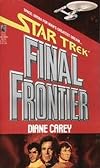
Diane Carey continues to have a strongly individualistic mindset but she's not doing the hyper-Randian thing anymore, for which I'm grateful. I think someone who likes classic sea stories might like this, as there's a fair bit about battle and maneuverability, but I didn't find it as engaging: George Kirk just can't get me excited the way that the "real crew" can! Still, a more than competent book.
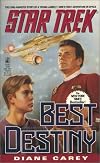
The reviews for this Star Trek novel are mostly positive, but I'm afraid the plot and characterisations didn't work for me at all. Where was the humour, the banter, the adventure? Between a snotty teenage Kirk and a miserable middle-aged Kirk, I was almost bored to tears. And why, why must Kirk have been a terrible teen in order to become a first rate captain? Couldn't he just have been inspired by his father and awed by the concept of travelling through space? I got the impression from the show more series that Kirk had always been an intelligent man and an idealist, and Starfleet gave him a way to channel his natural talents - Gary Mitchell called him a 'stack of books with legs' after all - yet in this version, he's little more than an ignorant punk until a(nother) life and death voyage into space with his father sets him straight. Not strictly out of character, although Kirk suffers from yet another dumbing down, but done to death in a coming of age story.
Kevin the teenager aside, the pacing is incredibly slow, only uniting past and (future) present in the last few chapters, and the secondary characters are clunkier than the pirate ship that knocks the Starfleet shuttle off course. I mean, come on, even for Star Trek, the faux-Aussie captain and his blockheaded second in command are laughably bad, and then we're supposed to take Kirk's own adolescent nemesis Roy seriously? He needs a smack upside the head and/or counselling (same for Kirk), not building up into an evil genius.
On the technical side, even the writing failed to impress. Some of the purple prose would be more suited to a romance novel - Kirk's father has 'a flop of argumentative sienna shag' instead of unruly red hair, and Kirk's 'antique gold eyes' burn with 'taupe fire'. The foreshadowing is also rather clumsy, with young Kirk slowly getting the message that his father and Robert April are big, brave pioneers making the uncharted galaxy safe for future generations, etc. I'm not sure that the author(s) really like Captain Kirk, which could explain why they were rubbing me up the wrong way throughout (Spock would not have made a better captain), but then why choose to write a backstory for his character?
Plodding and pretentious, Diane Carey's novel misses the charm of the original series, and turns young 'Jimmy' Kirk into a teenage nightmare. show less
Kevin the teenager aside, the pacing is incredibly slow, only uniting past and (future) present in the last few chapters, and the secondary characters are clunkier than the pirate ship that knocks the Starfleet shuttle off course. I mean, come on, even for Star Trek, the faux-Aussie captain and his blockheaded second in command are laughably bad, and then we're supposed to take Kirk's own adolescent nemesis Roy seriously? He needs a smack upside the head and/or counselling (same for Kirk), not building up into an evil genius.
On the technical side, even the writing failed to impress. Some of the purple prose would be more suited to a romance novel - Kirk's father has 'a flop of argumentative sienna shag' instead of unruly red hair, and Kirk's 'antique gold eyes' burn with 'taupe fire'. The foreshadowing is also rather clumsy, with young Kirk slowly getting the message that his father and Robert April are big, brave pioneers making the uncharted galaxy safe for future generations, etc. I'm not sure that the author(s) really like Captain Kirk, which could explain why they were rubbing me up the wrong way throughout (Spock would not have made a better captain), but then why choose to write a backstory for his character?
Plodding and pretentious, Diane Carey's novel misses the charm of the original series, and turns young 'Jimmy' Kirk into a teenage nightmare. show less
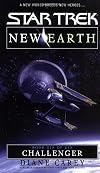
This is the final book of the "New Earth" six-book series, and the best, and it is fitting that the Grande Olde Dame of Star Trek fiction, Diane Carey, be the one to write it. This concludes the "Wagon Train to the Stars" storyline in a most satisfactory manner, with a lot of whistling-in-the-dark humor, with one quibble. Carey evidently contends in this book that Spock's mental balance is dependent upon McCoy for letting off pressure, and that without Bones to argue with for weeks at a show more time, his emotional balance suffers almost to the point of instability. This rings false to my understanding of the character over the last 35 years, and it surprises me that a veteran writer of Star Trek such as Diane Carey would make this contention. show less

When it comes to Star Trek novels, among the ones that I find the most interesting are those that are set prior to the “five-year mission” chronicled in the original series. What makes them so interesting is the authors’ efforts to fill in the backstories hinted at in the show, often by little more than a throwaway line of dialogue or a onetime appearance in an episode. These novels aren’t canon, but when they’re done right they can provide enjoyable speculations that help to flesh show more out familiar characters or otherwise unexplored aspects of the Star Trek universe. When they’re done poorly, though, they can be a source of eye-rolling frustration.
Diane Carey’s novel falls squarely into the latter category. In it, James Kirk finds himself questioning his life’s choices after sacrificing Edith Keeler during his trip through the Guardian of Forever in order to secure a Nazi-free future. Back on Earth, he goes through some of the letters his father George wrote while serving in Starfleet. This framing device is used to tell the story of the first-ever adventure of the starship Enterprise, when sabotage sends the uncommissioned (and as-yet-unnamed) vessel hurtling into Romulan space. As the crew works frantically to undo the damage, the ship becomes the target of an ambitious young Romulan officer, who seeks to supplant the noble commander patrolling the region for their empire. As premises go it’s not a bad one, even if elements of it were later contradicted by episodes of the other shows in the franchise.
The problem is with Carey’s depiction of some of her novel’s main characters. As a prequel that is developed mainly from an episode of the animated series, she has virtually a blank canvas on which to draw. Yet her crew is clueless in that annoying “I-need-smart-people-to-be-dumb-in-order-to-advance-my-plot” sort of way. This is particularly true for the ship’s captain, Robert April, who despite supposedly being one of Starfleet’s finest officers is portrayed as a patronizing fool who is almost blindly committed to his values. He is less a believable character than a two-dimensional foil for the novel’s real hero, George Samuel Kirk, whose hawkish choices invariably prove to be the correct ones. While Carey's limited characterization is mitigated somewhat by her portrayal of the Romulans, even here she leans into franchise cliches rather than providing something fresh and different for her readers.
Such ham-handed characterization in service to a militaristic morality play represents an opportunity wasted. Instead of exploring the virgin territory that such a setting provided Carey prefers instead to hammer home her view that a big stick is best used before speaking softly. It’s very much out of character for the values on which the series rests, which when combined with some lazy plotting makes for a novel that most fans of the franchise are best advised to give a pass in favor of ones that are truer to their source material. show less
Diane Carey’s novel falls squarely into the latter category. In it, James Kirk finds himself questioning his life’s choices after sacrificing Edith Keeler during his trip through the Guardian of Forever in order to secure a Nazi-free future. Back on Earth, he goes through some of the letters his father George wrote while serving in Starfleet. This framing device is used to tell the story of the first-ever adventure of the starship Enterprise, when sabotage sends the uncommissioned (and as-yet-unnamed) vessel hurtling into Romulan space. As the crew works frantically to undo the damage, the ship becomes the target of an ambitious young Romulan officer, who seeks to supplant the noble commander patrolling the region for their empire. As premises go it’s not a bad one, even if elements of it were later contradicted by episodes of the other shows in the franchise.
The problem is with Carey’s depiction of some of her novel’s main characters. As a prequel that is developed mainly from an episode of the animated series, she has virtually a blank canvas on which to draw. Yet her crew is clueless in that annoying “I-need-smart-people-to-be-dumb-in-order-to-advance-my-plot” sort of way. This is particularly true for the ship’s captain, Robert April, who despite supposedly being one of Starfleet’s finest officers is portrayed as a patronizing fool who is almost blindly committed to his values. He is less a believable character than a two-dimensional foil for the novel’s real hero, George Samuel Kirk, whose hawkish choices invariably prove to be the correct ones. While Carey's limited characterization is mitigated somewhat by her portrayal of the Romulans, even here she leans into franchise cliches rather than providing something fresh and different for her readers.
Such ham-handed characterization in service to a militaristic morality play represents an opportunity wasted. Instead of exploring the virgin territory that such a setting provided Carey prefers instead to hammer home her view that a big stick is best used before speaking softly. It’s very much out of character for the values on which the series rests, which when combined with some lazy plotting makes for a novel that most fans of the franchise are best advised to give a pass in favor of ones that are truer to their source material. show less
Lists
Awards


You May Also Like


Associated Authors
Statistics
- Works
- 70
- Also by
- 5
- Members
- 13,623
- Popularity
- #1,702
- Rating
- 3.5
- Reviews
- 140
- ISBNs
- 224
- Languages
- 11
- Favorited
- 6
